Apology for news on renewables, instead of on nuclear
 This is my apology for putting up so many items about renewable energy, instead of ones about nuclear energy
Yes – I know that my websites are supposed to be all about nuclear news. But what IS the nuclear news? And what IS happening in the energy world.
Well – my problem is that IT’s ALL HAPPENING IN RENEWABLE ENERGY.
The nuclear lobby huffs and puffs, and tries to blow down the house of renewable energy.
But it’s all hot air. The reality of the nuclear industry is that it hobbles on, in its servitude to nuclear weapons, it pretends that it’s economic, which it clearly isn’t, and it touts for markets all over the world.
The real news about the nuclear industry is that it can’t solve the waste problem, that it can’t convince the world’s health authorities, as it lies its head off about ionising radiation. And its costs just keep skyrocketing. Nuclear news is all negative stuff, and I get sick of it. In Australia, it’s sad stuff, – with the uranium industry in decline, and even South Australia’s Premier admitting that uranium has been “over-hyped”.
Meanwhile there’s all sorts of positive things happening in renewable energy, small and large scale, in energy storage, and in constantly falling costs.
Of course, as the nuclear lobby huffs and puffs, it tries to fight, to destroy, the clean energy movement. It brings to mind Mahatma Ghandi’s sayng:
“First they ignore you, then they laugh at you, then they fight you, then you win”
—
High risk, low return: Australia’s uranium industry’s poor record demands inquiry
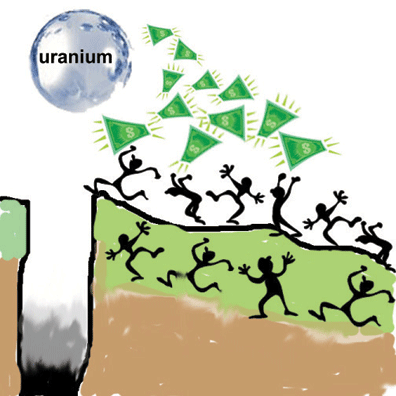 Dave Sweeney, 26 April 13 Australia’s uranium industry is a minor contributor to employment and the economy, a major source of domestic and international risks and is overdue for an independent inquiry into its effects on the environment, health, safety and security, according to a report released today on the anniversary of the 1986 Chernobyl nuclear disaster.
The report, Yellowcake Fever: exposing the uranium industry’s economic myths, released by the Australian Conservation Foundation, shows uranium accounted for only 0.29 per cent of national export revenue and less than 0.015 per cent of Australian jobs in the decade to 2011.
In the last financial year, revenue from uranium was four times lower than Australia’s 20th biggest export earner, eight times lower than Australia’s 10th biggest export earner and 103 times lower than the biggest earner, iron ore. “While Australia’s uranium sector remains an economic minnow, it is a leviathan when it comes to the damage it does to communities and the environment and the risks it spreads,” said the Australian Conservation Foundation’s Dave Sweeney.
“It is time for an independent and credible cost-benefit analysis of this sector and for decisions to be based on evidence, not self-interested industry enthusiasm.”
The most recent independent assessment of the Australian uranium industry – a Senate Inquiry in October 2003 – found the sector characterised by underperformance and non-compliance, an absence of reliable data to measure contamination or its impact on the environment and an operational culture focussed on short term considerations.
“In the decade since that Senate Inquiry, leaks, incidents and accidents have continued to dog uranium mines, Australia has sold uranium to more nuclear weapon states and Australian uranium has fuelled the continuing Fukushima tragedy,” said Dave Sweeney.
“The Australian Uranium Association’s push to reduce independent scrutiny of uranium projects shows why this sector does not enjoy community confidence or a social license.
“We call on the federal government to establish an evidence-based inquiry into the operations and impacts of this industry, particularly in the shadow of Fukushima.” Contact: Dave Sweeney, 0408 317 812
Conservative White Males are destroying the planet, and some women are helping them
 We are destroying the joint, REneweconomy By Carmen Lawrence on 26 April 2013 The Conversation
Without really knowing what he was saying, Alan Jones was right – we are “destroying the joint”.
Any dispassionate assessment of the state of “the joint”, both the corner we occupy and the planet as a whole, shows that we are making one hell of a mess of it. Increasing consumption and a growing population are accelerating the depletion of our finite resources, including our precious soils. We are polluting our air, land and water, destroying our heritage places and our communities, producing drastic changes to our climate and pushing out other species at an alarming rate. Human distress and inequality are on the rise, despite our increased material wealth. And all the while, most of us seem to be cheerfully – even wilfully – oblivious to the state we’re in.
But the “we” is not women, it’s all of us. And as a matter of record, since most women have not, until recently, occupied significant positions of influence and power, we should be judged less culpable than men.
Given that women are still in a minority in board rooms and executive positions, as well as in politics, I think it’s pretty rich to blame women for the current state of affairs. It’s fair to say that the responsibility for the mess we’re in resides mainly with those who’ve historically made decisions about the way we manage our societies and economies – privileged, powerful, Western white males.
It’s true, however, that many women now in positions of power appear to share the view that the planet’s resources are inexhaustible and that the only serious policy objectives are those which promote economic growth and material acquisition, with little eye to the social and environmental costs. Continue reading
Australia’s Opposition climate change spokesman Greg Hunt talks nonsense on CEFC
CEFC may write financing contracts before July, REneweconomy By Giles Parkinson 26 April 2013 “…..Hunt’s big dodgy number games
 Last Sunday, Opposition climate change spokesman Greg Hunt appeared on the Bolt Report, the program hosted by noted climate skeptic and News Ltd journalist Andrew Bolt, complaining about the government’s“dodgy numbers” on its climate policy.
Hunt knows something about dodgy numbers. That’s how most experts describe his Direct Action policy, but on ABC Radio on Wednesday he came up with a new one when he said (unchallenged) that the CEFC would spend up to $240 million a day between July 1 until the writs for the election are issued in early August. Hunt was so satisfied with his statement that he tweeted it too.
Of course, it’s utter nonsense, as Hunt well knows. He arrives at that figure by dividing the $10 billion in funds the CEFC will have at its disposal over 5 years, by the number of days between July 1 and the election writs. But these funds are only allocated in $2 billion batches over 5 yeas, so even if the CEFC spent its entire 2013/14 budget is the first six weeks, it would be well short of Hunt’s number. But, the bigger the number, the bigger the scare.
And the CEFC is not likely to rush its entire funds out the door in one fell swoop. The CEFC can only be disbanded by an act of government, which makes it as easy, or as difficult, to unravel as the carbon price. Unless the Coalition gets a majority in the Senate, or the Labor rump rolls over, then the CEFC could continue for a while longer.http://reneweconomy.com.au/2013/cefc-may-write-financing-contracts-before-july-28670
Collapsed roof at Chernobyl – radiation still leaking, 27 years after the disaster
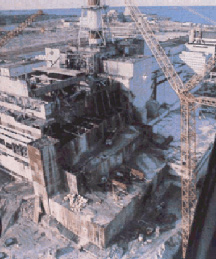
Chornobyl, 27 years later, still dangerous http://www.kyivpost.com/content/ukraine/chornobyl-27-years-later-still-dangerous-323760.html April 26, 2013, Ukraine — by Katya Gorchinskaya, Svitlana Tuchynska CHORNOBYL, Ukraine – A turbine hall adjoining Chornobyl’s destroyed fourth reactor has a gaping 600-square meter opening where the roof collapsed in February. The roof has not been fixed yet, letting in rainwater that mingles with radioactive dust and elements inside and oozes out.
Australia’s Clean Energy Finance Corporation can write contracts before July
 CEFC may write financing contracts before July, REneweconomy By Giles Parkinson 26 April 2013 The newly created Clean Energy Finance Corporation is likely to enter contracts for financing deals even before July 1, when the first of its $10 billion in funding becomes available, according to CEO Oliver Yates.
In an interview with RenewEconomy, Yates said the CEFC was capable of entering contracts in coming months, even if the $2 billion that can be spent by the organization in 2013/14 is not available until July 1.
The CEFC has become a subject of controversy because of the Coalition’s pledge to disband it, among other clean energy and climate change institutions, should it be elected in September, and because of the Coalition’s demand that it not make any investments pending the result of the election.
The CEFC became fully operational at the start of this month, and now boasts 50 staff, including those incorporated from Low Carbon Australia (LCA). As we reported on Wednesday, the government has released its final investment mandate, which defines its targeted returns and manner of operations.
Yates said the work of the LCA, particularly in the areas of energy efficiency, would continue, and would likely be upscaled. This would allow larger clients such as municipalities, hospitals and universities to get financing assistance for these sorts of projects.
“These organizations have got budget cycles, so they find it hard to fund such investments up front,” Yates said. ”We can help with that.”
Yates also identified solar leasing as an area of interest for the CEFC. Solar leasing, which allows home-owners and commercial companies to install solar PV on their rooftops for no deposit, removing the problems of upfront capital cost, has taken off in the US, where it accounts for around three-quarters of new installations. The financing is now well supported by mainstream banks such as Goldman Sachs and US Bancorp.
In Australia, however, solar leasing is relatively new and has struggled to gain finance from banks at interesting rates because they have no experience of the technology or the financing, and have so far resorted mostly to the private wealth market.
Yates said it was typical of the sort of investments where the CEFC could play some sort of trail-blazing role that would encourage the commercial market to follow…….http://reneweconomy.com.au/2013/cefc-may-write-financing-contracts-before-july-28670
Yorta Yorta Nation and Monash Sustainability Institute – new responses to Climate Change
 VIDEO http://www.preventionweb.net/english/professional/multimedia/v.php?id=32603 Australia: To see with both eyes collaboration between the Monash Sustainability Institute (MSI) and the Yorta Yorta Nation in developing responses to climate change.
Australia: A dual approach to climate change adaptation http://www.preventionweb.net/english/professional/news/v.php?id=32601 24 Apr 2013 :Monash University
A new video shows the benefits of collaboration between the Monash Sustainability Institute (MSI) and the Yorta Yorta Nation in developing responses to climate change. Nhawul Bultjubul Ma or To See With Both Eyes was filmed during the Yorta Yorta Climate Change Adaptation Workshop, held in Echuca last November. It features the international participants in the workshop speaking about traditional and western approaches to climate change and how each can inform the other.
The Yorta Yorta Nation, who hosted the workshop in conjunction with MSI, will use the video as a teaching tool, a demonstration of community leadership and an example of collaboration between Aboriginal societies and academia.
The workshop examined how Indigenous knowledge can contribute to improved adaptation to climate change for Indigenous communities and the Australian community in general – through ongoing protection of cultural heritage, promotion of healthy ecosystems and community empowerment. Director of MSI, Professor Dave Griggs praised Australian Indigenous people’s knowledge of the environment.
“They are the oldest living civilisation on the planet. They have an oral history which goes back many thousands of years. They have an intrinsic knowledge of how natural systems work,” Professor Griggs said. “I think if we had that kind of cultural connection, those deep roots into the land, we wouldn’t be doing some of the things that we’re doing.”
Yorta Yorta Research Creator, Lee Joachim said the MSI-Yorta Yorta collaboration had been worthwhile for both groups.
“Our work with MSI has benefited the Yorta Yorta Nation in so many ways – such as capacity building, community empowerment and international relations,” Mr Joachim said.
“In turn we’ve been able to educate the researchers in Yorta Yorta knowledge and culture – the possibility of seeing the world through two eyes – so they have benefited as well.“
Additional information http://www.monash.edu.au/news/show/a-dual-approach-to-climat.
Record growth in renewable energy predicted by Bloomberg New Energy Finance
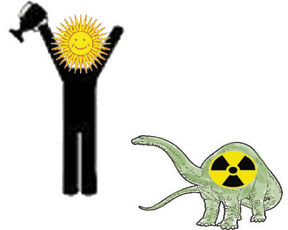 Annual Renewable Energy Investment Set To Sky-rocket By 2030, Cleantechnica April 25, 2013Joshua S Hill The next 15 years and more are going to be interesting ones for the renewable energy industry, as the cost of manufacturing and installation drop and the public face of fossil fuels continues to be tarnished. Specifically, the rising popularity and efficiency of wind and solar energy will push the renewable energy industry as a whole into a new era of prominence.
According to new research from Bloomberg New Energy Finance, the future of the renewable energy sector is a jump of 230% in annual investment to $630 billion per year by 2030. Continue reading
Renewable Energy Corporation solar panels – big installation in Thailand
Thailand’s Largest Solar Farm Powered By REC Panels by Energy Matters, 25 April 13
Renewable Energy Corporation has arrived in Thailand in a big way – supplying panels for the country’s largest solar power station.
The 9.5 MW Chiang Rai installation commenced operations last month. 41,000 REC Peak Energy Series solar panels are now generating enough electricity to provide the power needs of 7,200 Thai households and will avoid the production of 9,000 metric tonnes of carbon dioxide annually…. http://www.energymatters.com.au/index.php?main_page=news_article&article_id=3710
Australia’s uranium industry a poor performer, poor job provider
Green group says uranium industry doesn’t stack up http://www.abc.net.au/news/2013-04-26/green-group-says-uranium-industry-doesnt-stack-up/4652596?section=qld By Melinda Howells, 26 April 13 The Australian Conservation Foundation (ACF) says a uranium industry will not create huge revenue and job opportunities for Queensland. The State Government says Queensland’s deposits are valued at $10 billion and it is moving to re-establish the industry after after more than 30 years.
Campaigner Dave Sweeney says a new report compiled by the ACF shows the potential benefits have been overstated. “It is a $600 million industry that employs 650 people – 650 people,” he said. “There are not thousands of jobs in this trade, there are not billions of dollars in this trade.”
“It is a tiny contributor to dollars, an even smaller contributor to jobs, but it poses major domestic and international risks, legacies and problems. “We’re calling for a detailed independent cost-benefit analysis of this industry.”
44 Indigenous Carbon Funding projects approved – ready to go
Successful Indigenous Carbon Farming Fund projects announced http://www.investinaustralia.com/news/successful-indigenous-carbon-farming-fund-projects-announced-12c3 24 April 13 Environment Minister Tony Burke and Parliamentary Secretary for Climate Change, Industry and Innovation Yvette D’Ath today announced the 44 successful applications under the Australian Government’s Indigenous Carbon Farming Fund Capacity Building and Business Support stream.
Mr Burke said through this program, the Australian Government is helping Indigenous Australians access carbon farming specialists, business development expertise and legal advice for their carbon farming projects. “These projects are spread across Australia and range from undertaking feasibility assessments to developing carbon farming project ideas and existing carbon farming businesses,” Mr Burke said.
“This program will not only provide benefits for our environment but also provide employment opportunities in indigenous communities.”
Other successful proposals include feasibility assessment of carbon projects, community education, and the development of businesses to provide services or undertake carbon abatement and sequestration activities under the Carbon Farming Initiative (CFI).
Mrs D’Ath said the projects have received funding to assist Indigenous communities to benefit from the Carbon Farming Initiative.
“The Research and Development stream of this initiative provides funding to underpin CFI methodologies and the development of tools for estimating and reporting on emissions,” Mrs D’Ath said. “Up on Cape York Peninsula, where the project area covers an area of up to 2,300,000 ha in Aurukun, one group aims to avoid emissions of approximately 30,000 tonnes CO2 per year.”
The Fund will provide $22.3m over five years to assist Aboriginal and Torres Strait Islander people to participate in the CFI. The CFI enables Indigenous landholders and land managers to earn carbon credits by undertaking projects to reduce emissions or store carbon. Types of projects include early season savannah burning and environmental plantings.
For more information, including a list of successful projects, go tohttp://www.environment.gov.au/cleanenergyfuture/icff/index.html.
1 This month

of the week – Australians for War Powers Reform (AWPR)
To see nuclear-related stories in greater depth and intensity
 Antinuclear