Australian Uranium Association’s Paydirt Conference a Flop
 Always a big mutual admiration society “do”, the Australian Uranium Industry’s annual Paydirt Conference in Adelaide was a sad little affair this year.
It’s getting harder and harder for the uranium industry to jolly itself up, as the economic realities for the industry become more apparent. Touted as a “major” conference, this one attracted only half as many delegates as in 2012. The conference duration was shortened from 3 days to one. The venue was changed from the Hilton to the Intercontinental Hotel.
Press releases (as far as I could find) focused on excuses for why the Paydirt conference was such a lemon. “Mr Koutsantonis blamed the Fukushima disaster in Japan – and the global review of the industry – for the lack of attendance” – (Perth Now)
Nevertheless, uranium industry spruikers will spruik on.
So – during May, I think that I will just note the antidotes to the Australian Uranium Hype – by quoting salient bits from the just released YELLOWCAKE FEVER Exposing the Uranium Industry’s Economic Myths http://www.acfonline.org.au/resources/yellowcake-fever-exposing-uranium-industrys-economic-myths
For today’s example:
AUSTRALIA’S URANIUM EXPORT REVENUE IN PERSPECTIVE
In the 2011/12 financial year:
• uranium accounted for 0.19% of national export revenue;
• uranium revenue was 4.4 times lower than Australia’s 20th biggest export earner, wool;
• uranium revenue was 8.7 times lower than Australia’s 10th biggest export earner, aluminium; and
• uranium revenue was 103 times lower than the biggest earner, iron ore.
AUDIO The harsh economic facts contradict the Uranium Paydirt Conference’s hype
 AUDIO Australia’s uranium industry is high risk, low return, says campaigner http://www.radioaustralia.net.au/international/radio/program/connect-asia/australias-uranium-industry-is-high-risk-low-return-says-campaigner/1123008?autoplay=1122972 29 April 2013 Australia’s uranium industry is high risk, low return: that’s the assessment of a report designed to expose the uranium industry’s promise of great economic reward. Its findings suggest uranium accounted for just 0.29 per cent of Australia’s export revenue between 2002 and 2011.
The report by the Australian Conservation Foundation calls for a national independent inquiry into the industry’s contribution to Australia’s economy and employment.The report comes as uranium advocates meet in Adelaide today for the annual Paydirt Uranium Conference.
Presenter: Richard Ewart
Speaker: Dr Jim Green, national anti-nuclear campaigner for Friends of the Earth in Melbourne and co-author of the report, ‘Yellowcake Fever: Exposing the Uranium Industry’s Economic Myths’
Excerpts from this audio discussion

Fukushima’s radioactive waste water just grows and grows
NYTimes: Alarming reality at Fukushima Daiichi — Plant faced with new crisis — “Tepco is clearly just hanging on day by day” http://enenews.com/nytimes-alarming-reality-at-fukushima-daiichi-plant-faced-with-new-crisis-tepco-is-clearly-just-hanging-on-day-by-day
Title: Radioactive Water Imperils Fukushima Plant
Author: MARTIN FACKLER (Makiko Inoue and Matthew L. Wald)
Date: April 29, 2013
[…] the Fukushima Daiichi nuclear power plant is faced with a new crisis: a flood of highly radioactive wastewater that workers are struggling to contain. Groundwater is pouring into the plant’s ravaged reactor buildings at a rate of almost 75 gallons a minute. It becomes highly contaminated there, before being pumped out to keep from swamping a critical cooling system. […]
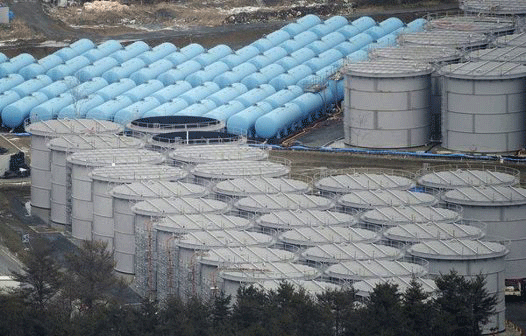
That quandary along with an embarrassing string of mishaps — including a 29-hour power failure affecting another, less vital cooling system — have underscored an alarming reality: two years after the meltdowns, the plant remains vulnerable to the same sort of large earthquake and tsunami that set the original calamity in motion. […]
“Tepco is clearly just hanging on day by day, with no time to think about tomorrow, much less next year,” said Tadashi Inoue, an expert in nuclear power who served on a committee that drew up the road map for cleaning up the plant. […]
See also: NYTimes: Fukushima plant unstable says official, concern another accident can’t be prevented — “Vulnerable… Very dangerous”
Indian former diplomat agrees that Australia’s uranium would further India’s nuclear weapons
Selling uranium to India ‘would lead to military use‘ http://www.sbs.com.au/news/article/1761076/Selling-uranium-to-India-would-lead-to-military-us Selling uranium to India ‘would lead to military use’ A former diplomat has admitted the sale of Australian uranium to India would free up that country’s domestic reserves for military purposes.29 APR 2013, SOURCE: KAREN ASHFORD, SBS
A former diplomat has admitted the sale of Australian uranium to India would free up that country’s domestic reserves for military purposes.

For 30 years Australian banned uranium sales to India because of its failure to sign the nuclear non-proliferation treaty, but negotiations are now underway on a uranium deal with a safeguards agreement.
“This issue has held to ransom Australia’s relationship and the economic interests with the world’s largest democracy for 40 years,” said Former Australian Deputy High Commissioner to India Rakesh Ahuja. But the energy strategist has admitted Australian uranium would free up India’s reserves for military use.
“That has always been the case, yes, I mean we sell to China, it frees up their domestic [use] for [military purposes], yes, it’s a fact of life,” he said….. the Greens warn of the consequences.
“India is a nuclear weapons’ state. They are on the record as saying they’re trying to buy foreign sources of uranium so they can lock up their domestic reserves for a nuclear arms race with Pakistan, so it’s a very volatile and dangerous security situation into
which to be selling uranium,” said Australian Greens senator Scott Ludlam.
An Indian perspective on clean non nuclear energy
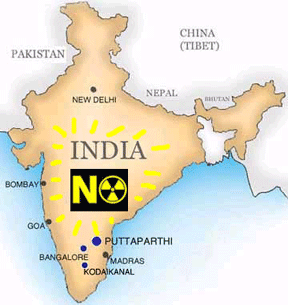 India has entered into nuclear deals with countries like US who are looking to revitalise their economies, while ignoring the concerns of the poor villagers who live near these plants. At Kudankulam, the agreement indemnifying the Russian supplier against accidents mocks the very absolute liability principle that deters foreign corporations from setting up nuclear plants in India.
Nuclear power is a centralised form of power supply that does not empower the local community. It makes them vulnerable to the decisions and interpretations of scientific and technological experts. All this falls through when a disaster happens. It is the locals and their future generations who bear the brunt of the accident. What India and the world needs are safe, small-scale, renewable power options.
Saying no to nuclear http://www.indianlink.com.au/headline/saying-no-to-nuclear/ The Radioactive Exposure Tour highlights the need for caution when it comes to nuclear power in India, reports?Jyoti Shankar Every time you visit India, you see the change, bigger malls, new flyovers, the lifestyle in the cities not very different to what you experience in the streets of any capital city in Australia, and, fewer power cuts. Move a bit further away from the cities and you realise that not much has changed. Dirt roads, constant blackouts, people struggling to make ends meet. And the paradox of progress hits you.
Nuclear power is just another aspect of this big picture where the pursuit of economic ?growth? at any cost seems acceptable. India is power hungry. It needs power for its burgeoning millions, as well as for industries that supply cheap goods to the consumers in the developed world. And the government is pursuing this objective setting aside all its democratic principles. Nuclear power is portrayed as a greener option, but scratch the surface, and a different story is revealed. Continue reading
Australia’s million-plus solar households have collectively become a massive power station
 Solar Slashing Wholesale Electricity Costs In Australia http://www.energymatters.com.au/index.php?main_page=news_article&article_id=3714 29 April 13, That solar is reducing the cost of wholesale electricity is not new news in itself – but now a figure has been put on the savings. Solar PV ranks highly in the Merit Order of electricity generation in some peak conditions; being cheaper than coal and gas.
At times when wholesale electricity costs from ‘traditional’ sources can eclipse $10,000 per megawatt-hour; surplus solar electricity is being exported to the mains grid for as little as $80 per megawatt hour.
Centre of Policy Development’s sustainable economy research director Laura Eadie says Australia’s rooftop solar power systems are saving between $300 million and $670 million each year in wholesale electricity costs; which could be reducing household power bills if electricity retailers pass the savings on to consumers. According to an article on NewsMail, Ms Eadie’s report also states solar households were more energy-aware; which not only reduces their own electricity costs, but also helps to further lighten the load on the mains grid network.
Australia’s million-plus solar households have collectively become a massive power station; with total capacity of 2,461,696 kW of solar panels on the nation’s rooftops as at early this month. According to figures from solar provider Energy Matters, Australia’s small-scale solar power systems could generate over $900 million worth of electricity over the next 12 months; based on an average 25c/kWh retail electricity cost.
While solar has been demonised in the past courtesy of myths perpetuated from certain corners, it’s becoming increasingly clear the scapegoating has been misdirected and solar’s net effect on Australia’s electricity infrastructure is a boon; not a blight.
Assuming satisfactory conditions and policies; residential and commercial-scalesolar energy will continue its ascent in Australia and help to not only slash the power bills of millions more, but also play a greater role in reducing the nation’s carbon emissions and support thousands of Australian families through employment in the sector.
Mining companies the largest leasholder of Western Australian pastoral land
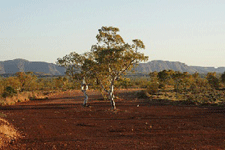 WA land owned increasingly by conservation and mining Science Network Western Australia, 29 April 2013 “The research focused on pastoral country from the edge of the Wheatbelt up to and including the Pilbara, which historically has been held under pastoral leases owned by families and used for grazing such as sheep and cattle stations”—Dr van Etten. Image: Stefan Jurgensen RESEARCHERS say an increasing amount of land in Western Australia is being managed for environmental conservation, however mining companies are the single largest lease holder of what was previously pastoral land. Continue reading
Los Angeles launches Solar Feed In Tariff
 Los Angeles Celebrates Launch of Largest Municipal Solar Program in U.S.http://www.enn.com/business/article/45915 Bonnie Hulkower, Triple Pundit, April 29, 2013 Los Angeles, a city more often known for its celebrity sightings and Hollywood stars, also shines bright in the solar arena. The City of Angels has dazzled in the last decade with a strong record of sustainability. So much so that on April 19th, local and national government representatives as well as business leaders gathered to celebrate the launch of the city’s solar Feed in Tariff (FIT) program (Clean L.A. Solar Program) at the Los Angeles Business Council’s (LABC) Sustainability Summit. The program focused on how to harness sustainability programs and regulatory initiatives for job growth.Essentially, the idea of the FIT is to make solar competitive in what naturally is one of the nation’s sunniest communities. Similar to President Kennedy’s mission to the moon, L.A.’s moonshot moment is to benefit from solar energy in a region blessed with sunny weather year round. Solar energy is especially appropriate in hot climates, as air conditioning demand coincides with the period of peak solar radiation.
L.A.’s FIT program will be the largest municipal commitment to solar, but not the first. Continue reading
USA utilities making money from solar and wind energy
 Solar and wind projects offer big advantages to electric utility companies. The utilities get a premium rate for solar power, the supply of which peaks in the afternoon alongside the higher demand for air conditioning. The utilities also can make a big profit from homes and businesses that install panels, buying the excess energy at off-peak prices and selling it later for a higher price.
Even the additional storage capacity needed to tap renewable energy can become a profit center.
Renewable energy becomes a utility lifeline http://money.msn.com/technology-investment/post.aspx?post=cbde9691-2d13-4345-9718-cb7453fdbb27 30 April 13, There are a number of ways to make money on solar and wind energy, as some of the nation’s electric utilities are discovering. By Dana Blankenhorn, Continue reading
1 This month

of the week – Australians for War Powers Reform (AWPR)
To see nuclear-related stories in greater depth and intensity
 Antinuclear