Investors have been burned, as governments and “analysts” hype Australia’s failing uranium industry

Last year the Olympic Dam expansion was cancelled, BHP disbanded its uranium division and sold the Yeelirrie uranium lease in Western Australia for about 11 per cent of the nominal value of the resource.
Also indicative of the state of the industry was Cameco’s announcement in February of a $162.5 million write-down on the Kintyre project in Western Australia. Just months after first production at the Honeymoon mine in north-east SA in September 2011, project partner Mitsui announced its decision to withdraw as it “could not foresee sufficient economic return from the project”.
In addition to industry propaganda, governments routinely inflate the significance and potential of the uranium industry, as do industry “analysts” (some of them market traders), some business journalists and some academics. There are real-world consequences to uranium mania — many “mum and dad” retail investors have been burned, especially during the speculative price bubble in the mid-2000s.
Uranium Industry Dreams Of Paydirt http://newmatilda.com/2013/05/02/uranium-industry-dreams-paydirt By Jim Green, 2 May 13, A new report released by the Australian Conservation Foundation: Yellowcake Fever: Exposing the Uranium Industry’s Economic Myths, shows that uranium accounted for just 0.29 per cent of Australia’s export revenue in the 10 years from 2002−2011. In the last financial year, uranium revenue of $607 million was 103 times lower than the biggest earner, iron ore. Milk and cream generate twice as much export revenue as uranium — and can’t be turned into Weapons of Mass Destruction.
Uranium export revenue is still more underwhelming given that the four companies mining uranium in Australia are all either majority foreign owned or 100 per cent foreign owned; in other words, a sizeable proportion of that export revenue never leaves the Northern Hemisphere and never comes anywhere near Australia. Continue reading
High spike in radiation levels in Japan and USA’s Pacific States – related to Fukushima leaks
 Fukushima pushes Japan over 26 times normal radiation http://www.agoracosmopolitan.com/news/headline_news/2013/05/02/5835.html 02 MAY 2013 BY SADIA ARSHAD As of the sampling done four days ago,
  the radiation fallout level has spiked up to twenty six times its average level since the past year in Japan. The reading indicates 100.4 MBq/Km2. The average reading was at 3.85 MBq/Km2 until 26th April. The reason behind this sudden climb is not known as of yet.
 As per air samples taken by the United States Environmental Protection Agency at eighteen different collection points in the Pacific States, the average level of radioactivity in the air has also spiked to more than seven times the normal levels.
Drastic fall in uranium company’s earnings and share price
 Cameco Profit Trails Analysts’ Estimates as Uranium Price Drops http://www.bloomberg.com/news/2013-05-01/cameco-profit-trails-analysts-estimates-as-uranium-price-drops.html By Christopher Donville – May 1, 2013 Cameco Corp. (CCO), the world’s third- largest uranium producer, reported first-quarter profit and revenue that trailed analysts’ estimates after a decline in the price of the raw material in nuclear-reactor fuel.
Net income fell to C$9 million ($8.9 million), or 2 cents a share, from C$129 million, or 33 cents, a year earlier, Saskatoon, Saskatchewan-based Cameco said today in a statement. Profit excluding one-time items was 7 cents a share, missing the 8-cent average of 14 estimates compiled by Bloomberg. Sales declined to C$444 million from C$466 million, less than the C$473 million average of six estimates.The price of uranium for immediate delivery has slumped 40 percent since the March 11, 2011, earthquake and tsunami in Japan led to a meltdown at Tokyo Electric Power Co.’s Fukushima Dai-Ichi nuclear power plant. In response to the disaster, Japan suspended its fleet of reactors while Germany canceled license extensions, shut down some of its oldest nuclear plants and ordered the others close by 2022.
“Fukushima is still a major factor in the uranium market,” Rob Chang, a Toronto-based analyst at Cantor Fitzgerald LP, said in a telephone interview before the results were released. “On top of that, commodity prices around the world have been dragged down by worries about global growth and Chinese demand for raw materials.”
Kazatomprom, Kazakhstan’s state-owned producer, and Paris- based Areva SA (AREVA) are the biggest uranium miners, according to the World Nuclear Association.
(Cameco scheduled a conference call to discuss results at 1 p.m. New York time at +1-877-240-9772or +1-416-340-8530.)
Cameco’s uranium earnings down 93% on last year’s so far this year
 Earnings down for Saskatoon uranium giant CBC News May 1, 2013 Lower sales, lower prices and higher costs pushed down first quarter results at Cameco. So far this year, the Saskatoon-based uranium company earned $9 million — down 93 per cent from the $129 million Cameco made in the first quarter of 2012……
The company recently laid off a number of staff at its Saskatoon headquarters.
Cameco said most of the power utilities that buy its nuclear products are locked into contracts until 2016….. http://www.cbc.ca/news/canada/saskatchewan/story/2013/05/01/saskatoon-cameco-earnings.html
Time to stop the exploitation of poverty-stricken Niger by rapacious foreign uranium companies
the grievances expressed by representatives of local populations in the mining zones and pastoral peoples as well as government representatives. Concerns relate to radioactive pollution, water resource depletion, work-related diseases for mine workers, and the appropriation of land and water resources, including legally enshrined common property regimes and pastoral territories, without required compensation.
It is widely acknowledged among government staff that the Nigerien government is not able to properly implement its environmental legislation and monitor the uranium mining industry.
Niger: Development Cooperation Must Support the Environmental Governance of Uranium Mining THE ISN BLOG, Rasmus K Larsen 2 May 2013 Niger’s new development strategy, the Economic and Social Development Plan, is also intended to guide international development cooperation. Environmental governance of uranium mining, the country’s by far largest single economic activity, appears hitherto to have constituted a ‘blind spot’ for environmentally oriented development cooperation. It is now time to remove the blinkers and include support to strengthen environmental governance of the mining sector in new programmes to assist Niger in meeting its development challenges
Niger is well known in international media as one of the world’s poorest countries, struggling with chronic structural hunger and malnutrition. UNDP ranks Niger 186 out of 187 countries in the Human Development Index, and in 2011, five million people (33% of Niger’s population) were at ‘high risk’ to food insecurity.
What is less well known is that Niger also hosts the fourth largest uranium production in the world. Export values totalled over EUR 348 million in 2010, representing more than twice the total development assistance finance received during the same year. However, the state retains less than one fifth of the value of the uranium ore that is exported. The exploitation of the mineral wealth by international investors is expanding, with granted and requested mining concessions comprising close to 10% of the national territory…….
Attention to environmental impacts or risks associated with the mining sector goes seemingly without mention in the guiding documents of the principal development partners, including the EU, the World Bank, the UNDP, and the African Development Bank.
Severe environmental governance issues Continue reading
A warning to Aboriginal people about Indigenous Land Use Agreements (ILUA)
Don’t sign your sovereign rights away with ILUAs, Aboriginal leader warns, 2 May 13A prominent Aboriginal leader warns Aboriginal and Torres Strait people against signing Indigenous Land Use Agreements (ILUA), saying they cede their sovereignty for a few crumbs if they do.
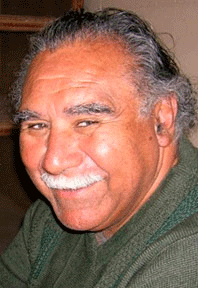 Michael Ghillar Anderson writes in a media release from Germany that state and Territory governments are trying to coerce Aboriginal peoples into signing ILUAs.
“This is an act of bastardry on the governments’ part as they are NOT informing our peoples of their deceitful intent.
“The ILUAs are designed in such a way that the state, Territory and federal governments can say to the world and the local courts, ‘The Aborigines recognise us as the sovereign state because they signed an ILUA under our law, therefore, they recognise our sovereignty and authority over them, together with sovereignty over the lands, airspace and waters therein.’”
Mr Anderson is the last survivor of the four men who set up the Aboriginal Embassy in Canberra in 1972 and spokesman for the First Nations Interim National Unity Government, which campaigns for sovereignty. He is the leader of the Euahlayi nation in northwest NSW and southwest Queensland.
“In Australia we have reached a very important time in our history. We must come together as distinct sovereign nations to jointly locate a national perspective on our sovereign rights,” he writes.
“We know that the Uncle Toms and Aunt Marys will all tell you that this is all a pie in the sky pipe dream. That is fine because they have always been the people who have betrayed our legal rights and interests. Continue reading
The secret high cost of Australia’s fossil fuel energy
The dirty secret of fossil fuels: more expensive than you think Crikey.com LAURA EADIE | MAY 02, 2013
Fossil fuel fans say we can’t afford to switch over to renewables. But maybe we can’t afford not to. Laura Eadie, research director for the Centre for Policy Development’s Sustainable Economy Program, reports.
The fossil fuel industry must have hoped to keep its dirty laundry private a little longer: the Australian Energy Market Operator has confirmed that a switch to 100% renewable electricity by 2030 is technically viable. What the report neglected to mention is that the investment bill of $220 to $250 billion is pretty close to the $240 billion needed by 2030 if we rely on gas and carbon storage instead… (registered readers only) http://www.crikey.com.au/2013/05/02/the-dirty-secret-of-fossil-fuels-more-expensive-than-you-think/
CSIRO ‘s UltraBattery could be a key component of Australia’s Smart Grid
How UltraBattery could help our grid http://ecogeneration.com.au/news/how_ultrabattery_could_help_our_grid/081278/ MELANIE RYAN May/June 2013 Low-cost, durable and fast with a long life-cycle – and it ‘smooths’ intermittent electricity from renewable sources. The CSIRO-developed UltraBattery could be the key component of an Australian smart grid of the future.
Dr Lan Lam, the primary inventor of CSIRO’s UltraBattery, retired in February 2013 after he and his team turned battery technology into a storage unit that simultaneously brings down the cost of hybrid electric vehicles and makes it easier to integrate more renewable energy into a grid.
Dr Lam leaves quite a legacy behind him: this year, the first UltraBattery will be released in the automotive market, powering hybrid electric vehicles in Japan, the United States, South America, Europe and Asia. In October 2013, the battery is also due to be installed at Tasmania’s King Island Renewable Energy Integration Project, becoming the largest clean energy storage system in Australia.
The UltraBattery combines a traditional lead acid battery and a super capacitor into one; normally they are separate components.
“It sounds simple, but we have now created a new technology that is 70 per cent cheaper than current batteries used in hybrid electric cars, and they can also be made in existing manufacturing facilities,” Dr Lam explains. UltraBattery technology has now been successfully installed in a large-scale solar power plant in New Mexico, United States; its storage capacity allows for intermittent renewable energy to be smoothly supplied to an electricity grid.
The CSIRO says that in comparison to alternate renewable energy battery options, the UltraBattery is more low-cost, durable, has faster discharge/charge rates, and has a life-cycle that is two to three times longer than a regular lead acid battery. When intermittent electricity from renewables is fed into the grid through UltraBattery’s smoothing process, power quality and stability are improved. UltraBattery can also store energy for use during peak demand times, assisting the grid to balance supply and demand and avoid local stress.
CSIRO UltraBattery team member Dr Peter Coppin says that a number of large-scale demonstration projects both completed and in-planning have shown the battery’s applications in power system support and smoothing. These projects include wind smoothing at Hampton Wind Farm in New South Wales and grid support at the PJM in Pennsylvania, United States.
“These real-world, at-scale applications are very important, as they clearly demonstrate the commercial viability of the UltraBattery,” Dr Coppin notes. “It’s exciting, as the interest in the UltraBattery projects is building rapidly, as managing intermittency from renewable sources becomes more of an issue for grid integration.”
CSIRO’s energy storage team says that it will continue Dr Lam’s legacy by researching and developing the UltraBattery, aiming to make it lighter and more efficient. CSIRO is considering next-generation development with new materials and higher-energy-density technologies, such as lithium.
1 This month
To see nuclear-related stories in greater depth and intensity
– go to https://nuclearinformation.wordpress.com/


 Antinuclear