Energy issues in Australia this week
 While there is nothing dramatic to report – that doesn’t mean that nothing is happening.
Uranium. The Australian Uranium Association’s annual Paydirt Conference, in Adelaide, was sad little affair this year. Poor attendances, schedule cut down from 3 days to one, venue changed from The Hilton to The Intercontinental Hotel. The star address was by the New Minister for Energy and Resources, Gary Gray. Mr Gray has just discovered that climate change is real. Gray has been an enthusiastic climate denier until now. But he has renounced his previous position that climate science was “pop science” and a “middle-class conspiracy to frighten schoolchildren”. Why? I hear your cry?
Well that’s simple. Australia’s nuclear lobby is pitching nuclear power as the cure for climate change. Well, it wouldn’t be very convincing to promote a cure for a disease that you denied existed, now would it?
Uranium economics. The Australian Conservation Foundation has produced a terrific analysis Exposing the Uranium Industry’s Economic Myth shttp://www.acfonline.org.au/sites/default/files/resources/ACF_Yellowcake_Fever.pdf
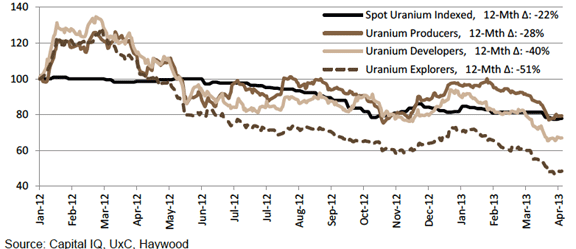
Tony Abbott promises to reinvigorate BHP’s massive Olympic Dam project, although BHP has rejected it, and the South Australia government admits that it was over- hyped.
Climate Change and Renewable Energy. Liberal Ministers of Energy in Western Australia, Queensland, New South Wales and Victoria unite in a chorus of climate scepticism, and downgrading of renewable energy . Labor’s Gary Gray joins in dismissing renewables. So you see – obeying the fossil fuel/nuclear lobby agenda is not really a party political thing. They are all equally illiterate about energy’s future trends.
Maralinga veterans. Although the UK government has rejected any claim for compensation for Australia’s nuclear veterans, the veterans, many suffering from cancer, are making an appeal to the Australian Human Rights Commission, on the illegality of their exposure to atomic radiation in the 1950s and 60s.
Lucas Heights nuclear wastes. Sutherland Council doesn’t want it stored there. Strange that they haven’t thought of the idea of just shutting it down, and not making any more radioactive wastes.
May 3rd: antidote to uranium lobby’s lies about EMPLOYMENT
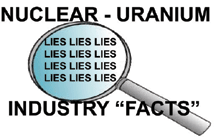 AUSTRALIA’S URANIUM EXPORT REVENUE IN PERSPECTIVE YELLOWCAKE FEVER Exposing the Uranium Industry’s Economic Myths , Australian Conservation Foundation “…..IBISWorld’s market report (March 2013) states there are just 650 jobs across Australia in uranium mining. In May 2006, the federal Department of Industry, Tourism and Resources estimated “over 700 jobs” in uranium mining and in October 2007 the Department’s
Human Rights lawyer seeks justice for Australia’s Maralinga nuclear veterans
 Australia: Last chance of justice for nuclear veterans http://www.mondaq.com/australia/x/236534/Personal+Injury/Last+chance+of+justice+for+nuclear+veterans 03 May 2013 by Joshua Dale An appeal to the Australian Human Rights Commission by Australian military veterans arising from Britain’s nuclear bomb tests in the Outback is gaining momentum.
Lodged by Stacks human rights lawyer Joshua Dale representing several hundred nuclear veterans, the appeal asks the commission to find the government of the 1950s and 60s breached their human rights by ordering them to be exposed to deadly radioactive fallout. Continue reading
Politicians against renewable energy are losing in USA, but perhaps not in Australia?
 In Australia, a similar battle is about to be waged. The difference here is that renewable energy targets are a federal policy mechanism, but the four mainland conservative state governments (Queensland, NSW, Victoria and Western Australia) are lined up firmly against them, and the new energy minister in WA, Mike Nahan, has upped the ante – possibly in anticipation of the Coalition winning the federal poll in September.
Are renewables doomed to failure in Australia?, REneweconomy By Giles Parkinson 3 May 2013 Across the United States right now, a pitched battle is being fought over the future of renewable energy targets in the 29 states that have them. Already, 16 of these states are considering legislation – templated by a fossil fuel-sponsored lobby group, the American Legislative Exchange Council – to repeal or dilute the ambition of renewable standards.
So far, the campaign – boosted by Tea Party radicals in the Republican movement – has not been successful. In the past week, North Carolina rejected the idea after leading utilities such as Duke Energy, and big data centre operators such as Apple and Google expressed their support for wind and solar projects.
In Colorado, the ALEC bill met a similar fate, with the state deciding instead to lift its clean energy standard for rural electric cooperatives to 25 per cent by 2020 — a 15 percentage point jump from the current 10 per cent.
Still, the fate of other state-based RPS schemes remains in the balance. ALEC task force director Todd Wynn recently told Bloomberg that 2013 will be the most active year yet in efforts to repeal renewable energy standards. “Natural gas is a clean fuel, and regulators and policy makers are seeing how it’s much more affordable than renewable energy.” Continue reading
Radio broadcast: Australia’s Mark Willacy reports on Fukushima flooding
 Hear this radio broadcast. Fukushima nuclear plant struggles to contain contaminated water http://www.abc.net.au/am/content/2013/s3750728.htm Mark Willacy reported this story on Friday, May 3, 2013 TONY EASTLEY: More than two years after the meltdowns at Fukushima, the plant’s operator is dealing with a new crisis – millions of litres of contaminated water inside the complex.
TEPCO has confirmed to AM that groundwater is flooding into the plant’s reactor buildings at the astonishing rate of 285 litres a minute.
Once inside, the water quickly becomes highly contaminated and has to be stored in tanks which cover 17 hectares of the plant’s grounds.
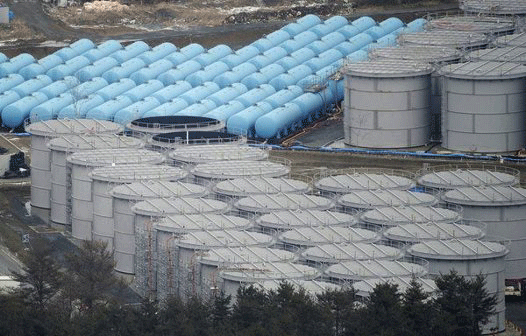
But with those tanks close to capacity now, TEPCO has started to clear an adjoining forest to make more space to store the contaminated run-off.
North Asia correspondent Mark Willacy reports from Tokyo. Continue reading
Clean Technology Investment Program funds Bendigo solar system
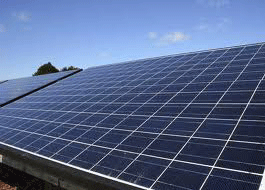 Australian Vaccine Manufacturer Going Solar http://www.energymatters.com.au/index.php?main_page=news_article&article_id=3720, 3 May 13 Veterinary vaccine manufacturer, MSD Animal Health, has been awarded funding under the Clean Technology Investment Program to install a 250kW solar panel system at its manufacturing facility in Bendigo East, Victoria.
The solar array will slash carbon emissions intensity from the facility by 22 per cent and result in savings of around $44,000 on electricity bills each year. The government’s contribution of $335,660 will be matched by the company. Continue reading
Centuries to decontaminate radioactive groundwater

 Santa Susana groundwater cleanup could take centuries, official says, VC Star, By Mike Harris, April 18, 2013 The groundwater cleanup at the Santa Susana Field Laboratory, the site of a 1959 partial nuclear meltdown, could take centuries, a state official said Wednesday night.
The soil decontamination will take far less time, a few or more years, but might not be finished by a 2017 deadline, Mark Malinowski of the state Department of Toxic Substances Control told about 100 people during a cleanup update at the Grand Vista Hotel in Simi Valley.
“It’s a very aggressive schedule to get to 2017, and many things have to happen correctly in order to get there,” said Malinowski, the department’s cleanup team manager.
The groundwater cleanup will take “a lot longer … decades, possibly centuries to complete,” Malinowski said. “Groundwater is an extremely difficult thing to clean up. This contamination we’re dealing with did not happen overnight.”……
Boeing owns most of the 2,850-acre site, formerly the Rocketdyne nuclear and rocket engine test facility, in the hills between Simi Valley and the San Fernando Valley. The rest of the site is owned by the federal government and administered by NASA.
During a question-and- answer period, cleanup activists sharply questioned Malinowski’s statement that no significant contamination has been found beyond the site’s boundaries.
“I had to remind him that in 2008, they removed three football fields of contaminated soil off the adjacent Sage Ranch Park property,” William Bowling said. “And then last year, the EPA found radioactivity in a well on the campus owned by the American Jewish University, which also adjoins the site.
“They’re not giving the public the clear picture, which is that there is off-site contamination,” Bowling said. http://www.vcstar.com/news/2013/apr/18/santa-susana-soil-cleanup-may-not-make-2017-deadli/#ixzz2SI1pAhgC
Germany’s timetable for shutting down all nuclear power plants
Germany aims to become one of the greenest countries in the world – with a huge shift towards renewable energy and massive energy savings

For Australia100% renewable energy is not as expensive as we thought
 100% renewables for Australia – not so costly after all, REneweconomy. By Giles Parkinson 29 April 2013 An exploratory study into 100% renewable energy scenarios for Australia has concluded that its impact on consumer electricity prices over the next few decades may be no more than the increases in the last few years to support much criticised network upgrades and the introduction of the carbon price.
The report by the Australian Energy Market Operator (AEMO) – you can access the executive summaryhere and the draft report here – canvasses the potential costs and practicality of transforming Australia’s coal-dependent electricity system to 100 per cent renewables, by either 2030 or 2050. It creates two scenarios – depending on the pace of falls in the cost of renewable and storage technologies – but both are considered conservative.
It concludes that the cost could range between $219 and $338 billion and would require wholesale electricity prices of $111-$133/MWh (more than double the current price). Unfortunately, and somewhat controversially, AEMO was not asked to compare these forecasts with “business as usual”, but it does provide one interesting set of data that does put it into some perspective.
The first is the impact on retail prices. ….. http://reneweconomy.com.au/2013/100-renewables-for-australia-not-so-costly-after-all-5021
Australia’s Labor and Liberal Energy Ministers wage war against renewable energy
Are renewables doomed to failure in Australia?, REneweconomy By Giles Parkinson 3 May 2013“…….The appointment of Nahan [as Minister fotr Energy, W.A. ]– along with Queensland’s Mark McArdle, NSW’s Chris Hartcher, and Victoria’s Michael O’Brien – and the impending return of the federal Coalition’s Ian Macfarlane, has doomed the industry to another period of uncertainty and inaction. All, it would seem, in the name of ideology. Look-alike energy ministers in Canberra
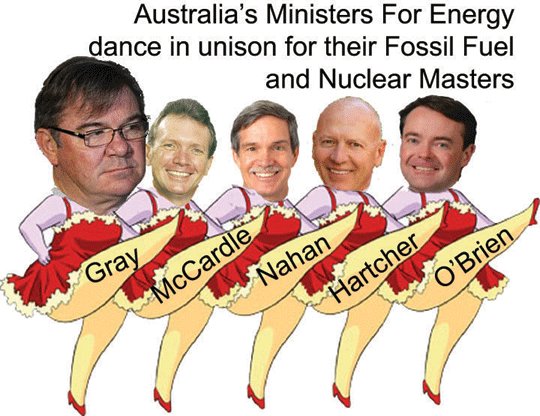
On the subject of federal energy ministers, it was fascinating to hear the newly appointed Federal Minister for Resources and Energy Gary Gray speak about the issue at a conference in South Australia this week.
As RenewEconomy pointed out after the resignation of former minister Martin Ferguson last month, he and his ultimate successor, the Liberal energy spokesman and former minister Ian Macfarlane, were like two peas in a pod – sharing like-minded, highly conservative views on Australia’s energy policies and how its energy system should evolve.
Gray – who says he is no longer a climate skeptic – is probably only keeping the seat warm for a return of Macfarlane come the September election, but he wants it known that he is of the same ilk as Ferguson, whom he labelled as a sometimes grumpy but “hardworking visionary,” and his Coalition counterpart.
“In many ways it really doesn’t matter from a Federal perspective if you look back at any (Federal Energy Minister), Ian Macfarlane or you look at Martin Ferguson, hopefully myself, you effectively see the same person,” Gray told a resources conference in Whyalla. “You see a Canberra political system that places the resource industry and the resource sector above politics, that cares deeply for the success of this sector and enjoys its success in the most obvious way.”
In the case of all three, it’s a matter of stepping on the gas. Gray is convinced the shale gas boom will deliver lower gas prices to Australia, notwithstanding that everyone else, including the gas operators themselves and market analysts, point out that gas prices will match export prices – and that means they are going up………. http://reneweconomy.com.au/2013/are-renewables-doomed-to-failure-in-australia-47501
Mike Nahan from Institute of Public Affairs – Western Australia’s Minister Against Renewables
 Are renewables doomed to failure in Australia?, REneweconomy By Giles Parkinson 3 May 2013 “………Mike Nahan (Western Australia) is an interesting choice as energy minister. For supporters of renewable energy, he’s actually quite a frightening one.
The American-born Nahan is a former executive director of the conservative, pro-market, anti-renewable think tank,  the Institute of Public Affairs, which is so intertwined with conservative policy making that many Coalition politicians refer journalists to the IPA for comment on issues such as energy and climate.
A collection of Nahan’s thoughts on climate and energy can be found on the IPA website as, like his contemporaries and successors, he was a prolific contributor to (mostly Murdoch-owned) newspapers. They give an interesting insight into his views on all things climate, energy and environment.
In 2005, he questioned the science of climate change. “Not only is the fact of global warming unclear, but a fully honoured Kyoto Agreement would have had only a trivial effect on temperatures,” he wrote in theHerald Sun.
In 2006, in the same paper, he hallelujahed the creation of the pro-nuclear and pro-business Australian Environmental Foundation, which has strong links to anti-wind farm groups. He also praised the expansion of the massive Hazelwood brown coal-fired power station, describing one of the country’s most polluting power plants as “efficient, profitable and clean.”
And, of course, he doesn’t like the Greens, accusing them of being “Watermelons” – former socialists who were red on the inside and green on the outer. He even decried the focus of Environment Day, saying such events should be a celebration of achievements – such as the fact that there were, he wrote in 2004– enough whales to support large whaling fleets.
Elsewhere, Nahan mocks the idea that the planet is depleting its resources, praises Conservative pin-up boy Bjorn Lomborg, and suggests that the global environment is actually improving rather than degrading. He also scoffed at suggestions that the Murray Darling Basin had water or salinity issues – both here and here.
Elsewhere, he dismissed the concept of “negawatts” – the idea promoted by the likes of the International Energy Agency that energy efficiency can play a critical role in decarbonising the world’s energy system, and to save money – as “activist jargon for subsidised energy conservation.” His preferred term was ‘megawatts’ – code for building more coal, gas and nuclear plants and burn as much fuel as possible.
Just in case you thought he might have evolved since being elected to state parliament in 2008, his views of wind and solar remain staunchly conservative, old school and just plain wrong. In a recent parliamentary debate, Nahan insisted wind energy required “one-for-one” backup by fossil fuel generators and did not reduce greenhouse gases, said solar cells were “hugely more costly” than polluting alternatives, and the only “low-cost, baseload, greenhouse-low energy” that existed was nuclear power.
He said Western Australia should consider nuclear power, but conceded they “do not fit the grid, because they are too big; they are too lumpy … our system is too peaky and nuclear would not fit. And then he goes on to suggest that the government should “consider nuclear power for the Pilbara,” which is an even smaller grid…………http://reneweconomy.com.au/2013/are-renewables-doomed-to-failure-in-australia-47501
1 This month

of the week – Australians for War Powers Reform (AWPR)
To see nuclear-related stories in greater depth and intensity
 Antinuclear