8 May – antidote to uranium lobby lies about the “benefit” to Western Australia
 AUSTRALIA’S URANIUM EXPORT REVENUE IN PERSPECTIVE YELLOWCAKE FEVER Exposing the Uranium Industry’s Economic Myths , Australian Conservation Foundation “….In WA, the Liberal National Government’s ‘Royalties for Regions’ policy was meant to use mining royalties to fund schools, health services and other community infrastructure. But $80 million was redirected to support mineral exploration and a significant amount has gone to uranium companies despite the promise that the Government would not fund uranium mining.
This issue was highlighted in the March 2013 state election context when community opposition led to the WA Nationals commitment to end R4R uranium funding…..” http://www.acfonline.org.au/sites/default/files/resources/ACF_Yellowcake_Fever.pdf
Australian media silent on the dire state of the uranium industry. Media repeats the industry’s hype.
 the media hasn’t responded at all. In March 2013, Bureau of Resources and Energy Economics reduced its mid-term forecast for uranium revenue by nearly half, and the media was silent. The Australian Conservation Foundation released a detailed, factual report on April 26 exposing the uranium industry’s economic misinformation, and the media was silent.
In the mid-2000s, uranium was the ‘new black’ as The Bulletin put it and investors could take their pick in this “radioactive heaven”. The number of listed uranium juniors doubled, and doubled again … and again and again.
A company sent radioactive drill samples for assay and quickly became the most traded stock on the ASX (leading to a suspension of share trading). Residents of the small Pacific Island Niue were surprised to learn from an Australian company that they might be sitting on 10 per cent of the world’s uranium, and surprised again when the project was abandoned two months later − easy come, easy go. The uranium spot price increased ten-fold and more, peaking at $US138/lb in June 2007.
Michael Angwin, the Australian Uranium Association’s Executive Director, said in 2008 that Australia “has enough reserves to be to uranium what Saudi Arabia is to oil.” Only a pedant would note that Saudi oil generates 466 times as much revenue as Australian uranium (and that most of ‘our’ uranium revenue never comes anywhere near Australia because of the high level of foreign ownership).
Politicians from the major parties have been only too happy to regurgitate uranium industry propaganda – for example former SA politicians Mike Rann and Kevin Foley have made the comparison with Saudi oil.
The Australian Securities and Investments Commission could hold uranium miners and wannabes to account for peddling misinformation – but it doesn’t. Business journalists could hold the uranium industry to account − but they usually don’t.Claims that nuclear power growth in China, India and Russia will drive huge increases in uranium exports are routinely and uncritically regurgitated yet they don’t withstand the simplest calculations. For example it is routinely claimed that uranium sales to Russia will generate $1 billion annually − but Australia would need to supply entire Russian demand twice over to generate that amount of export revenue.
Milk and cream generate almost twice as much revenue as uranium − so where are the newspaper column-inches with pithy headlines about corporate ‘moovers and shakers’; where the ponderous weekend think-pieces about how the nation that once rode on a sheep’s back is now attached to a cow’s udder? Why isn’t milk the ‘new black’? Continue reading
Deputy Liberal leader Julie Bishop promotes nuclear power for Australia
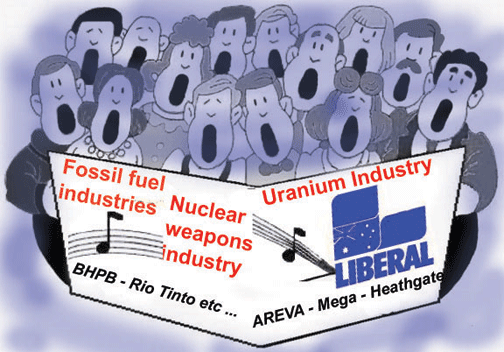 Bishop urges resources industry to back nuclear energy Financial Review, JONATHAN BARRETT, 8 May 13,
Deputy Liberal leader Julie Bishop has urged the resources industry to try to win public support for the politically sensitive case for nuclear energy.
Sitting in the audience at a business event in Perth on Tuesday, Ms Bishop asked a panel whether miners were doing enough to defeat “social activists” opposed to the development of the country’s natural resources……..
Many Liberals, including leader Tony Abbott, have argued that Australia should seriously consider nuclear energy as a means to reduce carbon emissions, even though it is not an official policy being promoted before the federal election.
Ms Bishop, the shadow minister for Foreign Affairs and Trade, has just returned from Russia, which recently received its first shipment of uranium from Australia. Her comments indicate she would also like to see Australia consider using its own vast reserves of uranium to produce nuclear power…… http://www.afr.com/p/2100/bishop_urges_resources_industry_TxeDLLGD90FDbofFcD4R9L
Wide area of radioactive cesium contamination from Fukushima radiation
Study: Vast area of 60 million people contaminated from Fukushima disaster (PHOTO) http://enenews.com/study-vast-area-of-60-million-people-contaminated-from-fukushima-disaster-photo
Title: Overview of active cesium contamination of freshwater fish in Fukushima and Eastern Japan
Date Published: April 29, 2013
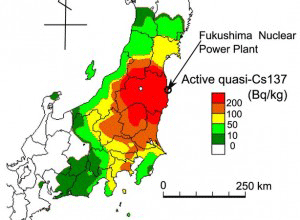 […] The extent of active cesium (quasi-Cs137) contamination of Ayu [fish] is observed in the entire eastern Japan. The some level of the contamination is recognized even in Shizuoka prefecture, 400 km south-west from the plant. […]
The serious accidents of the Fukushima Nuclear Power Plant have been contaminating a vast area in eastern Japan, home of 60 million people. […]
The widespread contamination in eastern Japan
To the south west of Fukushima prefecture, there lies the Kanto region which as well as containing the metropolitan prefecture of Tokyo also comprises Ibaraki prefecture, Tochigi prefecture, Gunma prefecture, Saitama prefecture, and Chiba prefecture. In the area, there is the Tone river basin that is the one of biggest river basins (16,840 km2) in Japan. […]
[…] In areas within a radius of 100 km from the nuclear plant, active cesium contamination levels of the Ayu are more than 200 Bq/kg. In those between a radius of 100 km and 200 km, it is around 60–200 Bq/kg. In those between a radius of 200 km and 300 km in which Tokyo is included, it is 20–60 Bq/kg. Therefore, it is estimated that contamination of freshwater fish is extended to all prefectures in eastern Japan. The contamination is recognized as far as Shizuoka prefecture, 400 km south-west from the plant. […]
Northern Territory govt sets levy on miners to clean up old mines, such as Rum Jungle
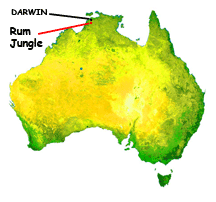 Miners to pay for mess, NT News, ALISON BEVEGE | May 8th, 2013 A MINING levy will raise funds to fix polluted legacy mine sites, the NT Government has announced.
The fee will be 1 per cent of the upfront environmental bond that all miners must pay, as set by the Department of Mines’ Security Assessment Board.
The Government has said the bond would be 100 per cent of clean-up costs but there is no way for the public to tell as the amount is secret. The new levy comes into effect in October. Mines Minister Willem Westra van Holthe said the impost would raise $6.5 million in its first year………. “We’re simply asking mining companies to chip in to a program that will be used to remediate legacy environmental problems caused by the industry.”
The move comes after the NT News exposed environmental disasters that festered for decades at defunct mines including Rum Jungle, Redbank and Mt Todd.
Camping is banned at the recreational lake near abandoned uranium mine Rum Jungle, 100km south of Darwin, as radiation levels are too high for long-term use…… Environment Centre NT co-ordinator Stuart Blanch said he supported the levy, but it would not be enough to clean up the polluted mine sites which could cost up to a billion dollars….. http://www.ntnews.com.au/article/2013/05/08/320647_ntnews.html
Victorian Health Department finds that wind turbines do not cause illness

 AUDIO http://www.abc.net.au/worldtoday/content/2013/s3753421.htm Wind farm report puts pressure on government restrictions Simon Lauder reported this story May 7, 2013 ELEANOR HALL: A company that makes wind turbines is urging the Victorian Government to respond to a Health Department report by ending restrictions on wind farms in the state.
The report by the Victorian Health Department dismissed concerns that wind farm noise makes people ill, although it did find that the noise could be annoying.
In Melbourne, Simon Lauder reports.
SIMON LAUDER: Noel Dean moved to Ballarat to get away from Waubra. He says the wind farm there made him sick…….
Now Victoria’s Health Department has produced a report dismissing that claim.
It says if you can’t hear a sound then there’s no way known that it can affect health, regardless of the frequency. It says the level of noise produced by a wind farm is somewhere between a rural night-time background noise and the sound of a car passing 100 metres away…….
The Government has never linked those restrictions with health concerns but Mr Garner says it should now reconsider them anyway.
STEVE GARNER: And a lot of those objections come about from the myth of your health and now that that myth has been taken away, then maybe revisiting those laws is something that ought to be done.
SIMON LAUDER: The Victorian Health Department report follows a recent report by South Australia’s Environmental Protection Agency, which also rejected the link between wind farms and sickness.
But the health argument is still a barrier for the wind industry.
Victoria’s Civil and Administrative Tribunal has put off its decision on a wind farm project near Seymour, until the National Health and Medical Research Council completes a review of evidence about the health effects…….
Busting the anecdotal “evidence” of the Waubra anti wind energy campaign
Anti-wind groups and others hostile to renewable technology wish to deem anecdotal evidence inscrutable – consequently, they must accept all claims of health effects, no matter how improbable. If those professing this fallacy were bound by a scientific framework, this attitude would be indefensible.
Wind farm sickness: anecdotes versus evidence KETAN JOSHI ABC 7 MAY 2013 Anedotes are concerning, but should not be immune to scrutiny. A family’s experience of illness they attribute to a local wind farm is concerning, but is no substitute for medical research and hard evidence. “……
“I know this lady and her husband, as I’ve said, I’ve known them the majority of my life, and, this woman looks twenty years older than her husband now……This woman is absolutely tormented by the things, and she’s got two of them, near her. There’s only two turbines.”
 – Australia DLP Senator John Madigan, Booroowa District Landscape Guardians Meeting, May 2012
Fear spreads better with a dash of human tears. As you visualise a weeping mother, her voice wavering as she speaks, the impact is instantaneous and potent. Millions of years of natural selection breathe life into the visceral salience of human suffering. Our ancestors, dwelling on the savannah, knew that the cost of ignoring a potential threat could be very, very high………..
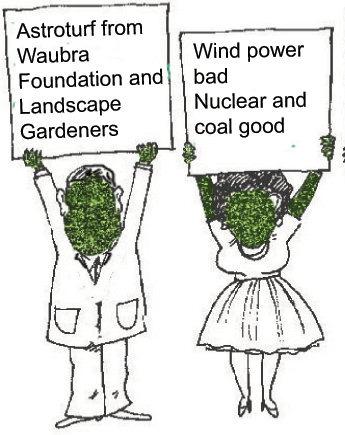 Anti-wind lobby groups (such as the Waubra Foundation, headed by ex-GP Sarah Laurie) travel to communities facing wind farm developments, and present direct testimony from individuals attributing a range of symptoms to the presence of wind turbines. Anecdotal evidence is their key instrument in spreading fear of wind energy.
This is stated explicitly by Peter Quinn, a South Australian barrister who regularly represents anti-wind lobby groups:
“That experience is in itself, evidence. If you dragged in thirty people from Waubra, twenty from Waterloo and put them in a court room, to talk about the loss and the suffering, it will support a claim to obtain an injunction against any wind farm being proposed”
The implication is quite clear – anecdotal reports and emotional recitations are powerful tools in the fight against wind farm developments. Consequently, a large number of claimed health impacts, attributed to wind turbines, exist in the public domain.
Chapman began compiling these symptoms in early 2012. His list grew rapidly – it currently numbers 216, and features a bewildering array of symptoms, involving adults, children, cattle, sheep, chicken, dogs, peacocks, cats, pigs, earthworms, crabs, goats, crickets and horses (pdf).
These symptoms are collectively referred to as “Wind Turbine Syndrome” (WTS), originally coined by Nina Pierpont (a paediatrician married to an anti-wind activist). It has become the fundamental claim of groups working to stifle the development of renewables in Australia.
The ‘disease’ is not recognised by any medical authority in the world. It is purportedly caused by infrasonic (less than 20 Hz) noise from wind turbines. The South Australian Environmental Protection Agency recently measured levels of infrasound near wind farms(pdf), and compared them to rural and urban environments. Wind farms had some of the lowest recorded levels in their study. Some of the highest levels of infrasound were recorded inside the EPA’s office in Adelaide.
Importantly, research conducted by Professor Simon Chapman of Sydney University seems to show that complaints of ill-health seem to cluster around wind farms that have been subject to the presence of anti-wind lobbyists. Continue reading
Billion-dollar global private equity fund investing in wind power in Australia
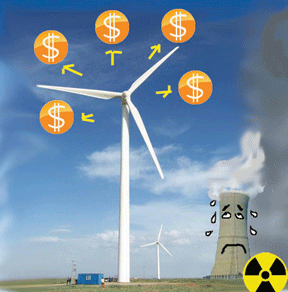 Global fund backs cheap Australian wind as local firms head abroad http://reneweconomy.com.au/2013/global-fund-backs-cheap-australian-wind-as-local-firms-head-abroad-99984 By Sophie Vorrath on 8 May 2013 At a time when Australian wind energy companies are turning their focus to overseas marketsin the search for growth opportunities, a billion-dollar global private equity fund has announced an investment of $75 million in wind power in Australia.
Denham Capital Management, a $7.3 billion US-based fund focused on mining and energy, announced on Tuesday that it had invested $75 million in a 1GW portfolio of Australian wind power projects currently under development. Part of the deal, which remains subject to procedural closing conditions, will see Denham join existing project sponsors Enersis Australia, National Power and Kato Capital to create a separate entity called OneWind Australia.
Denham’s arrival on the scene is hoped to accelerate the development of these projects, with an initial focus on the late-stage development and financing of several of them, including Glen Innes, a 100MW wind farm in NSW; Lincoln Gap, a 250MW project in South Australia; and Cattle Hill, a 240MW development in Tasmania. Continue reading
Elderly peace activists in court, face a 20 year prison sentence

that the real danger to USA is these nuclear weapons an d wastes facilities
If convicted, the activists face up to 20 years in prison on the charge of damaging a national defence premises
 Breach of nuclear facility endangered US security stuff.nz. 7 May 13 Three peace activists, including a now 83-year-old nun, endangered US national security last year when they breached a secure facility where enriched uranium for nuclear bombs is stored, a federal official testified on Tuesday at their trial.
Steven Erhart, site manager for the heavily guarded Y-12 National Security Complex in Oak Ridge, Tennessee, said the July 2012 break-in disrupted operations at the primary US site for processing and storage of enriched uranium.
“The 15-day shutdown put everything behind in terms of nuclear operations,” Erhart told jurors in the federal court in Knoxville. “It hurt our credibility and that credibility is tied to nuclear deterrence.”
Michael Walli, Greg Boertje-Obed and nun Megan Rice, who are charged with sabotage and destruction of federal property, cut several fences, walked through the complex for hours and spray-painted slogans and hammered on the walls of the facility. When confronted by a single guard, Kirk Garland, they offered him food and began singing.
“We were filled with love and compassion for the people working at the facility,” Rice testified on Tuesday. “I sort of had the intuition that for 70 years you couldn’t keep up 24-7 observation.”
Defence attorneys said the activists, who belong to a group called Transform Now Plowshares, had taken part in a symbolic break-in that did not harm the facility. Continue reading
Fujino – Japanese town leads the way to a renewable energy future

Energy transition: no longer why but how
Since the Fukushima nuclear disaster in 2011, Fujino’s popularity as a transition town has grown. Hide Enomoto, co-founder of the Fujino transition town initiative says people around Japan are realizing just how important it is to switch towards cleaner sources of energy. “The people are no longer asking ‘why do we need an energy transition?,” Enomoto said. “Rather ‘how are we going to do it?”……
Huge alternative energy potential
If some studies are to be believed, Japan could in future completely turn its back on fossil fuels and meets its entire energy needs through renewable energy by 2050
‘Transition Towns’ lead the way in low-carbon living, DW, 7 May 13 Following the Fukushima nuclear disaster in 2011, many in Japan are talking about switching to renewable energy for a cleaner future. The “Transition town” of Fujino has already made that a reality……. Following the catastrophe, the Japanese government led by Naoto Kan initially decided to phase out nuclear energy in Japan by 2040. Since summer 2012, all Japanese reactors – with the exception of two – have been taken off the grid. Instead, Tokyo plans to set up the world’s biggest offshore wind park along the Fukushima coast by 2020. The plan foresees installing 143 wind turbines with a total capacity of 1 gigawatts. Construction is expected to begin in July 2013…….
the current government is now backpedaling on plans to phase out nuclear energy.
Taking the initiative
Many Japanese, on the other hand, are losing patience with their government for failing to take the necessary steps to move towards an energy transition. Individual towns and communities are taking matters into their hands by taking steps to cut their reliance on fossil fuels and nuclear energy.
They’re part of the “transition town” initiative. Central to the initiative is the belief that, rather than waiting for governments to find all the answers or for individuals to act on a large enough scale, communities can be a catalyst for the societal redesign required to respond to climate change and prepare for the coming end of cheap oil. Continue reading
1 This month
7 April – WEBINAR – Australia and the Doomsday Clock – Preventing nuclear war through NoFirstUse and other policies
Online | Tuesday April 7, 4:00-5:30pm, Australian Eastern Time / 8:00-9:30am Central Europe Time
– Access the registration link
15 April – Zoom –Nuclear Power is Not the Solution
Apr 15, 2026 01:00 AM in Canberra, Melbourne, Sydney

Join the International Physicians for the Prevention of Nuclear War (IPPNW) on Tuesday, April 14th for a timely webinar exploring the risks associated with nuclear power and challenging the myth that it offers a simple, safe, carbon-free solution to the climate crisis

21 April Webinar: No Nuclear Weapons in Australia
Start: 2026-04-21 18:00:00 UTC Canberra, Melbourne, Sydney (GMT+10:00)
End: 2026-04-21 19:30:00 UTC Canberra, Melbourne, Sydney (GMT+10:00)
Event Type: Virtual
A virtual link will be communicated before the event.
Host Contact Info: australia@icanw.org

of the week – Australians for War Powers Reform (AWPR)
To see nuclear-related stories in greater depth and intensity
 Antinuclear