Antinuclear’s take on Australia’s Federal Budget
 Today’s special – a swathe of items about the Budget.
People are analysing the Budget all over the place. Christina Milne of The Greens is scathing  about how the Labor government has backed down on its clean energy commitments.
Still – the Australian Renewable Energy Agency survives, and solar and wind power are going to keep growing. Heaven help us if Tony Abbot gets in in September and tries to wreck renewable energy and climate change action. We may well look back on this Budget as something quite good.
The uranium lobby will be squealing, as new rules tighten, to stop the rorts on tax exempt exploration. But they keep all their other $billion perks.
Nuclear agencies continue to gobble up their $millions. The old dead, but still dirty High Flux has costly cleanups indefinitely, the live OPAL nuclear reactor continues to cost. Then there’s the radioactive waste dump planning.
And there are the Counsellors in India and China being funded – their job sounds very like marketing for Australia’s uranium industry.
Uranium mining: Budget slightly dents the government handouts to this industry
The mining industry has had a royal run from the Australian government. Up until this latest Federal Budget uranium mining companies could deduct the full cost of exploration immediately, or even 150 per cent of the cost of exploration in some cases. Tax breaks on exploration and equipment cost taxpayers more than $1 billion per year.
Now – mining companies will cry poor, as the new budget contains measures to tighten the rules on exploration deductions for miners. Companies will now only be able to deduct genuine exploration spending, rather than writing off the acquisition of a company that acquired mining rights and spent money on exploration. But hey, the Government is sacking more than 100 staff from the federal environment department, staff who help assess mining proposals
 But don’t let’s feel too sorry for the uranium, or indeed, any mining corporations. For example BHP Billiton and Rio Tinto pay tax on their fuel, but the government gives nearly all of it back through the Fuel Tax Credits program. Fears the diesel fuel rebates could be targeted again proved unfounded, with no direct changes to the 32 cent rebate.
As Charles Berge wrote (in Sydney Morning Herald May 11, 2010) “And then there are direct government services. Geoscience Australia’s annual budget is $130 million, much of which goes to providing free data and services to the mining industry. The CSIRO and various government research centres chip in another $130 million per year in benefits to the industry. And for the research the miners have to do themselves, they get $160 million back per year in the form of research and development tax concessions.
A billion or two for fuel, … a billion for free pollution and a couple of hundred million for subsidised science . . . pretty soon we’re talking real money.
And that’s before we’ve even begun to talk about government-provided roads, rail, ports, electricity networks and other infrastructure.
Mining is different from most other industries because it directly accesses publicly owned, non-renewable resources. It is appropriate that it pay for this privileged access, over and above its fair share of company tax. In light of the $4 billion to $5 billion in benefits the mining industry receives each year from the Australian taxpayer, the government’s proposed resource rent tax starts to look modest (and anyway, uranium mining was exempt from that tax)…..
So don’t be snowed by the big miners’ shrieks about sovereign risk driving them out of Australia. The biggest risk is that we continue to subsidise mining operations that aren’t paying a fair return for their use of public resources and taxpayer dollars.”
Nuclear and Uranium Related Expenses in Australia’s Federal Budget 2013
 Nuke Dump – $35.7m over 4 years National Radioactive Waste Management — securing a site and First Stage business case to “secure suitable volunteer site” and undertake initial scoping and design work, establish a Regional Consultative Committee and First State business case. (p253 bp2)
-
 Counsellor in New Delhi – $3.1m over 4 years to continue posting a Resources, Energy and Tourism Counsellor in New Delhi – is this to do with Uranium??


 ANSTO = $38.7m for decommissioning High Flux Nuclear Reactor and $8.1 m for increasing costs of running OPAL Nuclear Reactor (nuclear fuel and electricity) Australian Nuclear Science and Technology Organisation — additional funding for decommissioning and nuclear waste management activities

ARPANSA = $ 7.8 m over four years Australian Radiation Protection and Nuclear Safety Agency — improving Australia’s capacity to deliver effective radiation protection and nuclear safety to enhance capacity to issue new licences and undertake compliance, upgrade Yallambie and to address workplace health and safety issues. 5.1 m to be recovered through revising licencing fees and testing fees.
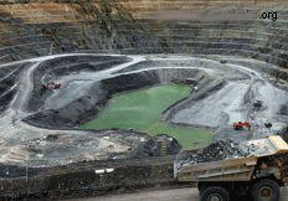
 Rum Jungle radioactive decontamination funds = 1.5 this year.
More detail on these nuclear-related expenses in the Budget: Continue reading
Australia’s Budget – a mixed result for clean energy – but Abbott’s agenda would be worse
 Budget 2013-14 And Renewable Energy http://www.energymatters.com.au/index.php?main_page=news_article&article_id=3739, 15 May 13, Australia’s Clean Energy Council has expressed disappointment in last night’s Budget, stating more than $600 million of funding for clean energy projects has been put in jeopardy.
While acknowledging a tough set of financial circumstances for the country and ambitious new projects such as the NDIS requiring funding, the CEC says chopping and changing clean energy program funding unsettles investors.
A deferral of $370 million in funding to the Australian Renewable Energy Agency (ARENA) over three years from 2014-15 is causing some concern as the CEC says the process for returning that funding to ARENA’s budget beyond 2020 is unclear.
$260 million of funding for energy efficiency programs and large-scale solar was also cut; the latter being $160 million of unallocated solar flagships funding which was to go to the ill-fated Solar Dawn project.
However, it wasn’t all bad news. The Clean Technology Programs did not receive rumoured cuts and $58 million of unspent funds in 2012-13 has been reallocated to 2017-18. $160 million of funding has been brought forward to 2014-15 to provide earlier access to funds for industry.
 Greens leader Christine Milne was particularly scathing of the Budget. In an email with the subject line of “weaker, dumber, meaner”; Ms. Milne said the Government’s cuts to renewable energy funding constituted “back-flipping on their commitments to the Clean Energy package made with the Greens”. Ms. Milne also said “This budget is bad but Tony Abbott’s extreme agenda would go even further.”
For potential buyers of small scale rooftop solar arrays, their was neither bad or good news in the Budget – it’s business as usual.
On a somewhat related topic, carbon capture copped it in the cuts; with $662 million of uncommitted funds for the controversial Carbon Capture and Storage Flagships program being returned.
A full round-up of Budget 2013-14 winners and losers (renewable energy related and otherwise) can be viewed on ABC News.
Australian Renewable Energy Agency relatively unscathed in Budget Cuts
Federal budget 2013: Renewable energy agency spared funding axe http://www.startupsmart.com.au/financing-a-business/federal-budget-2013-renewable-energy-agency-spared-funding-axe.html , 14 May 2013 | By Oliver Milman The federal government will extend the funding for its flagship clean tech initiative, the Australian Renewable Energy Agency, confounding fears from green start-ups that the program was to be slashed to the bone.
Media reports in the lead-up to the budget suggested ARENA was set for funding cuts after the government flagged a reduction in the carbon price and the deferment of a tax cut linked to the scheme.
In the budget papers, the government has indeed deferred the tax cut until the carbon price is estimated to be above $25.40, which is projected for 2018-19.
However, ARENA has emerged relatively unscathed, with Treasurer Wayne Swan and Climate Change Minister Greg Combet announcing that its funding will be extended by two years to 2021-22, with funding “remaining above $3 billion for the life of the program”. Continue reading
Mixed fortunes for Australia’s Renewable Energy Agency in Budget
ARENA plans new mechanisms as funding cut, deferred REneweconomy By Giles Parkinson on 15 May 2013 Australia’s Renewable Energy Agency – the independent institution charged with giving a kick-start to emerging renewable energy technologies and supporting infrastructure – has had its overall funding cut by around 5 per cent and a further $370 million deferred to beyond 2020 as part of changes announced in the 2013 Federal Budget on Tuesday.
The cut, which effectively reduces ARENA’s total budget from $3.2 billion to just over $3 billion – comes from a decision to return $159 million of unspent money from the Education Investment Fund – a $200 million facility that was to run alongside the now defunct Solar Flagships program – to the budget.
CEO Ivor Frischknecht said he was disappointed by the budget cut – which effectively removes 10 per cent of unallocated monies, even though these particular funds were not under its direct control – but he said the “reprofiling” of the funding for other programs could actually suit ARENA’s investment objectives.
Under the changes announced by Treasurer Wayne Swan, funding for ARENA would be trimmed by $70 million in 2014/15 and by $150 million in the two subsequent years, with the money backloaded from 2020 into a program that would be extended out to 2021/22.
The move to effectively delay around 7 per cent of its unallocated funds has been criticised by clean energy supporters. The Clean Energy Council said it was disappointed the funds had been sent into the “budget ether”, just one year after ARENA had been established as an independent body to provide long-term stability to investors, and to avoid this very problem of annual budget cuts. ARENA enjoys bipartisan support, unlike the $10 billion Clean Energy Finance Corporation.
However, Frischknecht told RenewEconomy in an interview that the “reprofiling” of funding was a “sensible” move because it would help align the funding with the agency’s own investment plans……..
Frischknecht said ARENA was particularly pleased to get a $6.1 million increase in operational funding, which would allow the agency to expand, adding in project managers and specialist financing and transactional teams to look at new projects. “This is a big vote of confidence in our work,” he said. http://reneweconomy.com.au/2013/arena-plans-new-mechanisms-as-funding-cut-deferred-81277
Staggering downturn in prospects for the nuclear energy industry
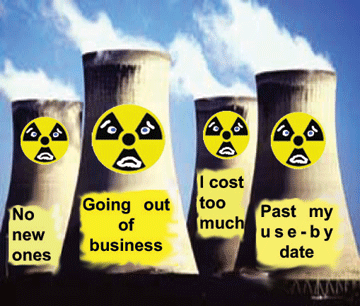 CNBC: Nuclear power has taken a beating — Engulfed by ‘cauldron of events’ — Staggering change from just a few years ago — Not many had forecast it would “all go wrong at once” http://enenews.com/cnbc-nuclear-power-beating-engulfed-cauldron-events-staggering-change-years-many-forecast-all-wrong
Title: Nuclear Power Falters, Engulfed by ‘Cauldron’ of Bad Luck
Source: CNBC
Author: Javier E. David
Date: May 13, 2013
Nuclear Power Falters, Engulfed by ‘Cauldron’ of Bad Luck
Once touted as a successor, or at least a competitor, to carbon-based power, the nuclear sector has taken a beating as the momentum behind new projects stalls and enthusiasm for domestic fossil fuel production grows.
Across the country, plans to build nuclear plants have hit roadblocks recently—a sharp turn for a sector that just a few years ago was looking forward to a renaissance. […]
The change in nuclear’s fortunes is staggering, given that the U.S. is the world’s largest producer of nuclear power […]
Peter Bradford, a law professor and a former member of the Nuclear Regulatory Commission
“Starting about four years ago, the industry felt it was in the middle of a renaissance”
“They’ve gone from that high-water mark to a point at which … we’re actually seeing the closing of a few operating plants, which was unthinkable even a few years ago”
[He] cited a “cauldron of events” for bringing the nuclear push to a standstill
“I don’t think there were many of us that forecast they would all go wrong at once”
“We don’t fight world hunger with caviar, and we’re not going to fight climate change with outlandishly expensive energy sources”
See also: “Inevitable nuclear power exit” in U.S.? Bulletin of Atomic Scientists exposes “dismal” and “extremely unattractive” situation
Fukushima Fisheries oppose TEPCO’s plan to discharge radioactive water to the sea
 Fukushima fisheries associations turned down Tepco’s discharging ground water http://fukushima-diary.com/2013/05/fukushima-fisheries-associations-turned-down-tepcos-discharging-ground-water/ by Mochizuki May 13th, 2013 ·
On 4/26/2013, Fukushima Diary reported “Tepco is about to discharge pumped ground water to sea, “They won’t remove 21,000 Bq/m3 of Tritium” [URL]”
According to Tepco, they are ready to discharge pumped ground water to the sea.
Currently 400 tones of ground water flows to the plant everyday. To control this water, Tepco made 12 wells to pump up the water before flowing to the plant.
Tepco is now ready to discharge the water pumped from 4 of 12 wells. They state they only need the “approvals” of the stakeholders.
The water is not purified before discharge. They only analyze the nuclides.
On 5/13/2013, Fukushima Prefectural Federation of Fishries Co-operative Associations decided not to approve the request of Tepco to discharge the ground water. The associations stated some of the members don’t distinguish ground water and contaminated retained water.
Tepco commented they will continue to convince the associations.
60 top Indian scientists unhappy about safety issues in Kudankulam nuclear power plant

 Top scientists express safety concerns over Kudankulam nuclear plant NDTV, by Pallava Bagla, Edited by Mala Das : May 14, 2013 New Delhi: Sixty of the country’s leading scientists have written to chief ministers of Tamil Nadu and Kerala, expressing safety concerns over the controversial Kudankulam Nuclear Power Plant which received the Supreme Court’s nod earlier this month. The scientists, most of who aren’t specialists in nuclear energy, have sought a safety review of the plant by an “independent panel” of experts.
The top court had declared that all expert bodies were of the unanimous opinion that adequate safety measures had been taken at the plant situated in Tamil Nadu.
But the scientists, in their three-page petition, have expressed doubts “particularly with reference to possible sub-standard components” that were supplied to the plant. Recently, four faulty valves were detected in the first reactor unit of the plant; they were later replaced. Some Russian officials had also been arrested recently over alleged corruption in sourcing sub-standard materials from some Russian nuclear plants.
Mining companies now fear activist shareholders
“They would just ignore them, they would say you’re not really a shareholder,” she remembered over tea sandwiches served following Rio Tinto’s annual general shareholder meeting last month. “There was one big, black aboriginal man who got up on the stage to have his say. The company heavies came up and lifted him out bodily, by the feet. It was quite spectacular.”
This year, Rio Tinto’s 140th anniversary, the attitude toward international visitors was much different. Rio Tinto chairman Jan Du Plessis effusively thanked an Alaskan Native Yupik elder, a Mongolian woman speaking on behalf of nomadic herders and others for making the trip.
Rio Tinto, like other major mining companies, now goes to great lengths to emphasize its “partnerships” with local communities and specifically indigenous people. ……
But members of the increasingly organized international mining watchdog movement say the companies are ultimately still determined to mine wherever, whenever and however they desire, and in the least costly way.
Hence, they say, all this talk about social responsibility is largely rhetoric or “greenwashing” and that companies would have to do a lot more — including making financial sacrifices — to really change their ways……… Continue reading
Uranium mining company loss reported for 1st quarter 2013
 Uranium One posts $9.5m Q1 loss, Mining Weekly, By: Natasha Odendaal 14th May 2013 JOHANNESBURG – JSE- and TSX-listed Uranium One on Monday reported a net loss of $9.5-million for the first quarter ended March 31.
This was down from earnings of $4.5-million recorded in the comparative period the year before.
The group, which owns assets in Kazakhstan, the US, Australia and Tanzania, recorded a 60% drop in earnings from mine operations, including joint ventures (JVs), reaching $19.6-million during the first quarter, compared with the $49.3-million achieved in the corresponding period the year before.
Revenue for the period dipped to $5.2-million, from $5.3-million in the first quarter of 2012, while its JV operations contributed revenue of $57.4-million, down from the $90.6-million earned in the comparative quarter last year.
Uranium sales also declined year-on-year with 1.38-million pounds of uranium sold at an average price of $45/lb in the first quarter, compared with the 1.8-million pounds sold at $53/lb in the first quarter of 2012…… the company warned that the year ahead would be capital intensive as it incurred capital expenditure of $164-million on its assets in Kazakhstan, the US and Australia.
About $98-million was allocated for wellfield development, and the remaining $66-million for plant and equipment.
Uranium One noted that general and administrative expenses – excluding noncash items – were expected to reach about $40-million.
Exploration expenses were expected to reach $8-million. http://www.miningweekly.com/article/uranium-one-posts-95m-q1-loss-production-up-10-2013-05-14
1 This month
7 April – WEBINAR – Australia and the Doomsday Clock – Preventing nuclear war through NoFirstUse and other policies
Online | Tuesday April 7, 4:00-5:30pm, Australian Eastern Time / 8:00-9:30am Central Europe Time
– Access the registration link
15 April – Zoom –Nuclear Power is Not the Solution
Apr 15, 2026 01:00 AM in Canberra, Melbourne, Sydney

Join the International Physicians for the Prevention of Nuclear War (IPPNW) on Tuesday, April 14th for a timely webinar exploring the risks associated with nuclear power and challenging the myth that it offers a simple, safe, carbon-free solution to the climate crisis

of the week – Australians for War Powers Reform (AWPR)
To see nuclear-related stories in greater depth and intensity
 Antinuclear