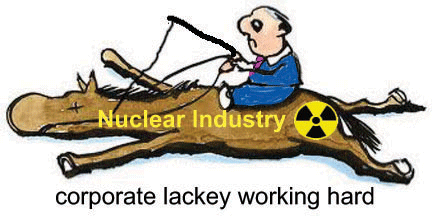
Toro Energy flogging a nearly dead uranium horse?
Claims Toro’s uranium project may struggle May 20, 2013 http://www.abc.net.au/news/2013-05-20/claims-toro27s-uranium-project-not-financially-viable/4700982 An economist is warning that the first proposed uranium mine in Western Australia may struggle to get off the ground.
The comments are made in a report, commissioned by Greens Senator Scott Ludlam and environmental groups, into the viability of Toro Energy’s proposed Wiluna project.
The study by ‘Economics at Large’ indicates the project’s profitability relies on a number of sensitive factors. The paper’s author, Roderick Campbell, says Toro may struggle to make the project viable.
“The Wiluna project sits very high on the cost curve of global uranium projects,” he said. “It’s difficult to see why any of the major uranium players would invest in this project when there’s a lot of cheaper projects out there.”
 Toro has released a statement saying the Wiluna project has won WA and Federal Government environmental approval to proceed after a rigorous three and a half year assessment process. It says, as a result, there is significant market interest from international energy utilities and global resource investors in the Wiluna project.
Senator Ludlam claims the project will just manage to be financially viable if Toro can avoid clean-up and decommissioning costs.He says Toro has not submitted a costed mine closure plan and the numbers are against the company when the cost of the clean-up is factored in.
Toro is yet to respond to that particular claim.
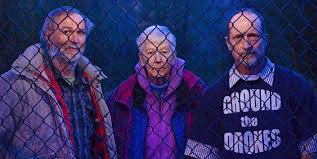
Sister Megan Rice in gaol, convicted of “crimes of violence !
 Feds Say Peace Activists Who Trespassed Onto Nuclear Facility Are A National Security Threat http://www.huffingtonpost.com/2013/05/20/peace-activists-nuclear_n_3306170.html Radley Balko, 20 May 13,
05/20/2013 11:13 In another case of possible overreach by federal prosecutors, an 82-year-old nun and two anti-nuclear activists face long prison terms after being convicted of “sabotage against the U.S. government” and other serious felonies. In truth, the three trespassed onto a nuclear facility, and damaged and vandalized some government property. Their most serious offense may have been to expose lapses in federal security at a nuclear weapons production facility.
In June of last year, peace activists Sister Megan Rice, 82, Greg Boertje-Obed, 57, and Michael Walli, 63, were able to access the Highly Enriched Uranium Materials Facility at the Y-12 nuclear weapons plant in Oak Ridge, Tenn., simply by cutting through a series of chain-link fences. The three then unfurled banners, spray-painted on the building, sang hymns and prayed until security finally arrived to arrest them.
As the activist site Common Dreams reports, over the next several months federal prosecutors applied increasingly serious charges to the activists, and this monthultimately convicted them of serious felonies that could carry long prison sentences. The three were convicted of “crimes of violence,” and will remain incarcerated until their sentencing in September, though the group didn’t harm anyone and carried with them messages of peace and nonviolence.
The severity of the charges may be more of a response to the public embarrassment the break-in caused for the Obama administration than to actual criminal culpability. In reporting on the case last August, for example, The New York Times reported that nuclear experts were calling the protest “the biggest security breach in the history of the nation’s atomic complex.” The paper called the fiasco a “huge embarrassment for President Obama,” and said that the three protesters had “made nuclear theft seem only a little more challenging than a romp in the Tennessee woods.”
The case is the latest of several — including the January suicide of Internet activist Aaron Swartz — to demonstrate the immense charging power of prosecutors. Some critics say these cases show an out-of-control federal justice system that allows politically motivated prosecutors to use criminal sanctions to target critics, make examples of protesters, or discourage those who seek to expose government lapses, abuses, and oversights.
Busting the anti solar myths of the Energy Supply Association of Australia (ESAA)
 ESAA Attack On Solar Households ‘Riddled With Myths’ http://www.energymatters.com.au/index.php?main_page=news_article&article_id=3750 21 May 13 A discussion paper recently published by the Energy Supply Association of Australia (ESAA) has been shot down by industry commentators. Adding to the Clean Energy Council’s comment that Big Energy is ‘clutching at straws‘ in its attempts to demonise solar households; others have weighed in on the issue.
Business Spectator’s Tristan Edis has commentedthat following the ESAA’s logic; any household that implements any sort of energy efficiency strategy would be viewed in ESAA’s eyes as ‘avoiding network charges’ through lowering their electricity bill. This could include non-solar households installing LED lighting, insulation – or even turning off lights when not in a room.
Mr. Edis also points out solar is a bit player in network upgrade spending and it was the rise of the air-conditioner that was used by network businesses to justify billions of dollars of additional network infrastructure expenditure; some of which has been labeled as ‘gold-plating‘.
“The ESAA’s demonisation of solar is a bit like a guy that just ran over your dog with a semi-trailer truck, who points the finger at the bicycle following afterwards that clipped the dog’s tail before it died.”
The role of air-conditioning is also pointed out by RenewEconomy’s Giles Parkinson; who states using the ESAA’s own figures, the costs ‘avoided’ by solar households is just one eleventh of the cross-subsidy paid by households with no air conditioning for those who do – yet the ESAA has not recommended air-conditioned households be hit with higher fixed tariffs to pay for network extensions.
“What seems inevitable however is that the industry will one day soon need to change its business model or face the same decline as fixed priced telephony or printed photos. They are fast approaching their Kodak moment,” says Mr. Parkinson; who mentions the role home energy storage systems may play in the future if Big Energy continues treating solar households as second-class citizens.
The ESAA’s focus on costs and little mention of benefits solar households bring that will outweigh those costs seems to indicate Big Energy is still yet to grasp the reality that solar households play an important role in Australia’s affordable clean energy future – and that ignorance runs the risk of ultimately negatively impacting all Australian households.
Canada’s Supreme Court considers the Collective and Individual Aboriginal Treaty Rights

 Canada: Supreme Court Of Canada Focuses Attention On The Collective And Individual Aspects Of Aboriginal And Treaty Rights Collective And Individual Aspects Of Aboriginal And Treaty Rights … to harvest timber on two tracts of land in the territory of the Fort Nelson … Asia, Australia, Canada, Africa, the Middle East, Latin America and Central Asia.
Clearly, this raises many questions, including the possibility that members of a community could successfully challenge a development project even if their political leaders have declared their satisfaction with the consultation process established by the Crown. This decision of the Supreme Court opens the door to complex discussions about how the Crown and developers should handle the concerns of Aboriginal communities and those of individual members of such communities…..” http://www.mondaq.com/canada/x/240100/indigenous+peoples/Supreme+Court+Of+Canada+Focuses+Attention+On+The+Collective+And+Individual+Aspects+Of+Aboriginal+And+Treaty+Rights
1 This month
To see nuclear-related stories in greater depth and intensity
– go to https://nuclearinformation.wordpress.com/


 Antinuclear