Walkatjurra Walkabout ends and uranium battles begin
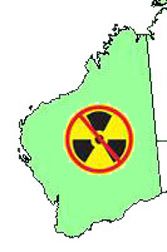 27 May 13, Over 70 people, including 12 Rangers from Leonora have just completed a three week walk from Yeelirrie to Leonora in opposition to uranium mining in the Goldfields, while celebrating an learning about culture and country. The Walk comes just months after the the Federal Government gave a significant but not final approval for the proposed Wiluna uranium mine – the first project to get this level of approval in WA.
State secretary of the Australian Manufacturers Workers Union, Steve McCartney came out to meet the walkers today in Leonora and said this “Today is the beginning of building a compact agreement between the union and the community in Leonora.” “We won’t be walking away from this fight against uranium mining,” he concluded.
Kado Muir, Chairperson of the West Australia Nuclear Free Alliance and Leonora local said “This walk has been about building alliances with the green movement, the union movement and Aboriginal communities. Each step we take is a step towards a nuclear free future for our communities.” Marcus Atkinson walk organiser, “The Wiluna uranium proposal is a bad deal but not a done deal. There is growing resistance to this toxic and dying industry across WA, across Australia and around the world.
“People from France, Finland, Japan, New Zealand, Spain, Scotland and Germany have joined this walk as part of a growing and united international campaign against the whole nuclear industry. WA is in the spotlight and so is Toro this small, inexperienced and struggling company,” concluded Marcus Atkinson.
Economists at Large have published a report outlining the unstable economics of the Wiluna project it is available at www.ecolarge.com/work/osos-sobre-toro-assessment-of-wiluna-uranium-project.
A Liberal Tea Party to fight wind energy- June 18, at Parliament House
 Libs defy party on wind farms http://www.theage.com.au/opinion/political-news/libs-defy-party-on-wind-farms-20130525-2n3rn.html#ixzz2UWrz9qhn May 26, 2013 Chris Johnson National Political Correspondent Come clean”: The boldness of the Liberal windfarm opponents is raising suggestions the Coalition is about the back-flip on the renewable energy target. Outspoken Liberal MPs plan to defy publicly the official party line by attending a Tea Party-style anti-wind-farm rally at Parliament House, widening the rift in Coalition ranks over renewable energy targets.
The Canberra rally on June 18 is being promoted through a clandestine group using a website called stopthesethings.com, which conceals the identity of many of its supporters. Broadcaster Alan Jones is named on the site as master of ceremonies for the event, which is being touted as the ”Wind Power Fraud” rally.
NSW Liberal MPs Craig Kelly and Alby Schultz are among the line-up of speakers, as is West Australian Liberal senator Chris Bach. The Coalition’s star candidate to replace the retiring Mr Schultz in the seat of Hume Angus Taylor has also been recruited. The boldness of the Liberal wind-farm opponents is raising suggestions the Coalition is about to backflip on the renewable energy target, a bipartisan commitment to source a fifth of Australia’s power from renewables by 2020.
The shadow environment minister Greg Hunt recently confirmed the party’s commitment to the target and chose not to chastise the MPs who had begun speaking out against it. ”The Coalition is aware of the community concerns regarding wind farms,” Mr Hunt said. ”We have committed to a full medical research into the potential impact if elected. It is important that MPs listen to their communities … there is no change to our support for the 20 per cent target.”
During a post-budget interview with Mr Jones, shadow treasurer Joe Hockey would not be drawn on the issue, saying only that he would have to consult with his colleagues. The rally’s organisers are goading Mr Hockey to ”come clean” over renewable energy.
Victorian senator John Madigan (Democratic Labor) and independent South Australian senator Nick Xenophon will also speak. The pair has co-sponsored of an excessive noise bill in relation to wind farms. Senator Xenophon said he was invited through Senator Madigan’s office and didn’t really know who was behind the rally.
”I don’t look at all my invitations that closely,” he said. ”But I am happy to talk at the event and I will say that, while I do believe something should be done about climate change, the economics of wind farms don’t stack up and neither do the environmental benefits.” Senator Madigan’s office confirmed he was scheduled to address the gathering.
Environmental groups did not wish to comment, but it’s understood plans are being considered to stage a Canberra event in support of renewable energy on the same day.
Liberal Coalition would reverse renewable energy progress. Risky politics?
 Reversing renewable momentum would be politically risky for opposition leader Tony Abbott, not only because of electoral concern about climate change and the billions of dollars at stake, but also because the push to cleaner energy was born in conservative politics.
Australia’s political freeze on renewables Climate Spectator, Rob Taylor 27 May13, On a line of low hills standing sentinel beside a dry lake bed near Australia’s capital, giant turbines turning slo in a chill winter breeze give no hint of a multi-billion-dollar storm building around renewable energy. Slowly Infigen Energy’s Capital Windfarm, built five years ago, was a vanguard for wind power as Australia sought to wean itself from cheap fossil-fuel power in the face of climate shift blamed in part for Lake George’s transformation to a vast plain.
But big plans to expand the Infigen renewable energy project near Canberra and others like it have been put on hold awaiting the outcome of the September election. The ballot, which opinion polls show the opposition conservatives winning, along with an economic slowdown and rising home energy bills have put the brakes on Australia’s decade-long clean energy push.
At stake in the September 14 vote is a controversial carbon trading scheme championed by ruling Labor to curb greenhouse gas emissions, with a $20 billion pipeline in renewable investment largely on hold as nervous companies sit on their hands. Continue reading
No, Michael Angwin, uranium is NOT a “normal” resource like any other
 rather than being a normal Australian mineral export, uranium has all sorts of political and security ramifications, which Michael Angwin chooses to ignore.
Reader riposte: Normalisation of uranium http://www.lowyinterpreter.org/post/2013/05/27/Reader-riposte-Normalisation-of-uranium.aspx By Reader Riposte – 27 May 2013 Richard Broinowski writes:
Michael Angwin believes that the ‘normalisation’ of Australian uranium policy is almost complete, and that uranium should be dealt with like any other Australian resource. He misses the rather salient point that uranium exports can never be ‘normalised’ because unlike any other natural mineral except thorium, uranium makes nuclear weapons. Strict safeguards should attach to every shipment, and customers should be carefully vetted as to their motives in buying it. Continue reading
Japan’s government ready to take the nuclear risk again
 Is it safe? Ruling party pushes nuclear village agenda BY JEFF KINGSTON JAPAN TIMES, 26 May 13, “……This April, the Nuclear Regulation Authority (NRA) began assessing whether the two Oi reactors meet new safety standards slated to go into effect in July. There are three active fault lines near the Oi plant on the Sea of Japan coast, but it will not have a remote command center ready until 2015 and its raised sea wall will not be completed until March 2014. The new safety guidelines also require that utilities equip reactors with filtered venting systems to reduce radioactive releases in the event of an emergency, but they are granted a five-year grace period before these must be in place.
Consequently, the reactors are now operating based on the hope that these countermeasures will prove unnecessary; Fukushima demonstrates the folly of wishing risk away. The findings of three major investigations into the Fukushima accident were released in 2012, detailing the absence of a culture of safety in the nuclear industry in Japan and cozy, collusive relations between regulators and the utilities that compromised safety……
In fact, tsunami risks should have come as no surprise to Tepco, as the Tohoku coastline has been battered by major ones in 1611, 1677, 1793, 1896 and 1933. Indeed, there are tsunami stones dotting the Tohoku coastline warning future generations to heed the perils. Tepco’s own researchers warned about the tsunami risk in Fukushima, and clearly the one triggered by the Great East Japan Earthquake on March 11, 2011, was no black swan, once in a 1,000-year event. But the utilities and the government ignored the risks and sited reactors in tsunami-risk zones.
The Diet investigation concludes that what’s termed “regulatory capture” — regulators regulating in favor of the regulated — was at the heart of the nuclear accident, and it blasts the absence of a culture of safety. Moreover, it outlines an institutionalized culture of collusion, complacency and deceit involving regulators and utilities that explains why Fukushima in particular, and the nuclear industry in general, settled for inadequate safeguards……..http://www.japantimes.co.jp/opinion/2013/05/26/commentary/is-it-safe-ruling-party-pushes-nuclear-village-agenda/#.UaPpE9JwpLs
Germany thriving in its nuclear power phaseout
 We can let fission fizzle out in a renewable world, New Scientist, 20 May 2013 by Jochen Flasbarth If Germany can phase out nuclear power and still thrive, why would other nations pursue a uranium-fuelled future? AT THE start of this year Germany officially entered the Dark Ages again – at least according to its state weather
  service. A mere 22.5 hours of sunshine were recorded in January – a 60-year low. Despite this, the country’s power supply, which has a world leading input from solar panels, firmly stood its ground, even without the eight nuclear reactors that were switched off in 2011.There was sufficient energy for charging smartphones, running dishwashers and the like – and enough for slightly more essential things such as industry or life-support systems in hospitals. And people in need of a fake tan could easily get one.
Such good news probably did not go down well with the pro-nuclear lobby. Grim and cold spells of this type had been their favourite doomsday scenario. Talk of a Stromlücke, or electricity gap, made headlines after the 2011 decision to shut nearly half of Germany’s 17 reactors in the wake of Japan’s Fukushima disaster.
The fear ran rampant that, without a nuclear backbone, blackouts might push German industry out of business – or at least out of the country. This proved groundless. Despite the reactor switch-offs, Germany was able to help nuclear neighbour France as she struggled to meet electric heating needs in the winter immediately after Fukushima. According to recent figures released by the Federal Statistical Office, German electricity exports in 2012hit a four-year high, which also rebuts the popular fallacy that the country relies on imported electricity from nuclear plants in France or the Czech Republic.
When a highly industrialised country such as Germany can cut a third of its nuclear capacity almost at the flick of a switch and still export more electricity than it imports, the pursuit of a nuclear renaissance elsewhere is puzzling. ……
Fortunately, there are far better alternatives. In 2010 my agency devised a study which showed how Germany could source all of its electric energy from sun, wind or water. Now the Energiewende, or energy transition, the country needs to make is high on the political agenda and gathering pace quickly. Remaining nuclear power stations will be shut by 2022 and fossil-fuel dependence reduced bit by bit.
Some fear carbon emissions will rise. However, Germany is still way ahead of its Kyoto target. In 2012 emissions were already down 25.5 per cent compared to 1990 levels. Under Kyoto only 21 per cent is expected. ……. http://www.newscientist.com/article/mg21829170.200-we-can-let-fission-fizzle-out-in-a-renewable-world.html
Energy Savings Agency – a practical proposal by The Greens
 Australian Greens Propose Energy Savings Agency http://www.energymatters.com.au/index.php?main_page=news_article&article_id=3760 27 May 13, Greens Leader Senator Christine Milne says an ‘Energy Savings Agency’ will make Australia’s energy system fairer, cheaper and cleaner.
Announcing the plan on Friday, Senator Milne saidFederal and State Governments had failed to prevent a blowout in spending on poles and wires; accusing some state governments on profiting from their electricity assets.
“Selling less electricity is not in their interest which is why reform of the energy market is too slow and why intervention is vital.”The Greens say the Federal Government had committed to fast-tracking establishment of a National Energy Savings Initiative to replace state-based energy
efficiency trading schemes, but three years on is yet to complete a Regulatory Impact Statement.
The proposed Energy Savings Agency would be an independent agency charged with disseminating information, analysis, advocacy and financial support to break down barriers to cheaper and cleaner energy options; such as solar power.
The Greens believe the Agency would also drive down power bills by achieving $1 billion in energy savings – energy efficiency is not only the low hanging fruit in slashing power bills; but also in reducing greenhouse gas emissions. As a result, a reduction of 3000 MW of peak demand would be achieved and 10 million tonnes of carbon dioxide emissions avoided.
The Energy Savings Agency would also ensure solar power system owners are paid a fair rate for the surplus electricity they export to the mains grid.
According to a paper (PDF) released to coincide with the announcement, “fair value” for solar electricity has been underestimated to date as benefits such as avoided electricity distribution costs and time of production were undervalued.
Targets set under the Agency would initially be ‘collaborative targets’; becoming mandatory targets if networks “do not respond adequately to the targets in this form within 18 months”.
Senator Milne said the proposal has been costed by the Parliamentary Budget Office and will cost $405 million to run each year.
Tasmania’s remarkable renewable energy opportunities
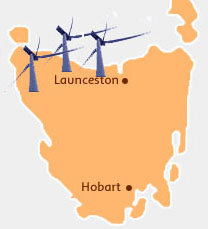 Plug into renewable energy, report urges http://www.examiner.com.au/story/1528260/plug-into-renewable-energy-report-urges/?cs=12 By CALLA WAHLQUIST, May 26, 2013, TASMANIA would become a net exporter of renewable energy by 2020 under a blueprint for climate action due to be released by the Tasmanian Climate Action Council tomorrow.
It suggests a range of measures to ensure Tasmania reaches its target of reducing carbon emissions by 60 per cent of 1990 levels by 2050, including introducing new energy efficiency standards for buildings and establishing fair renewable energy feed-in tariffs to encourage homes and businesses to generate their own electricity.
Homes that feed back into the grid from solar panels currently get 27 cents per kilowatt hour, but that could drop as low as eight cents per hour when Aurora Energy is split and the retail arm privatised in July.
Council chairwoman Lesley Hughes said the council would discuss the impending reduction of the tariffs in a meeting today and make a submission to government.
Climate Change Minister Cassy O’Connor said the council was the government’s peak advisory body on climate change, and its blueprint would inform the development of the government’s own climate plan, to be released later this year.
Ms O’Connor said Tasmania had already reduced its emissions by 30 per cent on 1990 levels. “There’s a huge economic opportunity here for Tasmania if we continue to build resilience into our economy, if we continue to move toward a low-carbon economy, then we can have a prosperous and sustainable future,” Ms O’Connor said.
“We can be a beacon to the world of sustainability and innovation.”
Opposition Leader Will Hodgman said he would not comment on the blueprint until he had seen it, but said the Liberal Party’s priorities were the re-establishment of frontline police, education and health services and revitalising the state’s economy.
Launch of Port Macquarie Library’s Solar System May 31st
 Port Macquarie Library Has Gone Solar – Official Launch http://www.energymatters.com.au/index.php?main_page=news_article&article_id=3759 27 May 13
What: Open Day for Port Macquarie Library’s solar power system
When: Friday 31st May 2013
Time: Open Day starts at 12.00 noon til 1.45pm, with official launch at 12.15pm
Where: Port Macquarie Library, Cnr Gordon & Grant Streets
As part of the NSW Government’s Waste and Sustainability Improvement Payment Program, Port Macquarie Hastings-Council has invested in a solar power system for its Port Macquarie Library in order to reduce operational costs. Continue reading
First Nations Sovereignty Challenge to Australian Government
Anderson challenges Prof. George Williams and the Commonwealth Attorney-general to publicly debate First Nations continuing Sovereignty at the Sydney Opera House.
Michael Anderson, Convenor of the Sovereign Union of First Nations and Peoples in Australia said today: “A recent comment[1] made by one of Australia’s leading constitutional lawyers, Prof George Williams, demonstrates the incapacities on non-Aboriginal legal experts to see beyond the legal system that they are sworn to serve and uphold. Prof Williams was responding to statements by Fred Hooper on the recent Declaration of Independence by the Murrawarri Nation.
“Clearly Prof Williams lacks objectivity in his radio interview with The Wire, because his teachings and his practice focus primarily on the system that affords him his status in his society, which is the same society that seeks to steal our patrimony, citizenship and usurp our sovereignty without any legal foundation.
“Many established lawyers fail to come to terms with other aspects of the Mabo decision. As a constitutional expert, surely Prof Williams understands, when the High Court held in Mabo that competing sovereignties between Aboriginal Nations and the colonial Australian state come face to face, no domestic municipal courts within Australia have the capacity to rule over issues of competing sovereignties. Continue reading
Australia half-hearted about removing corruption in oveseas mining operations
Tougher standards to fight corruption in the resources industry ABC News 26 May 13 By resources reporter Sue Lannin More of the world’s governments have signed up to measures designed to reduce corruption in the global resources industry.
Around 3.5 billion people live in poor countries that are rich in resources but they do not see the trillions of dollars that flow from their mineral and energy reserves.
Last week, the United Kingdom and France joined the Extractive Industries Transparency Initiative (EITI), which requires countries to fully disclose taxes, royalties and other fees they receive from oil, gas and mining income.
About 40 countries have now implemented the voluntary scheme and about $US1 trillion in revenue has been disclosed.
Australia has launched a pilot EITI scheme but is not yet fully compliant.
Despite recent reforms in the US and the European Union, Australia does not require mining and energy companies to publicly reveal the taxes and royalties they pay to governments around the world for natural resources.
Federal Minister for Resources and Energy Gary Gray said in his written speech prepared for the EITI conference in Sydney last week that transparency for transparency’s sake was not necessarily the best policy.
“While I recognise the benefit for governments to better understand and negotiate market conditions, exposure of sensitive project, contract and other market information will distort market competitiveness,” he said in the speech.
But the senior policy manager for extractive industries at Oxfam America, Ian Gary, says investor pressure is mounting in Australia for more openness…..
NGO says EITI merely symbolic
However, NGOs would like to see the standards tightened further as some of the new rules merely “encourage” countries to increase disclosure.
Environmental NGO, Global Witness, has called EITI a “totemic reformers club”, saying corrupt countries such as Nigeria are members…….
Australia’s SILEX uranium enrichment technology – a nuclear weapons danger
a SILEX facility could make it much easier for a rogue state to clandestinely enrich weapons grade uranium to create nuclear bombs
SILEX could become America’s proliferation Fukushima,
Controversial nuclear technology alarms watchdogs http://www.smartplanet.com/blog/intelligent-energy/controversial-nuclear-technology-alarms-watchdogs/18138 By David Worthington | July 30, 2012 A controversial nuclear technology is raising alarms bells among critics who claim it may be better suited for making nuclear weapons than lowering the cost of nuclear power and could lead to a nonproliferation “Fukushima” for the United States.
SILEX (separation of isotopes by laser excitation) is a method for enriching uranium with lasers. It was developed by Australian scientists during the mid 1990’s as a way to reduce the cost of nuclear fuel, because uranium must be processed before it can be used to generate power.
The scientists formed Silex Systems to license the technology for commercialization, and that process is still ongoing. In 2000, the governments of Australia and the United States signed a treaty, giving the U.S. authority to review whether SILEX should be deployed. That’s because there could be a major proliferation problem. SILEX reduces the steps necessary to transform fuel grade uranium into to weapons-grade uranium, and the process doesn’t create telltale chemical or thermal emissions, according to an article published by the Bulletin of the Atomic Scientists. R. Scott Kemp, an assistant professor of nuclear science and engineering at MIT, has the byline. Continue reading
(? Dangerous) Australian invention Silex Laser Uranium Enrichment
Silex Systems gets closer to nuclear ambitions LISTED uranium processing pioneer Silex Systems is a quantum step closer to its long-term quest of persuading a cabal of heavy-hitting US nuclear companies to build a full-sized power station using its next-generation enrichment method.
Silex last week revealed the consortium, Global Laser Enrichment, had completed a first-stage “test loop” at its facility in Wilmington, North Carolina. …. http://www.theaustralian.com.au/business/mining-energy/silex-systems-gets-closer-to-nuclear-ambitions/story-e6frg9df-1226650934760
Australia hosts the first World Indigenous Network conference in Darwin.
 Native voices join together at conference Border Mail, By Rick Feneley May 27, 2013 “….. Australia hosts the first World Indigenous Network conference in Darwin.
Launched on Sunday, it is a rainbow connection of about 1200 of the world’s indigenous rangers and land and sea managers. It will hear the mangrove people of Bangladesh on the challenge of climate change. The forest people of Madagascar and the Republic of Benin will talk about ecotourism. It will hear from the Bedouin of Egypt, the Maori and indigenous delegates from Brazil, Mexico, Tanzania, Kenya, South Africa, Mongolia, the Solomon Islands, Indonesia, Papua New Guinea and more countries……
Arnhem Land traditional owners used the event’s launch to celebrate the creation of Australia’s first government-recognised indigenous protected area over the sea. The new Dhimurru IPA will extend 40 kilometres out to sea from the Gove Peninsula and cover 450,000 hectares of water around the north-western tip of the Gulf of Carpentaria.
With the support of the federal and Northern Territory governments, the Dhimurru Aboriginal Corporation will manage the conservation of the sea territory in collaboration with quarantine, customs and fisheries authorities.
”It’s important because, in our culture, we have to look after the land and the sea,” says Dhimurru ranger Lisa Dhurrkay, 25. Their responsibility doesn’t stop at the shoreline, she says.
Four IPAs covering more than 85,000 square kilometres were declared in Western Australia’s Kimberley last week…. http://www.bordermail.com.au/story/1528298/native-voices-join-together-at-conference/?cs=7
VIDEO: Aboriginal Fire Power
 Fire Power, ABC, Broadcast: 26/05/2013 http://www.abc.net.au/landline/content/2013/s3767527.htm Reporter: Tim Lee PIP COURTNEY, PRESENTER: Although the Australian continent is shaped by fire and flood, large-scale devastating bushfires are a man-made modern phenomenon. That’s the view of distinguished historian Bill Gammage, who argues
  that Australians have failed to understand their environment. His views may be contentious, but his latest book has won the nation’s top literary prizes and continues to win new and influential supporters. Tim Lee reports…….
Bill Gammage contends that to confront the future, we must learn from the past. Specifically, and crucially, we need to heed the ancient knowledge and practices of Indigenous Australians…….
Aboriginal fire was actually making Australia, not a natural landscape, but a made landscape. Aborigines made it. And Europeans, when they came, assumed it was natural and so they left it alone. And what that meant was that trees and scrub were promoted to the disadvantage of grass….. BILL GAMMAGE: Can we get that knowledge back? I’d say there’s nobody that knows as much as the people of 1788, the Aborigines then, not even Aborigines now. But Aborigines know much more than the average European and they have a great advantage, and that is, especially in the north and centre, they want to stay on country. And the advantage of that is you learn local conditions – the local plants, how flammable they are, the local animals, what they need in terms of feed and shelter, where fire’s dangerous, where it’s safe, how often to burn. And staying on country and getting that local knowledge is the key to local fire management and Aboriginal people are far and away the best placed to do that. … What we lost by not listening to people in 1788 is a real tragedy. What we could have learnt is just beyond imagination. And it’s, you know, it’s cost us – it’s costing us a lot now in those cities and towns that get burnt and those people who get killed in fires.
1 This month

of the week – Australians for War Powers Reform (AWPR)
To see nuclear-related stories in greater depth and intensity
 Antinuclear