Australian Nuclear Spinbuster – theme for June 2013
This week we’ll look at uranium – Australia’s much hyped uranium industry To read the business headlines, you’d think it was booming!
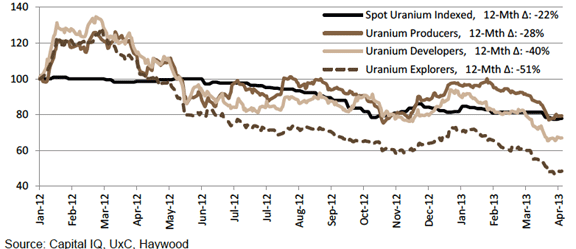
But in reality? Share prices:
- Energy Resources of Australia (ERA) $18.92 in 2007 to $1.04 now.
- Paladin Energy (PDN) hit $10.80 in 2007 to 94c now
- Bannerman Resources (BMN)
Losses – Paladin lost &39 billion in the 9 months to March 2012, and continues losses at Kayelekera mine (Malawi) to its writedown in May 2013. Cameco uranium company reported a 93% fall in earnings for the first quarter of 2013.
Events:
- BHP cut its uranium program 2012 delayed its Olympic Dam expansion, and sold its Yeelirrie deposit in Western Australia. In December BHP shut its South Australian uranium division, folding it into its base metals division.
- Cameco’s CEO Tim Gitzel February 11, 2013 stated that its Western Australian Kintyre project is not economically viable at current uranium prices and had to be written down by $168 million .
- ERA shut down Ranger uranium open-pit mining operations.
- Toro Energy’s Wiluna uranium mine economic forecast -likely to be not financially viable
Roundup of Australia’s renewable and nuclear news this week
 Well, this week, it’s still all about renewable energy. The Liberal Coalition promises to shut down the Clean Energy Finance Corporation (CEFC) , if they win the September election. But the CEFC is going ahead with contracts for low carbon companies, anyway. It will be interesting if an Abbott government goes ahead to break those contracts.
Wind: However, the most interesting energy news of the week is the stoush going on in formerly quiet little King Island. Rather sad, really. A small community being torn apart by the prospect of a feasibility study being done into having a big wind farm there. TasWind, a division of Hydro Tasmania, is running a running a comprehensive “consultative process”. But the anti wind heavies, the “Waubra Foundation” are there.
Meanwhile the anti wind farm camp is gearing up for a big rally at Parliament House on June 18. It’s run by an anonymous group called Stop These Things. Prominent anti wind campaigners will be speaking, also Alan Jones: 2GB Radio announcer. The the Institute of Public Affairs set up the Australian Environment Foundation. Don’t be fooled by that name. This organisation is a climate change denial crusader, especially targeting wind energy.
This week the 5 day The inaugural World Indigenous Network (WIN) Conference is on in Darwin, bringing together 1,500 delegates from over 50 countries. The international network of indigenous and local community land and sea managers recently became an official part of the United Nations – part of the United Nations Development Programme (UNDP). Its main focus is in the preservation of land and sea ecosystems, and in strengthening traditional knowledge of ways to do this.
Matters nuclear: Traditional owners, unions and environmentalists marched in Tennant Creek, showing their determined opposition to the Muckaty nuclear waste dump plan. West Australia Nuclear Free Alliance walkers completed their marathon walk from Yeelirrie to Leonora in opposition to Toro Energy’s planned Wiluna uranium project. A second economic study advises that this project is not likely to be financially viable.
Toro’s uranium project’s dubious financial viability
 Bear vs Bull: Toro Uranium project at risk onyserve.wordpress.com/2013/05/20/bear-vs-bull-toro-uranium-project-at-risk-senatorludlam-australia/ Australian Greens spokesperson on nuclear policy –. 20 May 2013.
The tenuous financial viability of Western Australia’s first proposed uranium mine is the subject of a new research paper undertaken by independent market analysts Economists at Large, commissioned by Western Australian Senator Scott Ludlam and a range of environmental groups.
“The study shows that Toro’s proposed Wiluna Project may scrape into financially viability if absolutely every possible variable goes Toro’s way – but only if the company can avoid clean-up and decommissioning costs,” said Senator Ludlam.
“Most crucially, the numbers are against the company as soon as the cost of clean-up is factored in. Because the company has not submitted a costed mine closure plan or established where it will find the money to post a rehabilitation bond, the site looks to become an open-ended contamination liability for taxpayers.
“According to this study, if the most optimistic range of estimates for the world uranium price, exchange rates, capital and operating costs all go the company’s way, the Net Present Value of the project is positive. As soon as any of these variables slip backwards from the company’s optimistic assumptions, the NPV calculations turn negative.
“Nuclear power is in retreat in Europe and the United States, and the disaster in Japan has torpedoed expectations for a big nuclear expansion in Asia. We commissioned this study because we believed Toro was a risky proposition; the numbers bear this out, and explain in part why much larger uranium companies BHP and Cameco have mothballed their WA projects while Toro pushes blindly ahead. This study tells the investment community in black and white: buyer beware.
“The Greens believe this project will be an environmental disaster if it goes ahead; this report gives some numbers to the scale of the financial disaster that may await as well,” Senator Ludlam concluded.
The study can be downloaded here: http://scott-ludlam.greensmps.org.au/content/media-releases/bear-vs-bull-independent-assessment-wiluna-uranium-project
Hear this: Clean Energy Finance Corporation will issue contracts to low carbon companies, despite Abbott’s threat
 Clean Energy Finance Corporation told to shelve contracts http://www.abc.net.au/news/2013-05-29/clean-energy-investment-at-stake-if-coalition-wins-election/4720894 AUDIO: Sarah Clarke reports on the clean energy future(The World Today) 29 May 13 The Coalition has already promised to dump the $10 billion Clean Energy Finance Corporation.
It was set up to lend money to firms delivering clean energy and low emissions, to give them a kick-start in the market.The Coalition is now warning it to stop drawing up contracts for new projects until after the election…….
Reserve Bank board member Jillian Broadbent, the chair of the Clean Energy Finance Corporation, says she is disappointed with the Coalition’s plans.
“There’s a lot of confusion about what we are and what the working model is and what kind of costs we’re going to be to the taxpayer, because on our numbers we’re going to be financially self-sufficient in probably within the first two years of our operation,” she said.”Then you start generating dividends which go to the Australian Renewable Energy Agency which can save the Government putting funds into that agency directly.”
The fund is currently considering applicants from at least 50 low carbon and low emission companies with contracts worth up to $2 billion.It plans to start issuing those contracts on July 1, despite calls for them to be shelved until after September.
Fund has ‘obligation to fulfil responsibilities’
Ms Broadbent says shelving the contracts is not possible. “We have an obligation to fulfil those responsibilities and that’s what we’re doing,” she said……..
The parliamentary secretary for Climate Change Yvette D’Ath says the Clean Energy Finance Corporation has a guaranteed future if Labor is re-elected. “These businesses have to meet very strict investment guidelines and criteria to get that finance through the Clean Energy Finance Corporation,” she said.
“So we’re very confident that there’ll be that rigour, there’ll be that transparency and that this will attract a lot of investment in Australia to invest in renewable energy.”
Clean Energy Finance Corporation explains its value, to Australia’s Liberal Coalition
Green fund makes its case to Coalition The Age, May 29, 2013 –
The Clean Energy Finance Corporation’s chief executive Oliver Yates outlines the case for preserving his $10 billion green fund in an email sent to the Coalition’s finance spokesman Andrew Robb.
The Coalition has vowed to scrap the fund if it wins office at the September 14 elections, and has called for the new corporation to halt loans before it formally starts operations on July 1.
Highlights of the email include the potential benefit to the Victorian economy of projects being considered, and that “active discussions are underway” with more than 50 project proponents, which are seeking CEFC finance of about $2 billion. CEFC has also received proposals from some 119 additional project proponents seeking CEFC finance of more than $3.3 billion.
(Sub-headlines have been added to break up the text.)
‘Rigorous commercial basis’…….
Public benefits…..
Externalities…..
Simpler approach…..
Project discussions…. http://www.theage.com.au/business/carbon-economy/green-fund-makes-its-case-to-coalition-20130529-2naxp.html#ixzz2UpEjXYvQ
Nuclear reactors shut down because of seaweed
Seaweed causes shut down of multiple nuclear reactors http://enenews.com/seaweed-causes-shut-down-of-multiple-nuclear-reactors BBC News,, May 28, 2013: A nuclear power reactor at Torness remains closed after seaweed threatened to clog its systems although a second has reopened. The plant’s owner EDF Energy took both reactors offline at Torness on Friday to prevent seaweed from entering the facility’s cooling system. […] In 2011 both reactors were closed after a swarm of jellyfish near the station.
Scotsman:WWF Scotland said that nuclear power had “once again proven itself unreliable”. Director Lang Banks said: “We should all be thankful that Scotland has grown its renewable energy capacity enough to be able to deal with Torness nuclear power station going offline without warning. “As we tap into ever more of our huge renewable resource, we look forward to the day Scotland can switch off nuclear power for good.”
See also: Wildlife vs U.S. nuclear plants: Flies short-out transformer — Pelican starts emergency generator — Snake causes fire — Bird shuts down reactor… more
23 per cent of Victorian voters likely to vote for Julian Assange

 New poll reveals that Julian Assange could win senate seat in Australian elections, TNT 29th May 2013 By Emma Featherstone Assange’s bid for a senate seat was seen by many as a stunt, but a poll has found 26 per cent of Australians would vote him in.
The Senate is in the upper chamber of Australia’s National Parliament and is comprised of 12 representatives from the six states, plus a pair of representatives from its territories.
The poll came from data through UMR Research, the Labour Party’s pollster. It was compiled from 1,000 Australian voters’ online answers.
They were asked: “Recently, Wikileaks has announced that Julian Assange plans to run for a seat in the Australian Senate. If he were to run, how likely would you be to vote for him and the Wikileaks Party?” 26 per cent of respondents declared themselves likely voters for the Wikileaks Party. 23 per cent of voters in Victoria, where Assange will run, consider themselves “likely” to vote for his party……. New poll reveals that Julian Assange could win senate seat in Australian elections – TNT Magazine
Strict regulations for wind energy, but not for coal and gas plants
“The next logical step would be for the Australian Energy Regulator to require monthly declarations from gas and coal-fired power stations, and their associated coal mines, that they are compliant with all air, water and noise pollution laws and regulations,”
 Wind industry angered over red tape http://www.smh.com.au/business/carbon-economy/wind-industry-angered-over-red-tape-20130529-2na9h.html#ixzz2UpGEFO00 May 29, 2013 Peter Hannam Wind energy producers are in a twist after being forced to demonstrate they are operating within noise limits every time they seek to surrender renewable energy certificates.
As of the start of June, all large-scale power stations accredited under the renewable energy target will have to submit a “standing notice” of ongoing compliance with all local, state and federal planning and approval requirements.
Operators say they were only advised of the change late last week. Power stations, including hydro, will continue to be required to complete an annual electricity generation return as before. Continue reading
Nuclear energy – a danger unlike any other
 Nuclear energy: Danger zone New Scientist, 29 May 2013 by Richard Garwin Even before the meltdown of the three reactor cores at Fukushima Daiichi, a nuclear renaissance was far from assured. In the US and Europe, any shift to nuclear had stalled more generally amid long-standing questions over safety, disposal of nuclear waste and the possibility that nuclear plants could generate material suitable for weapons
- Accidents involving the meltdown of a reactor core are unlikely, but when they do happen the consequences can be far-reaching. Two have directly led to loss of human life: the first in 1986 at the Chernobyl power plant in Ukraine and the second at the Fukushima Daiichi nuclear power plant in Japan in 2011.
Nuclear fission is not like combustion, where the process is stopped by cutting off the fuel supply. Shut down a reactor in a nuclear power plant, and while the chain reaction ceases, radioactive decay carries ..subscribers only http://www.newscientist.com/article/mg21829192.000-nuclear-energy-danger-zone.html
AUDIO: Clean energy investment frustrated due to fear of Abbott win in Australian election
Clean energy sector faces uncertain future if Coalition wins federal election http://www.abc.net.au/news/2013-05-29/clean-energy-investment-at-stake-if-coalition-wins-election/4720894 ABC Radio The World Today 29 May 13 By environment reporter Sarah Clarke Billions of dollars worth of investments in the clean energy sector are at stake if the Coalition wins the federal election in September.
The Coalition is vowing to scrap the carbon tax, review the renewable energy target and axe the $10 billion Clean Energy Finance Corporation if it takes Government.
As the largest owner of installed wind energy capacity in Australia, the company Infigen says the current level of uncertainty is playing havoc with some big investments.”It’s a problem that’s been in our industry for a number of years because it’s the first time legislation’s been reviewed or tinkered with,” Infigen’s executive director Miles George said.
“Now we have a prospect of a change of government, that uncertainty will remain until there is a change of government and a further review of the renewable energy target. “So yes, at the moment investment is pretty much stalled in the industry.”
Mr George says Infigen is yet to decide if it will go ahead with up to $2 billion worth of potential investments.
“We have a number of projects in our development pipeline but we won’t be progressing any of those until there’s more certainty about the legislation,” he said. “It’s very frustrating. Frustrating for our investors, frustrating for our capital providers for the sector, but it’s also frustrating given that the renewable energy target legislation has actually been very effective.”…….
1 This month

of the week – Australians for War Powers Reform (AWPR)
To see nuclear-related stories in greater depth and intensity
 Antinuclear