Where does Northern Territory’s Chief Minister Giles stand on NT becoming nuclear waste dump host?
 Nuke waste for Barkly? Tennant and District Times, By By Barkly MLA Gerry McCarthy May 31, 2013, “……..The Federal Court hearing in relation to Muckaty Station as Australia’s first nuclear waste management facility should become the Chief Minister’s ‘yard-stick’ as the decision reflects, can a small family group make a decision about Aboriginal land allowing development that adversely impacts on the extended clan, moiety and tribal owners including traditional owners from surrounding Aboriginal land?
Chief Minister Adam Giles, has not declared his position or the CLP Government’s position on the NT becoming the repository for Australia’s nuclear waste including intermediate to high level waste from nuclear fuel rods and decommissioned nuclear reactor from Sydney’s Lucas Heights.
However where do Mr Giles and his Government members stand on the Muckaty nomination as Territory Labor’s position has not changed in opposition to Federal colleagues imposing Australia’s first nuclear waste dump on the NT! http://www.tennantcreektimes.com.au/story/1540673/bali-for-tiwis-nuke-waste-for-barkly/?cs=1261
Military and Mining to rule Woomera – an area larger than England

 Australia eases access to world’s biggest weapon range, SMH, 30 May 13 , Australia will ease access restrictions on the world’s largest weapons test range in the remote outback – an area larger than England – to unlock an estimated $35 billion in untapped mineral resources, with legislation for the change unveiled on Thursday.
Australia will ease access restrictions on the world’s largest weapons test range in the remote outback – an area larger than England – to unlock an estimated $35 billion in untapped mineral resources, with legislation for the change unveiled on Thursday.
The Woomera Prohibited Area covers 127,000 square km of mostly barren desert and has been closed to the public since 1947, when it was used for Cold War rocket and nuclear tests by Britain, Australia and the United States.
The sprawling site, which is almost free from electronic signal interference, was also chosen this year as test site for the joint British-French unmanned supersonic stealth drone Taranis, under development by BAE Systems Plc. Defence Minister Stephen Smith told MPs that new legislation would allow miners and some members of the public with reason to be there to share access to the land with the military, to better balance national security and economic concerns………
Parts of Woomera, which hosted British nuclear weapons tests between 1955 and 1963, also lie adjacent to the Olympic Dam site, which BHP Billiton decided not to expand last year as Australia’s mining boom stalled. A small number of mines already exist in the area, including Prominent Hill and Kingsgate Consolidated Ltd’s Challenger gold mine.
Under the new access arrangements, the military would remain in charge of the area, but a permit system would give civilians the right to enter Woomera. As well as miners, indigenous Aboriginal residents can also enter the zone, and environmental or other researchers.The legislation sets up a series of zones, some of which would be zoned red for “continuous defence use” and others which would exclude mining and exploration for between 14 and 70 days a year, in a timeshare arrangement with the military.
“It allows users to make commercial decisions with some assurance as to when they will be required to leave the Area because of defence activity,” Smith said……Smith said the legislation would be passed as a priority before parliament was dissolved for September elections.: http://www.smh.com.au/business/australia-eases-access-to-worlds-biggest-weapon-range-20130530-2ne3a.html#ixzz2Uuz6nLoX
URENCO an example of the dying nuclear fuel industry
 one of the more important factors, surely, is the projected value of the MOX itself, which in turn is a function of long term uranium prices—there would be no point in completing the plant and then making the MOX, as opposed to just dumping the plutonium, if uranium will be dirt-cheap as far ahead as one can see.
the fate of the MOX plant is but one indicator of retrenchment in the global nuclear fuels market, post-Fukushima
the Japanese nuclear shut-down, which, the Times went on to note, has reduced global demand for nuclear fuels by close to 10 percent, plus Germany’s planned nuclear exit, have cast a pall that now stretches to New Mexico,
Kentucky, and South Carolina.
Restructuring and Retrenchment in Nuclear Fuels http://spectrum.ieee.org/energywise/energy/nuclear/restructuring-and-retrenchment-in-nuclear-fuels By Bill Sweet 29 May 2013 In 2000, the United States agreed with Russia to get rid of 34 tons of weapons-grade plutonium. To that end, it embarked on construction of a large plant at Savannah River, S.C.,where the plutonium would be mixed with uranium to make so-called mixed oxide fuel (MOX), suitable for use in nuclear power plants.
Buried in the president’s fiscal 2014 budget request is a line sharply cutting funding for the Savannah River MOX plant, which “may be
tantamount to killing it,” a former National Nuclear Security Administration official told Arms Control Today. Continue reading
The sad state of America’s nuclear industry, in spite of all its government perks
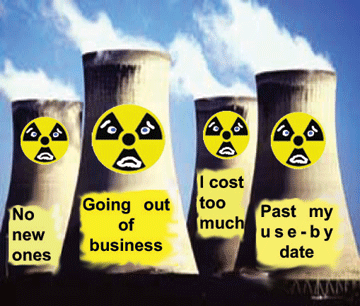 It was not supposed to be this way. In 2005 Congress approved subsidies to bolster the nuclear industry and encourage the construction of new plants. It extended a law limiting owner liability in case of accidents and, for the first few new reactors, offered $18 billion in loan guarantees, $2 billion in indemnification against cost overruns and $1 billion in tax breaks.
The NRC streamlined its licensing procedures, hoping to avoid the years of delays that inflated costs for earlier nuclear plants. (Southern ended up paying $8.7 billion for the existing reactors at Vogtle, a far cry from the $660m originally projected.)
None of this has worked as advertised.
Fracked off Thanks to cheap natural gas, America’s nuclear renaissance is on hold The Economist, Jun 1st 2013 | BURKE COUNTY, GEORGIA IT IS the sort of thing you would expect to see in China, not in the pine forests of rural Georgia. On the banks of the sluggish Savannah river towers one of the world’s biggest cranes. It is helping build two nuclear reactors, to add to the two already up and running at the Vogtle power plant. It testifies to the mammoth efforts that have been made in recent years to revive America’s nuclear industry—and to the disappointing results. Continue reading
Another desperate move to contain radioactive water at Fukushima – freezing earth around the plant
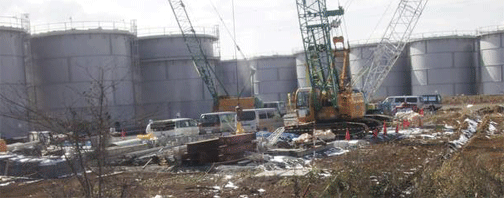 Soil around Fukushima to be frozen to stop groundwater leaking in http://www.abc.net.au/news/2013-05-31/operator-ordered-to-freeze-soil-around-crippled-nuclear-plant/4724554 By North Asia correspondent Mark Willacy, The Japanese government has ordered the operator of the Fukushima nuclear plant to freeze the soil around its crippled reactor buildings to stop groundwater seeping in and becoming contaminated.
Every day another 400 tonnes of groundwater forces its way into the plant, becomes contaminated with radioactivity and needs to be stored onsite. Plant operator Tokyo Electric Power Company (TEPCO) already has a quarter of a million tonnes of radioactive water stored in tanks at Fukushima. (below Fukushinma Daichi reactor No 6)

Fearing the nuclear plant is running out of space to store contaminated water, the Japanese government has ordered TEPCO to take the drastic step. The government hopes these frozen walls of soil will stop huge amounts of groundwater leaking into the buildings and it wants the system to be in place within two years.
According to a report compiled by a government panel on Thursday, there are no previous examples of using walls created from frozen soil to isolate groundwater being used for longer than a few years.
This means the project at the Fukushima plant poses “an unprecedented challenge in the world”.
Farming the sun – Australia’s first community-run solar farm at Lismore?
 North coast looks at sustainable energy alternatives, By ABC North Coast, 31 May 13, “………… Lismore could host Australia’s first community solar farm, as part of the new Farming the Sun project. Adam Blakester is in charge of the project which has received funding to establish seven or more community-owned solar farms around the country.
Mr Blakester said Farming the Sun is about bringing the community together and strengthening the local economy. It would mean local people would invest in the project and then on-sell the energy to a local organisation. “It’s really a community building project and particularly about learning and understanding electricity and energy which is an increasingly significant issue for all of us on a local scale and a global scale.
“That solar farm is owned by a local company; which is local people as shareholders – so that’s the community ownership.”……. He said while community-run solar farms haven’t been viable in the past, solar energy has just recently become more affordable than grid power. “Now, it’s financially cheaper to produce your own electricity with a solar panel, than to buy it off the electricity grid.
“By locally owning it, the money we’re spending on electricity starts to be recirculated for the life of this solar farm in the local region and local economy.”
A memorandum of understanding was signed last night by Lismore City Council, and by Starfish enterprises which – along with the NSW Office for Environment and Heritage and The Earth Welfare Foundation – has contributed funding towards the Farming the Sun project. …….
A feasibility study will now be conducted to see if it can go ahead in Lismore. http://www.abc.net.au/local/stories/2013/05/31/3771758.htm?site=northcoast
Investors attracted to Australia because of the Clean Energy Finance Corporation

“The latest analysis by Bloomberg New Energy Finance (BNEF) indicates that new wind power projects in Australia are as much as 18% and 14% cheaper than new gas and oil plants respectively,”
CEFC boosting investor interest in Australian renewables: report REneweconomy, By Sophie Vorrath 30 May 2013Investment in renewable energy projects in Australia has become more appealing since the establishment of the federal government’s $10 billion Clean Energy Finance Corporation, according to the latest edition of Ernst & Young’s Renewable Energy Country Attractiveness Index.
The index, released this week, ranks Australia’s ‘attractiveness’ in the global renewables investment market – a market it says is expected to be worth $US630 billion a year by 2030 – in fourth place, below the US, China and Germany (in first, second and third positions, respectively) and ahead of the UK, Japan, Canada, India, France and Belgium. Continue reading
Australia well on track to beat 2020 renewable energy target
Australia on course to beat 2020 renewable energy target, says study Consultancy forecasts that country will derive 22.5% of its power from renewables by 2020 Guardian UK, Oliver Milman 30 May 13 Australia is on course to surpass its renewable energy target by deriving 22.5% of its power from sources such as solar and wind by 2020, according to a new study. The analysis of government agency data, by consultancy Green Energy Markets, forecast a long-term decline in fossil fuels, with the use of coal for electricity falling by a third over the next 20 years.
Brown coal, the most carbon dioxide-heavy of all coal varieties, is set to be phased out as an energy source completely by 2050, as is oil.Meanwhile, renewables are set to grow from 13% of the energy mix to 51% by 2050, trumping the target of 20% by 2020 along the way.
Green Energy Markets says that changing consumption will also aid the bipartisan renewable energy target, predicting an average annual electricity generation growth rate of 1.47% until 2020 – a figure lower than previously thought. The report states that electricity consumption fell by 5.5% from 2008 to 2012, with half of this reduction driven by solar and energy efficiency schemes. A drop-off in manufacturing activity and energy bill price rises have also played a role.
However, clean energy groups have warned that political uncertainty over the future of the RET is undermining investment in the sector, potentially compromising the 20% target…… Kane Thornton, deputy chief executive of the Clean Energy Council, said that the RET policies needed to remain in place to ensure investment.
“The clean energy industry is tracking along well and the 20% target means there are lots of projects ready to go,” he said. “There are lots of investors looking to Australia and the key question is ‘will the RET stay in place?’ This investment will come to Australia as long as those policy settings are stable.”http://www.guardian.co.uk/world/2013/may/30/australia-2020-renewable-energy-target
AUDIO: Australia’s Liberal Coalition taking a “sad route” if they reverse carbon tax
There is a belief that your economy will suffer if you go down the route of reducing emissions of carbon dioxide, and I believe that is a mistake. I think for most economies green growth is the right way forward, and I don’t think the Western economies are going to climb out of the current economic crisis until they move in that direction.
the position of Australia would be very sad if they do go down the route that you’re suggesting the Coalition will take
 AUDIO: Climate adviser disappointed with Coalition climate stance http://www.abc.net.au/pm/content/2013/s3771218.htm Sarah Clarke reported this story on Thursday, May 30, 2013 ASHLEY HALL: Sir David King made international headlines when he claimed climate change was a greater threat than international terrorism. Almost a decade on and the former chief scientific adviser to the UK prime ministers Tony Blair and Gordon Brown says he’s concerned there’s been little action on a global climate deal…… individual countries are now putting together quite good action plans, depending where you look in the world. I’d say Britain is probably leading the way.
The interesting thing is that the action is now taking place amongst a large number of the developing nations and the emerging nations. It’s almost an inversion……
SARAH CLARKE: In Australia, and with an election in September, the polls are indicating that there’ll be a Coalition win. Now, the Coalition has stated that they will abandon a carbon price or carbon tax. What are your thoughts on that?
DAVID KING: Well, needless to say I’d be very, very disappointed with any government coming into power in the world to reverse the situation. I, naturally, was very pleased when Australia came in with a plan of action on climate change. Continue reading
Japan’s PM in a big hurry to sell nuclear reactors to India
 Japan, India seek prompt nuclear accord Asia One, 31 May 13 TOKYO – Prime Minister Shinzo Abe and visiting Indian Prime Minister Manmohan Singh agreed to conclude a nuclear cooperation agreement as soon as possible……Although the negotiations on the nuclear cooperation pact began in June 2010, they have been suspended due partly to the nuclear crisis at the Fukushima No. 1 nuclear power plant following the Great East Japan Earthquake in 2011.
The two leaders instructed related authorities to accelerate the negotiations……
The Abe administration considers the export of infrastructure to be a pillar of its growth strategy. The Indian government, for its part, plans to increase its nuclear energy generation by constructing 18 new nuclear reactors by 2020.
The Japanese side hopes to reach an agreement with India by the end of this year, leading to exports of nuclear power plants and related equipment……
Meanwhile, Singh expressed his support for Japan’s bid to host the 2020 Summer Olympics.
They also confirmed the plan to arrange an official visit by the Emperor and Empress to India from late November to early December. http://news.asiaone.com/News/AsiaOne%2BNews/Asia/Story/A1Story20130531-426340.html
India’s flourishing nuclear weapons development (helped by Australian uranium)
 India’s Agni-V ICBM to Carry Multiple Nuclear Warheads The Diplomat, By Zachary Keck May 31, 2013 India is reconfiguring its longest-range missile to enable it to carry multiple nuclear warheads, Chennai-based The Hindu reported on Wednesday, citing a senior Indian official.
V.K. Saraswat, Director-General of the Defence Research and Development Organisation, told the newspaper that a team is modifying the Agni-V to give it the ability to carry Multiple Independently Targetable Re-entry Vehicles (MIRVs).
“Work on that is going on and it is at design stage,” Saraswat told The Hindu.
The Agni-V is a nuclear-capable three-stage, solid-fuel missile with an initial range of 5,000 kilometers that will likely be extended to over 5,5000 kms, making it an Inter-Continental Ballistic Missile (ICBM). India first tested the Agni-V last April, and the launch was a success…… http://thediplomat.com/flashpoints-blog/2013/05/31/indias-agni-v-icbm-to-carry-multiple-nuclear-warheads/
The dirty inheritance left by uranium mining
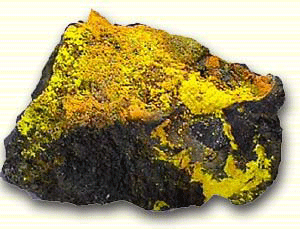 Uranium mining legacy expensive, The Star Phoenix, By Ann Coxworth, May 30, 2013 “…….The
  Canadian Nuclear Safety Commission recently reviewed plans for continuing management of some of the contaminated sites in northern Saskatchewan – relics of uranium mining activities that took place during the 1960s and 1970s.
The cost of remediating surface waters to levels compatible with Saskatchewan surface water quality objectives is so overwhelming that
we know it will never happen.
Because the companies that caused the pollution are no longer in existence, these costs now fall to the federal and provincial
taxpayers. The goal of industry and regulators now is simply to prevent the contamination from getting any worse. Continue reading
World Indigenous Network (WIN) conference – the start of a powerful international co-operation?
Native People More Than Just Park Rangers By Milagros Salazar DARWIN, Australia, May 30 2013 (IPS) – Some good-byes can actually mean the start of a long road working together. That was how it felt at the end of the World Indigenous Network (WIN) conference in this northern Australian city.
The big challenge is to consolidate “the indigenous network so its collective voice can be heard” and to get governments to implement its proposals, said one of the 10 speakers chosen by the delegations from more than 50 countries to sum up what was discussed in four days of sessions at the May 26-29 conference.
The gathering, supported by the Australian government, enabled face-to-face exchanges among indigenous people from around the world, who shared best practices in conservation of ecosystems and biodiversity and in the sustainable use of protected natural areas in Africa, Asia, Latin America, Canada and Australia.
The delegates to the conference of the “international network of indigenous and local community land and sea managers” stressed the importance of the world recognising that for ages, indigenous people have protected the land and sea thanks to their ancestral knowledge, and that their culture and way of life depends on their territories……
In the full auditorium during the closing session, perhaps the most sensitive issue was brought up by the representatives of Latin America, whose spokespersons pointed out that the question of defending indigenous territories was glaringly absent during the conference……..
The Latin American delegation, mainly made up of people from Ecuador and Brazil, as well as activists from Bolivia, Colombia, Mexico and Peru, said they went “one step further” by demanding that governments recognise indigenous rights over their ancestral territories.
“It’s not just about indigenous people taking care of parks and protected natural areas, but about a question of legitimacy, of states recognising that we have been the owners of the territory for a very long time,” Paulina Ormaza, an indigenous woman who formed part of the group from Ecuador, told IPS…….
The Equator Initiative is a partnership that brings together the United Nations, governments, civil society, businesses, and grassroots organisations to build the capacity and raise the profile of local efforts to reduce poverty through the conservation and sustainable use of biodiversity. http://www.ipsnews.net/2013/05/native-people-more-than-just-park-rangers/
Aborigines’ legal push for independence
Australia’s Aborigines Launch a Bold Legal Push for Independence TIME, By Ian Lloyd Neubauer May 30, 2013 If a determined group of indigenous people get their way, the world’s newest country won’t be in Africa or the Balkans but on the eastern periphery of Australia’s outback. A bleak, foreboding, flood-prone savannah the size of Austria 750 km northwest of Sydney, the Murrawarri Republic was home to an Aboriginal nation that lived in the Culgoa River region of the state of New South Wales (NSW) tens of thousands of years before the arrival of British settlers. On March 31, they took the first step in ending more than 200 years of colonial rule when they sent letters to Queen Elizabeth II and the Australian government demanding evidence of either a treaty or deed of cessation. When those parties failed to respond to the Murrawarri’s 28-day deadline, they issued a Declaration of the Continuance of the State of Murrawarri Nation.
“When Captain Cook arrived here in 1770, he said he was claiming the continent in the name of the Crown. But on what legal grounds did he take our land?” asks Sharni Gibbons, daughter of Fred Gibbons, chairman of the Murrawarri People’s Council.
Australia’s Aboriginal-sovereignty movement can be traced back to 1972. That year, on Jan. 26 — celebrated nationally as Australia Day — a group of black militants planted a tent on the lawns of the Old Parliament House in Canberra. The Aboriginal Tent Embassy galvanized support for indigenous land rights and thrust its ambassador Michael Anderson into the international spotlight…….. Continue reading
1 This month

of the week – Australians for War Powers Reform (AWPR)
To see nuclear-related stories in greater depth and intensity
 Antinuclear