The radioactive poisoning of Maralinga
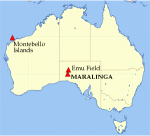 Historic records of Radiation Monitoring at Australian Nuclear Test Sites, Paul Langley’s Nuclear History Blog 3 June 13“……..RETURN TO MARALINGA, Australia Bomb Test Site On 24 May 1984 a special VIP flight to the RAAF left Adelaide for Maralinga. On board were the Minister of Resources and Energy, Senator Walsh, and the south Australian Premier, John Bannon, accompanied by scientists of the Australian Radiation Laboratory. The tour of the bomb sites took no more than four hours and the politicians learned little more than they already knew from their briefings in Canberra and Adelaide. But the importance of the trip was symbolic. The representatives of the Federal and South Australian Government were there jointly to express their regret that the atomic test series had ever been allowed to take place in Australia and to pledge their support for all investigations into the possible harm done to servicemen, Aborigines and the environment…….
-The Maralinga site will be a no-go area for many hundreds of years. At the One Tree test site, the scene of the first atomic bomb exploded at Maralinga, scientists have recorded the highest residual radioactivity level of any of the blast sites. It will be unsafe for human occupation well into the next century. At Taranaki, scene of the balloon-burst, twenty-one burial pits contain over 800 tons of contaminated material, including plutonium. At the test sites code-named TM 100 and 101, the experiments carried out in the minor trials left some twenty kilos of plutonium scattered over the surrounding area, and evidence of minute particles of plutonium on the surface of the ground are still picked up on the detection devices used by survey teams. The Australian Radiation Laboratory has declared that the British attempts at cleaning up after the tests were inadequate. The clean-up operation, code-named brumby, was carried out by a team of royal Engineers and scientists from AWRE in 1967. Before that date, the plutonium was left where it had been scattered. During Brumby it was ploughed back into the earth, under 10 centimetres of topsoil. Those who know the famous Maralinga winds and dust have argued that such a precaution was inadequate and the plutonium-contaminated soil was bound to get dispersed over the surrounding country. ‘The storms were like whirlwinds’, one veteran remembers, ‘and very powerful’……..
http://nuclearhistory.wordpress.com/2013/05/22/historic-records-of-radiation-monitoring-at-australian-nuclear-test-sites/
June 3, 2013 -
Posted by Christina Macpherson |
South Australia, wastes, weapons and war
No comments yet.
 Historic records of Radiation Monitoring at Australian Nuclear Test Sites, Paul Langley’s Nuclear History Blog 3 June 13“……..RETURN TO MARALINGA, Australia Bomb Test Site On 24 May 1984 a special VIP flight to the RAAF left Adelaide for Maralinga. On board were the Minister of Resources and Energy, Senator Walsh, and the south Australian Premier, John Bannon, accompanied by scientists of the Australian Radiation Laboratory. The tour of the bomb sites took no more than four hours and the politicians learned little more than they already knew from their briefings in Canberra and Adelaide. But the importance of the trip was symbolic. The representatives of the Federal and South Australian Government were there jointly to express their regret that the atomic test series had ever been allowed to take place in Australia and to pledge their support for all investigations into the possible harm done to servicemen, Aborigines and the environment…….

 Antinuclear
Leave a comment