Liberal State governments attack renewable energy – prelude to Abbott destruction of renewable energy
The second story was not just one, but a barrage of media placements from Queensland Premier Campbell Newman and others seeking to lay the blame for the state’s stunning 22.5 per cent average rise in electricity costs in 2013/14 on green energy schemes, glossing over the fact that the overwhelming majority of the bill increases come because the cost of the billions of dollars of network upgrades is being borne by the consumer.
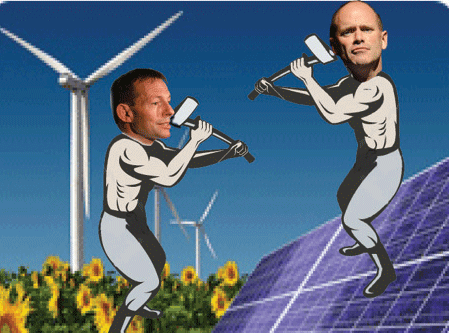 Abbott strangles $20bn green investment – to save 50c/week REneweconomy, By Giles Parkinson 3 June 2013 Two news stories over the weekend give a chilling insight into what might await the Australian renewable energy industry under a Federal Coalition government.
The first story was mostly symbolic in nature. The Newcastle Herald reported that the only wind turbine in Newcastle, the 600kW Kooragang turbine that was constructed in 1997 to “promote the emerging green energy market” is to be removed by Ausgrid – to make way for a new coal loader.
It is just a single turbine but, amazingly, apart from a small demonstration turbine at the CSIRO energy centre nearby, it is the only one in NSW north of Sydney. In fact, going north, you need to travel 2,000kms to the Atherton Tablelands before coming across another commercial wind turbine, 20 small towers amounting to 12MW at Windy Hill in the Atherton Tablelands. There are two other small turbines on Thursday Island, at the tip of the country and that is it – just 12.45MW of wind energy north of Sydney, out of a total of 2,500MW across the country.
How many other turbines are built in NSW will likely be influenced by key decisions being made by NSW Cabinet as early as today about rules governing wind farm developments and the state’s renewable energy plans. That, of course, and the fate of the large-scale renewable energy target – a federal decision.
The second story was not just one, but a barrage of media placements from Queensland Premier Campbell Newman and others seeking to lay the blame for the state’s stunning 22.5 per cent average rise in electricity costs in 2013/14 on green energy schemes, glossing over the fact that the overwhelming majority of the bill increases come because the cost of the billions of dollars of network upgrades is being borne by the consumer.
These are dangerous times for the renewables industry in Australia, particularly those looking to construct some $20 billion of utility-scale installations – be they wind or solar. Newman threw in large-scale renewables as part of the cause of rising prices, but the analysis by the Queensland Competition Authority shows that only 3.5 per cent of the average customer bill of $1451 a year will go to support the renewable energy target, including the small and large-scale schemes. That’s less than $1 a week for the average household.
Indeed, as this table below shows, the cost of the RET actually fell $6 in 2013/14, while network costs will rise $127 and the retailer’s margin (including the headroom they receive so they can offer “discounts” to certain customers) will rise $60.
Further analysis of the QCA data shows that the cost of the large-scale component is even less – amounting to $17 a year out of a $1451 bill for the “median household” (just 30c a week), or $25 (or 50c/week) for a typical four-person household with a total bill of $2005.
But in the popular debate around power prices, facts don’t count for much.
Australia’s largest utility Origin Energy has virtually declared war on renewables, arguing again on Friday that they are becoming a costly burden on households. It’s an argument that the state governments such as Newman’s have been keen to embrace.
For the record, the Climate Change Authority, in its review completed late last year, said the large-scale renewable energy target would add between $12 and $64 to the average household’s annual bill. The upper range assumed there was no impact on wholesale prices from the “merit order” effect, where prices on the energy market are forced down by the presence of more wind power. It said even slashing the RET target from 41,000GWh to 26,400GWh would only save around $17 a year from consumer bills, but would cause huge damage to the renewables industry.
But for now, it’s the ambivalence of the Abbott government on its clean energy policies that is effectively strangling the industry.
It’s bitterly ironic because Australia last week was rated as the fourth most attractive destination for renewable energy investment in the world by Ernst & Young. But that was based on the policies that are currently in force – such as the renewable energy target, and the presence of the Clean Energy Finance Corp and the Australian Renewable Energy Agency.
But the large-scale renewable energy industry is stalled at the gate – not because of these current policies – but because the industry and those that would finance it are making judgments about what will become policy once the Abbott team wins the September 14 poll. Abbott has yet to be elected, but his policies already hold sway, and have done so for months…….
The other great hope for the renewables industry is the Clean Energy Finance Corp, which is designed to encourage and accelerate the construction of newer technologies such as large-scale solar which have yet to be deployed in Australia.
But the Coalition is opposing that too, vowing to dismantle it and trying to force it stop making loans before the care-taker period, despite enormous attempts by the CEFC to explain that it is actually self-funding and working on a commercial basis.….. http://reneweconomy.com.au/2013/abbott-strangles-20bn-green-investment-to-save-50cweek-28651
No comments yet.
1 This month
7 April – WEBINAR – Australia and the Doomsday Clock – Preventing nuclear war through NoFirstUse and other policies
Online | Tuesday April 7, 4:00-5:30pm, Australian Eastern Time / 8:00-9:30am Central Europe Time
– Access the registration link
15 April – Zoom –Nuclear Power is Not the Solution
Apr 15, 2026 01:00 AM in Canberra, Melbourne, Sydney

Join the International Physicians for the Prevention of Nuclear War (IPPNW) on Tuesday, April 14th for a timely webinar exploring the risks associated with nuclear power and challenging the myth that it offers a simple, safe, carbon-free solution to the climate crisis

of the week – Australians for War Powers Reform (AWPR)
To see nuclear-related stories in greater depth and intensity
 Antinuclear
Leave a comment