Northern Territory nuclear waste dump – photographic exhibition on view in London
 NT radioactive waste dump plan under the lens in London, 8 June 13
See this video – Australia’s Atomic Confessions;
 Australia’s Atomic Confessions; Nuclear Bomb Testing Fallout Consequences To Aborigines And Downwinders
http://agreenroad.blogspot.com.au/2013/06/australias-atomic-confessions-nuclear.html AUSTRALIAN ATOMIC CONFESSIONS
Lambs on the alter of British science Australian Atomic Confessions is a story about the people of the land and the servicemen who served their country. 50 years after 12 atomic bomb tests, our nuclear history continues…
Australian Atomic Confessions Uranium mines, nuclear reactors and a nuclear waste dump. …
How far does it go? Australian Atomic Confessions, a 50 min. documentary Kathy Aigner &G.K. Young Music by Bart Willoughby, Frank Yamma and Louis Burdett
Greens’ Alex Bhathal likely to take over federal seat of pro nuclear Martin Ferguson
Alex Bhathal has worked tirelessly for 4 years on issues concerning her local electorate of Batman. Not that Bhathal is forgetting national and global concerns, either. The electorate of Batman deserves a highly intelligent and committed representative to represent this community, while furthering issues of benefit to the nation.
 This could be a big change from having Martin Ferguson a celebrity-star puppet of the nuclear and fossil fuel industries as Member of Parliament for Batman

Greens set sights on Batman http://www.theage.com.au/opinion/political-news/greens-set-sights-on-batman-20130607-2nuso.html June 7, 2013 Aisha Dow It’s meant to be the safest Labor seat in the nation.
But as the party bickers over preselection for the Melbourne electorate, the Greens have declared “Batman’s next” and pronounced themselves a genuine chance to snatch a surprise outright victory.
In her fourth time running as the Greens’ candidate for Batman, Alex Bhathal said she has been flooded with community donations.”I’ve had aged pensioners donating, people in public housing giving me five dollars, it’s just extraordinary people’s belief in the Greens and what we stand for,” Ms Bhathal said.
Instead he said the battle for Batman will be a two-horse race between the Greens and a Labor party he said no longer represented the progressive views of the electorate.
In the last federal election Ms Bhathal, a Preston social worker, achieved a swing of 6.3 per cent, pinching most of those votes off retiring former Labor frontbencher Martin Ferguson. She’ll need an even bigger swing, of about 8 per cent, if she is to turf out Labor in September.But on Ms Bhathal’s past form, which has seen the Green’s primary vote rise by almost 20 per cent within a decade, Bob Brown challenged the perception Batman was in fact as “safe” as it has been touted.
“It’s been seen as the safest because the Liberal vote is so small. The Greens vote is growing rapidly and the bean counters tend to look at the two big parties and don’t see the Greens coming,” he said. “It’s happened in Cunningham, we won the first seat in the lower house and it’s happened in Melbourne. “Batman is next.”
Best to vote Green – global warming concerns Liberals Malcolm Fraser and John Hewson
 Former Liberal PM Malcolm Fraser reckons you should vote Green in September! The Australian Greens 8 June 13 Former PM Malcolm Fraser just asked his twitter followers to vote Green, after a discussion on global warming & funding schools through the Gonski reforms.
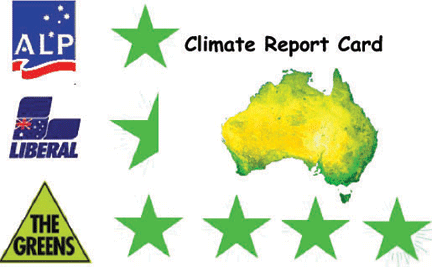
On Lateline last night, former Liberal leader John Hewson called on Australia’s $80+ billion Future Fund to cut global warming risk in their portfolio – just after Christine Milne launched our plan for the Fund to leave coal companies behind.
Two Coalition leaders in 24 hours. Do you think Mr Abbott might get onboard with tackling global warming and funding public schools too?
No? Better vote Green on September 14, then.
Cairns Evolve Energy has evolved a renewable energy + jobs plan for Far North Queensland
 The Tropical North Queensland Renewable Energy Industry Development Plan developed strategies to see 2500 people employed in the industry by 2020.
 Cairns energy costs could be lowered the natural way, Cairns, Caitlin Guilfoyle , June 8, 2013 SUGAR cane, wind and sunshine – it sounds more like a weekend away but experts reckons these natural resources could pull the Far North out of an electricity crisis…… experts say theFar North should take advantage of the region’s natural surrounds to harness renewable energy and ultimately cut back on spending.
Cairns’ Evolve Energy prepared the Tropical North Queensland Renewable Energy Industry Development Plan for the State Government last year, which detailed strategies to ramp up renewable energy use in the region. Continue reading
World awaits WHO report on Iraqi birth defects
 What’s delaying the WHO report on Iraqi birth defects? http://www.aljazeera.com/indepth/opinion/2013/06/201365101540408281.html A 2012 World Health Organization study on congenital birth defects in Iraq has still not been released to the public. 06 Jun 2013 Mozhgan Savabieasfahani Dr Mozhgan Savabieasfahani, a native of Iran, is an environmental toxicologist based in Michigan. She is the author of over two dozen peer reviewed articles and the book, Pollution and Reproductive Damage (DVM 2009).
Iraq is poisoned. Thirty-five million Iraqis wake up every morning to a living nightmare of childhood cancers, adult cancers and birth defects. Familial cancers, cluster cancers and multiple cancers in the same individual have become frequent in Iraq.
Sterility, repeated miscarriages, stillbirths and severe birth defects – some never described in any medical books – are all around, in increasing numbers. Trapped in this hellish nightmare, millions of Iraqis struggle to survive, and they and they call for help.
At long last, public pressure and media attention to this public health catastrophe prompted a joint study by the World Health Organization (WHO) and the Iraqi Ministry of Health to determine the prevalence of birth defects in Iraq. This study began in May-June 2012 and was completed in early October 2012. Continue reading
Economic realities kill a fourth USA nuclear power plant
California nuclear plant to shut: a case of unforgiving nuclear economics, Christian Science Monitor, Peter Spotts, 7 June 13 Southern California Edison is shutting the remaining two reactors at San Onofre, citing high repair costs and an NRC ruling that the utility says would delay reactor restarts.
The San Onofre Nuclear Generating Station (SONGS), a nuclear power plant set into the seaside bluffs in northern San Diego County, is closing after the high cost of repairs and a Nuclear Regulatory Commission board ruling prompted its owner, Southern California Edison, to pull the plug on the 45-year-old facility.The announcement Friday that San Onofre’s two functioning reactors were being shut down brings to four the number of reactors that nuclear utilities have slated for closure since last November. Meanwhile, nuclear utilities have three new reactors on the drawing boards.

At least for now, “we’re losing them faster than we’re building them,” quips David Lochbaum, a nuclear engineer by training who focuses on nuclear-energy issues at the Union of Concerned Scientists in Washington…..
n early May, the utility Dominion shuttered its single-reactor Kewaunee nuclear plant in Carleton, Wis., a casualty of cheaper sources of electricity and an inability to build additional reactors to take advantage of what the company called economies of scale.
“Nuclear economics is tenuous at best,” Mr. Lochbaum says. “If you do everything right, you can make money at this. But if you stumble, there’s a big price to pay, and not just from a Fukushima-type tragedy.”
Financial setbacks can take their toll as well, he says, whether a setback comes from lost business or from hardware failures or human error that sets the stage for costly repairs……..
What looked to the utility to be a sensible $780 million investment in 2009 and ’10 to extend the lifetime of the two reactors turned into an economic albatross, Lochbaum suggests. Continue reading
California moves to nuclear free economy
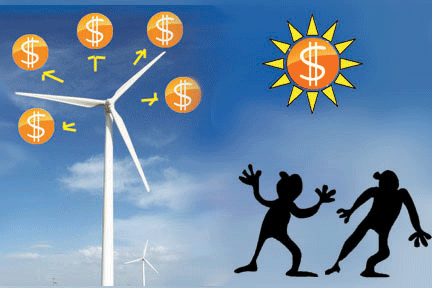 “we will see California move even more decisively” on renewable energy and become “one of the largest non-nuclear economies on our planet .”
That’s a big step in the vision of a nuclear power-free world using energy that people can live with—safe, clean renewable energy.
The End of the San Onofre Nuclear Plant — An Advance for Safe, Clean, Renewable Energy Technologies http://karlgrossman.blogspot.com.au/2013/06/the-end-of-san-onofre-nuclear-plant.html 7 June 13 Southern California Edison’s announcement this week that it will close its troubled twin-reactor San Onofre nuclear power plant—along with other recent setbacks for atomic energy in the United States—marks a downward spiral for nuclear power.
THe health toll of uranium mining on America’s indigenous people
A few decades after uranium mining began in the Navajo Nation, increased numbers of cancer cases, lung cancer in particular, began to show up in the miners. A 2008 literature review in New Mexico found that the “Risk of lung cancer among male Navajo uranium miners was 28 times higher than in Navajo men who never mined, and two-thirds of all new lung cancer cases in Navajo men between 1969 and 1993 was attributable to a single exposure — underground uranium mining. Through 1990, death rates among Navajo uranium miners were 3.3 times greater than the U.S. average for lung cancer and 2.5 times greater for pneumoconioses and silicosis.”
 America’s “Secret Fukushima”: Uranium Mining is Poisoning the Bread Basket of the World By Margaret Flowers and Kevin Zeese Global Research, June 07, 2013 Truthout
“……..Thousands of open uranium mines excavated beginning in the 1950s continues to release radiation today. There have been inadequate measurements but the limited measures done show ongoing leaks larger than Fukushima. How did we get here?
It is estimated that 60 to 80 percent of uranium in the US is located on tribal land, particularly in the lands of the Navajo and Great Sioux Nations. After WWII, the United States Atomic Energy Commission (AEC) was created so that the US could obtain uranium for weapons production domestically. The AEC guaranteed that it would purchase all uranium that was mined. A uranium boom ensued. Private corporations jumped in and, in areas of South Dakota, individuals started mining for uranium on their private lands unaware of the dangers.
Private corporations set up thousands of underground and open pit uranium mines on tribal lands and hired local native Indians at low wages. Other than jobs, the uranium mines brought little benefit to these nations because the lands were given to non-Indian companies such as Kerr-McGee, Atlantic Richfield, Exxon and Mobil. Native Indians had little control over what took place. Continue reading
1 This month

of the week – Australians for War Powers Reform (AWPR)
To see nuclear-related stories in greater depth and intensity
 Antinuclear