Climate change will bring floods to Northern Australia and Tasmania
 Scientists predict more major floods in northern Australia, Tasmania http://www.theage.com.au/environment/climate-change/scientists-predict-more-major-floods-in-northern-australia-tasmania-20130609-2ny8i.html#ixzz2Vr2IPs2u June 10, 2013 Tom Arup Major floods will occur more frequently in many parts of the world, including Australia, as the planet warms due to climate change, exposing millions more people to the threat, scientific modelling has found.
The projections by University of Tokyo researchers, using 11 global climate models, found areas most at risk were south-east Asia, most of India, eastern Africa and the northern Andes in South America.
More moderate increases in risk were forecast for northern Australia and Tasmania. But the threat of major floods would decline in northern and eastern Europe, central Asia, central North America and southern South America.
The researchers studied the likely frequency of floods in 29 international river basins, including the Murray-Darling.
The team found that if average global temperatures rise 2 degrees – a level scientists say gives the world a good chance of avoiding the worst impacts of climate change – 27 million people would be exposed to flooding, based on 2005 populations.
Australian public brainwashed into climate scepticism, by Murdoch media?
Sceptics put heat on climate change BY:DAVID UREN, The Australian, June 10, 2013


CLIMATE change sceptics outnumber believers, according to an OECD study that shows how the debate has sharply divided Australians
The study into household attitudes towards the environment shows Australians are more sceptical than any of the other 10 nations examined, with the exception of The Netherlands… (subscribers only) http://www.theaustralian.com.au/national-affairs/climate/sceptics-put-heat-on-climate-change/story-e6frg6xf-1226660995986
VIDEO- US depleted uranium weapons and birth defects in Iraq
Inside Story Americas – Did the US cause Fallujah’s birth defects? http://www.youtube.com/watch?v=V9YQ1GimBDc 1 Aug 2012
New research is under way on the alarming increase in birth defects in the Iraqi city of Fallujah, showing elevated levels of radioactivity in the city and across the country. Iraqi doctors have long reported a spike of cases involving severe birth defects in Fallujah since 2004 which are shocking in their severity. So is the US being honest about the weapons it used in the 2004 battle for the city, and in its other theatres of war? Guests: Ross Caputi, Dai Williams, Raed Jarrar.
Regional Australia’s Renewables (IRAR) programs- will halve remote area’s electricity costs
 In fact, the cost of diesel generation – sometimes more than $400/MWh – is probably closer to four times the cost of wind energy than two times, and is well above the cost of solar PV. Many developers of solar plants – be it solar PV or new technologies such as solar thermal or graphite blocks – are targeting remote regions because of the high costs of diesel,
ARENA targets 150MW in remote renewables program http://reneweconomy.com.au/2013/arena- targets-150mw-in-remote-renewables-program-38423 By Giles Parkinson 7 June 2013
Citizen action was the key to closing USA’s San Onofre nuclear power plant
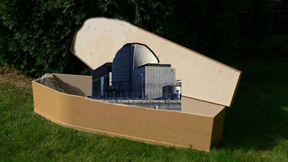 San Onofre is Dead & So is Nuclear Power, Nukefree.org, Harvey Wasserman, 7 June 13 From his California beach house at San Clemente, Richard Nixon once watched three reactors rise at nearby San Onofre. As of June 7, 2013, all three are permanently shut.
It’s a monumental victory for grassroots activism. it marks an epic transition in how we get our energy…… In the early 2000s, Units 2 & 3 needed new steam generators of their own. In the usual grasp for more profits, Edison chose untested, unlicensed new designs.
But they failed. And the whole world was watching. In the wake of Fukushima, two more leaky tsunami-zone reactors surrounded by earthquake faults were massively unwelcome.
So a well-organized non-violent core of local, state and national activists and organizations rose up to stop the madness.
At Vermont Yankee, Indian Point, Seabrook, Davis-Besse and dozens of other reactors around the US and world, parallel opposition is escalating.
Make no mistake—this double victory at San Onofre is a falling domino. Had the public not fought back, those reactors would have been “fixed” at public expense.
Today, they are dead…… we have yet another proof that citizen action makes all the difference in our world…… http://www.nukefree.org/editorsblog/san-onofre-dead-so-nuclear-power
Nuclear power project in India stalled by protesting villagers
 Residents oppose nuclear plant at Kovvada http://www.thehindu.com/news/national/andhra-pradesh/residents-oppose-nuclear-plant-at-kovvada/article4797223.ece 9 June 13, Officials unable to continue land acquisition for the project
Officials of Nuclear Power Corporation of India Limited and the State government are unable to continue the land acquisition process in Kovvada and surrounding villages of Ranasthalam mandal, Srikakulam district, following strong resistance from locals against the construction of the nuclear power plant. Continue reading
Financial benefits of solar power leading South Australians to make the switch
 Households in South Australia are increasingly turning to solar power to alleviate or even obliterate energy bill woes. National solar energy provider Energy Matters estimates a good quality solar power system installed in Adelaide can return a financial benefit of between $1,502 – $1,711 annually.
South Australian Electricity Prices Biting Hard http://www.energymatters.com.au/index.php?main_page=news_article&article_id=3784, 10 June 13 The last 6 months of 2012 saw a substantial increase in the number of SA households turning to electricity instalment plans and joining electricity retailer hardship programs says the Essential Services Commission of South Australia. Continue reading
51% renewable energy in Australia by 2050 – coal power on the way out
Australia moves from coal to renewables 51pct by 2050 http://www.coalguru.com/australia/australia_moves_from_coal_to_renewables_51pct_by_2050/10298 Australia, one of the most coal dependent energy economies in the world, is on track to produce 51% of all its energy by the year 2050. This would make the Land Down Under one of the greenest economies of all when it comes to energy production. Continue reading
1 This month

of the week – Australians for War Powers Reform (AWPR)
To see nuclear-related stories in greater depth and intensity
 Antinuclear