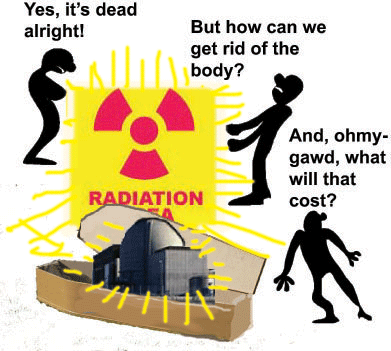
San Onofre nuclear plant – 9 years to build- 50 years (and $billions) to demolish
 A long cooling-off period for San Onofre nuclear plant http://articles.latimes.com/2013/jun/08/local/la-me-san-onofre-nuclear-20130609 Tearing down San Onofre’s two nuclear reactors will be a technically complex job completed over decades. It’s likely Southern California Edison will first mothball the plant.|By Ralph Vartabedian, Los Angeles Times
Southern California Edison built San Onofre’s two nuclear reactors in about nine years, but tearing them down will be a technically complex, multibillion-dollar job completed over decades. It is likely that Edison first will mothball the plant, which under federal rules could keep its imposing imprint on the Orange-San Diego County coastline for another half-century.
When the plant does come down, it will be a massive job.
Tons of highly radioactive fuel now stored in pools will have to cool before the rods can be moved to concrete pads outdoors. Giant pipes that extend more than a mile into the ocean will have to come out. Pieces of the reactors will have to be cut with special saws and torches that reach 20 feet into the vessels’ cooling water.
“They do very highly engineered cuts and stack the pieces like Pringle potato chips,” said John Christian, a division president at EnergySolutions, which is decommissioning a nuclear plant in Illinois that also has two large reactors similar to San Onofre’s.
Three-foot-thick walls of steel-reinforced concrete at San Onofre will have to be fractured by mechanical shears and carefully hauled out. Wrecking balls and dynamite are seldom, if ever, used in decommissioning nuclear plants.
Debris then would be sent on special rail cars to dumps that can accommodate low-level radioactive waste. Right now, the only two such sites in the U.S. are in Utah and Texas.
An estimated 3 million pounds of spent fuel at San Onofre is so radioactive that no repository exists that can handle it, meaning it will have to remain in concrete casks on the coast for decades, if not indefinitely.
“It is a difficult job but not impossible,” said Kevin Crowley, director of the nuclear and radiation studies board at the National Research Council. “The difficulty is separating the contaminated parts.”
Edison officials said Friday that they would permanently shut down the two reactors after an effort to replace the plant’s steam generators resulted in an outage that has lasted more than a year. The tubes inside the new generators began wearing out more quickly than expected and sprang a small leak of radioactive steam before the plant was shut down last year.
Edison officials have estimated that the ultimate cost of closing San Onofre will be $3 billion.
The company has $2.7 billion in a trust fund, money collected from its customers each time they pay for electricity. Separately, the shutdown could cost the company hundreds of millions in lost profit.
The decision to close the plant may affect nuclear utilities around the country that also must decide whether to make massive investments in old plants. A dual reactor plant in Florida was shut down this year when its steam generator replacement went awry.
No comments yet.
1 This month

of the week – Australians for War Powers Reform (AWPR)
To see nuclear-related stories in greater depth and intensity
 Antinuclear
Leave a comment