Tony Abbott is a danger to clean energy in Australia

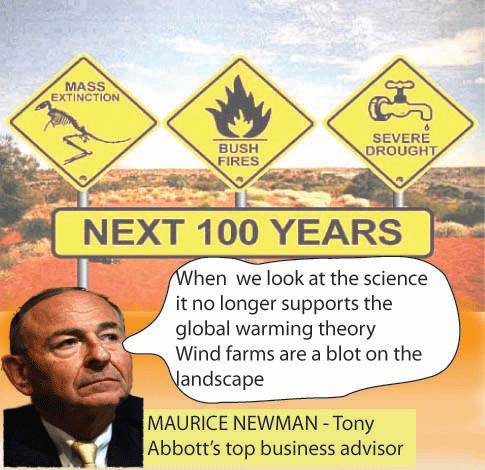
Tony Abbott’s proposed main business adviser just revealed that he thinks efforts to build more clean energy in Australia should be scrapped.
Top Abbott business adviser wants renewables target scrapped Maurice Newman, chairman of Coalition’s proposed business advisory council, doubts scientific case for global warming Lenore Taylor, political editor guardian.co.uk, 13 June 2013 The chairman of Tony Abbott’s proposed business advisory council, Maurice Newman, has called for the renewable energy target (RET) to be scrapped because he believes the scientific evidence for global warming and the economic case for renewable energy no longer stack up…….
Whether the Coalition will change their policy on the RET is up to them … I believe it should be removed because the basis upon which we accepted in good faith that we needed it is no longer there…..
- when we look at the science it no longer supports the global warming theory and when we look at the health and economic effects of windfarms and the obscene wealth transfer from poor to rich we have to ask: why are we persisting with them? I think it is a crime against the people.”….
Guardian Australia contacted Newman after seeing minutes of a meeting of an anti-windfarm group called the Crookwell District Landscape Guardians at his southern highlands property on 28 April.Newman appeared to warn the 56 attendees they might not sway the Coalition……
other anti-windfarm activists are preparing for a 18 June rally at Parliament House, effectively trying to use the same “people’s revolt” strategy encouraged by Abbott against the carbon tax to try to push the Coalition leader to drop the RET and stop new windfarms.
A slick, anonymously-run website called Stop These Things (STT) urged readers to attend the June rally because “while it’s safe to assume the Coalition will cruise to victory in September, don’t assume they are on our side”. It added: “It’s time to put them in the spotlight and find out precisely where they stand … the main game is in Canberra where the RET policy was started and where it has to end. The Coalition need to get the message loud and clear – and the message is simple. Australia simply can’t afford the great wind power fraud…… Continue reading
REneweconomy exposes the lies of the anti wind farm lobby
 How wrong can a press release for an anti-wind rally be? REeweconomy By Mike Barnard 12 June 2013 It’s time for another installment of Count the Whoppers. You may remember that we started this occasional feature a year ago with Max Rheese of the mischievously-named Australian Environment Foundation and Australian Climate Science Coalition, funded by the IPA and Heartland Institute respectively, and his fourteen whoppers in less than 1,700 words. We continued it in November with Senator John Madigan’s party policy on wind energy (subsequently removed), where he managed only 10 whoppers, but did it in a quarter of the words, 364.
This time the target in our sights is the anonymously written blog stopthesethings.com (STT).  This site is setting new lows in the anti-windpower astroturfing arena, featuring new posts daily attacking all aspects of wind energy and the people associated with it with imaginary data and unpleasant prose. The author has been anonymously vilifying members of the wind industry, researchers into wind energy and proponents of wind energy for nearly six months.
It’s become the go-to echo chamber for Australian anti-wind power activists, and attracts regular comments from the few but impressively vocal anti-wind activists in Canada, the USA and the UK. Unsurprisingly, the Internet quality rating service Web of Trust gives STT very poor marks indeed.
STT is trying to mobilise their small but angry readership to rally at Parliament House in Canberra on 18 June and has issued an anonymous media release to publicise it. They’ve lined up a remarkable number of current and retiring politicians who don’t seem to be fazed by the vitriol, lack of facts or the anonymity of the organisers. These include: Senator John Madigan, retiring MP Alby Schultz, retiring Senator Ron Boswell (all of whom are challenged by climate science) and, oddly, Senator Nick Xenophon who used to hold a rather more fact-based view of wind energy. They also have a handful of others, including a barrister and a fact-challenged radio ‘personality’ to round out the slate.
Unsurprisingly, given their website’s quick-and-dirty approach and the track record of anti-wind campaigners on this front, the presser is chock full of whoppers. For those interested in reading the full statement, please see the complete text at the end of this article.
Wind Reality 1: Wind energy is saving Australian consumers money….. Continue reading
A new community windfarm- breakthrough in Victoria
 “We wanted to spread financial benefits beyond the landowners, and we’ve done that through share ownership scheme,”
Vic wind farm breakthrough, with pioneering share structure, REneweconomy, By Giles Parkinson 12 June 2013 A small 5-turbine wind farm project with an innovative share ownership model has become the first wind energy project in the state of Victoria to receive council approval in recent years.
The application for the Coonooer Bridge wind farm – with 5 turbines of up to 150m tall to be built near the locality of  the same name north-west of Bendigo – was approved by the Buloke Shire Council on Wednesday night.
It is a notable project for several reasons. It is the first wind farm proposal to gain approval from a council in the state since former Premier Ted Baillieu introduced restrictive planning policies in 2011. And the project –located between the towns of Charlton and St Arnaud, about 90 km northwest of Bendigo – is also the first in Australia to find a way to combine corporate and community ownership, and the first renewable energy project in the country with an ownership structure that includes the local farming community in this way.
In all, 30 owners of property sited within 3kms of the planned wind farm have been offered shares, including one family with turbines on their land. All have taken up the offer, despite the concerns about wind energy of some. Windlab, a spin-off from the CSIRO which has developed an expertise in identifying strong wind resource areas, retains the majority stake. Continue reading
Labor and Liberal in happy agreement pro uranium mining
 States sign agreement on uranium ABC News, Jun 12, 2013 The New South Wales and South Australian governments have signed an agreement to encourage mining and exploration along the border of the two states.
The memorandum of understanding was signed at a uranium mining conference in Darwin yesterday.
Uranium exploration has only recently been allowed in NSW, while it is already being mined at Honeymoon and Beverley over the border…… “They want to see politicians whether they’re Liberal, Labor or National all working together and we are.”
Mr Hartcher says the agreement does not open the door to uranium mining in NSW….. http://www.abc.net.au/news/2013-06-12/states-sign-agreement-on-uranium/4748452
Rio Tinto’s Rossing uranium mine staring its terminal illness in the face
 Rössing Uranium fights on for survival INFORMANTE BY FLORIS STEENKAMP 12 JUNE 2013 Rio Tinto Rössing Uranium incurred an operational loss of N$474 million in 2012, some N$10 million more than the losses the mine made in 2011. Despite this, the mine will continue to battle on and bolster cost savings and operational efficiency to ensure its long term survival.
This was the message of the outgoing managing director of Rio Tinto Rössing, Chris Salisbury, on 6 June Swakopmund.
Uranium mines globally continues to operate in adverse economic conditions…… Since Japan and many other nations started to shy away from nuclear power generation as the future of clean energy, uranium market prices plummeted by more than 36%.
Uranium mines globally continues to operate in adverse economic conditions…… Since Japan and many other nations started to shy away from nuclear power generation as the future of clean energy, uranium market prices plummeted by more than 36%.
At the Rössing mine not even a production output increase of 36% and drastic cost-saving measures could avert the 2012 losses, as this market dip was too severe….. Salisbury confirmed that he will be assuming another position in the Rio Tinto Group in Australia and said a successor would be sourced within months.http://www.informante.web.na/index.php?option=com_content&view=article&id=12165:roessing-uranium-fights-on-for-survival&catid=1:coastal&Itemid=103
| I |
Fukushima clean-up delay because true conditions of melted nuclear cores is unknown
 Asahi: Locations and condition of melted Fukushima fuel unknown — Mainichi: 450 tons of scattered radioactive rods… unknown where holes in reactors are… plans may be delayed http://enenews.com/asahi-locations-and-condition-of-melted-fukushima-fuel-rods-unknown-mainichi-450-tons-of-scattered-radioactive-material-unknown-where-holes-in-reactors-are-plans-may-be-delayed-further
Asahi Shimbun, June 11, 2013: The workers have yet to gain a grasp of the locations and condition of the fuel debris. They have yet to develop extraction equipment and determine removal methods.
Mainichi,, June 11, 2013: Uncertainty over the location of melted fuel inside the crisis-hit Fukushima No. 1 Nuclear Power Plant continues to cast a shadow over plans to remove the fuel at an early date […] Reactor Nos. 1-3 at the plant contained a total of 1,496 rods of nuclear fuel in their cores. […] Each fuel rod weighs about 300 kilograms, and a high level of technical expertise would be required when undertaking a remote control operation to cut up and retrieve clumps of scattered radioactive materials weighing a combined 450 tons or thereabouts. […] the cores of reactors at the Fukushima plant have holes, and the task at hand is finding which parts have been damaged […] In a news conference on June 10, a representative of the Ministry of Economy, Trade and Industry’s Agency for Natural Resources and Energy said that bringing forward the plans would be dependent on developing technology, and suggested that the plans might even end up being delayed. […]
See also: State of melted fuel at Fukushima plant unknown — Worker: “We opened the Pandora’s box” — Journalist: “We’re headed toward a real crisis”
THE AUSTRALIAN ‘s good article on Fukushima, with a misleading title
 Fukushima nuclear reactor back from the brink BY:RICK WALLACE, TOKYO CORRESPONDENT , THE AUSTRALIAN June 13, 2013 “……..More than 1500 radioactive spent fuel rods sit immersed in water in the open-air pool, which is located about 30m above the ground in what’s left of the reactor No 4 building.
The rods are extremely volatile and, unlike the fuel in the reactors, are not surrounded by any containment structure. If exposed, they can spontaneously combust, creating a tragedy nuclear workers say would put 2011 – the worst nuclear disaster since Chernobyl in 1986 – in the shade.
Asked about other risks and challenges to the recovery process at Fukushima, Mr Takahashi cited removal of the melted nuclear fuel from the reactors and the ongoing build-up of contaminated water. “There are many difficult processes and among all of them the removal of the damaged fuel is the most difficult because no country has experience in doing this,” he said.
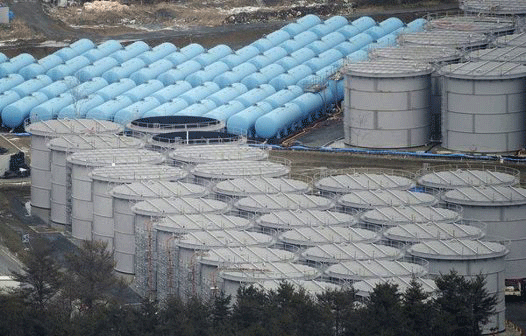
“The other main difficulty is treatment of the water and preventing the inflow of incoming water, and then we need to treat and dispose of the waste from that water.” Fukushima Daiichi is dotted with more than 300 giant tanks to store this water, each one holding some 1000 tonnes. TEPCO says it wants to expand its storage capacity to 700,000 tonnes and is digging underground tanks, too.
The company is also trying to lower the water table around the plant by digging wells to stem the entry of groundwater into the subterranean spaces of the reactors and minimise the outflow of contamination.
Each day, more than 3000 workers travel to Fukushima Daiichi to work, braving high radiation levels. Much of the debris at the plant has been cleared, although crumpled cars and trucks still dot the side that fronts the ocean. Pumps, and pipes that snake throughout the site, are keeping the situation stable for now but it’s readily apparent a huge amount of decontamination work remains before workers can turn to the task of decommissioning the reactors themselves.
Readings during yesterday’s press visit peaked at 1500 microsieverts near the reactor No 3 building. Standing in this spot for about 13 hours would give a person the 20 millisievert dose deemed as the trigger for evactuating civilians on an annual basis…..
The tour follows a series of embarrassing episodes for TEPCO, including a blackout that shut down cooling to the fragile plant for several hours.The company also recently revealed there had been a leak in one of the steel tanks storing radioactive water, and it had found radioactive cesium leaking into the groundwater near the plant. .http://www.theaustralian.com.au/news/world/fukushima-nuclear-reactor-back-from-the-brink/story-e6frg6so-1226662748414
Leichhardt City Council (Sydney) commits to 100% renewable energy by 2025
 NSW council commits to 100% renewable energy by 2025 REneweconomy By Sophie Vorrath 13 June 2013 The council of the inner-west Sydney city of Leichhardt has committed to becoming 100 per cent renewable by 2025, building on its recent draft plan to tackle climate change by reducing emissions in local government facilities.
Leichhardt, which last year became the second council in NSW to achieve carbon neutrality, made the commitment last week – a goal it plans to achieve through direct investment in renewable energy, and without the need to purchase offsets.
Leichhardt is also one of eight Sydney councils – including Marrickville, Ashfield, Canterbury, Kogarah, Rockdale, Bankstown and Canada Bay – working with the Institute for Sustainable Futures to develop a renewable energy master plan for the region.
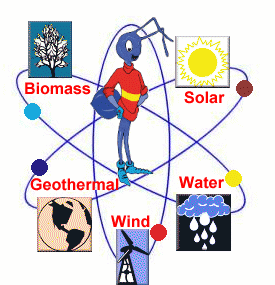
The master plan aims to identify the best ways to replace fossil fuels with renewable energy sources, including solar PV, solar thermal, waste-to-energy, mini hydro, wind power and co/trigeneration. There is also the potential for alignment with the City of Sydney’s renewable energy plan.
As part of its own plan, Leichhardt aims to install a large amount of solar across council facilities, including the Town Hall and Balmain Library. A cogeneration plant is being constructed at Leichhardt Park Aquatic Centre – the Council’s largest consumer of electricity. The plan also proposes retrofitting existing energy sources in facilities to be environmentally friendly.
Development of the city’s renewable energy plan is largely credited to the Greens councillors, who are said to have worked hard to gain the support of their Labor, Independent and Liberal counterparts. http://reneweconomy.com.au/2013/city-of-leichhardt-commits-to-100-renewables-by-2025#sthash.R3CtUtya.dpuf
Renewable energy investment moving fast in developing nations
Renewable Energy Investments Shift to Developing Nations http://www.bloomberg.com/news/2013-06-12/renewable-energy-investments-shift-to-developing-nations.html By Alex Morales – Jun 12, 2013 Renewable energy investments are shifting to developing nations as countries from Morocco to Chile pursue power sources that wean them off fossil fuel imports, two studies promoted by the United Nations said.
China’s $67 billion of investment in wind, solar and other renewable projects led developing nations to $112 billion of spending in 2012, according to an e-mailed statement today from the UN and other groups involved in the studies. That compares with $132 billion of expenditure in the industrialized world.
The gap on renewables spending between richer and developing countries shrank to 18 percent last year from 250 percent in 2007, marking a “dramatic change” in investment patterns, the statement said. Two-thirds of the 138 nations that now have clean-energy targets are in the developing world.
“The uptake of renewable energies continues worldwide as countries, companies and communities seize the linkages between low-carbon green economies and a future of energy access and security,” UN Environment Program Executive Director Achim Steiner said in the statement. “More and more countries are set to take the renewable energy stage,” he said, citing “the logic and the rationale of embracing a green development path.” Continue reading
South Australian wave energy project is progressing
 Port MacDonnell wave energy project ‘on track’ ABD News 12 June 13, Wave energy company Oceanlinx says the construction site of its $7 million Port MacDonnell development is being prepared this week. A 20-square metre offshore concrete unit is expected to be connected
to the power grid by the end of the year and will power 1,000 homes in Port MacDonnell. CEO Ali Baghaei says equipment has started arriving at the site and construction workers have begun setting up.
He says people will soon see the development taking shape….. “We are very much keen to ensure it stays on track and thankfully it has beenon track and I’m very pleased with the progress we have made,” he said. “I must say we have received quite a lot of support from the local communities and I want to thank them all for it.” http://www.abc.net.au/news/2013-06-12/wave-energy-firms-port-macdonnell-project-on-track/4748830
1 This month

of the week – Australians for War Powers Reform (AWPR)
To see nuclear-related stories in greater depth and intensity
 Antinuclear