Property Council of South Australia’s Nathan Paine,Theo Maras, Chris Burns push for importing nuclear waste
 Christina Macpherson, 15 June 13, In 1980, Senator Jean Melzer warned about Australia becoming “the quarry and waste dump of the world” . The Australian Labor Party soon got rid of her. In 2007 Kevin Rudd came into power as Labor appeared to be opposing a nuclear waste dumping industry in Australia.
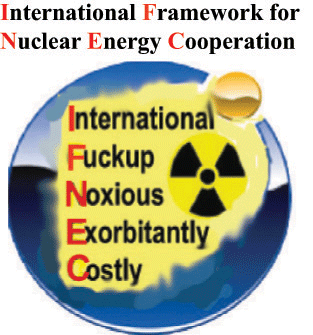
You might think that this nuclear waste importing idea has gone away. But it never did. And Australia has a global agreement that could swing it into action faster than you can swing a cat – the International Framework for Nuclear Energy Cooperation(IFNEC)
You might think that this noxious idea is not getting any support from the Australian public.
If so – you thought wrong.
In South Australia, the Property Council of SA, and several businessmen with more dollars in their eyes, than brains in their heads, are now pushing that same old nuclear barrow.
Here’s how they were reported in Adelaide Now today: “Some also call for the development of a domestic nuclear power sector that Property Council of SA executive director Nathan Paine predicts could turn us into the “Dubai of Asia”….

He said: “You’d almost be able to give every South Australian … when they turn 18, a cheque for $50,000 and a house.”……
, Mr Burns said SA should develop a nuclear sector. He said: “What we’ve got unique resources for in this state are for nuclear energy. We have the resources in the ground; we should be digging it up and processing it. Never sell it, only lease it and bring it back here to bury it. I think that’s the industry for the state.”
SA has 40 per cent of the world’s known uranium reserves. Mr Maras said if the government championed a nuclear industry, business would soon come on board…..
They even want South Australia’s “mums and dads” to invest in developing such ideas in the We’re for Jobs in SA campaign
Australian Financial Review joins the spruikers for Australia as the world’s nuclear waste dump
 Christina Macpherson 15 June 13, Today the Financial Review published a very worthy(?) article entitled “Energy sources to be a diverse mix by 2100” I should have been warned, when I saw it quoting Australian Renewable Energy Agency chairman Greg Bourne sayng that 100 per cent renewable energy power supply is not realistic.
But no – I read on this lengthy article, and then comes the real message – at the end:
 AUSTRALIA COULD BE ‘THE WORLD’S REPOSITORY OF NUCLEAR WASTE’
“In any discussion of Australia’s future energy needs and mix of sources, there is always a very big elephant in the room: nuclear energy. Australia is the Saudi Arabia of uranium, with almost 1.4 million tonnes of known recoverable resources. That is 1.4 times the resources of the number two supplier, Kazakhstan, and 2.6 times the resources of number three, Canada.
But Australia does not use the metal – exporting all it produces – and has no plans to do so. “Nuclear energy is quite simply the purest, cleanest and lowest-emission form of energy there is, and Australia has enormous reserves of that form of energy,” says Professor Stephen Martin,chief executive of the Committee for Economic Development of Australia (CEDA).
“If Australia is serious about mitigating the effects of climate change, then nuclear must be on the table. It has the potential to provide low-cost, clean, baseload energy and will be an important back-up if other renewable or clean energy options do not come to fruition. If we want to improve environmental outcomes, if we want to lower emissions, nuclear energy is a no-brainer,” Martin says…….
From the mini-reactors being developed, which are buried in the ground, to the ‘Generation IV’ reactors, and the potential of small-scale thorium reactors, it’s a pretty exciting outlook for nuclear energy. In fact, through technological changes, Australia could be the world’s repository of nuclear waste – which we could then refine and re-use,” Martin says.
Michael Angwin, chief executive of the Australian Uranium Association, agrees there needs to be a “reconfiguration of the Australian political dynamic” for our uranium to be used domestically for power, but says the case is compelling.
“Nuclear power is one technology that can supply electricity reliably for large population centres, with no emissions. It does this all over the world. If Australia had a nuclear industry we would be very keen to supply it,” Angwin says. http://www.afr.com/p/2100/energy_sources_to_be_diverse_mix_A2laV1flAoEMOCg5XYHneL
Small Modular Nuclear Reactors – USA’s biggest corporate taxpayer ripoff

 Golden Fleece Award Goes to Department of Energy for Federal Spending on Small Modular Reactors http://www.taxpayer.net/library/article/golden-fleece-award-goes-to-department-of-energy-for-federal-spending-on-sm $100 Million in “Mini Nuke” Corporate Welfare Already Doled Out, Another Half Billion Dollars Or More in the Pipeline for Major Corporations that Could Pay for Own R&D, Licensing
WASHINGTON, D.C. — The federal government is in the process of wasting more than half a billion dollars to pay large, profitable companies for what should be their own expenses for research & development (R&D) and licensing related to “small modular reactors” (SMRs), which would be about a third of the size or less of today’s large nuclear reactors. In response, the nonpartisan group Taxpayers for Common Sense today handed out its latest “Golden Fleece Award” to the Department of Energy for the dollars being wasted on SMRs.

Titled “Taxpayer Subsidies for Small Modular Reactors,” a related TCS background report is available online here……
In making the Golden Fleece Award, Taxpayers for Common Sense highlighted the following issues: Continue reading
High radiation contamination in fungus in a Japanese schoolground
 “Chilling Phenomena”: Fungus emitting radiation 70 times higher than nearby asphalt — “A boy sitting on that patch could do real damage to his gonads” http://enenews.com/chilling-
 phenomena-fungus-emitting-radiation-70-times-higher-than-nearby-asphalt-a-boy-sitting-on-that-patch-could-do-real-damage-to-his-gonads Title: Cleanup From Fukushima Daiichi: Technological Disaster Or Crisis In Governance?
Source: Fairewinds Energy Education
Author: Art Keller
Date: June 13, 2013
[…] One of the first demonstrations conducted by [Kevin Wang]’s team was at a Japanese school still in routine use. The contamination was widespread and included troubling accumulations of radiation in biological materials. While the asphalt driveway was contaminated, the grass next to it was four times as radioactive as the asphalt. The worst were the patches of fungus on the bleachers at the school’s baseball field, which had sucked-up radionuclides to such a degree that they were emitting radiation at 70-times the contaminated asphalt.
[Sam Engelhard, an industrial hygenist and certified radiation protection technologist] described the chilling phenomena of the fungus-turned-radiation-sponge as, “a remarkable example of biological amplification.”
Wang said it more bluntly, “A boy sitting on that patch to watch a baseball game could do real damage to his gonads.” […] Full report here
Read Terry Tamminen’s terrific article on the end of the nuclear power era
 Nuclear Power Is So 20th Century http://www.fastcoexist.com/1682328/nuclear-power-is-so-20th-century Terry Tamminen, 14 June 15, Nuclear power seems cheap, but if you count the embedded costs of dealing with the fuel, does it make sense as an option for a clean future? When I was born, in the 1950s, nuclear power was said to be “too cheap to meter.” Although few and far between, disasters at Fukushima and Chernobyl have laid waste to that claim and, for that matter, entire cities. German Chancellor Angela Merkel, herself a nuclear physicist, led the charge to eliminate her nation’s nuclear power plants in the next few years based on a rational risk analysis. With the decision by Southern California Edison to decommission its San Onofre Nuclear Generating Station (SONGS), we may now see enough data points to reasonably conclude that the nuclear power era is coming to a close. Continue reading
Rally for renewable energy in Canberra on Tuesday 18 June
 http://www.getup.org.au/campaigns/climate-action-now/rally-for-renewables/ Join us in Canberra on Tuesday and show your support for renewable energy. Tuesday 18 June 12 noon Garema Place Canberra
Tony Abbott has made an election promise to scrap the price on carbon, and now, Coalition MPs are trying to kick off a scare campaign about wind power to erode community support for renewable energy. They’re hosting a different event at Parliament next week, with speakers like Alan Jones, to call on Australians to scrap the Renewable Energy Target and halt development of wind power.
Right now, renewable energy has overwhelming community support, even among Coalition voters.Can you join us in person this Tuesday to show your suport for a renewable energy future?
Renewable energy is the best opportunity we have to reduce carbon emissions and do our bit to limit global warming to 2 degrees. We can’t let community support for renewable energy be undermined by lies and spurious claims. By coming together in our nation’s capital, we can counter fear-mongering with hope, look to the future, not the past, and show the way to a clean energy future.
Organised in association with our friends at Yes 2 Renewables, Friends of the Earth Australia.
The Solar Scorecard gives you the renewable energy position of your local Member of Parliament
 http://www.solarscorecard.org.au/ The Solar Scorecard lets you find out where your local politicians stand on renewable energy. Use it to help make sure that no matter who wins the election on September 14th, renewable energy wins as well.
ABOUT THE SOLAR SCORECARD Solar energy is on the agenda this election year. With one and a half million Solar Homes across the country Australians are turning to the sun. We’ve developed the Solar Score Card so you can see where your MP stands and  how they compare on key solar criteria.
The Solar Score Card has been put together by 100% Renewable, an Australian community campaign for a sustainable future. The scorecard is designed as a tool for those on the ground. That means you! You can compare MPs across parties and electorates to see who’s looking forward and who’s looking back. Even better you’ll be able take the Scorcard to your MP and show them what they’re getting right and what they’re getting wrong.
Each MP has a profile complete with scores on 7 key criteria and one wildcard. The wildcard is their chance to shine, or not. If you know of something wonderful or disastrous your MP has done for solar in Australia leave a comment and let us know!
Nukenomics? Can the nuclear industry stand on its own?
“SMRs are just the next chapter in a nuclear industry that can’t stand up on its own,” said Don Hancock, director for nuclear waste safety at the Southwest Research and Information Center, “so it always has to be funded by the government.”
Even if some risks are reduced, “pocket nukes” would still be more dangerous than wind, solar and other renewable energy, according to UCS. They’re also much more vulnerable to use by terrorists.
“The few projects now going forward in Europe,” “notably in Finland and France, suggest that the industry’s cost estimates are wildly unrealistic.”
 Nuclear Power, Part 2: Nukenomics By Ned Madden, 14 June 13 TechNewsWorld Can the nuclear industry stand on its own two feet financially?….. Even giant corporations in the nuclear energy industry are cautious about the fiscal viability of the nuke space. Construction cost estimates for new nuclear power plants are highly uncertain.
Risky Business However, construction costs are just the beginning. Billions of dollars are spent in operating performance, fuel price, waste disposal and other factors.
Analysis of the economics of nuclear power must take into account who bears the risks of future uncertainties. To date, all operating nuclear power plants worldwide have been subsidized by governments and developed by state-owned or regulated utility monopolies.
Most of the risks associated with nuclear power plants have been borne by taxpayers and ratepayers rather than suppliers….. Insurance protection is another enormous factor. In accordance with the Price-Anderson Nuclear Industries Indemnity Act of 1957, nuclear power in the U.S. has been granted indemnity from the burden of carrying full third-party insurance liabilities…. In fact, Price-Anderson significantly shifts accident and security risks from industry to taxpayers by limiting the primary insurance a nuclear plant owner is required to carry to $375 million, the UCS charges……. Continue reading
ABC TV to screen David Bradbury’s film about Paul Cox, and later a film on Vietnam War
Bradbury has also been busy travelling and filming in recent years, visiting India and Iraq to explore the dangers associated with those countries’ nuclear industries and the effects on the health of civilians there of exported Australian uranium.
“Depleted uranium is the new agent orange of the 21st century,” Bradbury explains, after describing his experiences filming deformed babies in a hospital in Iraq.
 Bradbury turns the camera on filmmaker with cancer, http://www.northernstar.com.au/news/black-comedy-latest-offering/1908586/ Jamie Brown 15th Jun 2013 MULLUMBIMBY documentary filmmaker David Bradbury’s latest offering for television departs from his usual interest in war and the threat of uranium to focus on something closer to the heart of humanity.
ABC 1 will screen On Borrowed Time, Sunday at 9.45pm.
The film is a gentle portrait of filmmaker Paul Cox as he faces his own mortality as a result of liver cancer.
Cox is arguably one of the most important filmmakers to come out of this country, and certainly one of the most prolific, having created 18 feature films, 14 shorts, 11 documentaries and four made-for television productions. Man of Flowers (1983), My First Wife (1984), Exile (1994), Innocence (2000) and Human Touch (2004) are among his list of art-house films. Although the film screens on television for the first time tomorrow, Bradbury finished filming two-and-a-half years ago and has since produced a black comedy, When the Dust Settles, for the Electrical Trades Union.
Shot in the Mullumbimby home of local comedian Mandy Nolan, who plays a leading role alongside fellow comedian Austen Tayshus, the film seeks to promote the dangers of working in Australia’s uranium mining industry.
Funded by the ETU for its members, Bradbury’s creation is a lot closer to his heart, with much of his life’s work focusing on the dangers of radiation.
That interest was piqued in 1981 when he travelled to Hiroshima with war correspondent Wilfred Burchett.
In the making of that film, Public Enemy Number One, Burchett relived the atrocities he witnessed as the first Westerner to travel to the bomb-struck city that closed the war in the Pacific and heralded the birth of a new menace.
Bradbury has also been busy travelling and filming in recent years, visiting India and Iraq to explore the dangers associated with those countries’ nuclear industries and the effects on the health of civilians there of exported Australian uranium.
“Depleted uranium is the new agent orange of the 21st century,” Bradbury explains, after describing his experiences filming deformed babies in a hospital in Iraq.
Bradbury’s next project, recently funded by the ABC, will feature a re-enactment of the biggest battle of the Vietnam War – the battle of Coral and Balmoral that persisted for three weeks. http://www.northernstar.com.au/news/black-comedy-latest-offering/1908586/
1 This month
15 April – Zoom –Nuclear Power is Not the Solution
Apr 15, 2026 01:00 AM in Canberra, Melbourne, Sydney

Join the International Physicians for the Prevention of Nuclear War (IPPNW) on Tuesday, April 14th for a timely webinar exploring the risks associated with nuclear power and challenging the myth that it offers a simple, safe, carbon-free solution to the climate crisis

of the week – Australians for War Powers Reform (AWPR)
To see nuclear-related stories in greater depth and intensity
 Antinuclear