Danger in Australia selling uranium to undemocratic Middle Eastern regime
Australia’s plan to sell uranium to the UAE is ill-considered. It essentially requires us to turn a blind eye to the UAE’s poor democratic form and strikes a blow to the goal of a nuclear-free Middle East. It also fails to apply adequate scrutiny and attention to Australia’s corner cutting uranium trade – an industry described by a Senate report as needing urgent changes in order to protect the environment and people from ‘serious or irreversible damage’
 Why Australia shouldn’t sell uranium to the UAE Online opinion, By Dave Sweeney , 17 June 2013 For most Australians nuclear issues are the concern of other nations, largely because we don’t, and are most unlikely to ever have, domestic nuclear reactors. But as home to one third of the world’s uranium Australia is a significant player in the global nuclear game and we are playing an increasingly irresponsible hand.
Today in Canberra representatives from the Australian Conservation Foundation, Friends of the Earth, the Medical Association for the Prevention of War and the International Campaign to Abolish Nuclear Weapons will have a rare window of opportunity to put their case to a Parliamentary committee as to why Australia should not sell uranium to the United Arab Emirates (UAE).
The UAE is country with an illiberal government situated in one of the world’s most insecure regions. The commercial interests of multi-national uranium producers have been prioritised over the wider national interest. Instead of industry assurances it is now time to test the claims – and examine the costs – of Australia’s uranium industry.
The value of the employment and economic contribution made by the Australian uranium sector is consistently exaggerated while its risks and liabilities are routinely played down. When it comes to jobs and dollars uranium is a small contributor to Australian export revenue and employment, but when it comes to global impact and risk Australian uranium is in the major league.
From 2002 to 2011, uranium sales averaged $627 million annually and accounted for only 0.29 per cent of all national export revenue: small beer, but with a big hangover…… Continue reading
Regional renewable energy projects to get funding through Regional Australia’s Renewables (RAR) initiative
 ARENA Launches $400 Million Regional Renewable Energy Fund Design Build, By Marc Howe, 17 June 13, The Australian Renewable Energy Agency (ARENA) has launched a new $400 million fund which seeks to replace the usage of diesel in remote off-grid parts of the country with renewable energy options such as solar and wind power.
The Regional Australia’s Renewables (RAR) initiative seeks to create 150 megawatts in renewable energy capacity in remote locations over the next five years. The funding program specifically targets off-grid and fringe-of-grid areas in Australia, and in addition to rural communities could also apply to remote industrial operations such as mines.
The plan is already expected to lead to the creation of two large-scale renewable energy plants with capacities of at least 10 megawatts…..
Big financial risk for investors in Small Modular Nuclear Reactors (SMRs)

“SMRs are just the next chapter in a nuclear industry that can’t stand up on its own,” said Don Hancock, director for nuclear waste safety at the Southwest Research and Information Center, “so it always has to be funded by the government.”
Even if some risks are reduced, “pocket nukes” would still be more dangerous than wind, solar and other renewable energy, according to UCS. They’re also much more vulnerable to use by terrorists.
Perhaps even more sobering, though, is nuclear power’s true cost.
In February, Taxpayers for Common Sense handed out its “Golden Fleece Award” to the DoE for the dollars being spent on SMRs.
Nuclear Power, Part 2: Nukenomics, By Ned Madden, 14 June 13 TechNewsWorld Can the nuclear industry stand on its own two feet financially? It all depends on whom you ask. “There are plenty of cost estimates out there regarding what a new nuclear power plant will cost — unfortunately, those estimates are speculative. It has been decades since anyone has tried to build a nuclear plant in the United States,” said the Cato Institute’s Jerry Taylor.
There’s no denying that safety and effectiveness are both critical concerns when it comes to nuclear power, and that’s just as true for investors in the technology as it is for those who rely on the energy it generates.
Part 1 of this three-part series describes a new generation of small modular reactor designs whose promise is undeniably compelling. What’s less certain, however, is whether they are feasible as a free-market business proposition without current levels of government-backed investment.
That’s the question at the heart of what’s sometimes called “nukenomics,” and it’s a complicated one.
Even giant corporations in the nuclear energy industry are cautious about the fiscal viability of the nuke space. Construction cost estimates for new nuclear power plants are highly uncertain.
Risky Business Continue reading
Small Modular Nuclear Reactors (SMRs) fraught with safety and insurance problems
Although significantly smaller than traditional reactors, SMRs will still require significant insurance in the event of an accident. New nuclear reactors are currently covered by the Price-Anderson Act for accidents valued at over $12.6 billion. Price-Anderson may fall dramatically short in the case of SMRs
Taxpayer Subsidies for Small Modular Reactors Taxpayers for Common Sense February 27, 2013 Download: Golden Fleece: Taxpayer Subsidies for Small Nuclear Reactors (pdf)
“……..Current Applicants Seeking Federal Subsidies
Five small modular reactor projects have applied for support from DOE to date, but none of the five different reactor designs have been licensed by the NRC. NRC and DOE aim to award the first design certification license by 2018 and final construction/operating license by the early 2020s. Currently, all five projects are in the pre-application phase with NRC working towards initial design certification.
All but one SMR project would develop an integral pressurized light water reactor (iPWR) while the other would develop a fast neutron reactor (FNR)…… Continue reading
Australian Government assimilates Aboriginal people by deceit and theft
 “Now the governments’ efforts through the Northern Territory Emergency Response (NT Intervention) are designed to get the people away from their own Country and to force the people to live amongst the white people so as to be absorbed.
“Now there is the move to have Aboriginal people recognised in the Australian constitution by referendum. There will be no rights granted as a result. Just simple recognition so that the Government can run around the world saying look at us, look how good we are, and Aboriginal people have consented to be governed by us.
“They are doing it by engaging deceitful covert policies. The Government seeks to erase our Aboriginality and make us Australian, and then we will have no connection to our land, or our spirituality.
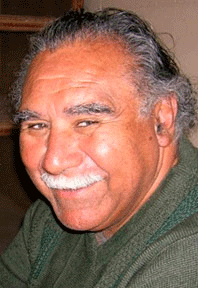
Anderson: Governments are attempting to steal our original sovereign citizenship and independence by deceit and assimilation by Grant. Michael Anderson said from his home today that research analysis has now shown the real nature of the contemporary Australian Assimilation policies.
“The Policy of Assimilation of the Aboriginal Peoples was first developed by all the Australian States and the Commonwealth Government during the Aboriginal Welfare conference[1] in the same year as the German Final Solution decree was made in 1937 against the Jews.
“During the course of the Canberra meeting, which was designed to develop a solution to ‘The Aboriginal Problem’, the Western Australian Chief Aboriginal Protector (sic), A.O. Neville, concluded that, ‘In 50 years we should forget that there were any Aborigines in this country.’ What this man was proposing was the total annihilation of the Aboriginal race.
“The policy that was agreed upon at this 1937 National Conference was that a policy of assimilation could have the same effect, that is, remove the children from their families, educate and acculturate them into a single Australian community where everyone shall be influenced by the same beliefs, have the same customs as everyone else, by having the Aborigines ‘absorbed’ into the main stream community of the Australian State. Moreover, marrying the Aboriginal ‘half-castes’ into the lower class white Australia would see the disappearance of colour. Absorption into the white community will have been completed.
“The Commonwealth and State Government social engineers have been very clever in covering up the real and hidden agendas that all of the Australian Political Parties have been running for a long time. To understand this, we must revisit some of the evil doings of past Government practices. Continue reading
Nuclear business boom – in shutting down reactors!
“Nuclear decommissioning “has been a growth industry on and off,” Margaret Harding, a self-employed nuclear industry consultant based in Wilmington, North Carolina, said in a phone interview. “Right now, it’s big business.”
Nuclear Decommissioning Surge Is Investor Guessing Game, Bloomberg by Stefan Nicola in Berlin at snicola2@bloomberg.net; Julie Johnsson in Chicago at jjohnsson@bloomberg.net editor responsible for this story: Reed Landberg at landberg@bloomberg.net 16 June 13
Nuclear utilities thrust into the spotlight after the Fukushima meltdowns have ordered 20 reactors shut, the most in a three-year span since Chernobyl’s aftermath, saddling the industry with a possible $26 billion in costs.
EON SE and RWE AG (RWE) are leading the biggest decommissioning project by European utilities ever, an effort to tear down 12 reactors in Germany over two decades. Edison International (EIX) said June 7 it will never restart its idled two-unit San Onofre Generating Station outside Los Angeles, bringing the number of U.S. reactors permanently closed in a year to a record four.
The global utility industry faces its biggest test to prove enough money was saved for shutdowns, having undergone numerous cost-overruns building atomic plants. A cautionary tale can be seen with government-owned facilities. In Britain, where taxpayers are on the hook to retire the Sellafield complex’s seven reactors and fuel-reprocessing stations on the Irish Seaduring the next 100 years, the U.K. government this year doubled its estimate for the work to 67.5 billion pounds ($106 billion).
“There’s a lot of speculation how much these projects cost, but an exact estimate can only be given by utilities,” said Sascha Gentes, a Karlsruhe Institute for Technology professor specializing in atomic shutdowns. “The longer a nuclear decommissioning project takes, the more expensive it becomes.” Continue reading
Nimbin to have Aboriginal Tent Embassy
Aboriginal tent embassy going up at Nimbin Rocks next month, Northern Star Melissa Gulbin 17th Jun 2013 AN Aboriginal tent embassy at Nimbin Rocks will be established next month. It is being set up in solidarity with the West Papua Freedom Flotilla, a convoy of resistance against what the independence movement call the “genocide” of its indigenous population under Indonesian military occupation.
It will be a tight itinerary, but last week it was decided that Nimbin would be added to healing ceremonies taking place from Lake Eyre to West Papua. The official Nimbin ceremonies will take place on Sunday, July 28, but the public are also invited to prepare the day prior.
The indigenous populations have granted each other with Aboriginal passports……. The convoy intends to transport sacred water collected from the mound springs of Arabunna country while following the ancient song lines across Australia in a freedom ride from Lake Eyre.
The convoy aims to reconnect culturally and creatively with Aboriginal communities at Alice Springs, Tennant Creek and now Nimbin.
The people of the Northern Rivers have been invited by Arabunna Aboriginal Elder Uncle Kevin Buzzacott, who believes that following their song lines will reveal a deep connection between the lands which were once joined.”We were one people, we still are one people. We must uphold our cultural connection, the old land is calling us,” he said. To be involved email ruth.forsythe@gmail.com. http://www.northernstar.com.au/news/uniting-to-retrace-past/1909144/
Report on first World Indigenous Network Conference, held in Darwin
“…a worldwide movement of Indigenous Peoples to highlight their strong connections to ancestral territories and waters and ever greater recognition by governments and international community of the importance of these connections”.

Summary of ICCA Consortium participation at World Indigenous Network (WIN) Conference http://iccaconsortium.wordpress.com/2013/06/13/summary-of-icca-consortium-participation-at-world-indigenous-network-win-conference/ June 13, 2013 Darwin, Australia – A small yet strategic group comprising 10 delegates from countries such as Iran, Philippines, Nepal, Pakistan, Taiwan, Zimbabwe and Australia associated with ICCA Consortium participated in the first World Indigenous Network (WIN) Indigenous and Local Communities Land and Sea Mangers’ Conference, May 26-30 in Darwin, Australia.
Darwin is a ‘country’ of Larrakia nation, also known as ‘Saltwater People’ who are aboriginal traditional custodians of all land and waters of the greater Darwin region. Hosting of this conference in the country of Larrakia peoples is symptomatic of respect and recognition of strong connections to land and sea, and the conservation stewardship of aboriginal peoples in the Northern Territory of Australia. Continue reading
1 This month
7 April – WEBINAR – Australia and the Doomsday Clock – Preventing nuclear war through NoFirstUse and other policies
Online | Tuesday April 7, 4:00-5:30pm, Australian Eastern Time / 8:00-9:30am Central Europe Time
– Access the registration link
15 April – Zoom –Nuclear Power is Not the Solution
Apr 15, 2026 01:00 AM in Canberra, Melbourne, Sydney

Join the International Physicians for the Prevention of Nuclear War (IPPNW) on Tuesday, April 14th for a timely webinar exploring the risks associated with nuclear power and challenging the myth that it offers a simple, safe, carbon-free solution to the climate crisis

of the week – Australians for War Powers Reform (AWPR)
To see nuclear-related stories in greater depth and intensity
 Antinuclear