Remembering Senator Jean Melzer , an anti nuclear hero
Jean Isobelle Melzer died on June 18, 2013. An Australian Senator, Jean Melzer represented the Australian Labor Party and the state of Victoria. She was elected at the 1974 election, becoming the first woman Labor senator from Victoria . In 1978 she was the first woman elected as the Secretary of the Labor Caucus. She served two terms. In 1980, despite Melzer’s great popularity in the labor party and electorate, the ALP executive moved her to an unwinnable 3rd ticket position, replacing pro uranium Robert Ray at the top ticket. This ensured Melzer’s defeat at the 1980 election.

In 1984, Jean Melzer as Convener of the Movement Against Uranium Mining led the campaign opposing Labor’s move to a pro uranium mining policy.
She also stood unsuccessfully as the lead Victorian senate candidate for the Nuclear Disarmament Party in the 1984 election.
Jean Melzer was also a great campaigner for Aborigines, migrants, pensioners, and for anti discrimination in all areas. She stood up for the rights of the disadvantaged.
Pushed out of her Senate position by the pro nuclear ALP, Jean Melzer continued working in the community and in environmental protection.
In 2004 she was awarded the Medal of the Order of Australia (OAM).
Jean Melzer will be remembered for her many contributions to Australia, and for her warning:
“Don’t let Australia become the quarry and waste dump of the world” Noel Wauchope 25 June 2013
King Island resists anti-wind propaganda, votes for wind farm feasibility study
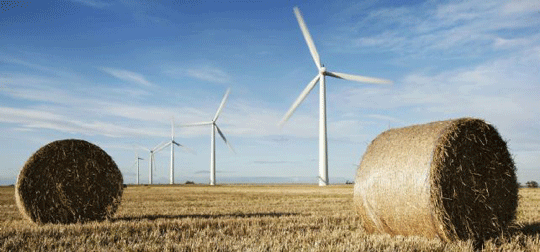 King Island community votes ‘yes’ to wind farm feasibility, rejects scare campaign http://yes2renewables.org/2013/06/24/king-island-community-votes-yes-to-wind-farm-feasibility-rejects-scare-campaign/ June 24, 2013 by Leigh Ewba In 2012, King Islanders were trusted to determine the fate of a proposed wind farm. Today, the results of a community vote are in.
Despite an anti-wind energy scare campaign backed by wealthy NIMBYs and big PR, the community has voted for a wind farm feasibility study. The result shows that King Islanders won’t be fooled by anti-wind energy spin.
TasWind, the firm proposing a 600MW wind farm for the island, has won community backing for a feasibility study. It gave the feasibility study the green light at a press conference in Hobart. The two-year feasibility study will examine the economic, technical and environmental aspects of the wind farm proposal. The community will now be able to get all the information to needed to make an informed choice about the wind farm proposal.
King Islanders, who have lived with wind turbines for a decade and a half without complaint, have dismissed absurd claims of ‘wind farm noise disease’. Now it’s time for the anti-wind energy campaign accept the community’s endorsement of a feasibility study and end its divisive campaign. Yes 2 Renewables have visited King Island several times in 2013 to observe the community consultation process. It’s apparent to us that the wind farm proposal has the potential to transform the King Island economy for the better. It can diversify the economy as it struggles in the wake of the closure of an abattoir, shrinking population and increased shipping costs.
The King Island community’s decision will put the island on the radar of new economy firms such as Google, Facebook and Apple, who are seeking renewable energy of the scale proposed by TasWind to power data centres. The island has the opportunity to become a truly clean, high-tech economy, mixing it’s renowned dairy and meat industry of today with clean renewable and web-based economy of the 21st Century.
Petition : End fossil fuel subsidies for big mining companies
 End fossil fuel subsidies for big mining companies http://greensmps.org.au/content/end-fossil-fuel-subsidies-big-mining-companies 11 Apr 2013 | Christine Milne
Dear Prime Minister Gillard & Treasurer Swan:
I support ending fossil fuel subsidies for big mining companies.
The diesel fuel rebate and accelerated depreciation for assets and exploration will cost the Australian people more than $13 billion over the next four years.
That $13 billion would be far better spent caring for people, instead of the mining lobby. Imagine: what would that mean for our public school students?
It’s more than enough to increase Newstart by $50 a week, reverse your cuts to vital support for single parents, and more.
Your petitioners ask that you:
End these subsidies that drive the fossil fuel pollution driving global warming, and invest in people instead.
Changing energy market, as wind ans solar bring down the cost of electrcity generation
because wind and solar have very low marginal costs of generation (i.e. they cost little to run once built) this has caused the wholesale price of electricity to fall.
base load plants disappear, and only flexible generation remains. This is an aspect that appears to be not understood in Australian policy and regulatory circles, to the point where there is more risk that markets will be redesigned to support the incumbents at the expense of renewables, which is not the point at all. But such may be the power of the incumbents. But more of that another time.
 How wind and solar broke the world’s electricity markets REneweconomy, By Giles Parkinson on 25 June 2013 Late last year, RenewEconomy wrote an analysis entitled the energy markets are broken. We were pilloried by some for exaggeration and being overly dramatic. But we simply drew on insight from the experts, and now they are quite open about the problem: the world’s energy markets do need to be redesigned, otherwise they cannot cope with the impact of wind and solar.
The International Energy Agency, in its recent special update of progress on climate policies, noted that liberalised energy markets (such as Australia’s) should be able to encourage a “significant decarbonisation” of the energy mix. The problem was that these markets – created to support incumbent, centralised fossil fuel generators, were not suited to deliver the sort of energy transformation that was needed to meet climate change targets.
Part of the problem is that the current “energy” markets are designed to allow baseload fossil fuel generation to trundle through at relatively low cost – but no environmental accounting. When demand rises, more expensive peaking plant generation is brought in, with prices rising for all generators. This has underpinned much of the revenues and profits for the incumbents.
(This problem is best illustrated in France, where the government actively encouraged households to consume more electricity to justify the massive investment in nuclear. Now that efficiency is becoming a focus as it approaches the time to replace that capacity, it is no longer looking like such a smart idea). Continue reading
Germany at the forefront of the world’s transition to renewable energy

the people of Berlin seem to gravitate towards an environmentally conscious energy discussion. Bike commuters abound, energy efficiency and environmental concerns are a tenant of the informed public. In the relatively hot summer – 37 degree highs on average – the most noticeable omission from most building’s energy profile is air conditioning……..
Germany spearheads global renewable energy awareness Mohammed Alshoai Saudi Gazette, 24 June 13 BERLIN – The streets of Berlin face a different kind of traffic than those of Riyadh: bicycle traffic, which speaks multitudes in a city cultured with environmental awareness, so much so that Energiewende – literally: energy transformation – has become a word recognized in every household and office building in the German capital.
Following the Fukushima incident in 2011, the Germans took an almost unanimous vote on moving away from nuclear energy and promoting renewables. This vote has lead to a consensus on nuclear phaseout, which has become a tenant of Energiewende, emphasized by the high public tension surrounding nuclear energy.
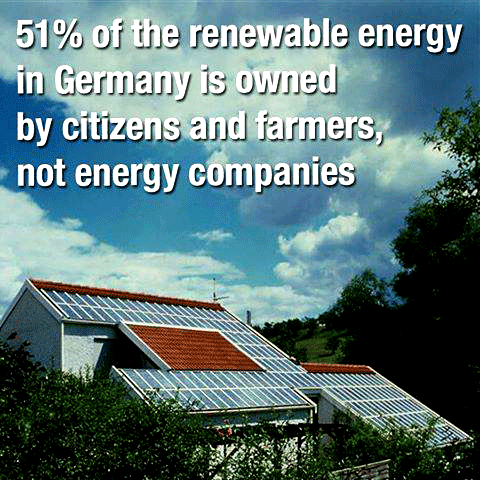
Rainer Baake, currently the director of Agora Energiewende and formerly State Secretary at the Federal Ministry for the Environment, Nature Conservation and Nuclear Safety said at a roundtable: “Nobody wants to get back into nuclear. It is very clear that everybody wants to expand on renewables.” Renewable energy is an economic, environmental and political concern in Germany, currently emphasized by their upcoming elections in September. The main sources of renewable energy in Germany are wind power, solar and photovoltaic cells, collectively making up between 23 and 25 percent of the European nation’s energy structure, according to Agora Energiewende, along with several government organizations in Berlin.
One current issue being discussed on a political level, Baake said, is the expansion of Germany’s grid system versus a capacity market bent on storing energy for low peak production times and high consumption seasons, particularly in Germany’s cold winters.
“Grids are much more important than storage,” Baake said, adding that it is a much more affordable option, where heating in winter attributes a peak demand of 80 gigawatts. Baake added that the price per megawatt has gone significantly down from €90 to €100 in 1998 to approximately €30 to €50 today. Continue reading
Let’s not forget- the blacks owned this country, and in many ways, still do
The Alice: problematic but never sad for long , Brisbane Times June 25, 2013 Jenna Price Columnist for The Canberra Times.Everyone in the supermarket is speaking Pitjantjatjara; and that includes the very young man behind the till at the checkout.
He doesn’t look black but because I live in Glebe, in Sydney’s inner-west, I no longer fall for the idea that you have to ”look black” to be black. When I say ”no longer”, I still have to slap myself sometimes to remember that I am on Aboriginal land. Really, I am.
This land may be colonised but it was still Aboriginal land first. No matter what any historian may say about how this land was acquired by white people, we mustn’t erode or ignore the fact that this was Aboriginal land first.
In the city, that moment is often lost on us white folk, except for the requisite acknowledgement of country. Which often feels to me like we are running our hands under water. Do this and it’s a way of ameliorating the damage. The ongoing disasters. Incarceration. Health. Education. Income management. Someone pretending to know how to manage my money better than I know myself………
we can help communities. Ebony Allen, a project manager with indigenous consultancy Winangali and this week’s guest tweeter on @IndigenousX, visited Alice in March this year. Like me, she didn’t find Alice sad. She stood in a queue at the Commonwealth Bank branch in Todd Mall.
”Everyone around me was speaking a [traditional] language, it was like music to my ears,” she said.
The health of the local languages says to her that ”they haven’t been as colonised as the rest of Australia”. She’s an east-coast woman (Kamilaroi and Dharug) and there, local indigenous communities are often regenerating their traditional languages. Here in Alice, English is sometimes a second, third or fourth language……..
Alice is a constant and obvious reminder that blacks owned this country. And in many ways, still do. http://www.brisbanetimes.com.au/comment/the-alice-problematic-but-never-sad-for-long-20130624-2oske.html#ixzz2XGF7mFdI
1 This month

of the week – Australians for War Powers Reform (AWPR)
To see nuclear-related stories in greater depth and intensity
 Antinuclear