Warren H Williams a strong Greens contender for Northern Territory Senate seat
 He nominated land rights, protecting the land and the Greens’ opposition to uranium mining as a reason he wanted to represent the party.The Greens will announce Mr Williams along with other senate candidates in Canberra on Wednesday
Country singer challenges Peris in Senate race http://www.crookwellgazette.com.au/story/1597432/country-singer-challenges-peris-in-senate-race/?cs=12 By Heath Aston June 26, 2013,

The Greens will seek to capitalise on bad blood over the shafting of veteran Labor senator Trish Crossin by running Aboriginal country singer, Warren H Williams, in the Northern Territory senate race.Mr Williams, a multiple ARIA award winner and a major star in the Top End an the country music scene, will take on political novice Nova Peris for the one winnable seat for the progressive side of politics. Continue reading
Australia’s opposition Liberal Coalition in confusion about climate change
 Green energy helps reduce power bills, study finds June 25, 2013 The Age Peter Hannam Carbon economy editor “…….Maurice Newman, the chairman of the opposition’s proposed business advisory council, wants the target dumped because he does not accept climate change science and says renewable energy is pushing up prices.
Liberal senator Chris Bach and Nationals senator Ron Boswell spoke at an anti-wind farm rally in Canberra last week.
Senator Boswell said aid to the wind and solar energy sector was “fraudulent” and that leader Tony Abbott would face mounting pressure to alter the legislation.
Coalition climate action spokesman Greg Hunt said last week that the Coalition continued to back the policy.
“We support the Renewable Energy Target and we support the 20 per cent,” he said…..”.http://www.theage.com.au/business/carbon-economy/green-energy-helps-reduce-power-bills-study-finds-20130625-2ou3e.html#ixzz2XMBA2zNU
President Obama beholden to nuclear lobby, as his Climate Action plan shows
 President Obama depended on support from the nuclear lobby from very early on in his career
President Barack Obama, who has received throughout his political career significant campaign contributions from the nuclear industry, has consistently been an outspoken advocate for nuclear power.
In Feb. 2010, Obama pledged $8 billion in loan guarantees needed to build the first U.S. nuclear reactors in nearly three decades. Obama’s $27.2 billion FY 2013 budget request for the DoE included $770 million for nuclear energy, with $65 million for cost-shared awards to support first-of-a-kind SMRs, and $60 million for nuclear waste R&D. http://www.technewsworld.com/story/78268.html
Extract from US Presidents Climate Action Plan
“Nuclear Power. The United States will continue to promote the safe and secure use of nuclear power worldwide through a variety of bilateral and multilateral engagements. For example, the U.S. Nuclear Regulatory Commission advises international partners on safety and regulatory best practices, and the Department of Energy works with international partners on research and development, nuclear waste and storage, training, regulations, quality control, and comprehensive fuel leasing options. Going forward, we will expand these efforts to promote nuclear energy generation consistent with maximizing safety and non-proliferation goals.”
Anti wind farm lobby has not given up, on King Island wind project
Clean Energy Council policy director Russell Marsh said scaremongering by groups such as the “deceptively-named” Australian Environment Foundation created stress and division in the communities they claimed to be helping.
“There are more than 200,000 wind turbines at wind farms all over the world, many of them much closer to people’s houses than is possible under Australia’s strict planning regulations,” Mr Marsh said.
 Wind farm issue smolders The Mercury HELEN KEMPTON | June 26, 2013 THE mood on King Island is still tense as residents mull over news Hydro Tasmania will move on to the next stage of its proposal to build a 200-turbine wind farm.
Mayor Greg Barratt said the community was still fiercely divided on the issue and he did not expect that division to ease any time soon.
Hydro Tasmania expects it will take two years to conduct a feasibility study into its $2 billion wind project, which will need outside investment. Cr Barratt said he hoped the community could come back together as it learned more about the project.
“I encourage people to quieten down and take a deep breath and see what the feasibility study brings,” he said “I understand the ‘no’ people are very disappointed that the study is going on despite Hydro Tasmania not quite achieving the 60 per cent support they were seeking.”
A poll of residents and off-island property owners on whether Hydro Tasmania should take the project to the feasibility stage showed 58.77 per cent were in support. The company’s board decided that was close enough to proceed.
More than 400 people who were eligible to have their say did not bother…………….. Continue reading
Retransfer of Australian obligated plutonium to Australia’s major uranium market, Japan

 Australia-Euratom Nuclear Safeguards: Plutonium Retransfers …..The Agreement will enter into force when Australia notifies the Delegation to the European Commission that all domestic requirements necessary to give effect to the Agreement have been satisfied…. Department of Foreign Affairs and Trade – Australian Government 01/06/2013 | Press release distributed by noodls http://www.noodls.com/view/2FBAFE516E5E78B9F15B62CBEB136F9A32994CC7
Australia and the European Atomic Energy Community (Euratom) exchanged diplomatic notes in Canberra on 28 May 1998 as the first step towards bringing into force an Agreement under which Australia will – subject to certain conditions – broaden its consent for the return from the European Union to Japan of Australian obligated plutonium following the reprocessing of Japanese spent fuel in Europe. The European Union is an important provider of nuclear fuel cycle services for countries purchasing Australian uranium and Japan is a major market for Australian uranium exports. Continue reading
Japan’s galloping plutonium problem
Storage pools for spent fuel are quickly reaching capacity at nuclear power plants across the nation. If Aomori Prefecture refuses to accept spent fuel, nuclear plants will be saddled with overflowing spent fuel pools and will be unable to continue operations.
Direct disposal, or burying spent fuel without reprocessing, was considered under the previous Democratic Party of Japan government. But discussions have gone nowhere after the Liberal Democratic Party took over government in December.
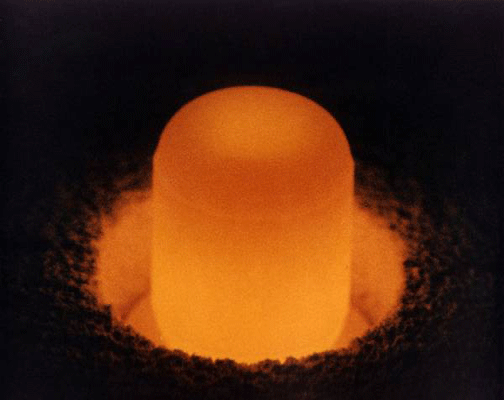
 Plutonium problem lingers as mixed-oxide fuel comes to Japan June 25, 2013 THE ASAHI SHIMBUN A shipment of mixed-oxide fuel will arrive in Japan as early as June 27, part of the nation’s plutonium stockpile that is already equivalent to 5,000 Nagasaki-type atomic bombs.
The shipment, two years behind schedule due to the Great East Japan Earthquake in 2011, is expected to be used for plutonium-thermal (pluthermal) power generation, a key component of Japan’s nuclear fuel recycling program.
However, the fuel recycling program has been plagued by so many problems that the nation’s plutonium stockpile could increase further, heightening concerns in the international community about possible nuclear weapons proliferation.
The shipment from France is also creating headaches for Kansai Electric Power Co., which plans to use the fuel at its Takahama nuclear power plant in Fukui Prefecture, pending approval of its application to restart the No. 3 and No. 4 reactors there in early July.
Under pluthermal operations, mixed-oxide fuel, which contains plutonium extracted from spent nuclear fuel, is used in nuclear reactors.
A French company processed spent nuclear fuel from Kansai Electric into 20 mixed-oxide fuel assemblies, which contain an estimated 900 kilograms of plutonium. Kansai Electric has not disclosed how many of the fuel assemblies will be brought into the Takahama plant.
Japan currently possesses 44 tons of plutonium, according to the Atomic Energy Commission. Nine tons, including the latest shipment, are in Japan, while the remaining tons are in Britain and France, where spent fuel from Japan has been reprocessed. Continue reading
Australia benefits from Clean Energy Finance Corporation
The Opposition has said it will not honour contracts written by the corporation, discouraging companies from investing in projects reliant upon those contracts. Although Yates acknowledges that this is possible, he suggests that this would be an unusual precedent that could threaten the attractiveness of any government contract in future
 Can we do without a clean energy finance bank? SBS WORLD NEWS, 25 JUN 2013, SOURCE: THE CONVERSATION Jenny Riesz asks how an Abbott Government would make sure Australia brings to market the diverse ranges of renewable technologies needed to transform our energy sector. The Opposition has clearly stated its intention to remove the Clean Energy Finance Corporation if it takes government at the next election. Will the Coalition introduce another mechanism to take its place? How will an Abbott Government make sure Australia brings to market the diverse range of renewable technologies we need to transform our energy sector?…….
The corporation does not provide grants. It is designed like a “green bank”, providing loans for clean energy projects. Loans must be ultimately paid back, and the corporation is expected to make a return over the investment portfolio. Dividends will be paid to ARENA. The intention is to provide an ongoing, self-supporting scheme that keeps producing renewable technologies over the long term without being a drain on taxpayers.
The corporation is required to co-finance projects with the private sector so that support does not displace private investment. Schemes of this sort have been or are being established around the world (such as the UK Green Investment Bank and the US Green Bank), and in Australia (such as the Low Carbon Australia fund, which achieved a private investment ratio of 13:1). Continue reading
Renewable energy saves money for consumers,
Green energy helps reduce power bills, study finds June 25, 2013 The Age Peter Hannam Carbon economy editor Wind farms, hydro power and other renewable energy sources will actually cut household electricity bills, not push up bills as detractors have claimed, a new study suggests.
Research commissioned by wind farm owner Meridian Energy found the national renewable energy target – which requires electricity generators to provide at least 20 per cent of power from clean sources by 2020 – will ultimately force down wholesale power prices.
It found the renewable energy legislation would save Victorian households about $35 a year if the carbon price stayed, and $50 if it were abolished. South Australia – which already gets more than 20 per cent of power from renewables – would save as much as $56 a year. Continue reading
1 This month

of the week – Australians for War Powers Reform (AWPR)
To see nuclear-related stories in greater depth and intensity
 Antinuclear