The week in nuclear and energy news, Australia
 Former Senator Jean Melzer died on 18 June. She will be remembered for many achievements and her lifelong
  dedication to the causes of lifting conditions of underprivileged groups, and of protecting the environment. Jean Melzer was Victoria’s first woman Labor senator, and first woman elected as the Secretary of the Labor Caucus. She was Convenor of the Movement Against Uranium Mining. Her anti-nuclear stance resulted in 1980’s pro nuclear Labor Party ousting her. She then stood as the lead Victorian senate candidate for the Nuclear Disarmament Party. A celebration of Jean Melzer’s life will be held in Queens Hall, Parliament House, Victoria at 12.30 on Wednesday 3rd July.
Federal politics. What will Kevin Rudd do about climate change, energy etc? What will Tony Abbott do?. I recommend Glies Parkinson’s REneweconomy of you want to learn about this. Indeed, I recommend Crikey – http://www.crikey.com.au/ Independent Australia New Matilda , even the Liberal leaning Online opinion Why bother with the Murdoch, Fairfax etc press and media? Even the ABC – they’re all happy doing personality politics – much more fun than policies and issues – and the media have been a large contributor to the mess that Australian politics is in today.
Carbon tax – A national poll finds that Only a third (37 per cent) of Australians believe that the Coalition should repeal carbon pricing if it is elected government at the next federal election. The full fact sheet is here
Northern Territory. Popular Aboriginal singer Warren H Williams is standing again for the Senate, and looking to be a strong contender for a winnable Senate seat – standing against ALP’s parachuted in political novice Nova Peris. Williams is uncompromisingly anti nuclear.
Wind Energy Australia’s wind generation is cost effective, says International Energy Agency. Despite an anti-wind energy scare campaign backed by wealthy anti wind front groups , the King Island community has voted for a wind farm feasibility study. However, many in the community remain apprehensive and confused following influx of “Waubra Foundation style anti wind campaigners.
“Ugly Australian” Paladin Energy uranium miner continues to slide in share price, as it tries to sell off its flagship Langer Heinrich operation in Namibia, to raise funds to pay off debts.
Retransfers of Australian obligated plutonium from Europe to Japan come into force, and at the same time, Japan takes in its first shipload o mixed uranium and plutonium (MOX) from Europe – to add to its already huge and dangerous pile of plutonium.
Giles Parkinson on Kevin Rudd, renewable energy, and the carbon tax
 Will Rudd get to axe the tax before Abbott? REneweconomy By Giles Parkinson 27 June 2013 Good luck guessing what the extraordinary drama played out in Canberra last night means for climate change and renewable energy policies in Australia. From a Starbucks café in the Mojave Desert, a short drive from the 392MW Ivanpah solar power tower project (an extraordinary sight that must represent Australia’s energy future, but more on that later), the events make as little sense as they would do from inside Parliament House. Or from inside the office of an investor contemplating putting money into new energy technologies…….
It’s pretty clear that the hung parliament may well remain the pinnacle of policy making in Australia, at least in the short term. The current suite of policies – carbon pricing, renewable energy target, the Clean Energy Finance Corporation, and the Australian Renewable Energy Agency – make Australia one of the most attractive destinations in the world (were it not for the imminent threat of repeal).
The only thing missing has been a national energy efficiency plan, and a recognition by the states that it is time to move forward.
Now, the principal actors that made this possible are stepping back. Gillard has paid the price for the manner of her appointment, a poisoned chalice that was amplified by an intolerance of having a woman in the top job. Like many others, she saved her best for her resignation speech, when she was no longer a politician……eaves only Greens leader Christine Milne, who faces marginalisation if her party loses the balance of power. The prospect of that, though, will recede if Rudd succeeds in rescuing Labor’s electoral prospects, even if he doesn’t win. This would be disastrous for the renewable energy industry. The last time a Coalition government trod on renewable developments, the only thing that saved the industry were supportive state governments. They no longer exist.
Good climate change and renewables policies were put in place because of the tenacity of a few strong individuals willing to act on principle. That drove the factions and the mainstream media mad. The reaction of the factions was entirely predictable. The reaction of the media has been a crushing disappointment……. Quite where we go from here in the policy perspective is impossible to say. Rudd championed climate change in 2007 and got himself elected on the strength of it. But then he used it as a political wedge rather than a public policy pursuit. In the end his CPRS was an unsavoury compromise with the Opposition, and was ditched after pressure from Julia Gillard and Wayne Swan.
Rudd says now that he regrets the decision to dump his climate policies. But frankly, it is unclear whether Rudd sees that mostly in the prism of his own career or as a public policy issue. Renewable energy supporters would rather he didn’t keep saying “let’s get cooking with gas”…….
n the short term, however, most interest will be on the fate of the CEFC, and the numerous projects which are under consideration. An early election call – depending on the flow of events today – would mean that the caretaker period would start immediately, and the board of the CEFC would not be able to make any new decisions.
In the event of an Abbott victory, it would probably have to wait until after the election to make those announcements and continue on. It cannot stop work until its supporting legislation is repealed, and that is unlikely until next July. The CEFC is absolutely sure of its legality, but the rhetoric (and frankly the ignorance) of the Opposition might suggest some sort of challenge. But they may have other fish to fry. http://reneweconomy.com.au/2013/will-rudd-get-to-axe-the-tax-before-abbott-24216
Compare policies between political parties on carbon, renewable energy
 Environment policy: where the parties stand, ABC News 27 June 13 By Sarah Clarke and Andrew Greene “………What aspects do the major parties agree/disagree on?
Greenhouse gas emission reduction targets
Both ALP and the Coalition agree on the science of climate change, and have formally backed Australia’s emissions reduction target of 5 per cent by 2020. But there are some differences
- ALP: Committed to 5-25pc reduction on 2000 levels by 2020, based on the ambition of global agreement and 80pc reduction by 2050 which is in line with the UK and Germany. Signatory to second commitment period of Kyoto Protocol for 2020 reduction and intention to ratify.
- Coalition: Committed to the 5-25pc reduction on 2000 levels based on ambition of global agreement. Review in 2015 to consider longer term target in light of international agreement. Coalition has stated “in principle” support for second commitment period of Kyoto Protocol but no position on ratifications announced.
- Greens: Committed to 25-40pc reductions on 1990 levels by 2020, net zero emissions by 2050 and the second period of the Kyoto Protocol. Continue reading
Australian uranium company Paladin having more troubles, as share price falls
 Uranium producer Paladin’s shares slide after stake sale delay BY:BARRY FITZGERALD The Australian June 27, 2013 SHARES in African uranium producer Paladin have been pulled back to near 52-week lows because of a delay in a planned debt-reducing sale of a minority equity position in the group’s flagship Langer Heinrich operation in Namibia.
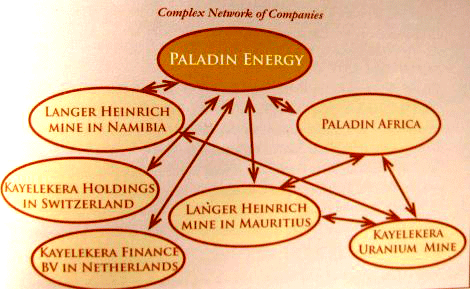
It had been hoped that Paladin would make inroads into its $US740 million debt pile by making the sale the news of which pushed the shares from an April low of 70c to more than $1 a share in late May. But recent concerns that the previously advised June 30 target date would not be met have sent the shares lower.
The concerns were well placed, with Paladin saying yesterday that the planned sale had been delayed until mid-to-late August. Paladin shares closed 6c, or 6.8 per cent, lower at 82c.
The fall came despite Paladin managing director John Borshoff remaining confident a sale will be achieved. The planned deal is with two unnamed nuclear groups……http://www.theaustralian.com.au/business/mining-energy/uranium-producer-paladins-shares-slide-after-stake-sale-delay/story-e6frg9df-1226670445221
World Health Organisation, UNSCEAR, minimise health effects of ionising radiation
U.N. Downplays Health Effects of Nuclear Radiation, IPS, By George Gao, 26 June 13 UNITED NATIONS, – The United Nations has come under criticism from medical experts and members of civil society for what these critics consider inaccurate statements about the effects of lingering radioactivity on local populations. Scientists and doctors met with top U.N. officials last week to discuss the effects of radioactivity in Japan and Ukraine, and the U.N. has enlisted several of its agencies, including the International Atomic Energy Agency (IAEA), the World Health Organisation (WHO) and the U.N. Scientific Committee on the Effects of Atomic Radiation (UNSCEAR), to address the matter.

In May, UNSCEAR stated that radiation exposure following the 2011 Fukushima-Daichii nuclear disaster in Japan poses “no immediate health risks” and that long-term health risks are “unlikely”.
“I think it’s ridiculous,” said Helen Caldicott, an Australian doctor and dissident, in response to the UNSCEAR report.
“There have been health effects. A lot of people have experienced acute radiation illness, including bleeding noses, hair loss, nausea and diarrhoea,” she told IPS……. Asked why UNSCEAR and WHO released such statements if they were medically inaccurate, Caldicott referred to a 1959 WHO-IAEA agreement that gives the IAEA – an organisation that promotes nuclear power – oversight when researching nuclear accidents.
“The WHO is a handmaiden to the IAEA,” said Caldicott, who engaged in a 2011 debate on the subject with The Guardian’s George Monbiot. Monbiot had argued that nuclear plants are a viable alternative to coal plants. “It’s a scandal which has not really been exposed in general literature and to the public,” said Caldicott of the WHO-IAEA agreement.
Caldicott said of WHO, “They didn’t do any studies of Chernobyl, they just did estimates.” She cited a 2009 report by the New York Academy of Sciences, which painted a different picture…… Continue reading
Radioactive groundwater leaking into Pacific Ocean, from Fukushima?
 Radioactive material “soars” in ocean near Fukushima plant — Tepco: Contaminated groundwater leaking into Pacific? http://enenews.com/radioactive-material-soars-in-ocean-near-fukushima-plant-tepco-contaminated-groundwater-leaking-into-pacific
Title: Tritium samples in sea near No. 1 soar
Source: Japan Times
Author: Reiji Yoshida
Date: Jun 25, 2013
The density of radioactive tritium in samples of seawater from near the Fukushima No. 1 nuclear plant doubled over 10 days to hit a record 1,100 becquerels per liter, possibly indicating contaminated groundwater is seeping into the Pacific, Tokyo Electric Power Co. said.
The latest sample was taken June 21 from the sea near a water intake point east of the reactor 1 turbine building. […]
Tepco said late Monday it was still analyzing the water for strontium-90 […]
[…] during a news conference Monday in Tokyo, Masayuki Ono, a Tepco executive and spokesman, this time did not deny the possibility of leakage into the sea, while he said Tepco is still trying to determine the cause of the spike.
See also: TV: Groundwater shows massive spike in radioactive material at Fukushima plant — Strontium-90 up over 10,000% in past few months — Tepco apologizes (VIDEO)
Australia’s wind generation is cost effective, says International Energy Agency
Renewable energy use gaining worldwide:IEA http://www.theaustralian.com.au/business/breaking-news/renewable-energy-use-gaining-worldwideiea/story-e6frg90f-1226670621465 AAP June 27, 2013 RENEWABLES like solar and wind power represent the fastest-growing source of energy generation and will make up a quarter of the global power mix by 2018, the International Energy Agency IEA says.
The IEA said that in 2016 renewable energy will overtake natural gas as a power source and will be twice that of nuclear, and second only to coal as a source of power.
The growth of renewables has been bolstered by increased competitiveness with conventional energy.
It is “a bright spot in an otherwise bleak assessment of global progress towards a cleaner and more diversified energy mix,” said IEA Executive Director Maria van der Hoeven.
The report listed Australia as one of several countries where renewable energy was becoming more competitive.
It said Australian wind generation is cost-effective next to new coal and gas-fired plants with carbon pricing. Continue reading
AUDIO: Obama’s climate change plan
 Audio: Obama sidesteps ‘flat earth’ science deniers with new climate change plan, http://www.abc.net.au/am/content/2013/s3789621.htm ABC Radio AM Ben Knight reported this story on June 26, 2013 TONY EASTLEY: The US president Barack Obama has cited rising water levels in New York Harbour, the increasing prevalence of forest fires and heatwaves in Alaska as he’s laid out a broad new plan to fight climate change.
Because of difficulties getting his legislation through Congress, president Obama plans to use executive powers to get around what he described as “flat earth” science deniers.
He wants new restrictions on existing and new power plants to curb carbon emissions and he’s pledged to push new generation clean energy sources.
North America correspondent Ben Knight is in Washington……
1 This month
To see nuclear-related stories in greater depth and intensity
– go to https://nuclearinformation.wordpress.com/


 Antinuclear