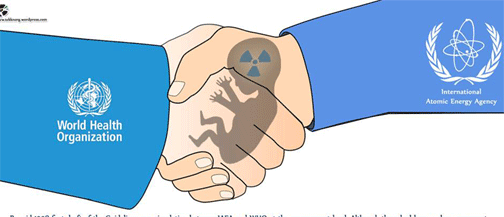
World Health Organisation, UNSCEAR, minimise health effects of ionising radiation
U.N. Downplays Health Effects of Nuclear Radiation, IPS, By George Gao, 26 June 13 UNITED NATIONS, – The United Nations has come under criticism from medical experts and members of civil society for what these critics consider inaccurate statements about the effects of lingering radioactivity on local populations. Scientists and doctors met with top U.N. officials last week to discuss the effects of radioactivity in Japan and Ukraine, and the U.N. has enlisted several of its agencies, including the International Atomic Energy Agency (IAEA), the World Health Organisation (WHO) and the U.N. Scientific Committee on the Effects of Atomic Radiation (UNSCEAR), to address the matter.
In May, UNSCEAR stated that radiation exposure following the 2011 Fukushima-Daichii nuclear disaster in Japan poses “no immediate health risks” and that long-term health risks are “unlikely”.
“I think it’s ridiculous,” said Helen Caldicott, an Australian doctor and dissident, in response to the UNSCEAR report.
“There have been health effects. A lot of people have experienced acute radiation illness, including bleeding noses, hair loss, nausea and diarrhoea,” she told IPS……. Asked why UNSCEAR and WHO released such statements if they were medically inaccurate, Caldicott referred to a 1959 WHO-IAEA agreement that gives the IAEA – an organisation that promotes nuclear power – oversight when researching nuclear accidents.
“The WHO is a handmaiden to the IAEA,” said Caldicott, who engaged in a 2011 debate on the subject with The Guardian’s George Monbiot. Monbiot had argued that nuclear plants are a viable alternative to coal plants. “It’s a scandal which has not really been exposed in general literature and to the public,” said Caldicott of the WHO-IAEA agreement.
Caldicott said of WHO, “They didn’t do any studies of Chernobyl, they just did estimates.” She cited a 2009 report by the New York Academy of Sciences, which painted a different picture……
Radiation from uranium mining
The IAEA promotes “safe, responsible development of uranium resources”, the raw materials used to fuel nuclear reactors and build nuclear bombs.
For Ashish Birulee, a Ho tribal resident of Jadugoda, India, safe uranium mining in his community is far from reality, and the health effects of radiation are as clear as the photographs he has taken to document them.
Birulee, a student and photojournalist, lives next to a tailings dam, filled with radioactive waste from a uranium purification plant operated by the Uranium Corporation of India.
“Lung cancer, skin cancer, tumours, congenital deformities, down syndrome, mental retardation, megacephaly, sterility, infertility in married couples, thalassemia [and] rare birth defects like Gastroschisis [are] common in the area,” he told IPS.
“We are like guinea pigs here,” he said, citing government negligence on the matter. “I’m experiencing everyday radiation exposure and also witnessing how my people are suffering.”
Radiation from nuclear tests
During the Cold War, the Soviet Union conducted 456 nuclear tests at the Semipalatinsk test site in present day Kazakhstan.
“Based on information collected during the missions and subsequent research, there is sufficient evidence to indicate that most of the area has little or no residual radioactivity directly attributed to nuclear tests in Kazakhstan,”according to the IAEA.
But the IAEA narrative differs from those who live around Semipalatinsk. According to the preparatory committee for theComprehensive Nuclear-Test-Ban Treaty Organization (CTBTO),”A number of genetic defects and illnesses in the region, ranging from cancers to impotency to birth defects and other deformities, have been attributed to nuclear testing.”
“There is even a museum of mutations at the regional medical institute in Semey, the largest city near the old nuclear testing site,” it noted.
“What radiation does – gamma, alpha or beta – is it either kills the cell or changes the biochemistry of the DNA molecule,” Caldicott, who has worked on nuclear issues for 43 years, explained. “One day [the cell] will start to divide by mitosis in an unregulated way, producing literally trillions and trillions of [mutated] cells, and that’s a cancer,” she said.
“You don’t know you’ve been exposed to radiation,” Caldicott pointed out. “You can’t taste or see radioactive elements in the food, and when the cancer develops, of course it doesn’t denote its origin
http://www.ipsnews.net/2013/06/u-n-downplays-health-effects-of-nuclear-radiation/
No comments yet.
1 This month

of the week – Australians for War Powers Reform (AWPR)
To see nuclear-related stories in greater depth and intensity
 Antinuclear
Leave a comment