Confusion about New South Wales Government’s attitude to nuclear power and uranium mining
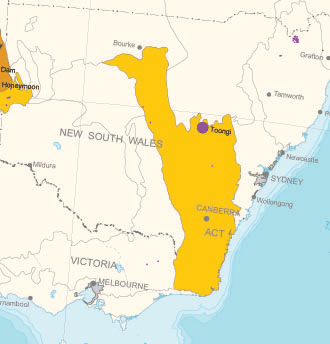 In May, the minister’s office said evaluation of the expressions of interest were due to begin, with an announcement of the successful applicants due “mid-year”.
It’s far from clear, but presumably the announcement – which must be imminent – will not only tell us which companies have applied to explore uranium, but also where they want to do so. (at left, areas recommended for uranium exploration)
[NSW Premier -] “The Uranium Mining and Nuclear Facilities (Prohibitions) Act 1986 continues to prohibit the construction of nuclear generation facilities in this state,” a spokesman told Fairfax Media when approached about the response.
“There has been and will be no change in the NSW government’s position on that.”
Nuclear act is still a minefield http://www.brisbanetimes.com.au/comment/nuclear-act-is-still-a-minefield-20130628-2p2cm.html#ixzz2XfneLben June 29, 2013 Sean Nicholls Sydney Morning Herald State Political Editor More than a year after the heat generated by last year’s announcement that the NSW government would overturn a 25-year ban on uranium exploration, things have gone a little quiet – publicly at least.
Premier Barry O’Farrell declared the move would help boost the state economy, particularly in light of the federal government decision to allow export of uranium to India. As expected, it was met with furious opposition from environment groups. Greenpeace labelled it “obscene”.
But while O’Farrell talked up the decision as a potential economic boost, he insisted his government was “not about to rush into mining uranium until we have carried out the necessary environmental and exploration checks and have had a mature and sensible discussion about utilising this resource”. Continue reading
This could be the 2013 climate change election
Australia got its price on carbon under the prime ministership of Julia Gillard. Gillard, whatever you think of her, was remarkable in her ability to forge consensus in a hung parliament. The Greens party and independent MPs supported the Clean Energy Future Act, which in most ways was similar to Rudd’s carbon reduction scheme, albeit with more investment in renewable energy.
During this time, as I’ve written about earlier, the conservative opposition leader, Tony Abbott, ran an unrelenting fear campaign against the carbon price. Support for the carbon price from 2010 to 2012 fell sharply, until July last year when it came into effect. Since then, public support in Australia has increased for the carbon price.
 Kevin Rudd’s return could herald a second Australian climate election http://www.guardian.co.uk/environment/southern-crossroads/2013/jun/28/kevin-rudd-australian-climate-election The Labor leader’s return to the Australian prime ministership could see a repeat of 2007’s ‘climate change election’ Rudd was elected in 2007 saying that climate change was the “the greatest moral, economic and environmental challenge of our generation”. In many ways, 2007 was the climate change election.

The first act Rudd took as prime minister was to ratify Kyoto, a symbolic break from the lead-footed conservative government under John Howard. A price on carbon was the major policy that the new Labor government saw to reduce carbon emissions, called the carbon pollution reduction scheme.
The scheme was defeated in the Senate in 2009 after the Greens party refused to support it, and voted with the Liberal and National parties to oppose it. Then the dismal efforts of Copenhagen further dampened efforts for climate action. Rudd’s final climate act as prime minister in 2010 was to announce that the carbon pollution reduction scheme would be shelved. Continue reading
Honeycomb like changes in thyroids of Fukushima children
 Former head doctor of National Cancer Center,”Thyroids of Fukushima children look like honeycomb from too much cysts” http://fukushima-diary.com/2013/06/former-head-doctor-of-national-cancer-centerthyroids-of-fukushima-children-look-like-honeycomb-from-too-much-cysts/ by Mochizuki on June 28th, 2013
Dr. Matsue is the chief of this clinic. He stated thyroids of Fukushima children have countless numbers of cysts to look like honeycomb. <Translate>
(In the thyroid test of Fukushima children) Shockingly about 30% of the children have thyroid cysts. It was also 35% from Fukushima prefectural government’s test. Prefectural government’s test probably misses small cysts of 1~2mm because their test is too quick, but the cysts rate was almost the same. However, <Translate>
Countless numbers of small cysts were found in the thyroids of about half of those 30% children, which is not reported in the prefectural government’s test. I thought it was like “honeycomb”, I have never seen such a thing.
Recently, a clinic in Kobe tested the thyroid of the children who evacuated from Fukushima..
<Translate>
The doctor in Kobe also reported about the “honeycomb looking thyroids”. What the world is that ? It’s no less than the half of the thyroids. The half-life of I-131 is 8 days, but it’s not strange if it causes any thyroid abnormality. Rationally thinking, it has something to do with radiation. <Translate>
“Accumulated I-131 might have changed the structure of the thyroid.” http://togetter.com/li/481810?page=1
Australia’s Clean Energy Finance Corporation launches investment, but Coalition opposes it
 The Coalition has vowed to axe the CEFC, along with the carbon price.
It has also written to the corporation saying any contracts it signs will not be honoured by the Coalition if it forms government.
Clean Energy $100m deal gets Coalition cold shoulder http://www.theage.com.au/environment/clean-energy-100m-deal-gets-coalition-cold-shoulder-20130628-2p2q9.html#ixzz2XgCLAQWO June 29, 2013 Tom Arup Environment editor, The Age Australia’s Clean Energy Finance Corporation has launched its first investment, committing to a joint $100 million energy efficiency loan program with the Commonwealth Bank.
The deal sets up a stand-off with the Coalition which has vowed not to honour any contracts signed by the $10 billion corporation if it wins office later in the year.
The corporation’s chief executive, Oliver Yates, said on Friday it would co-finance loans for medium-sized businesses for energy efficiency projects such as energy saving lighting, solar panels, and cogeneration and trigeneration plants.
The CEFC and the Commonwealth Bank will each chip in $50 million to the program, which will hand out loans between $500,000 to $5 million. It builds on an existing scheme put in place by another government agency, Low Carbon Australia – now folded into the CEFC – which has so far delivered $10.2 million to projects in manufacturing firms.
The CEFC is also working on a number of other larger deals, and it is understood some could be introduced as early as next week. It is reportedly negotiating to help New Zealand company Meridian Energy increase its debt in the massive Victorian Macarthur wind farm with a $100 million-plus loan, before it sells its share in the project. Continue reading
Renewable cities can become a reality – Sydney Council’s plan could happen
‘ the [Sydney] council’s plan says.
”The issue for Australia is not that these renewable energy resources and technologies cannot be deployed in Australia but that the current narrow view and mindset … has to change if Australia is to become a renewable energy economy and potentially a major exporter of renewable energy.”
 Renewable cities not just a pipedream Eyre Peninsula Tribune, June 29, 2013, Looking out of an aircraft window as you approach Sydney Airport or Melbourne’s Tullamarine, our cities look clean, green, pollution-free. Solar panels wink back at you from a growing number of roofs.
But the simple fact is they are more dependent now on coal than they ever were in the depths of the Industrial Revolution. It’s just that the energy generators are hidden away in the hinterlands, feeding vast amounts of power to the cities through high voltage cables and pumping out invisible CO2. It is the coal from Gippsland or the Hunter Valley that keeps the bright lights on in St Kilda and Kings Cross…….
is it possible for a modern, industrialised metropolis such as Melbourne or Sydney to be run solely off renewable energy, at a realistic cost? The answer is yes, but the journey to get there would require decisive change – in effect, another Industrial Revolution. Continue reading
“Plutonium Pollyanna” – a review of film “Pandora’s Promise”
Finally (as Beyond Nuclear and other watchdog groups have noted), relying on nuclear power to mitigate CO2-driven climate change is unaffordable and impractical since it would require putting a new reactor online every two weeks……
Ultimately, Pandora’s Promise comes across as a well-executed but disingenuous exercise in special pleading. Instead of devoting 89 minutes to honestly and fully assessing the pros and cons of renewable technologies alongside the risks and benefits of new, untried nuclear power systems,Pandora’s Promise promotes a narrow agenda. As a result, the film winds up as little more than a tunnel-vision exercise in “plutonium Pollyannaism.”
 Another Take on Pandora’s Promise EARTH ISLAND JOURNAL BY GAR SMITH – JUNE 28, 2013 Pro-nuclear power film obscures as much as it reveals You’ve got to give the producers of Pandora’s Promise credit for gumption. It takes a lot of chutzpah to release a pro-nuclear polemic in the wake of the triple meltdown in Fukushima, Japan. The film also suffered the ignominy of opening the same week that the owners of California’s troubled San Onofre Nuclear Generating Station announced the permanent shutdown of the facility’s two crippled reactors. Even the film’s title takes a bit of nerve; it was Pandora’s Box, after all, that unleashed a host of once-contained evils into the world.
So, given the extensive history of nuclear mishaps and near-catastrophes, how do the producers of Pandora’s Promise manage to spin their counter-narrative of a “safe, green” nuclear future? Basically by: (1) at first accepting the criticisms of traditional nuclear power and then (2) arguing that the solution lies in “new, improved” nuclear reactors. Like a smart defense attorney, director Robert Stone begins by admitting all of the defendant’s worst foibles up front, thereby depriving the prosecution of an opportunity to score points by revealing these issues later…….
The filmmakers pronounce the radioactive contamination “infinitesimal” and proclaim there has been “no evidence of medical consequences.” No citations are offered to support this positive conclusion. The fact that 40 percent of Fukushima’s evacuated children have subsequently developed thyroid abnormalities goes unmentioned.
Where Are the “Anti-nuclear Environmental Leaders”? Continue reading
1 This month

of the week – Australians for War Powers Reform (AWPR)
To see nuclear-related stories in greater depth and intensity
 Antinuclear