Australia’s “Northern Territory Intervention” trashed the reputation of Aboriginals on behalf of mining industries
 Government had made it clear that it wished to re-engage itself more directly in the control of community land through leasing options as well as to open up Aboriginal land for development and mining purposes.
The plan was to empty the homelands, and this has not changed. However, it was recognised that achieving this would be politically fraught – it would need to be accomplished in a manner that would not off-side mainstream Australia. Removing Aboriginal people from their land and taking control over their communities would need to be presented in a way that Australians would believe it to be to Aboriginal advantage, whatever the tactics.
So began the campaign to discredit the people and to publicly stigmatise Aboriginal men of the Northern Territory
And even in 2009 when the CEO of the Australian Crime Commission, John Lawler, reported that his investigation had shown there were no organised paedophile rings operating in the NT, no formal apology was ever made to the Aboriginal men and their families who were brutally shamed by the false claims.
 Sixth Anniversary of the Northern Territory Intervention – Striking the Wrong Note Lateral Love Australia‘concerned Australians’ Michele Harris, 21 June 13 Aboriginal advocate Olga Havnen, in her Lowitja O’Donoghue oration has asked a critical question. She asks what has been the psychological impact of the Intervention on Aboriginal people of the Northern Territory. It is surprising that so little attention has been given to this critical, yet in some ways tenuous, link before now.
Even before the Intervention began in June 2007, government had long planned a new approach to the ‘management’ of Aboriginal people in the Northern Territory. It was no longer part of government thinking that self-determination and Aboriginal control over land could be allowed to continue. These were the Whitlam notions of 1975 and they were no longer acceptable.
Early inklings of change occurred in 2004 with the management of grants being transferred from communities to Government’s newly established Indigenous Co-ordination Centres. More ominous were the Amendments of 2006 to the Aboriginal Land Rights Act and the memoranda of agreements that followed. Government had made it clear that it wished to re-engage itself more directly in the control of community land through leasing options as well as to open up Aboriginal land for development and mining purposes. Continue reading
Tony Abbott keen to rush coal development, stifle renewable energy
 Abbott to fast-track coal mines, in competition for ideas REneweconomy By Giles Parkinson on 1 July 2013 Tony Abbott has given his clearest indication yet that he intends to fast-track approval for large thermal coal mining projects, saying his new “one stop” shop for environmental approvals will ensure quick decisions on project approvals.
Abbott’s move, along with his party’s policy platform that has effectively suspended most investment in large scale renewables, comes as newly restored Prime Minister Kevin Rudd seeks to take the wind out of Abbott’s sails by proposing a more rapid transition to a (low) market price for carbon, as first foreshadowed on this website last Thursday morning, and the Greens push for even more ambition – proposing a 90 per cent renewables target by 2030.

Solar energy storage could be revolutionised by Australian invention
 Australian Invention Could Revolutionise Solar Energy Storage http://www.energymatters.com.au/index.php?main_page=news_article&article_id=3816 1 July 13, ANU researchers have developed a material that can store large amounts of power rapidly – and with very little energy loss. Based on the mineral rutile, it is a ‘dielectric’ material; which are used in the construction of capacitors.
The researchers say their material is superior to current capacitors in energy absorption, is cheaper to manufacture and can function effectively in a massive temperature range: -190°C to 180°C.
“With further development, the material could be used in ‘supercapacitors’ which store enormous amounts of energy, removing current energy storage limitations and throwing the door wide open for innovation in the areas of renewable energy, electric cars, even space and defence technologies,” says Associate Professor Liu of the ANU Research School of Chemistry. Continue reading
Radiation persists in the forests of Chernobyl
 27 Years Later, Radiation Still Hides Out in Chernobyl’s Trees (Fukushima’s Too) The April 26, 1986, meltdown of the Chernobyl Nuclear Power Plant scattered radioactive material across 58,000 square miles of eastern Europe. In a ring 18 miles from the destroyed plant, authorities set up the Chernobyl Exclusion Zone—a place where no one is supposed to live (though of course some do.) Scientific American has the story of how, though the disaster took place decades ago, radiation persists in a huge area around the defunct power plant—ready to be re-released to the environment. http://blogs.smithsonianmag.com/smartnews/2013/06/27-years-later-radiation-still-hides-out-in-chernobyls-trees-fukushimas-too/ 30 June 13

In the forests around Chernobyl, the trees have absorbed some of the radioactive fall-out. Washed from the air by the rain, radionuclides are taken up by trees and stored for long periods. The worry, says Scientific American, is that a forest fire could loose this radiation back to the environment.
For almost three decades the forests around the shuttered nuclear power plant have been absorbing contamination left from the 1986 reactor explosion. Now climate change and lack of management present a troubling predicament: If these forests burn, strontium 90, cesium 137, plutonium 238 and other radioactive elements would be released, according to an analysis of the human health impacts of wildfire in Chernobyl’s exclusion zone conducted by scientists in Germany, Scotland, Ukraine and the United States.
A recent study showed that the same is true for the forests around the Fukushima Daiichi Nuclear Power Plant. Continue reading
AUDIO: investors won’t support the failed technology of Thorium Nuclear Reactors

investors are refusing to put their money into either nuclear power, or this supposedly ‘new’ thorium idea, which is actually a very old idea being recycled from the 1960’s when it was found not workable. So why should the public put their tax money into thorium reactors?
http://agreenroad.blogspot.ca/2012/12/thorium-reactor-fort-st-vrain-power.html MSR Thorium Reactor 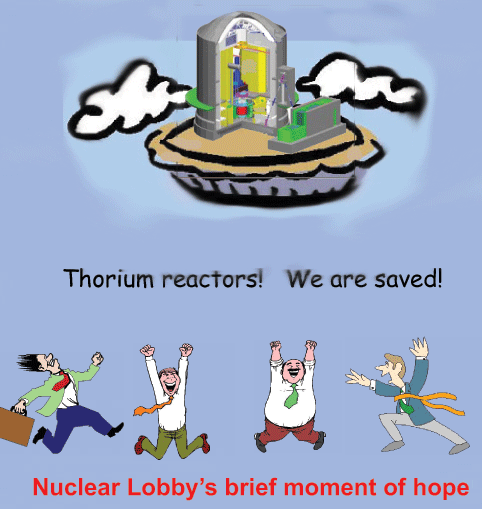 Fort St. Vrain Power Station Experiment Failed – A Green Road Magazine, 1 July 13
Australian Greens propose ambitious renewable energy plan
 Greens call for 90% clean energy by 2030 http://www.theage.com.au/business/carbon-economy/greens-call-for-90-clean-energy-by-2030-20130701-2p6g1.html#ixzz2XqON8QTl 1 July 13 The Greens will push for a 90 per cent renewable energy target by 2030, party leader Christine Milne has announced.
Senator Milne said on Monday that the target was achievable and she hoped that one day 100 per cent of energy would be from renewable sources.
She said critics had said a 20 per cent target by 2020 was too ambitious, but once a plan and technology development was in place business got behind it.
“Not only do I think it is achievable, I actually think by setting a road map, by setting an ambitious target, you are more likely to get there faster,” she told reporters in Melbourne. “But let’s actually set the target.”
Senator Milne said a move to be considered by the Labor cabinet to make an earlier move to an emissions trading scheme was a “populist pitch to the Australian Industry Group, to the big polluters”.
“What (Kevin Rudd) wants to do is make it cheaper for the big polluters to pollute,” she said.
“Why would you want to tinker with something that is working?”
Australia’s electricity demand falls, as more direct solar systems established
Demand forecasts slashed again as consumers turn to solar REneweconomy, By Giles Parkinson on 28 June 2013 The Australian Energy Market Operator has again slashed its demand forecasts for the coming year and over the coming decade, as households and business turn increasingly to rooftop solar PV, and as energy efficiency efforts also take bite.
The latest AEMO National Electricity Forecasting Report – released on Friday – cited rooftop solar and energy efficiency regulations in buildings as the main reasons cutting its forecast demand across the National Electricity Market (which includes all states except WA and Northern Territory) for 2013/14 by 2.4 per cent. Lower than expected industrial demand also played a role.
This comes a year after AEMO slashed its forecasts for 2012/13 by nearly 10 per cent. As it is, demand for 2012/13 looks to have come in 1.1 per cent below event that forecast…….
One of the reasons for the revised estimates is that AEMO has introduced new modeling techniques, including those that better recognize the impact of solar and energy efficiency. Up to two years ago, it relied heavily on forecasts given to it by state-owned network operators, who had a self-interest to give bullish demand forecasts because it would justify greater infrastructure investment and bigger profits for the networks.
Consumers are now paying heavily for those forecasts, and for network assets that may not have been required. But those same network operators, along with other incumbent generators and retailers, are now likely to use the pared down forecasts for their own benefit, this time by resuming their campaign to have the renewable energy target diluted, or even removed…..
ncreased use of solar PV, where consumers generate some, or even a large part of their own energy needs, and increased energy efficiency (which also reduces demand), are two of the central planks of policy measures taken by the US and China to reduce their emissions. It is also part of the central policy recommendations of the International Energy Agency. http://reneweconomy.com.au/2013/demand-forecasts-slashed-again-as-consumers-turn-to-solar-78062
Micronesian island of Yap switches from diesel to renewable energy
AUDIO Yap adopts renewable energy to break reliance on diesel http://www.radioaustralia.net.au/international/radio/program/pacific-beat/yap-adopts-renewable-energy-to-break-reliance-on-diesel/1153432 28 June 2013, The Yap island in the Federated States of Micronesia is solely dependent on imported diesel for its power generation, with fuel imports accounting for about 15% of the island’s GDP. But government plans to curb reliance on fuel have been strengthened by a new renewable energy project with the Asian Development Bank.
The ADB will fund a wind farm in Colonia, Yap’s main urban centre, solar panels on government buildings, and a new fuel efficient diesel generator will replace the existing equipment.
Tom Maddocks spoke to Anthony Maxwell, Energy Specialist with the Asian Development Bank, who explained the advantages of converting to renewable energy.
Presenter: Tom Maddocks
Speaker: Anthony Maxwell, Senior Energy Specialist with the Pacific department of the Asian Development Bank
1 This month

of the week – Australians for War Powers Reform (AWPR)
To see nuclear-related stories in greater depth and intensity
 Antinuclear