Australia is big on nuclear disarmament talk, but bad on nuclear disarmament action
Australia is good at talking the talk. Yet when it comes to taking action, Australia’s governments have fallen far short of their heroic rhetoric.
The 2009 Lowy Institute poll report stated that seventy-five per cent of Australians “somewhat” or “strongly” agree that “global nuclear disarmament should be a top priority for the Australian government”.
On Australia Day in 2012, nearly eight hundred Order of Australia recipients – including former prime ministers, governors-general, foreign affairs and defence ministers, premiers, governors, High Court justices and chiefs of the armed forces – called on the government to adopt a nuclear weapon-free defence posture and work towards a nuclear weapons convention.
If we want to play a proactive role on disarmament, Australia should end its hypocritical reliance on US nuclear armaments by renouncing extended nuclear deterrence.
 AUSTRALIA’S NUCLEAR DISARMAMENT HYPOCRISY , Right Now, BY DAVID DONALDSON 4 July 13 On the face of it, Australia is a great advocate for global peace and disarmament efforts. It played a proactive role on banning chemical weapons, giving its name to the Australia Group of countries aimed at preventing the spread of chemical weapons. The Keating government created the Canberra Commission on the Elimination of Nuclear Weapons, which illustrated the necessity – and possibility – of complete nuclear disarmament.
In the same vein, the Rudd government initiated the widely cited joint Australian-Japanese International Commission on Nuclear Non-Proliferation and Disarmament (ICNND), whose report argued that nuclear weapons are “the most inhumane weapons ever conceived, inherently indiscriminate in those they kill and maim, and with an impact deadly for decades.”
In 2008 Kevin Rudd declared that “we must be committed to the ultimate objective of a nuclear weapons free world.” At diplomatic meetings, Australia says it wants a reduced role for nuclear weapons in military doctrines, and that it believes that nuclear weapons states “need to do more to reduce and ultimately eliminate all types of nuclear weapons.” Continue reading
More trouble hits Australian uranium company Paladin’s African empire
Some of the issues pertain to female worker’s miscarriages; [CEO] Duvenhage’s apparent failure to engage with the union; the company’s reluctance to give workers a “single cent” for an annual increment; unfair performance bonuses; nepotism and corruption.
Australian-based Paladin Energy Ltd. (TSE:PDN) owns 100% interest in the mine.
Protests hit second largest uranium mine in Namibia http://www.mining.com/protests-hit-second-largest-uranium-mine-in-namibia-85919/ Vladimir Basov | July 2, 2013 About 300 workers, including mine staff and contractor employees, picketed at Langer Heinrich Uranium (LHU) mine last Thursday over pay and working conditions, The Namibian reported.
Workers and media were barred from the minesite where the demonstration was supposed to take place although the protesters had organized the peaceful demonstration at the beginning of last week and had announced it to the mine’s management.
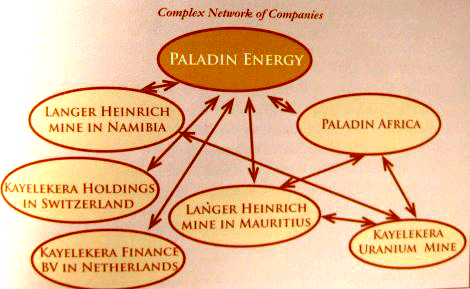
As a result, all day shift buses were forced to stop inside the concession area where workers then had to disembark – about five kilometres away from the actual site. To their dismay, the protesters were forced to picket at the concession area. The Mineworkers Union of Namibia (MUN) branch executives felt that the mine’s management snubbed what it termed a legal and democratic action. Continue reading
World Meteorological Organisation’s critical report on Climate Change


The WMO says droughts affect more people than any other kind of natural disaster because of their large scale and long duration. The decade saw droughts across the world, with some of the longest and most severe in Australia (2002 and other years),
Clear upward trend’ in global temperatures: WMO ABC News, ALEX KIRBY, 5 July 13, In the first decade of this century extreme weather, global temperatures and sea level all continued a trend in a “clearly upward direction”, says a new report from the World Meteorological Organisation.
If you think the world is warming and the weather getting nastier, you’re right, according to the United Nations agency committed to understanding weather and climate.
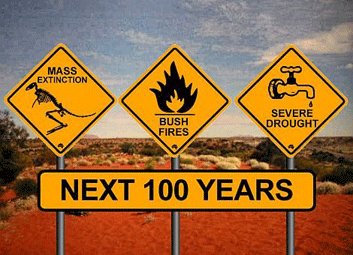
The World Meteorological Organisation says the planet “experienced unprecedented high-impact climate extremes” in the ten years from 2001 to 2010, the warmest decade since the start of modern measurements in 1850.
Those ten years also continued an extended period of accelerating global warming, with more national temperature records reported broken than in any previous decade. Sea levels rose about twice as fast as the trend in the last century.
A WMO report, The Global Climate 2001-2010: A Decade of Climate Extremes, analyses global and regional temperatures and precipitation, and extreme weather such as the heat waves in Europe and Russia, Hurricane Katrina in the US, tropical cyclone Nargis in Myanmar, droughts in the Amazon basin, Australia and East Africa, and floods in Pakistan. Continue reading
Highest radiation levels in a year recorded in Fukushima
 Fukushima records highest radiation level in a year http://www.straight.com/blogra/398066/fukushima-records-highest-radiation-level-year by
  CHARLIE SMITH on JUL 4, 2013 You might think that radiation levels would be falling more than two years after Japan’s most serious nuclear disaster since the bombing of Nagasaki in the Second World War.
But on a rooftop in Fukushima, radioactive cesium levels were at the highest levels observed in the past year, according to the Asahi Shumbun newspaper. The publication reported that University of Tokyo associate professor Ryoji Enomoto found moss with 1.7 million becquerels just over 50 kilometres from a crippled nuclear-power plant.
This was confirmed by a nonprofit group, the newspaper noted. According to an article by David Chandler of the Massachusetts Institute of Technology, a dose of 500 millisieverts can cause symptoms of radiation poisoning. It’s not easy converting becquerels, which measures radiation emitted, to millisieverts, which measure biological damage.
But you would likely want to move if levels of 1.7 million becquerels were ever detected in your neighbourhood.
Scientists detect highest cesium levels in a year in Fukushima http://ajw.asahi.com/article/0311disaster/fukushima/AJ201307040081 July 04, 2013 FUKUSHIMA–Radioactive cesium levels found in moss on a rooftop in downtown Fukushima exceeded 1.7 million becquerels, the highest levels detected in a year, researchers said. Continue reading
A public health challenge to Australia’s use of medical ionising radiation
We’ve known about the risks of radiation for some time, but these three studies quantify the risks. Essentially, they show that relatively low doses of ionising radiation, previously considered ‘safe’ can translate into excess cancer cases.
We believe that these findings call for a change in imaging practice. First, ionising radiation should be a consideration for the referring doctor when deciding whether a patient needs a scan (and if so, what type). Second, imaging techniques and machines that reduce ionising radiation doses should always be used. Finally, government funding models must be reviewed to ensure there are no inappropriate incentives towards a radiating scan.
For example, in Australia, if a young patient presents to a GP with low back pain and the GP orders a scan, Medicare would fund a CT scan but not a magnetic resonance imaging (MRI), even though this may be a safer alternative in terms of radiation.
The body of evidence is growing. We need to start translating evidence into practice
 The risks of ionising radiation: three new studies and their impact on imaging in sports medicine http://www.clinicalsportsmedicine.com/the-risks-of-ionising-radiation-three-new-studies-and-their-impact-on-imaging-in-sports-medicine-jessica-orchard-and-john-orchard~ Jessica Orchard and John Orchard 2 July 13, In 2012, two major studies were published about the risks of ionising radiation from imaging. Pearce and colleagues’ study in The Lancet examined the excess risk of leukaemia and brain tumours for children and adolescents exposed to computed tomography (CT) scans. They found that children exposed to cumulative doses of 50mGy (3-5 CTs) may have triple the risk of leukaemia, and doses of 60mGy may have almost triple the risk of brain tumours.[1] In addition, the Pijpe and colleagues’ GEN-RAD-RISK paper in theBMJ[2] study showed that women such as Angelina Joliewho carry a specific mutation associated with breast cancer (BRCA1/2), and who were exposed to diagnostic radiation before the age of thirty, had almost twice the risk of breast cancer (with a dose-response pattern). This study involved lower doses, which we have previously considered fairly ‘safe’ (e.g. 4mGy from a single mammogram or shoulder X-ray).
On the basis of these studies, we wrote a blog post and started writing an editorial for theBritish Journal of Sports Medicine. While we were in the final stages of preparing the editorial,[3] a third study was published. The Matthews et al Australian data linkage study,[4] with an enormous cohort (11 million) showed that the adjusted overall cancer incidence for young people exposed to a CT scan was twenty-four percent greater than for those who were not exposed.
That is, one in every 1800 scans resulted in an excess cancer case. As the mean follow up time was only 9.5 years (relatively short in relation to the time taken to develop cancer), this suggests the true lifetime risk may be much higher. We await with interest the relative risk in older people to see whether the risks for the young also apply to those in middle age. Continue reading
Sea level rise likely to affect Wyong properties
Wyong Council Meeting: Sea Level Rises on the Agenda ABC News, Jul 4, 2013 A sea level-rise recommendation being made to Wyong Council could have ramifications for thousands of home owners.
The Tuggerah Lakes Estuary and Flood Plain Management Committee will tonight recommend to Council that the 1 in 100 flood level should be increased by 400 milimetres to cope with future sea level rises.
If the recommendation is accepted by council, homes would need to be built at 3.1 metres above sea level rather than the current 2.7 metres…..http://www.abc.net.au/news/2013-07-04/wyong-council-meeting3a-sea-level-rises-on-the-agenda/4800070
The Uranium Exploration and Mining Accountability Act – indigenous Americans fight back
The proposed legislation can be found at the website of Defenders of the Black Hills,
 Uranium Mining and Native Resistance: The Uranium Exploration and Mining Accountability Act http://intercontinentalcry.org/uranium-mining-and-native-resistance-the-uranium-exploration-and-mining-accountability-act/ BY CURTIS KLINE • JUL 2, 2013 NATIVE AMERICANS IN THE NORTHERN GREAT PLAINS HAVE THE HIGHEST CANCER RATES IN THE UNITED STATES, PARTICULARLY LUNG CANCER. IT’S A PROBLEM THAT THE UNITED STATES GOVERNMENT HAS WOEFULLY IGNORED, MUCH THE HORROR OF THE MEN AND WOMEN WHO MUST CARRY THE PAINFUL, LIFE-THREATENING BURDEN.
The cancer rates started increasing drastically a few decades after uranium mining began on their territory.
According to a report by Earthworks, “Mining not only exposes uranium to the atmosphere, where it becomes reactive, but releases other radioactive elements such as thorium and radium and toxic heavy metals including arsenic, selenium, mercury and cadmium. Exposure to these radioactive elements can cause lung cancer, skin cancer, bone cancer, leukemia, kidney damage and birth defects.”
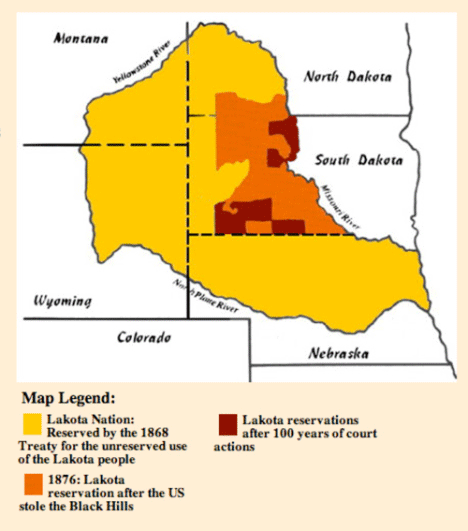
Today, in the northern great plains states of Wyoming, Montana and the Dakotas, the memory of that uranium mining exists in the form of 2,885 abandoned open pit uranium mines. All of the abandoned mines can be found on land that is supposed to be for the absolute use of the Great Sioux Nation under the 1868 Fort Laramie Treaty with the United States.
There are also 1,200 abandoned uranium mines in the Navajo Nation, where cancer rates are also significantly disproportionate. In fact, it is estimated that 60 to 80 percent of all uranium in the United States is located on tribal land, and three fourths of uranium mining worldwide is on Indigenous land.
Defenders of the Black Hills, a group whose mission is to preserve, protect, restore, and respect the area of the 1851 and 1868 Fort Laramie Treaties, is calling the health situation in their own territoryAmerica’s Chernobyl. Continue reading
The reality of Australia’s sorry history on nuclear disarmament policy
 AUSTRALIA’S NUCLEAR DISARMAMENT HYPOCRISY , Right Now, BY DAVID DONALDSON 4 July 13 “……..The Australian government’s submission also noted that extended deterrence has “removed the need for Australia to consider more significant and expensive defence options” – defence-speak for Australia developing its own nukes. Linking Australia’s decision not to develop nuclear weapons – a position to which it is bound by international law – to extended nuclear deterrence amounts to little more than an absurd threat to the Americans not to remove a guarantee that has never been publicly acknowledged.
Such statements demonstrate the lack of real commitment by the Federal Government to disarmament, and have no doubt made Obama’s stated desire to reduce the number of nuclear weapons in the world that little bit harder. Faced with an inevitably sceptical Pentagon and obstructive allies like Australia, the soaring anti-nuclear rhetoric of Obama’s 2009 Prague Speech has brought few results.
More recently, Australia refused to sign on to an 80-nation statement on the humanitarian impact of nuclear weapons at the 2013 Nuclear Non-Proliferation Treaty Preparatory Committee. The statement sought to address the fact that, in spite of the widely acknowledged catastrophic effects of any use of nuclear weapons, such concerns have “not been at the core of nuclear disarmament and nuclear non-proliferation deliberations for many years.”
While more than 150 countries have expressed support for a treaty banning nuclear weapons under international law – based on similar conventions on landmines and cluster munitions – the Australian government is not among them.
Moreover, the Future Fund continues to invest in nuclear weapons companies, despite having agreed to divest from tobacco, cluster munitions and landmines companies……. HTTP://RIGHTNOW.ORG.AU/WRITING-CAT/ARTICLE/AUSTRALIAS-NUCLEAR-DISARMAMENT-HYPOCRISY/
Western Australians stand to benefit with employment from tourism, rather than mining
 Tourism is a much more important job provider than is mining. And – it must be noted – mining is transient – and usually leaves a nasty looking degraded environment, and a dying town, when it ends. Tourism goes on, can go hand in hand with environmental conservation, and provide ongoing employment.
Tourism a jobs winner http://au.news.yahoo.com/thewest/a/-/wa/17874412/tourism-a-jobs-winner/ Yolanda Zaw, 5 July 13, Tourism will overtake mining and construction as one of the biggest employers in WA, according to statistics to be released today. Tourism accounts for 7 per cent of all jobs in the State, just behind mining with 8 per cent, construction 10 per cent and health care and social assistance, the top employer with 11 per cent.
Tourism Council chief executive Evan Hall said tourism would become more important to the WA economy as the resources boom slowed.
“The trend is for tourism jobs to grow as mining jobs decline,” he said. “With the lower Australian dollar, cheaper hotel rates and more flights to Perth, WA can win back the leisure tourists we lost over the last few years.”
Mr Hall said in all other States tourism employed more people than mining. Continue reading
Hypocrisy ! Australian Pipeline Industry Association wants GAS to be treated as RENEWABLE ENERGY
Gas sector wants access to renewable energy support Climate Spectator, By a staff reporter 5 July 13 The Australian Pipeline Industry Association has called for gas suppliers to be able to access government support currently available to renewable energy.
In a policy document released today they suggest government establish a technology-neutral energy investment program, allowing renewables, clean coal, gas and any low-emission technologies to compete for investment funds……http://www.businessspectator.com.au/news/2013/7/5/renewable-energy/gas-sector-wants-access-renewable-energy-support
Dirty Tricks – Climate Change Denialists adopt Tobacco propaganda methods
 Climate Change Deniers Using Dirty Tricks from ‘Tobacco Wars’ http://www.sciencedaily.com/releases/2013/07/130704095132.htm July 4, 2013 — Fossil fuel companies have been funding smear campaigns that raise doubts about climate change, writes John Sauven in the latest issue of Index on Censorship magazine. Environmental campaigner Sauven argues: “Some of the characters involved have previously worked to deny the reality of the hole in the ozone layer, acid rain and the link between tobacco and lung cancer. And the tactics they are applying are largely the same as those they used in the tobacco wars. Doubt is still their product.”
Governments around the world have also attempted to silence scientists who have raised concerns about climate change. Tactics used have included: the UK government spending millions infiltrating peaceful environmental organisations; Canadian government scientists barred from communicating with journalists without media officers; and US federal scientists pressured to remove words ‘global warming’ and ‘climate change’ from reports under the Bush administration.
Writing about government corruption in the Indian mining industry, Sauven says: “It will be in these expanding economies that the battle over the Earth’s future will be won or lost. And as in the tobacco wars, the fight over clean energy is likely to be a dirty one.”
1 This month

of the week – Australians for War Powers Reform (AWPR)
To see nuclear-related stories in greater depth and intensity
 Antinuclear