Uranium miner Paladin among many suspected Australian tax cheats
Advocacy group ActionAid claims poor countries are losing more than $130 billion in tax revenues a year by giving generous tax breaks to big companies, including Australian miners. There are about 240 Australian mining companies with operations in Africa.
Perth-based uranium miner Paladin Energy, came under scrutiny for its tax arrangements in Malawi where it runs a mine in Karonga. A report by the group Norwegian Church Aid alleges there are discrepancies between Paladin’s reported tax and its tax paid. It also alleges other payments by Paladin in Malawi are lower than the company reports.
Paladin has subsidiaries registered in Mauritius and the British Virgin Islands, both tax havens. Last year’s annual report showed the company accumulated losses that mean it will need to make profits totalling $208 million in Australia before paying any tax.
Tax man takes scalpel to energy and resources firms http://www.theage.com.au/national/tax-man-takes-scalpel-to-energy-and-resources-firms-20130705-2phat.html July 6, 2013 Georgia Wilkins The Tax Office will open 60 cases of suspected tax dodging by Australian and international companies amid global pressure to crack down on profit shifting.
The investigations will add to the 26 cases of offshore restructuring already under review by the government body.
Under scrutiny are companies that deliberately restructure their business to route profits through low-tax jurisdictions or tax havens to avoid paying higher taxes in Australia, often through the use of post box companies or marketing hubs that have little real substance. Continue reading
Scandalous legacy of Western uranium mining companies in Africa
 Health hazards posed by uranium mining IPP MEDIA 5th July 2013“……..History has it that uranium mining companies had never solved problems associated with extraction of uranium and also never employed good practice of settling uranium radioactive waste seriously after the mining activity is complete.
Of course, these foreign companies have their eyes fixed on maximising profits against corresponding safe infrastructure investment. Some of the companies run away from implementing this social cooperative responsibility to the poor ignorant communities.
This happens in countries where local atomic energy commissions are non-existent, or if present are under- equipped with the necessary human and material resources for effective supervision, monitoring and control of the foreign mining companies for radiation protection  to the miners and the environment.
The whole population in the area surrounding the mines is endangered with the diseases mentioned above, lung cancer being the most serious for miners due to inhalation of radon gas in the pits and in the dusty atmosphere of the processing mills.
Uranium radioactive waste stored close to the mines can leach into ground water and contaminate drinking water. Other possibilities of radioactivity reaching humans and environment are a result of deficient radioactive waste management practices by the mining companies, Continue reading
At last, two countries willing to give asylum to fugitive whistleblower Edward Snowden
 Edward Snowden offered asylum by Venezuelan president Reuters in Caracas guardian.co.uk, 6 July 2013 Nicolás Maduro says whistleblower has ‘told the truth in spirit of rebellion’, while Nicaragua also weighs asylum offer Venezuelan president Nicolás Maduro said on Friday he had decided to offer asylum to former US intelligence contractor Edward Snowden, who has petitioned several countries to avoid capture by Washington.
“In the name of America’s dignity … I have decided to offer humanitarian asylum to Edward Snowden,” Maduro told a televised military parade marking Venezuela‘s independence day.
The 30-year-old former National Security Agency contractor is believed to be holed up in the transit area of Moscow’s Sheremetyevo international airport.
WikiLeaks said on Friday that Snowden had applied to six more nations for asylum, bringing to about 20 the number of countries he has asked for protection from US espionage charges.
Maduro said Venezuela was ready to offer him sanctuary, and that the details Snowden had revealed of a US spy program had exposed the nefarious schemes of the US “empire”.
“He has told the truth, in the spirit of rebellion, about the US spying on the whole world,” Maduro said.
“Who is the guilty one? A young man … who denounces war plans, or the US government which launches bombs and arms the terrorist Syrian opposition against the people and legitimate president Bashar al-Assad?”
“Who is the terrorist? Who is the global delinquent?”…….
Earlier on Friday, Nicaragua said it had received an asylum request from Snowden and could accept the bid “if circumstances permit”, president Daniel Ortega said.
“We are an open country, respectful of the right of asylum, and it’s clear that if circumstances permit, we would gladly receive Snowden and give him asylum in Nicaragua,” Ortega said during a speech in the Nicaraguan capital, Managua…….http://www.guardian.co.uk/world/2013/jul/06/edward-snowden-venezuela-asylum
Like King Canute, Wyong Council behaves as if the sea level will not rise
 Actually – that headline is not really fair to King Canute. The Canute story is that his courtiers believed that King Canute had god-like powers, and could stop the tide coming in. Canute, in order to educate them, went down to the beach, and ordered the tide not to come in. However, as he expected, the tide did come in, and he got wet.
And the Wyong mayor and councillors might get we one day.
Sea level rise recommendation rejected http://www.abc.net.au/news/2013-07-05/sea-level-rise-recommendation-rejected/4802480, 6 July 13
A sea-level rise recommendation for building heights in Wyong has been rejected by the Tuggerah Lakes Estuary and Flood Plain Management Committee.
Wyong Council staff had recommended that an increase to floor level building heights of 400 millimetres was needed to allow for any future
sea level rises. Wyong Mayor Doug Eaton says the recommendation was rejected five votes to one.
“That recommendation of the committee now has to go to council to be either endorsed or changed by it my view it will almost certainly be
endorsed,” he said.
Uranium company cuts back its NT and Queensland operations as uranium price plummets
 Deep Yellow slashes jobs, cuts pay, Minng.com, 5 July, 2013 Vicky Validakis Uranium exploration company Deep Yellow has cut jobs and reduced salaries by five per cent as it ramps up steps to reduce overhead costs, blaming the move on the weakness in the uranium sector.
The company announced board fees and executive salaries would be reduced by five per cent for at least six months, with salary scales to remain fixed at 2013 rates.
The company also said its Perth office had reduced staff to just three, comprising the managing director, financial controller and office manager.
Deep Yellow is said it is also planning to move to a smaller office by the end of the year.
The latest pay cuts follow a ten per cent reduction in base salary and fees and group-wide salary freezes in July 2012…… Deep Yellow’s chairman Mervyn Greene said the steps to reduce overheads costs was due to ongoing volatility in financial markets and a weakness in the uranium market…… In Australia the company owns the Napperby Uranium project in the Northern Territory as well as exploration tenements in Queensland. http://www.miningaustralia.com.au/news/deep-yellow-slashes-jobs-cuts-pay
Equipment breakdown at Fukushima – again, the cause was a rat
 Rat causes equipment breakdown at Fukushima No. 2 nuclear plant http://enenews.com/rat-equipment-breakdown-fukushima-2-nuclear-plant
Title: TEPCO reports another rat problem, this time at Fukushima No. 2 plant
Source: THE ASAHI SHIMBUN
Date: July 04, 2013
A rat caused a battery charger to break down in an emergency gas turbine generator vehicle at the Fukushima No. 2 nuclear plant, the latest rodent-related problem to hit Tokyo Electric Power Co.
The rat is believed to have entered the vehicle through a 3- to 4-centimeter opening for cables and then shorted a switchboard, a TEPCO official said July 3. […]
The gas turbine generator vehicle was deployed for emergency use at the No. 2 plant after the Great East Japan Earthquake […]
See also: NYT: Rat Chase Again Bedevils Fukushima Nuclear Plant — Power lost to spent fuel pool for hours
Victorian city of Ballarat could be powered by 100% renewable energy – Greens candidate
 Greens’ renewable energy plan outlined http://www.thecourier.com.au/story/1619753/greens-renewable-energy-plan-outlined/?cs=62 By PATRICK BYRNE July 5, 2013, THE Australian Greens candidate for Ballarat believes the city can one day be powered by 100 per cent renewable energy. Stephanie Hodgins-May yesterday announced a long-term plan to have Ballarat and the surrounding region invest more heavily in renewable energy.
She also slammed the federal opposition leader and Liberal members of parliament for denying the existence of climate change.
Ms Hodgins-May said the possibility of the region relying only on renewable energy was completely achievable.“When you look at a town like Daylesford, that whole town can be powered by only two wind turbines at the Hepburn wind farm,” she said.
“There is no reason why a city like Ballarat cannot one day rely solely on renewable energy.”
She said that both the Labor and Liberal parties needed to commit to a renewable future, instead of avoiding the issue and, in some instances, flatly denying the existence of climate change.“The Labor and Liberal parties are creating uncertainty with possible changes to the price on pollution and clean energy investment,” Ms Hodgins-May said.
Ms Hodgins-May announced plans for a “clean energy roadmap” that would help to one day power the city.The roadmap includes plans to increase the current renewable energy target, aiming to achieve 90 per cent renewable energy by 2030.The current government energy target is for at least 20 per cent of Australia’s electricity to come from renewable energy by 2020.
Sweden’s example to Australia, on low carbon cities
It ain’t just IKEA: we can learn from Sweden’s low-carbon cities The Conversation, Leigh Glover, Mikael Granberg 5 July 2013,While governments and nations are deadlocked in negotiations to reduce carbon emissions and prevent catastrophic warming, some cities are quietly turning over to renewable energy.
Sydney was the first Australian city to claim carbon neutrality in 2008, using offsets and Green Power. It aims to source all its energy from renewable sources by 2030. So, when it comes to cutting carbon, are cities the place to start?
There have been calls for Australian local government to promote low-carbon cities, especially since global levels of CO2 passed 400 ppm.
There are good reasons for aiming carbon-reduction at cities and local government. Local government can deal directly with households and small businesses in ways the state and federal government can’t. Local government has also proved to be an important source of program innovation.
But engaging Australia’s local governments is easier said than done. Our councils are uncoordinated, underfunded and often lack the necessary expertise when it comes to environmental protection.
Perhaps we can look elsewhere for inspiration. Recent achievements by Swedish cities show how Australian cities could adopt low-carbon initiatives.
A Swedish smörgåsbord Continue reading
A warning to Tanzania, (where an Australian company is to start mining uranium)
Health hazards posed by uranium mining IPP MEDIA 5th July 2013“…….. the developing countries in the process of starting mining uranium, must learn a lesson from the USA, the most powerful rich and technically advanced nation in the world, who for the sake of protecting its environmental pollution from the known post uranium mining hazardous health effects, to its citizen of today, tomorrow and future generation, admitted that enough was enough, and shut down most of uranium mining in their country.
The big lesson here for Tanzania with its Uranium deposit soon to be exploited is that; until now there is no proper way of destroying completely remains of uranium mining, and therefore it is difficult to control the effects of the mineral that will end thousands of years. Above all the cost of cleaning up the environment and avoidance of effects caused by remains of big uranium mines and management of radioactive waste will put a big strain on the already ailing country’s economy. Continue reading
Germany’s renewable energy success vindicate’s Chancellor Merkel’s no nuclear decision
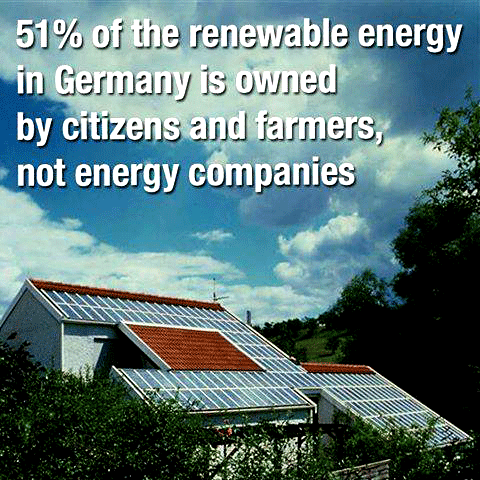 Nuclear Cuts Vindicate Merkel as RWE Profit Dips, Bloomberg By Julia Mengewein – Jul 5, 2013 Germany’s $710 billion green-energy drive is cutting production at nuclear reactors, the nation’s most profitable large-scale plants, as power prices slump to a six-year low. The proportion of hours during which electricity traded at less than 30 euros ($39) a megawatt-hour, the level at which UBS AG says reactors start losing money, rose to 50 percent last month, the most since 2007 and 92 percent more than a year ago, data from the Epex Spot SE exchange show. RWE AG (RWE) cut output at its Gundremmingen plant near Munich 31 times in the first half as solar and wind output jumped, compared with 18 times in 2012, according to data compiled by Bloomberg.
The reductions, which typically last for hours at a time, underscore how Chancellor Angela Merkel’s plan to replace atomic power with renewable energy within a decade is gaining ground at the expense of profit at utilities from RWE to EON SE. The boom in green power, coupled with the lowest demand in 10 years, sent the average operating margin at 15 European utilities to the lowest since 2002, company data compiled by Bloomberg show.
“We will see more of those situations where renewable output is so high, that spot prices collapse below the level of the cash costs for nuclear plants,” Patrick Hummel, an analyst at UBS in Zurich, said July 2 by e-mail. “This really is a double-whammy for power producers. Fewer running hours means less power is sold and that happens at a lower price.”….. Continue reading
Nuclear advertising film Pandora’s Promise gets it seriously wrong
Despite the unknowns, Pandora wants a massive turn to new types of nuclear power plants. The world’s power plants currently produce about 5,000 gigawatts (1 gigawatt = 1 billion watts). Replacing this fleet with new plants of 1 gigawatt each — the common commercial size — means building 5,000 new nuclear plants, over 10 times the current number. Existing experience indicates that $6 billion may be a lower cost estimate to build such plants, so the total cost would be about $30 trillion, possibly higher.
Is such a sum even conceivable? Maybe yes, but would such a massive program be the best use of $30 trillion? At the same time, Pandorafails to seriously address the promises and challenges of developing major roles for renewable energy.
“Pandora’s Promise” and “Switch” raise the right issues but get nuclear wrong, Grist, By John Perkins, 6 July 13Two recent movies, Pandora’s Promise and Switch, promote massive changes in the U.S. energy economy; both embrace nuclear power and point to France as the nuclear success story. The two-part company, however, on natural gas: Switch sees gas plus nuclear as the major energy sources of the future, but Pandora gives gas no significant role.
These are “good-bad” movies. They effectively raise the right issues but crash on flawed conclusions. Pandora correctly places energy at the heart of the most important environmental issue: climate change…..
Make no mistake about it: These films engage and persuade. That’s precisely why the nonsense of their conclusions is so deadly…… Continue reading
1 This month

of the week – Australians for War Powers Reform (AWPR)
To see nuclear-related stories in greater depth and intensity
 Antinuclear