Australian Labor and Liberal against Aboriginal Land Rights being enshrined in the Constitution

As far as I can see, corporate Australia will get its way, as usual, with a pretty meaningless and toothless reference to Aborignals in the Australian Constitution
 Major parties cool on ‘locking in’ land rights, ABC News 9 July 13 By Melanie Arnost The Federal Government and Opposition have both reacted coolly to a call from the Northern Land Council to have the Aboriginal Land Rights Act enshrined in the Australian constitution.
Land council chairman Wali Wunungmurra, speaking ahead of NAIDOC week’s celebrations of the Yirrkala bark petitions, said last week he wanted the act included in the constitution.
“(To) protect it from people watering it down, tearing it apart,” Mr Wunungmurra said…….The Yirrkala bark petitions were presented to Federal Parliament in 1963.
Mr Wunungmurra was one of 12 signatories to the petitions, which are credited with galvanising the land rights debate across Australia.http://www.abc.net.au/news/2013-07-08/cool-reaction-to-calls-for-land-rights-act-to-be-put-in-constit/4805192
Recognition of the Aboriginal law system in Australia
In 1971 Justice Blackburn dismissed the Yolngu claim but importantly did acknowledge for the first time in an Australian higher court the existence of a system of Aboriginal law
The Yirrkala Bark Petitions. How an old typewriter helped change the course of Australian history, Crikey BOB GOSFORD | JUL 07, 2013 “………In a small display case in a dimly lit room in Australia’s Parliament House in Canberra – cheek by jowl with a facsimile of the Magna Carta and Australia’sConstitution – sit three panels of richly painted stringy-bark.

It is significant that these documents, all of which inform contemporary law in this country, can be found within metres of each other. The Magna Cartaand The Australian Constitution are fundamental elements of European law in this country. Few Australians know of the content, importance and continuing relevance of the Magna Carta and our Constitution and even fewer know, let alone realise the significance of, these three small pieces of bark, each with ancestral images wrapped around a sheet of yellowing paper with faint text.
The first two of these petitions were presented to the Commonwealth Parliament 50 years ago in August 1963 and represent the first documents received by that parliament that recognised the existence – but not the primacy – of Aboriginal law and claims to ownership of their ancestral lands.
The petitions were unsuccessful – the first was the subject of an extraordinary technical challenge by then Territories Minister Paul Hasluck – but that did not deter the Yolngu traditional owners, who in December 1968 issued writs in the Supreme Court of the Northern Territory against the Nabalco Corporation, which had secured a bauxite mining lease from the Federal Government. In that claim the Yolngu claimed unextinguished communal native title to their lands. Continue reading
12 $billion costs, and over 3 years before Japan’s nuclear reactors could restart
 The regulator has said that its review of Japan’s nuclear fleet may take more than three years.
The equipment improvements the reactors need to comply with the new rules could cost the industry as much as $12 billion
Companies Face Long Wait to Restart Nuclear Plants in Japan, NYT By REUTERS July 8, 2013 TOKYO — Japanese nuclear operators applied Monday to restart reactors under rules drawn up after the Fukushima disaster, but  early approval is unlikely as a more independent regulator strives to show a skeptical public it is serious about safety.
The governing Liberal Democratic Party of Japan and the utilities are eager to get reactors running again, with the reining in of soaring
fuel costs a key part of Prime Minister Shinzo Abe’s economic plan.
But the Liberal Democrats must tread carefully to avoid compromising the independence of the new regulator, which is struggling to build credibility with a public whose faith in nuclear power was shaken after meltdowns at Tokyo Electric Power’s Fukushima Daiichi plant.
The Nuclear Regulation Authority has said it will take at least six months to review nuclear plants, after which the consent of
communities that are host to reactors is needed…….
Polls show that a majority of Japanese want to end reliance on atomic power and are opposed to restarting the plants. Continue reading
A warning that some solar panels are inferior
 Inferior Solar Panels Invade Australia Energy Matters 9 JULY, 2013: Inferior solar panels are being sold to unsuspecting Australians, with the cost in lost energy production calculated for the first time at $3,261* per household.
It is estimated 397,545 Australian homes have inferior ‘Tier 3’ solar panels installed, which are generally considered lower-grade due to the way they are manufactured. Three tiers of solar panel manufacturers were defined in an independent report by Pike Research in 20112.
Energy Matters’ Nick Brass explains why so many people have installed these ‘Tier 3’ solar systems.
“Unfortunately, people don’t realise they’ve purchased a second rate system. Unlike many consumer electronics that have brands famous for quality, the solar market in Australia is dominated by unknown brands – even though premium Tier 1 panels such as REC and Panasonic exist 3. Tier 2 panels can also be solid performers, but performance can vary wildly between the various brands2.” Continue reading
Dianne Stokes. from Northern Territory, in Melbourne for legal case against Muckaty nuclear waste dump
 *From Muckaty to Melbourne* Dianne Stokes, Traditional Owner for Muckaty (600km north of Alice Springs in the Northern Territory) is speaking at Friends of the Earth on Monday the 15th July. The fight to stop the radioactive waste dump at Muckaty is six years strong and counting.
 Come along to hear the Muckaty story and where the campaign and the community are at. The Muckaty Traditional Owners are challenging the Federal Government and the Northern Land Council in the Federal Court, there’s a hearing for the case on the morning of the 15th, so come along for court support if you’re able to (contact Gem on 0421 955 066 for details)!
And later that day. From Muckaty to Melbourne Monday 15th July 2013 6pm to 7.30pm at Friends of the Earth, 312 Smith St Collingwood.
Speakers:
Dianne Stokes, Traditional Owner for Muckaty
Natalie Wasley, coordinator Beyond Nuclear Initiative
There will be snacks! Organised by the ACE Collective (Anti-Nuclear and Clean Energy) at FoE. Facebook event: https://www.facebook.com/events/479899822098516/
Edward Snowden reveals Australia’s role in USA’s spying web
 Snowden reveals Australia’s links to US spy web Hume Weekly, By Philip Dorling July 8, 2013, United States intelligence leaker Edward Snowden has provided his first disclosure of Australian involvement in US global surveillance, identifying four facilities in the country that contribute to a key American intelligence collection program.
Classified US National Security Agency maps leaked by Mr Snowden and published by US journalist Glenn Greenwald in the Brazilian O Globo newspaper reveal the locations of dozens of US and allied signals intelligence  collection sites that contribute to interception of telecommunications and internet traffic worldwide.
The US Australian Joint Defence Facility at Pine Gap near Alice Springs and three Australian Signals Directorate facilities: the Shoal Bay Receiving Station near Darwin, the Australian Defence Satellite Communications Facility at Geraldton and the naval communications station HMAS Harman outside Canberra are among contributors to the NSA’s collection program codenamed X-Keyscore.
The New Zealand Government Security Communications Bureau facility at Waihopai near Blenheim also contributes to the program.
X-Keyscore reportedly processes all signals before they are shunted off to various “production lines” that deal with specific issues and the exploitation of different data types for analysis – variously code-named Nucleon (voice), Pinwale (video), Mainway (call records) and Marina (internet records). US intelligence expert William Arkin describes X-Keyscore as a “national Intelligence collection mission system”. Continue reading
Radioactive isotopes found in groundwater near Fukushima nuclear power plant
 Toxic radiation detected in groundwater at Fukushima nuclear plant Raw Story France-Presse July 7, 2013 Toxic radioactive substances have once again been detected in groundwater at the crippled Fukushima nuclear plant, its Japanese operator said on Sunday, the latest in a series of incidents at the tsunami-battered complex.
Tokyo Electric Power Co (TEPCO) said tests showed that tritium, a radioactive isotope of hydrogen used in glow-in-the-dark watches, was present at levels 10 times the permitted rate. “From test samples on July 5… we detected a record high 600,000 becquerels per litre” of tritium, 10 times higher than the government guideline of 60,000 becquerels per litre, TEPCO said in a statement….
 The new readings came after TEPCO said in late June that it had detected the highly toxic strontium-90, a by-product of nuclear fission that can cause bone cancer if ingested, at levels 30 times the permitted rate. At the time it had detected tritium at around eight times the allowed level, or 500,000 becquerels per litre.
The substances, which were released by the meltdowns of reactors at the plant in the aftermath of the huge tsunami of March 2011, were not absorbed by soil and have made their way into underground water.
Subsoil water usually flows out to sea, meaning these two substances could normally make their way into the ocean, possibly affecting marine life and ultimately impacting humans who eat sea creatures…. http://www.rawstory.com/rs/2013/07/07/toxic-radiation-detected-in-groundwater-at-fukushima-nuclear-plant/
Radiation leak plans at Olympic Dam uranium mine – 15 years out of date
 Olympic Dam mine radiation leak plan 15 years out of date news.com.au by: Miles Kemp The Advertiser July 07, 2013 THE radiation plans for Olympic Dam are more than 15 years out of date because of an administrative bungle, the Environment Protection Authority has revealed.The plans are needed because between 2003 and 2012, BHP-Billiton reported 31 radiation leaks at its Olympic Dam mine, totalling more than 3000 cubic metres of material, or the volume of a large hot-air balloon.
Responding to a Freedom of Information application that exposed the problem, the EPA could only find plans from 1997 and 1998 and has stated: “We acknowledge that an update is overdue and action is being taken to address this situation”. Greens MLC Mark Parnell said he sought a copy of the management plan to monitor how BHP-Billiton dealt with radiation leaks to protect workers and the environment.”Workers at Olympic Dam are at risk because the EPA and BHP-Billiton have failed to update their practices for over 15 years,” he said. “What sort of oversight is there by the EPA at Olympic Dam when the basic management plan required under the National Code is ridiculously out of date?”
The EPA searched its records for 10 months before responding that there was no up-to-date plan and it needed a new one. “All these plans should be available in the public realm and not have to be chased using FOI application,” Mr Parnell said.
He said there had been six triggers since 1998 that should have prompted an updated plan, including an expansion in the mine’s capacity.”Between 1998 and 2013, an extraordinary amount of change has occurred in the regulation of radioactive material, with increasing awareness of the risks to workers and the natural environment and advances in processing,” he said…….. http://www.adelaidenow.com.au/national-news/south-australia/olympic-dam-mine-radiation-leak-plan-15-years-out-of-date/story-fnii5yv4-1226675659296#ixzz2YU1PMjCI
Graphic evidence of Germany’s successful transition to renewable energy
I highly recommend this article. It shows with several excellent graphs, just how successful German counties are being in developing renewable energy and energy efficiency. The example below is of just one county
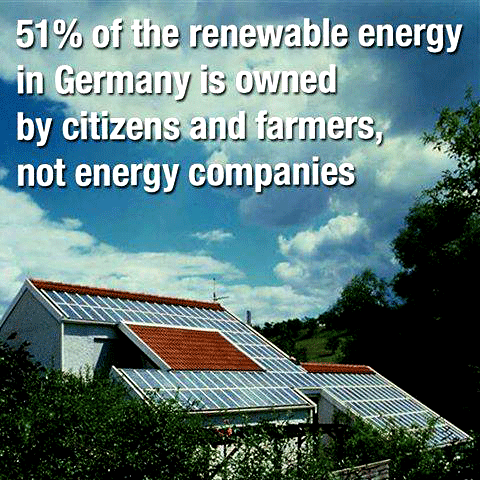 One of the most important details being missed by most of those common limited observations is the fact that the renewable energy success of the last decade was mainly driven by some pioneering regions, counties, and municipalities. Those local communities moved forward with conviction, while many others have remained dormant willingly or hindered by state governments that blocked investments by passing arbitrary anti-renewable regulations in favor of conventional power companies.
To showcase what we know about what is at least possible, here are the top 3 out of 295 Landkreise (Counties / administrative districts) in terms of the renewable share in their regional power mix. Most of their success is based on investments during the last 10–15 years based on technology that is now outdated

Germany: 100% renewable energy and beyond http://reneweconomy.com.au/2013/germany-100-renewable-energy-and-beyond-78310 By CleanTechnica on 8 July 2013 While many countries still discuss whether or not a 100% renewable energy system – or “just” a 100% renewable electricity supply – is even theoretically possible, Germans seem no longer bothered by such unscientific doubts. To make matters “worse,” some of them (including myself) are even convinced that a transition to a 100% renewable energy system can and should be accomplished within only a few decades’ time.
Some people might find this different perception of the problems we face to overcome the energy crisis of the 21st century so puzzling that they would rather choose to believe that the Germans have simply gone mad. Luckily, nothing could be further from the truth, and I’ve got a few nice examples that might explain the German mindset……
Another popular myth among so called “professional journalists” is that what is happening in Germany is due to on some kind of “big government” program. Obviously, this domestic narrative-driven reporting is not very interested in looking at important details that could explain the big picture. Continue reading
Maurice Newman and fossil fuel front group stop New South Wales wind farm
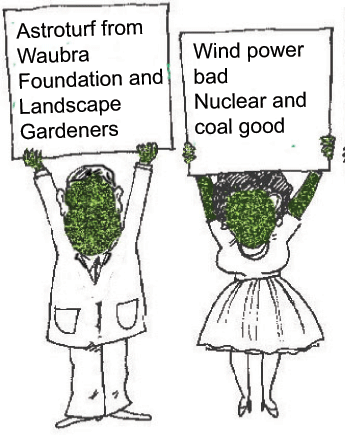 Protests stop wind farm plan BY:HARRY EDWARDS The Australian July 08, 2013 A LARGE wind farm proposed for near Goulburn in NSW has been shelved after protests from local landholders including Maurice Newman, the former head of the Australian Securities Exchange who has been anointed to chair a new business advisory council if the Coalition wins this year’s federal election.
The planning application for the 100-turbine Golspie wind farm, lodged by renewable energy developer Wind Prospect CWP, lapsed last week, with the company citing “wind resource, land security and grid connection issues”.
Mr Newman, who opposes wind farms and has pledged to lobby against subsidies for them, argues that fluctuations in output from renewable energy sources have increased power costs for consumers by requiring the construction of expensive backup generators.
Mr Newman belongs to Landscape Guardians, a community lobby group that actively campaigns against all wind farms in the Upper Lachlan shire, where he owns land. In January Tony Abbott announced that Mr Newman — appointed by the Howard government to chair the ABC — was his choice to head a new business advisory council for a Coalition government……

Labor’s Renewable Energy Target aims to have 20 per cent of electricity generated from renewable sources by 2020. The Coalition intends to review the RET next year if it wins the election, and could rely on Mr Newman’s advice to scrap the target.
Climate Change Minister Mark Butler said the system was working. “Labor stands by our unprecedented investment in clean, renewable energy which is driving a transformation of the Australian economy with a 30 per cent increase in renewable energy generation in the last 12 months and a 7 per cent drop in carbon pollution in the national electricity market,” he said……. http://www.theaustralian.com.au/national-affairs/climate/protests-stop-wind-farm-plan/story-e6frg6xf-1226675644019
Tasmanian government acting on UV radiation danger of solariums
Tasmania to outlaw use of solariums Examiner By Alex Druce July 7, 2013, WIDELY publicised cancer risks and strict operating laws have seen tanning beds almost phased out of Tasmania. And in 18 months, they will be outlawed completely.
Health Minister Michelle O’Byrne said Tasmania would join New South Wales, Victoria and South Australia in banning solariums from commercial use by December 2014.The move comes four years after the government slapped heavy restrictions on solarium owners, including bans for customers aged under 18, bans for people with very fair skin, and mandatory training for all operators. Continue reading
Nuclear executives facing the unpalatable reality of the industry’s decline
 Nuclear power faces uncertain future The shifting economics of energy and Japan’s Fukushima disaster may have squashed the industry’s attempted comeback. Jonathon Berr, MSN Money, 7 July 13, About a decade or so ago, many Americans were talking about a “Nuclear Renaissance.” The public’s unease about the industry, which dated at least as far back as the 1979 Three Mile Island accident, had begun to fade and new nuclear power plants were being proposed in the U.S. for the first time in decades…..Now, though, optimism surrounding nuclear energy is slipping away, even as President Obama has vowed that 80% of America’s electricity will come from renewable resources by 2035 to reduce greenhouse gas emissions…….
“There were expectations that (a new nuclear plant) might come, but the combination of the recession and the development of shale gas practically nipped it in the bud,” says John Rowe, the former chief executive of Exelon(EXC -1.13%, news), one of the biggest operators of nuclear power plants, in an interview. “You just don’t have an economic space for new nuclear anymore.”
Exelon, which is based in Chicago, looked into building new reactors in Texas but scrapped the idea in 2007 when it realized the project was economically unfeasible, he said. Merchant power plant operator NRG Energy (NRG -0.46%, news) also abandoned a reactor project in the Lone Star State in 2011. Duke Energy (DUK -0.18%, news) shelved plans for reactors in North Carolina earlier this year….. Continue reading
The success of California’s renewable energy ambition
 California finds clean energy’s magic ingredient: Ambition REneweconomy, By Giles Parkinson on 8 July 2013 California, the world’s eight biggest economy, has a lot in common with Australia, the 13thbiggest. Both have emission reduction targets, a carbon price, renewable energy targets, strong rooftop solar programs, and energy efficiency measures. The one big thing that California has that Australia doesn’t is ambition.
That is why on all those measures, California is way ahead of Australia. There is no talk of repealing or diluting the carbon price, and its renewable energy target is 33 per cent by 2020 instead of 20 per cent in Australia. Some time in the next couple of years the California legislature in Sacramento is likely to move the bar even higher, to 40 or even 45 per cent (by 2025 or 2030).
Edward Randolph, the energy director from the California Public Utilities Commission, which oversees the investor-owned utilities in the state, says constantly raising that level of ambition has proved extremely successful. Continue reading
Solar powered plane flies across America

 Solar-Powered Plane Lands At JFK in a Sweeping Victory For Renewable Energy http://www.policymic.com/articles/53209/solar-powered-plane-lands-at-jfk-in-a-sweeping-victory-for-renewable-energy Maggie O’Neill, 7 July 13Last night, at approximately 11:09 PM, co-pilots Bertrand Piccard and André Borschberg safely landed at JFK International Airport on a plane operated by nothing but solar energy.
New York was the final destination of a transcontinental journey that began in San Francisco, followed by Phoenix, then Dallas, then St. Louis, and then Washington, D.C. Continue reading
Protest against nuclear waste dump plan for Great Lakes area

 Stop the Great Lakes Nuclear Waste Dump Eco Watch, Michael Leonardi July 3, 2013“………. More than 500 citizens from across North America gathered at the Southampton, Ontario, flagpole on High Street by the lake. They gathered to voice their opposition to nuke dumps on these beautiful shores and to the continued production of this dangerous and deadly waste. They walked several kilometers through the town and along the beach to heighten awareness and bring attention to this diabolical plan, orchestrated largely in secret by local and national authorities and a deceitful industry, to bury low level, intermediate and high level nuclear waste underground and less than a mile away from this important fresh water source. They gathered to push back against a corrupt political leadership from the local level to the upper levels of dirty energy frontman Stephen Harper’s disastrous national government. They marched to say no to an industry that has been lying and deceiving the public about the dangers of nuclear energy and radiation exposure for decades. They walked to promote real renewable wind and solar energy alternatives.
Surely the question that comes to many is why on Earth would anyone in their right mind consider the shores of Lake Huron for the first permanent nuclear dump in North America? Lake Huron sits to the north of Lakes St. Clair, Erie and Ontario and the water of this lake flows southward and eastward, eventually connecting to the Atlantic Ocean through the St. Lawrence Seaway. The Great Lakes account for 21 percent of the world’s fresh water resources, or a little over one fifth, and to many native American cultures and First Nation peoples, the Great Lakes are considered the sacred heart of Turtle Island. So, why would anyone consider dumping radioactive poisons that will remain deathly dangerous for hundreds of thousands of years next to such an integral part of the our Great Lakes ecosystem? The answer begins with the human folly of siting what is now the world’s largest nuclear energy producer in this very same location. Continue reading
1 This month

6 March -Online – Reversing nuclearization:
From nuclear weapons in Belarus and NATO host countries to a European-Nuclear-Weapon Free Zone
Mar 6, 2026 03:00 AM in Canberra, Melbourne, Sydney

of the week – Australians for War Powers Reform (AWPR)
To see nuclear-related stories in greater depth and intensity
 Antinuclear