Renewable energy is revolutionising Australia’s power generation sector
 Renewable Energy Making Its Presence Felt In Australia http://www.energymatters.com.au/index.php?main_page=news_article&article_id=3836, 12 July 13 Once disregarded as being any sort of threat to the energy status quo; renewable energy is rapidly changing the power generation sector in Australia.
According to a new report from the Energy Supply Association of Australia (ESAA), new renewable and gas power stations now account for more than 90 per cent of planned energy investment in the country.
Wind farms made up half of all new large-scale generation investment in 2012-13, compared to just 11 per cent in 2002-03.
The ESAA has acknowledged renewable energy has reined in the average wholesale price of electricity; but believes this isn’t necessarily a good thing. Others might argue the energy gravy train losing a little of its bloat is a very good thing indeed. The number of instances where the wholesale cost of electricity jumped above $300 per megawatt hour have greatly decreased in recent times. The consumer is yet to see any benefit as any savings have been overshadowed by network cost increases.
The ESAA raises the spectre of reliability issues possibly resulting from a sustained lower wholesale electricity price, but it has noted reliability in Australia’s electricity supply improved in 2011/12 according to the Australian Financial Review. The ESAA also says the value of the National Electricity Market has shrunk by more than $4 billion, or 40 per cent, in the last four years.
In its public statement regarding the report, the ESAA has avoided directlydemonising home solar. A previous discussion paper on energy in Australia released by the organisation was criticised as being riddled with myths in this regard.
ESAA’s membership includes AGL, Origin, Energy Australia and other Big Energy participants.
The marked increase in renewable energy in Australia has also played a role in reducing power generation related carbon emissions. The pitt&sherry Carbon Emissions Index indicates electricity generation in the National Electricity Market (NEM) 2011-12 to 2012-13 decreased by 2.2 percent while emissions were down by 12.2 million tonnes carbon dioxide equivalent -equivalent to just under seven percent for the first full year under the carbon tax.
New World Nuclear Industry Status Report exposes the nuclear lobby’s fairy tale
As always in the face of failure, the industry puts forth new designs as a basis for new promises, now touting small modular reactors with the same fervour with which it touted large, partially modular reactors a decade ago. Congress finds a few hundred million to preserve these dreams even as its cutbacks shatter so many others.
A new movie, Pandora’s Promise (no film-maker familiar with nuclear history would include “promise” in a title intended to be pronuclear), recently screened at Sundance.Featuring the same old converts and straw men, it opened in cinemas a few weeks ago to tiny audiences and generally unenthusiastic reviews, especially from reviewers knowledgeable about nuclear power.
In the astonishing persistence of the global appetite for false nuclear promises lies the critical importance of the World Nuclear  Industry Status Report, published on Thursday.
Nuclear renaissance was just a fairy tale http://www.guardian.co.uk/environment/2013/jul/11/nuclear-renaissance-power-myth-us The promise of cheap, low-carbon power – with 31 new reactors in the US – was based on rhetoric and obedience. Anyone who doubts that should read the new status report on the industry Peter Bradford guardian.co.uk, 12 July 2013 Nuclear power requires obedience, not transparency. The gap between nuclear rhetoric and nuclear reality has been a fundamental impediment to wise energy policy decisions for half a century now.
For various reasons, in many nations the nuclear industry cannot tell the truth about its progress, its promise or its perils. Its backers in government and in academia do no better.
Rhetorical excess from opponents of nuclear power contributes to the fog, but proponents have by far the heavier artillery. In the US, during the rise and fall of the bubble formerly known as “the nuclear renaissance”, many of the proponents’ tools have been on full display. Continue reading
Planning report recommends go ahead for Western Australian wind farm
 Report gives conditional nod to wind farm http://www.abc.net.au/news/2013-07-11/report-gives-conditional-nod-to-wind-farm/4814128 Jul 11, 2013 A planning report, compiled for a panel that will decide whether a Great Southern wind farm proceeds, has recommended it go ahead with strict conditions.
Moonies Hill Energy’s Flat Rock Wind Farms project would create a 150-megawatt facility in the shires of Kojonup and Broomehill-Tambellup.
The company says the project could power 90,000 homes and inject $130 million into the local economy.
However, it hit a snag earlier this year when the Great Southern Joint Development Assessment Panel refused to give planning approval to the part of the development in Broomehill-Tambellup.
The company appealed against that decision and another hearing is scheduled for next Friday, when the panel will decide whether to accept the Broomehill-Tambellup Shire planner’s recommendation to approve it.
That recommendation includes strict conditions, including noise regulations and that the development begins within four years of the issuing of a building permit.
Increasing radiation levels into the Pacific, Japanese authorities do not know why
 Fukushima Radiation Leaks Rise Sharply By William Boardman, Reader Supported News 11 July 13 Bad as the situation is at Fukushima, it’s gotten worse. Perhaps you’ve heard that radiation levels of the water leaving the Fukushima Daiichi nuclear power plant in Japan and flowing into the Pacific Ocean have risen by roughly 9,000 per cent. Turns out, that’s probably putting a good face on it.
By official measurement, the water coming out of Fukushima is currently 90,000 times more radioactive than  officially “safe” drinking water. These are the highest radiation levels measured at Fukusmima since March 2011, when an earthquake-triggered tsunami destroyed the plant’s four nuclear reactors, three of which melted down.
As with all nuclear reporting, precise and reliable details are hard to come by, but the current picture as of July 10 seems to be something like this:
On July 5, radiation levels at Fukushima were what passes for “normal,” which means elevated and dangerous, but stable, according to measurements by the owner, the Tokyo Electric Power Company (TEPCO).
- On July 8, radiation levels had jumped about 90 times higher, as typically reported. TEPCO had no explanation for the increase.
- On July 9, radiation levels were up again from the previous day, but at a slower rate, about 22 per cent. TEPCO still had no explanation.
- On July 10, Japan’s Nuclear Regulation Authority (NRA) issued a statement saying that the NRA strongly suspects the radioactive water is coming from Fukushima’s Reactor #1 and is going into the Pacific.
The primary documents in Australian Aboriginals’ fight to keep their land
 50 YEARS ON, YIRRKALA CELEBRATES BARK PETITIONS THAT SPARKED INDIGENOUS LAND RIGHTS MOVEMENT Yahoo 7 News, 11 July 13, The remote community of Yirrkala in East Arnhem Land is celebrating 50 years since the signing of the historic bark
petitions that paved the way for the Indigenous land rights movement……… Local NAIDOC week coordinator Rosealee Pearson says what
the leaders achieved at a time before Indigenous Australians were even counted on the national census cannot be overstated.
“It’s pretty astounding that a group of people who weren’t even counted as human beings decided to do that,” she said.
“It’s because of them and the fight they fought that I exist as a person.”
The ochre-framed bark petitions were adorned with the clan designs of all that was threatened by mining – from the snakes to the sand dunes. They were first traditional documents to be recognised by the Australian Parliament.
Ms Pearson says the combination of traditional and modern forms of communication helped bridge a gap between the two cultures at the time. The petitions were created in 1963 to protest against the Federal Government’s removal of 300 square kilometres of land from the Arnhem Land reserve so that bauxite found there could be mined…… Despite not achieving the constitutional change sought, the petitions were the spark which lit the flame for the eventual recognition of Indigenous rights in Commonwealth law.
Less than five years later, a referendum was held and the Australian
Constitution amended to count Indigenous Australians in the national census.
Less than a decade after that, the Northern Territory Aboriginal Land Rights
Act was passed…….
http://au.news.yahoo.com/latest/a/-/article/17938240/50-years-on-yirrkala-celebrates-bark-petitions-that-sparked-indigenous-land-rights-movement/
Tony Abbott’s chief advisor out to prevent wind farm development
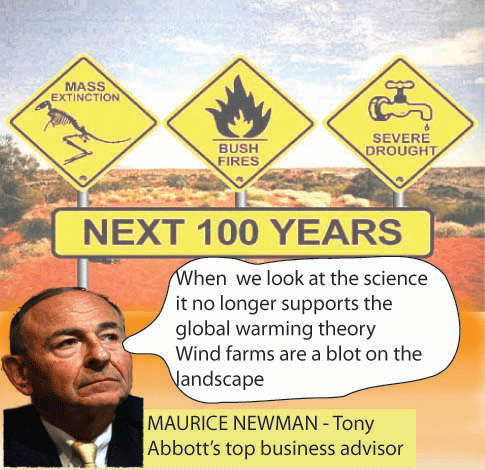 Abbott’s chief business advisor claims first wind farm victim REneweconomy, By Staff Reporter on 8 July 2013 Tony Abbott’s main business advisor, the former head of the Australian Securities Exchange Maurice Newman, has claimed his first wind farm victim after the development of 100-turbine project near Goulburn – and one of Newman’s properties – abandoned the plan.
The Australian reported on Monday that Wind Prospect CWP let the project lapse last week, citing “wind resource, land security and grid connection issues”.
The newspaper said Newman, who opposes wind farms and argues that fluctuations in output from renewable energy sources have increased power costs for consumers – by requiring the construction of expensive backup generators – belongs to the Landscape Guardians, a community lobby group that actively campaigns against all wind farms in the Upper Lachlan shire, where he owns land.
Silverton wind farm delayed on fear of Coalition election
Reviews of the renewables policy should occur every four years, rather than every two years, to give investors more confidence, according to a December recommendation from the Climate Change Authority, which is advising the government.
AGL Delays Australian Wind Farm on Government Policy Concern http://www.bloomberg.com/news/2013-07-11/agl-delays-australian-wind-farm-on-government-policy-uncertainty.html By James Paton – Jul 10, 2013 AGL Energy Ltd. (AGK), Australia’s largest developer of renewable energy projects, said it delayed a A$550 million ($509 million) wind farm because of uncertainty over government policy to boost investment in the industry.
AGL will defer hiring an engineering and construction contractor for the proposed Silverton wind farm in Australia’s New South Wales state and review its position in 2014, the Sydney-based company said today in an e-mailed statement.
“This decision does not indicate reduced enthusiasm for the project,” Nigel Bean, the head of power development at AGL, said in the statement.While Australia’s opposition coalition said in March that it’s committed to the nation’s 2020 renewable energy target, it called for a review of the policy in 2014 if it wins this year’s election, which must be held by Nov. 30. Australia plans to generate at least 20 percent of its electricity from renewable energy by the end of the decade as it seeks to reduce its dependence on coal.
 Prime Minister Kevin Rudd’s return to the leadership in Australia has sparked a surge in support for Australia’s Labor government, with a poll showing the party has closed the gap with Tony Abbott’s opposition. Labor rose to its highest level on a two-party preferred basis in almost nine months and is tied on 50 percent with the Liberal-National coalition, the Newspoll published July 9 in The Australian showed. Continue reading
Fukushima: potential danger of radioactivity measured in bequerels
Fukushima Radiation Leaks Rise Sharply By William Boardman, Reader Supported News 11 July 13 “………Here’s another perspective on the same situation:
- 10 becquerels per liter – The officially “safe” level for radioactivity in drinking water, as set by the NRA.
A becquerel is a standard scientific measure of radioactivity, similar in some ways to a rad or a rem or a roentgen or a sievert or a curie, but not equivalent to any of them. But you don’t have to understand the nuances of nuclear physics to get a reasonable idea of what’s going on in Fukushima. Just keep the measure of that safe drinking water in mind, that liter of water, less than a quart, with 10 becquerels of radioactivity.

- 60 becquerels per liter – For nuclear power plants, the safety limit for drinking water is 60 becquerels, as set by the NRA, with less concern for nuclear plant workers than ordinary civilians.
- 60-90 becquerels per liter – For waste water at nuclear power plants, the NRA sets a maximum standard of 90 becquerels per liter for Cesium-137 and 60 becquerels per liter of Cesium-134.
At some of Fukushima’s monitoring wells, radiation levels were in fractions of a becquerel on July 8 and 9. At the well (or wells) that are proving problematical, TEPCO has provided no baseline readings.
- 9,000 becquerels per liter – On July 8, according to TEPCO, the company measured radioactive Cesium-134 at 9,000 becquerels per liter. Since TEPCO characterized this as 90 times higher than on July 5, the implication is that the earlier reading (about 100) was less than twice as toxic as the allowable limit and only 10 times more toxic than drinking water for civilians.
- 11,000 becquerels per liter – TEPCO’s measurement of Cesium-134 on July 9.
- 18,000 becquerels per liter — TEPCO’s measurement of Cesium-137 on July 8.
- 22,000 becquerels per liter – TEPCO’s measurement of Cesium-137 on July 9.
- 900,000 becquerels per liter – TEPCO’s measurement of the total radioactivity in the water leaking from Reactor #1. This radiation load includes both Cesium isotopes, as well as Tritium, Strontium and other beta emitters. There are more than 60 radioactive substances that have been identified at the Fukushima site.
A becquerel is a measure of the radioactivity a substance is emitting, a measure of the potentialdanger. There is no real danger from radiation unless you get too close to it – or it gets too close to you, especially from inhalation or ingestion……. http://readersupportednews.org/opinion2/271-38/18354-focus-fukushima-radiation-leaks-rise-sharply
Australia helping China to organise its emissions trading cheme
 China seeks Australia’s help building emissions trading scheme The Age, July 11, 2013 Heath Aston Political reporter Australia has been drafted in to help design an emissions trading scheme for China, the world’s biggest polluter.
A deal announced in Canberra on Thursday will see the Australian National University take leadership of a program that will analyse pollution data provided by China and allow Chinese university researchers to examine Australia’s experience of the carbon tax and transition to an emissions trading scheme.
China is aiming for a full national emissions trading scheme by 2015.
The program, known as the “Australia-China research program on market mechanisms for climate change policy”, will team Australian researchers with those from three provincial universities in China and the Beijing Institute of Technology. The University of New South Wales and Melbourne University will also take part……. Climate expert and economist Ross Garnaut, a professor at ANU, said the most recent climate science showed a two degree warming of the planet was now a minimum and Chinese leaders understand there is a huge potential impact from climate for that nation. http://www.theage.com.au/federal-politics/political-news/china-seeks-australias-help-building-emissions-trading-scheme-20130711-2prjh.html#ixzz2Ys4PY1At
1 This month
15 April – Zoom –Nuclear Power is Not the Solution
Apr 15, 2026 01:00 AM in Canberra, Melbourne, Sydney

Join the International Physicians for the Prevention of Nuclear War (IPPNW) on Tuesday, April 14th for a timely webinar exploring the risks associated with nuclear power and challenging the myth that it offers a simple, safe, carbon-free solution to the climate crisis

of the week – Australians for War Powers Reform (AWPR)
To see nuclear-related stories in greater depth and intensity
 Antinuclear