Muckaty Traditional owners in Court today, challenging nuclear waste dump plan
 From Muckaty to Melbourne* Dianne Stokes, Traditional Owner for Muckaty (600km north of Alice Springs in the Northern Territory) is speaking at Friends of the Earth on Monday the 15th July. The fight to stop the radioactive waste dump at Muckaty is six years strong and counting.
Come along to hear the Muckaty story and where the campaign and the community are at. The Muckaty Traditional Owners are challenging the Federal Government and the Northern Land Council in the Federal Court, there’s a hearing for the case on the morning of the 15th, so come along for court support if you’re able to (contact Gem on 0421 955 066 for details)!
 And later that day. From Muckaty to Melbourne Monday 15th July 2013 6pm to 7.30pm at Friends of the Earth, 312 Smith St Collingwood.
Speakers:
Dianne Stokes, Traditional Owner for Muckaty
Natalie Wasley, coordinator Beyond Nuclear Initiative
A group of traditional land owners opposing the dump are fighting the case in court
Fight Continues Over Australia’s First National Nuclear Dump, National Geographic, by Natalia A. Bonilla on April 6, 2012 “….. the Australian Senate approved the National Radioactive Waste Management Bill, which proposes the construction of a nuclear waste dump in Muckaty Station. Australia does not have any nuclear power plants, but needs a repository for its medical and uranium mining waste, which is currently being held at temporary sites around the country.
The Muckaty site, situated about 75 miles (120 kilometers) north of the Tennant Creek township on Aboriginal land, has been under consideration as a potential dump site for the past six years, and a group of traditional land owners formally nominated the site in exchange for a promised $12 million payment.
But other clans have disputed the right of that group to make such a nomination. “None of the Ministers have ever come to talk to us about the waste dump,” some of Muckaty’s traditional land owners wrote in a petition last year. “We have invited [Resources Minister] Martin Ferguson to meet with us but he has never said yes. We have travelled a long way to see him, but when we go to his office in Melbourne they lock the door and won’t let us in to deliver our letters.
“We have never been properly told or asked about this dump, either by the Northern Land Council or the federal government.” Continue reading
America must face up to the reality of its accumulating radioactive trash

the only sane thing to do is to stop making the stuff!
If America chooses not to wake up to this reality, sooner or later it will cost us dearly: A spent fuel accident at San Onofre Nuclear Waste Dump could cost a trillion dollars. The spent fuel will need to be guarded for hundreds of millennia, but right now it is MOST important that it be guarded properly.
Shutting down ALL the reactors now, and properly securing ALL the waste immediately, is the only logical thing to do
 A spent fuel accident at San Onofre Nuclear Waste Dump could cost a trillion dollars. Deal with it. Salem News Ace Hoffman July 13th, 2013 “……..For all intents and purposes Fukushima was a spent fuel accident. While it’s true that the reactors tripped after the earthquake and had only been shut off for a short while when the tsunami struck, it’s also true that even if the reactors had been off for years, the same basic sequence of events could have happened if water wasn’t circulated properly
  around the used fuel assemblies.
Spent fuel is incredibly deadly stuff, but in fact, Fukushima was not a “worst case scenario” by any means. An even larger catastrophe is still possible at Fukushima because of the fuel that’s still there in the spent fuel pools and dry casks, and because the melted blobs of “corium” (uranium and plutonium) can theoretically go critical again. Massive explosions of the corium blobs are also possible without a new criticality event, when/if they reach the local water table. And more than two years after the meltdowns, nobody knows precisely where the corium blobs are.
There are 23 reactors similar to Fukushima’s operating in America, and all other types of reactors have other dangers which make them just as capable of catastrophic accidents as those were, but in different ways. There are no “safe” reactors, and there is no safe way to store or transport the fuel. Continue reading
In 2012 – it was a Very Bad Year for the nuclear industry
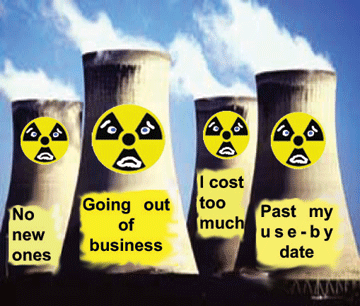 2012 Was the Worst Year Ever for Nuclear Energy the Motley Fool By Tyler Crowe, July 14, 2013 There are lots of nuclear energy companies that would like to leave 2012 behind. Of all the major energy sources, it was the only one that saw a global decline in total consumption. The decline in the United States was largely attributed to cheap natural gas, as it captured a much larger chunk of market share, while alternative energy options became more attractive. To compound the problem, the Fukushima Daiichi meltdown made several countries abroad rethink nuclear use. In Japan, 89% of all nuclear power was shut down as a result of the disaster.
So the question remains, where does nuclear go from here? The increasing attractiveness of solar and wind is going to make it harder and harder to justify using nuclear as a base-load power source, because the economics of doing so is not as attractive as that for natural gas or even coal…..
Sunshine Council – an Australian first – to have council solar farm
 Sunshine Coast Council To Go Solar http://www.energymatters.com.au/index.php?main_page=news_article&article_id=3837 14 July 13, Queensland’s Sunshine Coast Council is planning to build a solar farm that would supply half of its electricity needs. Mayor Mark Jamieson says it would be the first council in Australia to have a utility scale solar farm constructed.
“The $24-30m solar farm proposed to be built at Valdora near Coolum would meet half of council’s electricity needs for at least the next 30 years,” he said. “Over the next three decades council is expected to pay in excess of $110m for electricity, and the solar farm would have the potential to reduce that by many millions of dollars.”
Council believes it will save around $10 million over the expected life of the project.
The solar farm project would inject $10 million into the local economy over the next 10 years and create 40 jobs during construction.
One of the reasons Sunshine Coast Council believes now is the right time to invest is energy contract re-negotiation with current retailers is due in 2014. It also recognises solar panel prices are currently very low; something that could change given fluctuations in the Australian dollar and other factors.
The solar farm would help develop the Sunshine Coast’s cleantech industry hub and skills developed during construction could be deployed to similar projects within Queensland and elsewhere in Australia; helping to further diversify the local economy.
“This project has the potential to transform the Sunshine Coast. It would become the embodiment of everything we stand for; a region which is economically, environmentally and socially sustainable,” said Councillor Mark Jamieson. “It would save money, reduce our carbon footprint and take us another step closer to becoming the most sustainable region in Australia”
Council will call for Expressions of Interest to design and build the solar farm in the next few weeks and hopes construction will commence in 2014.
Doom and gloom in Australia’s uranium investment sector
 Uranium, rare earths miners in doldrums BY:ROBIN BROMBY The Australian July 15, 2013 A FEW years ago, talking up a well-balanced portfolio of uranium and rare earth elements assets would have been a mouth-watering come-on for investors. Not now, of course.
You’ve got Toro Energy (TOE) with most of its ducks in a row including finance and government approvals to develop Western Australia’s first uranium mine.
All except the rather important duck of a spot uranium price somewhere in the vicinity of $US70 a pound that would make the mine viable; it’s stuck with $US39.50/lb.
A few years ago, the average resources punter would have sold their children to raise money for buying such a share, but Toro languishes at just 9c.
And there was disappointment on Friday for Aura Energy (AEE), French nuclear giant Areva pulling the plug on plans to partner up with the Australian junior in its Haggan uranium project in Sweden, one of the largest undeveloped uranium projects in the world (389,000 tonnes)…..
Global warming brings multiple threats to nuclear and coal plants, says USA Dept of Energy
 Warming already taking toll on U.S. energy sector — DOE Hannah Northey, E&E reporterGreenwire: Thursday, July 11, 2013 Rising temperatures, decreasing water availability, more severe storms and rising seas stemming from climate change are already affecting every part of the country’s energy sector, and those threats will only grow more severe in years to come, the Energy Department said today.
DOE in a new report outlines the effects a warming world with more chaotic and damaging storms, wildfires and other natural disasters is having on oil and gas exploration, power plants, and an aging electric grid.
The outlook isn’t pretty.
The agency pointed to the unprecedented shutdown of a nuclear reactor because of rising seawater temperatures on the Connecticut coast last year, as well as the request by power plants to dump hotter-than-permitted water into nearby lakes and streams.
In another case, high temperatures and high demand last year caused a transformer and power line to trip in Arizona, triggering a cascading blackout that tripped the San Onofre nuclear plant offline, leaving millions of people without power. Continue reading
Australia’s democracy in thrall to the mining giants
The super-rich in this country, the owners of the mines and the banks in particular, exert huge pressure on the government to get exactly what they want, and to stall, co-opt or shut down any possible threat to their continual profit expansion.
It is also very clear that BHP, Rio Tinto other big fossil fuel companies simply will not stop until they have extracted every last drop of oil, pound of coal or gas from the ground in their insatiable search for profits. By that time it will be too late.
 This election, ‘fight for a meaningful democracy’ Green Left, , July 13, 2013 By Liam Flenady – We all know that Australia has experienced an unprecedented mining boom over the past decade. This boom is slowing now, but it is still producing huge wealth.
Over the last decade, profits of the mining companies have gone up by 400%. The big mining corporations now make almost a quarter of all profits in this country. Gina Rinehart now has a net wealth of $29 billion.
In the same period, the effective tax rate of the mining companies has plummeted from 40% down to just 13.9%. This is a disgracefully low figure.
The banks have also greatly benefited. At a time when the global economy is in crisis, Australia’s big four banks have been making huge profits. An article in the Sydney Morning Herald revealed that the four big banks made $27 billion in profit this year — a record.
And at the same time, nearly 3 million people in this country are living below the poverty line. The poorest 20% of the population own only 1% of the wealth, and the poorest 60% — that is, the majority — own less than 20%. Continue reading
San Onofre – a glaring example of America’s nuclear waste dilemma
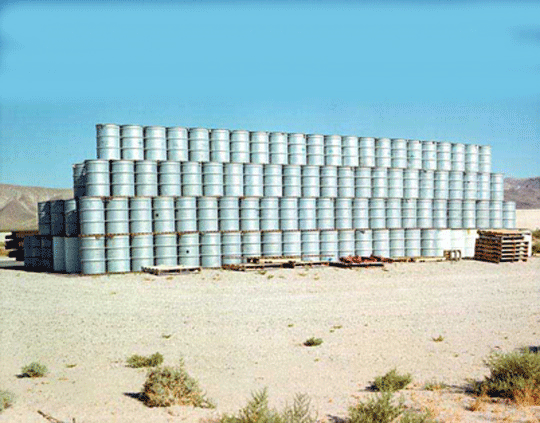
All plans for long-term or “interim” storage have been stopped thus far — not by “NIMBYism” so much as by common sense. No sane community wants the waste. 50 years ago the waste issue was recognized by many top scientists — brilliant nuclear physicists — as “intractable.” The definition of “intractable” has not changed in the interim. Solutions have not been found.
New dry casks are popping up around the country at the rate of about one a week these days. As spent fuel pools fill up, that rate will increase to a steady-state (for 100 reactors) of about 4 to 6 dry casks per week around the nation.
Each one, if its contents get out, could wipe out a small state
A spent fuel accident at San Onofre Nuclear Waste Dump could cost a trillion dollars. Deal with it. Salem News Ace Hoffman July 13th, 2013 “……… some people, even some among those who helped shut down San Onofre because of the danger, now refuse to talk about moving the waste, primarily for one of two reasons:
First, they are concerned about transportation accidents — a reasonable fear. But consider this: Transport risks last for only a few days each trip, and there are a finite number of trips, because, thankfully, the reactors at San Onofre are permanently closed. So that’s a relatively limited risk. On the other hand, leaving the waste to sit dangerously in an earthquake/tsunami/growing population zone is a danger that lasts for decades or centuries, and possibly forever.
The other reason some people oppose transporting the waste away from San Onofre is that there’s nowhere to put it. Continue reading
Arnhem land Aboriginals to bring gas protest to Sydney
 Traditional owners bringing gas protest to Sydney , Green Left Saturday, July 13, 2013 By Jim McIlroy Aboriginal traditional owners and the Protect Arnhem Land community campaign, based in the town of Maningrida, Northern Territory, are seeking the assistance of environment groups and Indigenous networks in Sydney to help raise awareness of the threat to Arnhem Land from oil and gas exploration.
Five traditional owners are travelling from Maningrida to Sydney in mid-July and are holding a public protest in Martin Place outside the offices of exploration company Paltar Petroleum.
The Environment Centre NT said: “Arnhem Land is under threat from fossil fuel companies and need your help. Ninety per cent of the land and all the nearshore waters are being targeted for exploration. These are some of the most ecologically uintact areas left in Australia, and the ancestral lands of thousands of Indigenous Territorians”.
The Wilderness Society and the Australian Marine Conservation Society are sponsoring the visit to Sydney by the Maningrida traditional owners.
The visit follows a growing campaign by NT traditional owners against oil and gas exploration in Arnhem Land. On December 10 last year, a meeting of 250 gathered in Maningrida to protest moves by Paltar Petroleum to gain exploration permits for offshore and onshore exploration in the region.
On February 19 this year, a large public meeting in Darwin, addressed by a broad range of speakers from concerned organisations, including Eddie Mason from the Maningrida community, and Drew Hutton from the Lock the Gate Alliance, condemned the plans for oil and gas exploration in the NT.
On March 14, a large meeting of traditional owners in Maningrida strongly opposed all oil and gas mining on land or sea in the Arnhem Land region. Since then, another company, Empire Gas, has claimed to have signed a Native Title Agreement with the NT Land Council and some Native Title claimants in the Urapunga region of eastern Arnhem Land.
[The protest will be held at 32 Martin Place, noon on July 19. For more information, visit Environment Centre NT.] See more at: http://www.greenleft.org.au/node/54497#sthash.UJOG9Scb.dpuf
PolitiFact – Fact Checker finds Coalition’s carbon price claims are false
 Coalition’s $15b carbon price claim ‘mostly false’ (includes videos) The Age, July 15, 2013 Peter Martin Economics correspondent What’s in a fact check?
Peter Martin explains how Fairfax’s fact-checking collaboration with PolitiFact, and reports back on its first target, the Coalition’s $15b carbon pricing claim.
The Coalition’s claim that moving swiftly to a floating carbon price would cost the budget up to $15 billion has been rated “mostly false” by the fact-checking service PolitiFact, which partners with Fairfax Media from Monday.
During the 40 days leading up to the election, PolitiFact will publish a checked fact a day on The Sydney Morning Herald and The Age websites.
The claim the change would mean “a black hole of up to $15 billion in the budget” was made by shadow treasurer Joe Hockey on the Channel Seven Sunrise program on Friday, June 28, two days after Kevin Rudd retook the Labor Party leadership…….More details are available at politifact.com.au. http://www.theage.com.au/federal-politics/federal-election-2013/coalitions-15b-carbon-price-claim-mostly-false-20130714-2py81.html#ixzz2ZA7evzxO
1 This month

of the week – Australians for War Powers Reform (AWPR)
To see nuclear-related stories in greater depth and intensity
 Antinuclear