Ignorance among Australians, even doctors, on the radiation hazard of CT scan
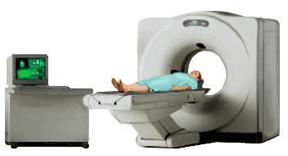 “It’s easier to administer, so it’s used more frequently – and is performed more often on children.
” we were astonished to find that many GPs incorrectly believe that CT scans deliver only a low-to-medium dose of radiation, and that MRIs and ultrasound scans also deliver radiation – they don’t.”
Radiating good health? Health Canal, Karen Green 15 July 13 CT scanning technologies have been simplified, but there are complex issues associated with the procedure, including its unnecessary use and the potential risk to the patient…….
“Australians are very keen to use new technologies. Current generations have different expectations of health care and thehealth system,” says Associate Professor Rachael Moorin, from Curtin’s Centre for Population Health Research……
Although most of us are keen to try medical innovations, Moorin is concerned about our lack of knowledge on some of the technologies we embrace – especially computed tomography, or CT, scanning.
CT scans deliver a high dose of radiation, she warns. And in some cases, the high-resolution scan delivered by CT doesn’t warrant the potential harm of the radiation exposure. “In the past, CT was used primarily for cancer diagnosis and follow-up. But today the technology is being used for conditions like sporting injuries,” Moorin says, “which changes the risk–benefit dynamic.”
MOORIN has been investigating the reasons for the surge indiagnostic imaging, and in CT scans in particular. The National Health and Medical Research Council is funding the study, recognising that the increase in CT scans has implications forpatient safety and policy decisions.
Another of her concerns is the manner in which CT scanning technologies are now ‘packaged’. “It’s often a ‘black box’ approach, with manufacturer presets that make the scan more automated and faster,” she says.
“It’s easier to administer, so it’s used more frequently – and is performed more often on children.
“However, the parameters need to be tailored to the patient to reduce the radiation dose.
“People don’t consider that the risk from radiation is cumulative over a lifetime, and the risk is exponentially greater at younger ages.”
The research leads from a previous study funded by the Cancer Council Western Australia. “There is a lack of consensus among service providers in Western Australia – including our public hospitals – on the radiation dose to use when CT scanning,” Moorin says…….
“And we were astonished to find that many GPs incorrectly believe that CT scans deliver only a low-to-medium dose of radiation, and that MRIs and ultrasound scans also deliver radiation – they don’t.”
Moorin’s study involves researchers from The University ofWestern Australia and Notre Dame University (Fremantle).http://www.healthcanal.com/public-health-safety/40781-radiating-good-health.html
No comments yet.
1 This month
7 April – WEBINAR – Australia and the Doomsday Clock – Preventing nuclear war through NoFirstUse and other policies
Online | Tuesday April 7, 4:00-5:30pm, Australian Eastern Time / 8:00-9:30am Central Europe Time
– Access the registration link
15 April – Zoom –Nuclear Power is Not the Solution
Apr 15, 2026 01:00 AM in Canberra, Melbourne, Sydney

Join the International Physicians for the Prevention of Nuclear War (IPPNW) on Tuesday, April 14th for a timely webinar exploring the risks associated with nuclear power and challenging the myth that it offers a simple, safe, carbon-free solution to the climate crisis

of the week – Australians for War Powers Reform (AWPR)
To see nuclear-related stories in greater depth and intensity
 Antinuclear
Leave a comment