Western Australia’s Noongar land deal not in the best interests of Aboriginals

It will be a mistake for Noongars and taxpayers to let this deal go through and allow the argument that all future claims have been extinguished.
If the deal goes through, future Noongars will have courts telling them that their ancestors signed their rights away
LAND DEAL FAILS IMPORTANT TESTS Lateral Love Australia Doubts surround the State Government’s native title deal, say Len Collard and Gerry Georgatos. 16072013 Doubts surround the State Government’s native title deal, say Len Collard and Gerry Georgatos. Much has been made of the State Government’s billion-dollar-plus offer to the Noongar people via the South West Aboriginal Land and Sea Council.
But is it a genuine native title offer or a politicised move to coerce a proposition that native title rights have been settled for all those considered Noongars and that all future rights are extinguished?
Noongar is a generic term and not representative of all the different cultural clans across Perth and southern WA — others include Whadjuk, Yuet, Mineng, Koreng, Ballardong, Bibbelmun and so on.
Legally, these Aboriginal clans and families will maintain connection to country that are exclusive domains and do not overlap one another. Continue reading
Central Victorian Greenhouse Alliance keen to keep energy efficiency and renewable energy investment
 Green group wants parties to keep carbon cutting commitment http://www.abc.net.au/news/2013-07-16/green-group-wants-parties-to-keep-carbon-cutting/4822444 Jul 16, 2013 A central Victorian green group says it is hopeful the move to an emissions trading scheme can continue to fund local energy efficient projects.
The Federal Government has announced it will remove the fixed carbon price a year earlier than planned. Prime Minister Kevin Rudd is expected to announce today how Labor would pay for the change, which is expected to cost the Government billions of dollars.
The Central Victorian Greenhouse Alliance’s Karen Corr says she just wants Labor and the Coalition to keep their commitment to reduce carbon emissions.
“But whatever way they do it, we’re really interested in the outcomes and the investment into our region so that we can encourage businesses and local government to move to energy efficiency and renewable energy as quickly as possible because that’s going to be better in the long-term anyway,” she said.
US navymen’s legal case over radiation-caused illnesses
Sailors were drinking desalinated seawater and bathing in it until the ship’s leadership came over the public address system and told them to stop because it was contaminated, Hair said. They were told the ventilation system was contaminated, and he claims he was pressured into signing a form that said he had been given an iodine pill even though none had been provided. As a low-ranking sailor, he believed he had no choice.
The Navy has acknowledged that the Reagan passed through a plume of radiation
The Defense Department created the Operation Tomodachi Registry to show radiation dose estimates based on shore locations — and to list more than 70,000 DOD-affiliated people in the area March 12-May 11, 2011 and their individual exposure levels. More than two years after the disaster, the registry remains incomplete.
In growing lawsuit, service members fault TEPCO for radiation-related illnesses By Matthew M. Burke Stars and Stripes July 15, 2013 SASEBO NAVAL BASE, Japan — Five months after participating in humanitarian operations for the March 11, 2011, earthquake and tsunami that led to nuclear disaster in Japan, Petty Officer 3rd Class Daniel Hair’s body began to betray him.
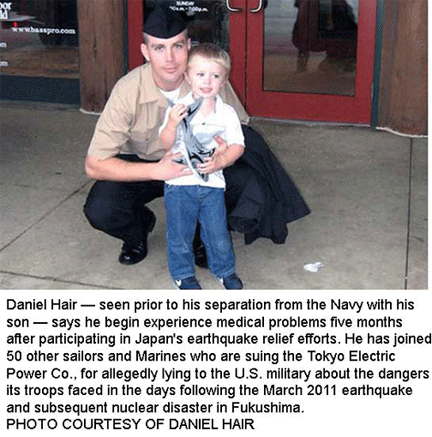
He had sharp hip pains, constant scabbing in his nose, back pain, memory loss, severe anxiety and a constant high-pitch ringing in his
ears as his immune system began to attack his body. The diagnosis, he said, was a genetic immune system disease, which on X-rays looked to have made his hip joint jagged and his spine arthritic. He was put on a host of medications and eventually separated from the Navy job heloved.
Hair believes radiation is the cause. He is among 50 sailors and Marines in a growing lawsuit against Tokyo Electric Power Co.,
alleging that Japan’s nationalized utility mishandled the meltdown at the Fukushima Dai-ichi nuclear plant that spewed radiation into the
air and water.
Other servicemembers have been diagnosed with leukemia, testicular cancer and thyroid problems or experienced rectal and gynecologicalbleeding, the lawsuit says. Hair said one of his friends, a fellow USS Ronald Reagan shipmate, was diagnosed with a brain tumor……..
The plaintiffs allege that TEPCO lied about the risk of exposure, luring American forces closer to the affected areas and lulling others
at bases across Japan to disregard safety measures. They are seeking at least $40 million each in compensatory and punitive damages and more than $1 billion for a fund to cover health monitoring and medical expenses. Continue reading
Official reports underestimate the extent and harm of Fukushima marine radiation
 It’s my conclusion that the official monitoring regime being carried out by TEPCO and other Japanese agencies is inadequate to the task of identifying the potential radiobiological threats to the public.
 Nuclear-news.net, Tim Deere-Jones: Marine Radioactivity Consultant July 2013 “……I am deeply concerned to note that a number of highly relevant issues and phenomena relating to the behaviour and fate of the Fukushima sea discharged radioactivity and its potential for delivering doses to human populations remain un-recorded, under researched and/or completely ignored.
Thus it is evident that the true impacts of the radioactive contamination of the Japanese east coast are not being documented or acted upon.
Issue 1: The number of radio-nuclides entering the marine environment of the east coast of Japan.
The currently operating marine environmental monitoring regimes in the relevant sea area are focussing on a very small number of radio-nuclides, principally Caesium, Iodine and Strontium which represent less than 10% of the total inventory of nuclides likely to be found in the reactor and cooling ponds of BWR nuclear power station (between 40 and 50)
I’m pretty sure that this is happening because of the relatively high costs of radiological analysis of samples. Having been involved in a number of field work campaigns which have involved raising funds in order to pay for radiological analysis I can confirm that the cost of analysis for caesium (for instance) are much lower than those of analysis for plutonium or tritium. ….
Issue 2: The nature of the radio-nuclides derived from reactor and cooling pond outputs:…… there can be little doubt that a range of other isotopes including actinides/ alpha emitters (probably 4 or 5 isotopes of Pu, 3 of Uranium, also Americium and Curium) will also have been released and entered the marine environment.
In the case of independent and self funding green groups and NGOs with limited resources this is both understandable and acceptable practice. However, in the case of national governments, government funded environmental protection agencies and nuclear industries, under whose watch a disaster of this magnitude has occurred, I can see no justification for refusing to investigate the concentrations of approximately 90% of the radioactive material (all of which are capable of contaminating environmental media and delivering doses of radioactivity to wildlife and human populations) that may have entered the marine environment
Issue 2: The nature of the radio-nuclides derived from reactor and cooling pond outputs:
Iodine is formed in fuel elements and would only be present in (coolant) discharges as a result of fuel cladding defects and or fuel pin failure.
Caesium is a fission product and is also present in coolant as a result of fuel pin cladding defect or failure.
The presence of both Iodine 131 and the two isotopes of Cs, demonstrates that fuel pin cladding defect and/or fuel pin failure has occurred.
If this is the case then there can be little doubt that a range of other isotopes including actinides/ alpha emitters (probably 4 or 5 isotopes of Pu, 3 of Uranium, also Americium and Curium) will also have been released and entered the marine environment…..
It’s my conclusion that the official monitoring regime being carried out by TEPCO and other Japanese agencies is inadequate to the task of identifying the potential radiobiological threats to the public.
They are under-measuring both in terms of nuclides and the number and type of samples they are investigating because they have failed to pursue the issue of Iodine and Caesium production to it’s logical conclusion, which is that fuel failure also leads to the production of alpha emitting actinides which must also be present in the environment (note the Pu found in “pools” adjacent to the NP station)
As nuclear industries , pro nuclear governments and their nuclear regulators always have done, they over represent the issue of dilution and dispersion
As nuclear industries, pro nuclear governments and their nuclear regulators always have done, they under represent the issues of re-concentration, transport, transfer from one environmental media to another and pathways of delivery to human populations…..http://nuclear-news.net/2013/07/17/fukishima-radioactivity-in-seawater/#more-54133
Fukushima radiation did reach Australia
 Traces of Fukushima reach Australia Asian Correspondent, By Gavin Atkins May 03, 2011 Tiny traces of radioactive particles from Fukushima have been picked up by monitoring stations in Australia, Fiji, Malaysia and Papua New Guinea.
Detected on April 13, the small amount of Xenon detected in Darwin is too small to be of concern for public health. The Government agency responsible,the Australian Radiation Protection and Nuclear Safety Agency (ARPANSA) has kept the news at a low profile by burying the information in its media releases. ARPANSA operates some of the monitoring stations and is tasked with informing the Australian public about radiation risks……..
The system of more than 270 monitoring stations around the world (eventually to number 337) is being established primarily to ensure that all nuclear tests are detected.
Eighteen of these stations operate around Australia and in Antarctica, and another two are being constructed…….
The monitoring system can detect a range of radioactive isotopes that would have been emitted from Fukushima including Caesium-137. The CTBTO says that current readings are clearly consistent with material from a damaged nuclear power plant, almost certainly Fukushima.
The monitoring stations are astonishingly sensitive, being able to pick up a few atoms of radioactive materials and can, for example, detect one tenth of a gram of Xenon if it is evenly distributed throughout the earth’s atmosphere. http://asiancorrespondent.com/53525/traces-of-fukushima-reach-australia/
Opportunity for more Australians to take up solar power
National solar provider Energy Matters says the early ETS move and retaining of the Household Assistance Package provides an opportunity for more families and businesses to not only burn a hole in their power bills or blow them away altogether by going solar; but to buffer against possible future electricity price rises that can occur due to a variety of factors.
Carbon Tax Relief = More Bucks For Australians To Go Solar http://www.energymatters.com.au/index.php?main_page=news_article&article_id=3843 17 July 13 The early move to an emissions trading scheme combined with the household assistance program staying as is presents an opportunity to use part of the windfall to create even more savings – by going solar now.
Prime Minister Kevin Rudd says the Federal government’s decision to terminate the carbon tax will help reduce cost of living pressures for families and operational expenses for small business. The Government will also be maintaining its special assistance payments given to families and low income earners. Continue reading
1 This month
7 April – WEBINAR – Australia and the Doomsday Clock – Preventing nuclear war through NoFirstUse and other policies
Online | Tuesday April 7, 4:00-5:30pm, Australian Eastern Time / 8:00-9:30am Central Europe Time
– Access the registration link
15 April – Zoom –Nuclear Power is Not the Solution
Apr 15, 2026 01:00 AM in Canberra, Melbourne, Sydney

Join the International Physicians for the Prevention of Nuclear War (IPPNW) on Tuesday, April 14th for a timely webinar exploring the risks associated with nuclear power and challenging the myth that it offers a simple, safe, carbon-free solution to the climate crisis

of the week – Australians for War Powers Reform (AWPR)
To see nuclear-related stories in greater depth and intensity
 Antinuclear