The week that was in nuclear news Australia
 Legal case; Traditional owners; led by Dianne Stokes, in Melbourne for their federal case opposing the Muckaty nuclear waste dump. Next hearing in August.
Climate Institute did a survey. Surprise surprise – they found that older men favour nuclear power, and women (of all ages) favour solar power.
The good news – New South Wales students taking their zero emissions house to China’s Solar Decathlon. Mildura’s concentrated solar power plant officially launched. Victorian and New South Wales wind farms kick-started by Clean Energy Finance Corporation. New South Wales to get advanced wind power turbines with energy storage. Central Victorian Greenhouse Alliance keen to keep energy efficiency and renewable energy investment
Politics. Kevin Rudd’s Emissions Trading Scheme is far from satisfactory. Still, it looks good compared to Abbott’s love affair with climate denialists. Greens launch an energy efficiency/renewable energy program directed towards helping farmers.
Nuclear issues in Australia would seem to be forgotten, with all the election – Rudd- Abbott – stuff,
And yet – and yet – Pro nuclear propaganda is rife. Australia’s new Energy Minister, Gary Gray, showed us again how he is as big an enthusiast for nuclear power, as Martin Ferguson was before him. A pity, in this new age of renewable energy, that the Labor government saw fit to appoint a mining man to the role. Gary Gray spoke in Perth at a uranium conference. He gave a rose-tinted view of the current disastrous state of the uranium industry, brushed off that minor “incident” at Fukushima, and displayed his ignorance of the world nuclear industry’s decline, and of climate change action.
Meanwhile, in South Australia, Family First Senate candidate Bob Day urges that Australia manufacture nuclear submarines – a good job provider, he reckons. Also from South Australia, nuclear lobby front groupers – Barry Brook, Ben Heard etc, gear up for a conference to be held in Sydney July 25-26 – to promote nuclear power for Australia.
The Age published a sloppily written article promoting nuclear power Want to kill fewer people? Go nuclear. I am hoping that The Age will publish a response to this article. (I’m adding my own comment below)
Australia’s uranium industry – in the doldrums, as even The Australian admits. Retiring soon, Paladin Energy boss John Borshoff admits that the industry is “in crisis” and faces years of uncertainty
COMMENT Continue reading
New South Wales students taking their zero emissions house to China’s Solar Decathlon
Win or lose, beyond Datong, the long-term plan is to convert the Illawarra Flame into a commercially viable concept that will work at scale, so Australia’s fibros can be cleaned up, revitalised and power on for another lifetime.
 Chic shack SUE WHITE ABC Environment 16 JUL 2013 A humble Australian home is an unlikely contender in the ‘energy olympics’ being held in China in a few weeks.
When 33 students from the Wollongong region started packing for their upcoming travels to Datong, China, luggage limits were put to the test. Fifty packets of Tim Tams. Hundreds of koala key rings. At least one cricket set. And oh yes, an entire house.
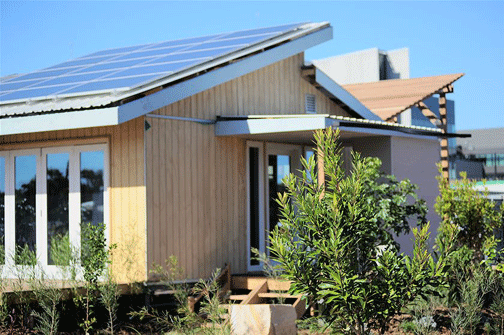 The “Illawarra Flame” renovated fibro at an open day earlier in the year.
Clearly, this was no normal end of semester break. But for the students and their supporters (totalling 51 students, staff and contractors from the University of Wollongong and TAFE Illawarra Institute), not much is normal about their entry into this year’s Solar Decathlon China.
Even getting in was no small feat. Team UOW, as it’s known, is the first Australian team ever accepted into the prestigious international event. This two-week marathon is the largest sustainable building research and innovation competition in the world. There are 23 teams from around 30 countries entering their eco-friendly houses, and all are hoping to come home as the winner of 2013’s ‘Energy Olympics’.
For Team UOW, it’s been a two-year journey to demonstrate it’s possible to transform a typical uninspiring Aussie fibro house into the Illawarra Flame; a stylish, net zero-emission home powered by the planet and, of course, plenty of student power — of both the brain and brawn varieties. Continue reading
Gary Gray, Minister for Energy is loyal to the nuclear lobby, not to Australia
 Gray shows folly of making ex-mining boss a Minister by backing nuclear power – again http://greensmps.org.au/content/media-releases/gray-shows-folly-making-ex-mining-boss-minister-backing-nuclear-power-%E2%80%93-again17 Jul 2013 Resources and energy Minister Gary Gray has again advocated nuclear power and uranium mining, showing his loyalty to the mining industry is distorting his judgement, the Greens warned today.
Senator Scott Ludlam said “An economists report has found the proposed first uranium mine for Western Australia – Toro’s Wiluna project – could only scrape a profit if the taxpayers foot the bill for the closure and clean-up of the site. The uranium sector is terminal, and it seems Gary Gray needs to be dragged kicking and screaming to the funeral”.
“At today’s uranium conference Minister Gray praised the Ranger mine’s output without mentioning its long and sorry history of accidents and spills.
“The deliberate myopia was particularly bad when the Minister mentioned the Fukushima Daiichi ‘incident’ and the fall in the world uranium price, ignoring the fact the uranium price had been disintegrating for four years prior to Fukushima, from a record high of almost $140 a pound to around $65 a pound. Minister Gray also neglected the fact Australian uranium was in all four reactors at Fukushima.
“Minister Gray’s claim that there is a significant role for uranium to play in addressing climate change is pure fantasy. In Europe 150 nuclear power stations are ear-marked for closure as countries such as Germany, Spain and Switzerland lead the way with huge and growing renewable energy sectors.
“Labor and the Coalition are in lock-step supporting the dangerous, dirty and obsolete nuclear power sector. Only the Greens are standing up for the clean energy and sustainable jobs the renewable energy sector will deliver.”
Australian uranium industry “in crisis” says Paladin Energy boss
I wasn’t able to read this whole article, as I am not a registered reader. However, I’d bet that Mr Borschoff goes on to speak of the wonderful investment opportunities that must exist, seeing that the uranium price must now be at rock bottom. I mean – it can’t go further down – or can it?
I love the way the uranium lobby and Australia’s subservient mass media use the ever plunging uranium price as evidence of what a fine investment it must be – CM
 Uranium industry facing volatility: Paladin MD John Borshoff BY:PAUL GARVEY , THE AUSTRALIAN, July 18, 2013 THE uranium industry is “in crisis” and faces years of uncertainty and volatility, mining veteran John Borshoff has warned.
Mr Borshoff, the managing director of Perth-based uranium miner Paladin Energy, told the Australian Uranium Conference in Fremantle yesterday that “absurdly low uranium prices” had halted the development of the new supplies …. (registered readers only) http://www.theaustralian.com.au/business/mining-energy/uranium-industry-facing-volatility-paladin-md-john-borshoff/story-e6frg9df-1226680989121
Radiation the likely cause of Fukushima’s deformed butterflies
 Japan Biologist: Radioactivite contamination from Fukushima disaster is most reasonable explanation for butterfly deaths and abnormalities — “I think maybe this is a very touchy issue, politically” http://enenews.com/japan-biologist-radioactivity-from-fukushima-is-most-reasonable-explanation-for-butterfly-deaths-and-abnormalities-i-think-maybe-this-is-a-very-touchy-issue-politically
Source: Nature
Author: Ewen Callaway
Date: 16 July 2013
[…] Last week […] biologists studying Fukushima and Chernobyl came together at the annual meeting of the Society for Molecular Biology and Evolution in Chicago […]
What Fukushima data do exist are sporadic — and contested. […]
[…] Insects collected in May [2011] showed few problems, but their lab-reared offspring had many abnormalities, such as misshapen wings and aberrant eyespots, and many died as pupae (A. Hiyama et al. Sci. Rep. 2, 570; 2012). Among the September-collected butterflies, more than half of the progeny showed such defects.
[…] “You can come up with alternative explanations, but I think the hypothesis that radiation caused death and abnormalities is the most reasonable,” [Joji Otaki, an ecologist at the University of the Ryukyus in Nishihara, Japan] says.
Tim Mousseau, an evolutionary geneticist at the University of South Carolina in Columbia […] is heading to Fukushima this week to begin his third season of field work […] His team saw die-offs in some insects and declining numbers of some bird populations […]
For funding, Otaki says he has had to turn mostly to private foundations. “I think maybe this is a very touchy issue, politically,” he says.[…] The Department of Energy has largely stopped funding its research programme in low-dose exposure, and the National Science Foundation and the National Institutes of Health have awarded few grants […]
See also: Japan Scientists: Truly unusual deformities in Fukushima — Forests may be evolving into different ecosystems — “There’s been a sudden, large change”
Mildura’s concentrated solar power plant officially launched
Australia’s largest concentrated solar power plant officially launched REneweconmy, By Sophie Vorrath on 17 July 2013 Australia’s largest concentrated photovoltaic (CPV) solar power plant was officially opened today, with the Victorian energy minister joining executives from the plant’s developer, Solar Systems, to cut the ribbon on the 1.5MW demonstration facility in Mildura.
The demonstration of the “dense array” solar technology of parent company Silex Systems is a fore-runner for what is expected to be a 100MW power plant, with construction slated to begin in 2014. Another 1MW demonstration plant is being built in Saudi Arabia, with hopes of further development as that country pushes into the start of a $100 billion solar spending program
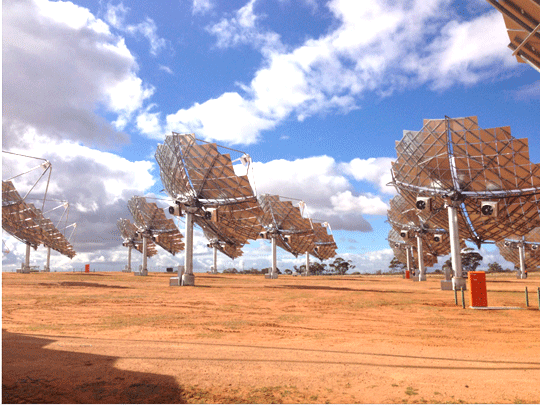
The array – whose 40 CPV dishes have been feeding power into the national grid for almost a month, after their successful commissioning began in April – collects sunlight in more than 100 curved mirrors and focuses it onto ultra-high efficiency “mulit-junction” PV cells; technology originally developed by Boeing to power satellites. Silex CEO Michael Goldsworthy says the cells currently boast efficiency rates of around 43 per cent – about double that of today’s best silicon-based cells and up to four times the efficiency of thin film solar cells – but he hopes this can be lifted to more than 50 per cent, or even 60 per cent, with further research.
The technology also uses ‘active cooling’ technology to maximise power output while minimising water consumption and prolonging the technology’s lifespan…….. Continue reading
Victorian and New South Wales wind farms kick-started by Clean Energy Finance Corporation.
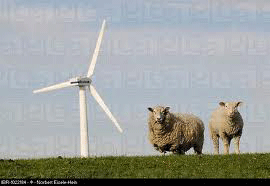 Clean Energy Finance Corporation funding two Australian wind farms – K. Jalbuena Eco Sees, 17 July 13, Two major wind farm projects in Australia will be the beneficiaries of the Australian government’s Clean Energy Finance Corporation. The C.E.F.C., a legislated fund dedicated to investing in clean energy, will invest 50 million Australian dollars ($45.94 million) to refinance Macarthur Wind Farm and will provide 37.5 million Australian dollars in senior debt finance to help build the Taralga Wind Farm.
Largest wind farm in the southern hemisphere
The 420 MW Macarthur Wind Farm in south western Victoria is said to be largest wind farm in the southern hemisphere. It is a joint undertaking between Meridian Energy Limited and AGL Energy Limited through AGL subsidiary Macarthur Wind Farm Pty Limited.
Fully operational since January 2013, the Macarthur Wind Farm can generate enough energy to power 220,000 Victorian households and reduce carbon emissions by 1.7 million tonnes a year…….
Australian engineered and sourced
C.E.F.C. will also be providing 37.5 million Australian dollars in senior debt finance for the construction and operation of the Taralga Wind Farm, 45 kilometers of Goulburn in New South Wales…… Continue reading
Japan’s nuclear crisis- reactors expected to restart, as Fukushima radiation rises
 Japan’s nuclear energy dilemma Alex Thomson, 17 July 13 Everything about nuclear power is divisive…..
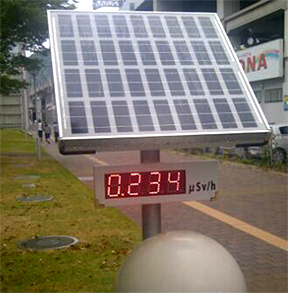
(at left – Japan- solar-powered radiation monitor) ….even as they continue to pour tonnes of water daily into the reactor fuel rods at Fukushima to stop a full-scale meltdown; even as they struggle to isolate why the place is leaking radioactive water into the Pacific; even as they cannot explain why caesium levels near to Reactor 2 are now higher than at any time since the earthquake struck the plant – even as all this is gong on, the Japanese nuclear industry is rousing itself from idling offline and looking to generate power once again.
Ten nuclear power plants are actively lobbying to restart full operations, and most are sited at or near the coast, as is the Japanese way. Many – like Fukushima – are old plants now and desperate to get back into the game after sitting offline for this long period of national Japanese soul-searching.
Yet a recent demonstration against the nuclear industry brought more than 30,000 onto the streets of Tokyo. That is a big number in Japan…… Even as they struggle to contain what is going on in the plant (and nobody really knows the full extent of that) debate rages across Japan and beyond……
For now though, they are still crisis-managing at the stricken plant itself. Indeed whether they really are managing it at all is another level altogether of raging debate. Meanwhile, there are permanent-looking radiation monitors which have spring up for miles around the plant itself, displaying to the public the background radiation levels twenty-four seven.
Nobody much notices them nowadays. But I cannot help seeing they are powered by solar panels. http://blogs.channel4.com/alex-thomsons-view/japans-nuclear-energy-dilemma/5381
Tony Abbott wrong, Kevin Rudd running scared, on climate change

 Dancing to Abbott’s tune SARA PHILLIPS ABC Environment 16 JUL 2013 Opposition leader Tony Abbott is wrong when he says the world is moving away from pricing carbon.
Abbott’s climate statements are incorrect and Rudd seems to be running scared on climate. Meanwhile the majority of voters still want a leader who is strong on climate change.”……It always surprised me that Abbott, as leader of the party that champions the power of a free market, would be opposed to a mechanism for reducing greenhouse gases that aims to harness this power.
And then there’s his comment that everyone else in the world has moved away from carbon pricing.
This statement is flatly incorrect. First there’s the European Union’s emissions trading scheme, which has been running since 2005 and encompasses 15 nations. Then there’s South Korea, New Zealand, India, parts of China and California (whose economy is bigger than most countries). Meanwhile a separate group of US states have come together with the aim of building an emissions trading scheme. Even Kazakhstan has an emissions trading scheme.
The World Bank released a report (pdf) in May which said “Regional, national and sub-national carbon pricing initiatives are proliferating. Despite weak international carbon markets, both developed and developing countries are mainstreaming carbon pricing initiatives in national climate change and development strategies.”……http://www.abc.net.au/environment/articles/2013/07/16/3803539.htm
Abbott’s comments on carbon dioxide as being an “invisible substance” appeal to those who don’t believe that greenhouse gases are a problem. But the majority of Australians care about the climate and are prepared for action on climate to be taken.
Rudd should remember that he was propelled to power in 2007 partly because of his stronger stance on climate change than John Howard. His expulsion from the top job was in part because he softened his climate approach.
Moving faster to the ETS looks like running scared, when Australians have historically rewarded those who have stood firm on climate.
By dancing to Abbott’s tune, Rudd tangos to a man whose climate statements are incorrect. It’s not a good look for either of them.
2 million poor people in Peru get solar power on homes
 Peru to Provide Free Solar Power to its 2 Million Poorest Citizens http://inhabitat.com/peru-solar-power-program-aims-to-give-electricity-to-the-countrys-2-million-poorest-citizens/ by Timon Singh, 07/16/13 The country of Peru is looking to provide free electricity to over 2 million of its poorest citizens by harvesting energy from the sun. Energy and Mining Minister Jorge Merino said that the National Photovoltaic Household Electrification Program will provide electricity to poor households through the installation of photovoltaic panels.
The first part of the program aims to provide solar systems to 500,000 extremely poor households in areas that lack even basic access to the power grid. Unsurprisingly, it is a massive opportunity for domestic solar installers, and Merino has said that bidding for the contract will open later this year to fix the rest of the panels.
The project was first started in Contumaza, a province in the northeastern region of Cajamarca, where 1,601 solar panels were installed. The energy minister has said that when the project is finished, the scheme will allow 95% of Peru to have access to electricity by the end of 2016.
Speaking to the Latin America Herald Tribune, Merino said: “This program is aimed at the poorest people, those who lack access to electric lighting and still use oil lamps, spending their own resources to pay for fuels that harm their health.”
If Peru can do this for its people, it makes you wonder why more prosperous countries can’t do the same. Peru to Provide Free Solar Power to its 2 Million Poorest Citizens | Inhabitat – Sustainable Design Innovation, Eco Architecture, Green Building
AUDIO: Grandmothers the solar energy experts in Fiji
 AUDIO Fijian grandmothers educating locals on solar panel installation http://www.abc.net.au/news/2013-07-17/fiji-grandmothers-educating-younger-generation-on-solar-pane/4826594 Jul 17, 2013 A group of grandmothers in Fiji are educating the younger generation on solar panel installation to generate electricity in their villages.
The elderly women underwent training at the Barefoot College in India, an NGO that provides rural communities with training and education. Fiji’s Womens Minister, Dr Jiko Luveni, has told Radio Australia’s Pacific Beat program the training programme was specifically for grandmothers.
“The idea behind it is that these women are already established in the villages,” Dr Luveni said.
“They have their homes and they are not likely to leave the village as soon as they come back with their skill. Dr Luveni says the elderly women are now celebrated as solar experts and are supervising their young trainees as they install the solar equipment. Continue reading
New South Wales to get advanced wind power turbines with energy storage

So where are these cutting-edge turbines headed? Sixty-seven of them will be built for installation in the mountains of New South Wales in Australia i, with power expected to be flowing into the grid by the end of 2014.
Gamechanger: Next Generation Wind Turbines With Storage Are Cheap, Reliable And Brilliant Climate Progress, By Ryan Koronowski on Jul 14, 2013 What makes a new wind turbine exciting?
Wind companies are always trying to making their next turbine spin more efficiently and generate more power than the last, just as car companies are looking for better fuel efficiency and engine power. Advances usually come in small jumps in both cases, with a single percentage improvement cause for celebration.
GE announced a new line of wind turbines in May that generate between 20 and 24 percent more power than the previous best turbine in its class. It does this through traditional improvements in turbine design, but also through innovations that address one of the main issues that critics of wind power raise: intermittency. Continue reading
Family First Senate candidate Bob Day is keen for Australia to build nuclear submarines
“Informed defence opinion tells us we need, as a minimum, three nuclear powered and six diesel powered subs. …..Australia should consider entering a joint venture with the UK to build our own nuclear powered submarines in the UK with the inclusion of South Australian labour”. Family First federal chairman and SA Senate candidate Bob Day quoted in – Australian Conservative, 17 July 13
Australian invention: device to measure radiation exposure in pilots
 New technology to measure radiation exposure in pilots (Medical Xpress) 17 July 13, —Researchers from the University of Wollongong have developed a unique device that measures how much radiation pilots and astronauts are exposed to. The silicon-based microdosimeter assesses the radiation risk to astronauts and pilots, and radiation damage to microelectronics, during long-term space missions and high altitude flights.
Exposure to too much radiation can cause cancer, damage to the foetuses of pregnant women and genetic defects that can be passed onto future generations.
Professor Anatoly Rozenfeld, Director of the Centre for Medical Radiation Physics (CMRP) – the largest research body of its kind in the Asia Pacific region – has just been granted a US patent for his invention.
“Silicon microdosimetry is providing a new metric for the estimation of hazards from ionizing radiation in mixed radiation fields. It is an essential contribution toradiation protection of pilots and astronauts in avionics and space, where the radiation environment is not easy to predict,” Professor Rozenfeld said…..
Professor Rozenfeld also recently received a Chinese patent for a skin dosimetry technology that was 10 years in the making. ‘Drop-in’ accurately measures (in real time) the amount of radiation absorbed into a patient’s skin during procedures such as radiotherapy and CT scans that can give off high levels of ionising radiation.
“An accurate skin dose measurement can help prevent a patient’s skin from being overdosed, and at the same time, provide a vital indication of overall radiation safety,” Professor Rozenfeld said. http://medicalxpress.com/news/2013-07-technology-exposure.html
Study finds that the Coalition’s carbon storage plan is not viable
Coalition’s soil carbon plan ‘unviable’, study finds SMH, uly 17, 2013 Peter Hannam Carbon economy editor The Coalition’s plan to store carbon dioxide in soil as a central plank of its climate policy has been thrown into further doubt by new research showing Australian soils are unlikely to offer low-cost emissions cuts.
A University of Melbourne survey of hundreds of Australian studies going back three decades found that using the country’s soils to offset a significant proportion of national greenhouse gases “is technically limited and economically unviable at the present time”. Published in the journal Nature Scientific Reports, it suggests farmers would lose out through soil-carbon projects at carbon prices backed by both the government and the opposition.
Report co-author Rick Roush, the Dean of the Melbourne School of Land and Environment, said most active soil scientists thought it would be “a stretch” for farmers to use the Carbon Farming Initiative – a policy that encourages soil-carbon projects and is backed by both major parties……
Sequestering carbon would likely be restricted to the top 10 centimetres of soil, and be limited by low-nutrient levels and water scarcity. Application of fertiliser would boost the sink capacity of soils but at a rising cost to farmers, Professor Roush said.
Better investment Carbon is slow to accumulate in the soil, and the agricultural methods mostly likely to encourage it, such as no-till farming, are already widely used, he said.
While the survey focused on Australian studies, Professor Roush said carbon bio-sequestration may not have much greater promise overseas. “Our gut suspicion is that it will also be disappointing even in areas that have better rainfall and better soil fertility to start with, for the same reasons,’’ he said. ‘‘It’s difficult to keep soil carbons accumulating when you continue to plough and cultivate annual crops.”http://www.smh.com.au/environment/climate-change/coalitions-soil-carbon-plan-unviable-study-finds-20130717-2q3e3.html#ixzz2ZQw8eNMA
1 This month

of the week – Australians for War Powers Reform (AWPR)
To see nuclear-related stories in greater depth and intensity
 Antinuclear