Gloomy reality facing USA nuclear industry
The U.S. Nuclear Power Industry’s Dim Future Bloomberg Business Week By Matthew Philips July 18, 2013 “……optimism has given way to despair. Four reactors have closed so far in 2013—a record for the industry. Because of the shale energy boom, natural gas prices crashed, followed by coal. Electricity demand fell during the recession and has yet to regain its 2007 peak. Bolstered by billions of dollars in green energy subsidies in the 2009 stimulus package, renewables, especially wind, have come on faster than many anticipated. Cap and trade never happened. And Japan’s Fukushima disaster in 2011 reminded the world just how dangerous nuclear power can be.
The industry hasn’t done itself any favors. A radioactive steam leak and a botched repair job have led to the permanent closure of three reactors in the last several months, two in California operated by Southern California Edison (EIX), and another in Florida run by Duke Energy (DUK). Faced with growing political opposition, billions of dollars of estimated repair costs, and cheaper alternatives, utility executives in both cases decided to pull the plug rather than fix the plants.
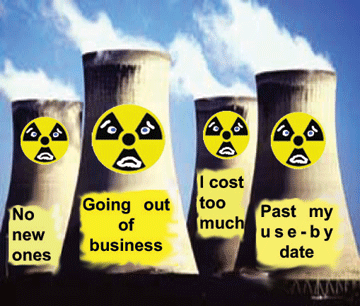
More troubling for the industry is the decision thatDominion Generation (D) made in May to close its Kewaunee reactor in Wisconsin. Squeezed by cheap coal and natural gas and unable to find a buyer after looking for more than a year, Dominion shut down the facility rather than keep operating it at a loss.
A year ago, Exelon (EXC), the largest operator of commercial nuclear plants in the U.S., killed plans to build a 3,000-megawatt plant in Victoria County, Tex. After shuttering its Crystal River reactor in Florida, Duke Energy announced in May that it would not build two plants in North Carolina. In June, MidAmerican Energy, majority-owned by Warren Buffett’s Berkshire Hathaway (BRK/A), decided not to go ahead with new nuclear plants in Iowa. Of those 24 applications for reactors filed in 2008, only four have resulted in new construction. “In a competitive market, you can’t even come close to making the math work on building new nuclear plants,” says Daniel Eggers, a utilities analyst with Credit Suisse (CS). “Natural gas is too cheap, demand is too flat, and the upfront costs are way too high.”…….
The four reactors that are under construction are within about 120 miles of each other in Georgia and South Carolina. That’s hardly a coincidence. In 2006 state legislators in South Carolina, Georgia, Florida, and Tennessee made financing new nuclear plants easier by allowing utilities to raise electricity rates before the reactors were operational. Southern Co. (SO) had already collected $481 million through 2012 from customers in Georgia to help finance two new reactors as part of a $14 billion expansion of its Vogtle facility. Meanwhile, two new reactors at the Summer station in South Carolina are costing $10.5 billion. Scana, which owns 55 percent of the project, has raised electricity rates six times since April 2009 by a total of 11.5 percent, including a 2.9 percent hike slated to take effect this November.
With fewer new plants, the average age of America’s fleet of reactors will steadily rise. A report by Credit Suisse projects that the total annual operating costs of running a nuclear power station could rise by 5 percent a year. Unless they get license extensions, 43 reactors will have to close within 20 years. The pressures on nuclear will only increase as more renewables come online. …
The bottom line: Of 24 applications submitted in 2008 to build nuclear power facilities, only four have resulted in new construction. http://www.businessweek.com/articles/2013-07-18/the-u-dot-s-dot-nuclear-power-industrys-dim-future
No comments yet.
1 This month

of the week – Australians for War Powers Reform (AWPR)
To see nuclear-related stories in greater depth and intensity
 Antinuclear
Leave a comment