This week in Australian nuclear news
 Accentuating the Positives – Right now, Brisbane is hosting Clean Energy Week. In Fremantle, the clean energy people had a jolly breakfast, celebrating: they didn’t bother to protest, while while nuclear lobby held another flop of a conference. A new Australian invention Flat Pack Solar Buildings . Australia’s Dr Helen Caldicott was a hit, lecturing in Taiwan.
The Negatives: War Rehearsals – USA-Australia Talisman Sabre war games going on in Shoalhaven N – thousands of troops and military hard-ware – wreckinhg that beautiful environment. You wouldn’t get to hear of it except that two American soldiers were injured – Oh and yes, they dropped two unexploded bombs on the Great Barrier Reef. Courageously, Peace Convergence protestors Graeme Dunstan and Greg Rolles have broken into the venue
Australian media With the uranium spot price, and the term contract price, very slow, and going lower fast, you might think that the uranium/nuclear story in Australia is dead in the water.
Wrong. First of all the mainstream media continues to give glowing coverage to the fine market situation for uranium – that’s a pack of lies. Fairfax media did not see fit to publish an article correcting the sloppily written nuclear advertorial, by John Watson, that they published last week. The ABC is covering a pro nuclear conference in Sydney this week. We wait to see what the ABC does with this.
I am pessimistic about Australian news media. They have pretty much sacked all their science journalists. Science writing will now be done by journalists who will call upon the Australian Science Media Centre to provide information. So far this Centre has toed the corporate/government line on Fukushima – that’s the line – “it’s not so bad really: they’re getting it under control” etc. They’re likely to toe the corporate line on matters nuclear – but the generalist journalists might not be able to pick up on the bias.
Australia’s Paladin Energy uranium miner continues to be in trouble in Malawi, getting a bad report from the UN Human Rights Commission, for its operations there.
USA’s secret military operations in Pine Gap, and influence in dismissing Prime minister Gough Whitlam – after over 30 years, whistleblower Christopher Boyce speaks out.
Brisbane hosting Clean Energy Week
 Clean Energy Week Kicks Off http://www.energymatters.com.au/index.php?main_page=news_article&article_id=3855 24 July 13 Thousands of delegates are expected to attend Australia’s biggest renewable energy and energy efficiency industry event, which kicks off today in Brisbane.
Incorporating the ATRAA trade exhibition, Clean Energy Week will also incorporate two awards programs and a clean energy debate on the 2013 conference theme of ‘rethinking energy’.
Clean Energy Week is presented by the Clean Energy Council (CEC), an industry association made up of almost 600 member companies operating in the fields of renewable energy and energy efficiency.
The CEC says the event will see Australia’s leading politicians staking their claim on the clean energy agenda ahead of the next Federal Election.
“The new Climate Change Minister Mark Butler and Greens Leader Christine Milne are scheduled to speak, providing a fascinating look into their pre-election thinking,” said Clean Energy Council Chief Executive David Green.
“Queensland Energy Minister Mark McArdle will also join a top-flight line-up of national and international speakers who will challenge and illuminate delegates in equal measure.”
Other speakers include:
– The Hon Yvette D’Ath MP, Parliamentary Secretary for Climate Change, Innovation and Industry
– Senator Simon Birmingham, Shadow Parliamentary Secretary for the Environment
– Dr Yang Fuqiang, Senior Advisor on Energy, Environment and Climate Change, Natural Resources Defense Council (NRDC) China Progam
– Ivor Frischknecht, CEO, ARENA
The event will deliver the latest news on policy initiatives and technology developments, as well as the opportunity for industry participants make valuable new contacts.
The ATRAA (formerly known as the Appropriate Technology Retailers Association of Australia) exhibition component began back in 1979 and this year will feature dozens of exhibitors.
Clean Energy Week is being held at the Brisbane Convention and Exhibition Centre, South Brisbane. The event runs today, tomorrow and Friday. Further details can be viewed here.
UN says Malawi is getting a poor deal from Australian uranium mining company Paladin
 UN rubbishes Malawi’s Paladin uranium deal, fertilizer subsidyBy Hudson Mphande, Nyasa Times July 23, 2013 United Nations Special Raportuer on the Right to Food Olivier De Schutter who was in Malawi for an assessment of the food situation in the country has rubbished Kayerekera uranium mine deal between Malawi and Australian Paladin Mining Company saying the Southern African country has had a raw deal that is robbing the poor.
The UN Raportuer said the uranium mining deal was one of the investments in Malawi through which the country is losing resources that could otherwise make a difference in food security and other pro-poor initiatives. He said in the life span of the mine Malawi is expected to lose almost US$281 million…
“Mining companies are exempt from customs duty, excise duty, value added taxes on mining machinery, plant and equipment. They can also sign special deals on the rate of royalty owed to the government. I believe that there are more reasons that investors would come to Malawi without such incentives,” he said.
De Schutter was addressing journalists in the capital Lilongwe at the end of his 11-day tour of the country.
He bemoaned that due to illicit financial flows, tax envasion as well as tax incentives that the country offer to both domestic and foreign companies currently Malawi was failing to get maximum use of its resources.
De Schutter said that revenue losses from special tax incentives to Paladin Africa Mining alone are estimated at almost K67 billion (US$205 milion) since the mine started its operations and could reach almost K92 billion (US$281 million) over its13-year lifespan.
“Paladin alone is costing the budget more than US$20 million (almost K8 billion) a year in taxes,” he said.
He added: “I am convinced that unless combined with a comprehensive enhancement and optimisation of tax revenue, current macro-economic reforms may not have substantive positive impacts. There is need for
Malawi to examine its national tax laws and policies towards preventing illicit capital flight. As mining develops, Malawi can simply not afford business-as-usual.”
The UN Special Raportuer said it is estimated that the country has lost over 10 percent of its growth domestic product (GDP) to illicit outflows and tax evasion over the period 1980 to 2009……..
De Schutter also specifically expressed concerns on the country’s current minimum wage currently at K371 ($1.12) per day, describing it as the lowest in the world…… The UN special rapporteur said he will give a report and his recommendations to both the UN Human Rights Commission and the Malawi Government. http://www.nyasatimes.com/2013/07/23/un-rubbishes-malawis-paladin-uranium-deal-fertilizer-subsidy/
Paladin Energy – the Ugly Australian uranium mining company in Malawi
the British silently stole our uranium and left when their projections did not add up to their whims, and now we have the Aussies who are refusing to deal fairly.
Honestly I loved Crocodile Dundee the movie but this Aussie corporation turning Malawi land into some ‘plunder outback’ is making me sick
Killing Malawians through the rotten extractives deals: The case of Paladin’s uranium mining Nyasa Times, by Patrica Masinga, 24 April 13, Malawi has in the few weeks been engaged by a plethora of stakeholders discussing strategies to revive, or more on the ground, reclaim the benefits that Malawians are been milked of by the so-called extractive industry multi-national corporations.
They call themselves investors, and government believes that the Malawi Development Goals (MDGs – who cares if it’s the second phase) will be boosted, particularly that mining alone through Kayerekera of Paladin Energy Limited group of companies (trading as Paladin (Africa) Ltd in Malawi?) could provide a large economic base.
But that is all a fat lie. Paladin and many other foreign multinational mining countries are least interested to contributing to the Malawi economic growth. They are here to milk the country – exploiting all that it has rich in minerals and dump us when the time is right even poorer.
Imagine, to screw Malawians of their rightful economic gains, the company, incorporated in Australia first listed on the Australian Stock Exchange (ASX) on March 29, 1994 under code ‘PDN’, and quickly changed its name from Paladin Resources NL to Paladin Resources Ltd in 2000 and listed under the Toronto Stock Exchnage (TSX) in Canada April 29, 2005, and again changed its name to Paladin Energy Ltd in November 2007 and listed on the Namibian Stock Exchnage on February 2008.
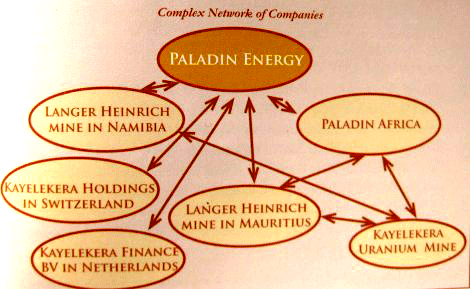
By such trends, one is compelled to question the motive, considering also that in Namibia itself the company owns the Langer Heinrich Uranium Mine where it started production in 2008 and has Kayerekera Uranium Mine as its second largest mining venture in this part of Africa acting also as a good supllment to the Langer Heinrich Uranium Mine. Continue reading
Record low price for uranium, and it continues to go down fast
 The week ended with TradeTech’s Weekly U3O8 Spot Price Indicator sitting at $36.50 a pound, a decline of $1.75 over the prior week’s value. This is the lowest price that has been seen in more than seven years
The weakness was not isolated to the spot market and is starting to spill over into the term market.
Uranium Market Marches South at Double Time 9 News Finance byFN Arena By Andrew Nelson Tuesday, July 23, 2013 The crack appeared the week before last. Sellers started to buckle under the strain and gave in to lower prices. A US$1.30 drop ensued. That’s the way last week started and from there things only got worse for the uranium spot price. Continue reading
Secrecy over US Bomb tests in Marshall Islands
The Fallout from Nuclear Secrecy , Consortium News, July 23, 2013 During the Cold War’s early years, the U.S. government detonated dozens of nuclear explosions on Pacific atolls, spreading nuclear fallout around the globe and making some areas uninhabitable, a grim legacy captured in secret documents finally being shared with the Marshall Islands’ government, reports Beverly Deepe Keever.
More than a half century after U.S. nuclear tests shattered the tranquility of Pacific Ocean atolls — rendering parts of them uninhabitable – the U.S. government has quietly released secret fallout results from 49 Pacific hydrogen-bomb blasts with an explosive force equal to 3,200 Hiroshima-size bombs. Continue reading
High rate of birth defects near USA’s most radioactive site – Hanford
Twelve specific malformations were analyzed for evidence of association with parental employment at Hanford and with occupational exposure to ionizing radiation. […] Neural tube defects showed a significant association with parental pre-conception exposure […]
“Worrisome” spike in deadly birth defects around leaking U.S. nuclear site — Officials claim “it could be a complete coincidence” — No news reports mention it’s by the most contaminated area in Western Hemisphere #Hanford http://enenews.com/worrisome-spike-in-deadly-birth-defect-around-leaking-u-s-nuclear-site-officials-claim-it-could-be-a-complete-coincidence-all-media-reports-fail-to-mention-its-nearby-most-contaminate
Title: Washington State Health Officials Stumped by High Rate of Birth Defects
Source: ABC News with Diane Sawyer
Author: Gillian Mohney
Date: July 18, 2013
high rate of birth defects has confounded Washington health officials, who have been unable to identify a cause. Continue reading
Flat pack modular solar buildings – another Australian first
 Australian Flat Pack Solar Buildings http://www.energymatters.com.au/index.php?main_page=news_article&article_id=3852 24 July 13 An Australian company is producing flat pack modular accommodation that incorporates solar power.
Blue Planet Buildings, based in Revesby, New South Wales, manufactures a modular system that in flat-pack configuration sits in its own metal bottom frame with adjustable feet and does not require a concrete slab or brick piers.
Engineered to exceed Category D Cyclone standards, the building’s frame is made from extruded aluminium. Metal wall and roof modules are 80mm thick, the floor 110mm thick and feature injected EPS insulation. All windows in the structure are double glazed to maximize energy efficiency and suppress noise.
Optional fittings include plumbing and provision for a deep cycle battery bank.
2 people can assemble the buildings in as little as an hour; with a crane or forklift required to position the roof section. Assembly is so simple, tradespeople are not needed.
Up to 6 flat packed units can fit in a single shipping container. The demountable buildings are being used across Australia in mining, construction, emergency services, education, transport and infrastructure sectors. Once a project is complete, the units can be disassembled and relocated.
Blue Planet Buildings was the recipient of The Australian Business Award for Best Eco Product in its industry classification for 2013.
1 This month

of the week – Australians for War Powers Reform (AWPR)
To see nuclear-related stories in greater depth and intensity
 Antinuclear