Wind energy company wins award, but still faces problems on King Island
 Hydro Tasmania wins engagement award http://www.weeklytimesnow.com.au/article/2013/07/26/577753_national-news.html
Shannon Twomey | July 26, 2013 HYDRO Tasmania has won the Community Engagement Award at the Clean Energy Council Awards.
The awards are hosted by the Clean Energy Council as part of Clean Energy Week.
Hydro Tasmania won the award for their community engagement on the Musselroe Wind Farm Project in the north east of Tasmania.
The Musselroe Wind Farm is a 56-turbine, 168-megawatt wind farm that provides power to 50,000 homes and prevents the emission of 450,000 tons of greenhouse gas emissions.
Project director Andrew Hickman said from the start Hydro Tasmania have worked closely with communities in the area.
“Many members of the project team have lived and worked in the north east region over the entire construction period and have become a real part of that community,” Mr Hickman said.
“Hydro Tasmania have engaged with local schools, tourists bodies, indigenous elders and business groups to build the relationships that have resulted in genuine community ownership of this project.”
Friends of the Earth and Yes 2 Renewables spokesperson Leigh Ewbank said Hydro Tasmania have a good reputation for strong community engagement.
Hydro Tasmania are currently working on another wind farm development, the TasWind Project, on King Island. Continue reading
A visit to Fukushima’s radioactive “dead zone”
We also spotted many suspicious looking flowers and other forms of vegetation. According to Yoichi, radiation has affected some flowers in the nuclear zone to go haywire and outgrow their natural size (a
topic for future research). Yoichi noted that radiation affects different plants differently, some are hardy and not affected; others, especially flowers may receive small doses but have big results in terms of mutations.
Below: Yoichi indicates the normal height of this flower compared to this giant version

We already know that the biologist and expert on mutagenetic affects, Tim Mosseau, has shown that in Fukushima prefecture a variety of insects and other species have been affected (1).
My Trip To The Fukushima Nuclear Disaster Zone http://rense.com/general96/trip.html
(Part One) By Richard Wilcox Ph.D. 7-26-13 On July 20, 2013 Yoichi Shimatsu and I departed from Ueno station in Tokyo to visit the Fukushima nuclear disaster region and see what we
could see…..
Undoubtedly Japan’s countryside regions have suffered from brain drain and thus the numbers of passengers do not justify the number of trains. After the Fukushima disaster many people moved out of the immediate area and this has reduced the need for trains.
Beyond that fact, Yoichi speculates that the Japanese government does not want people going up there to snoop around, Fukushima is now a DEAD ZONE and off limits. Indeed it is, even while they are urging
some people to move back in. Families that moved out of the immediate area of the nuclear disaster may now live in safer zones to the south, but they are forced to train their kids back to their original schools during the daytime, if that is where their family property is registered. Continue reading
Nuclear lobby’s religious optimism, despite global glut of uranium and price plunge
 Elemental: How some people are playing the uranium glut 24 Jul 2013 | By: Anna Andrianova | Special to CNBC.com With Japan shuttering its nuclear reactors and Europe pulling away from the nuclear power, the world has more uranium than it needs. But that’s not stopping some people from betting on the radioactive element in the longer term. ……
Nuclear bulls
Despite those low prices—or perhaps because of them—some investors are putting bets on a uranium turnaround.
Uranium Energy Corp, an exploration and production company, said it expects demand to pick up faster than production can respond. “With the uranium prices falling so low post-Fukushima, they are well below the economic incentive level needed to see new mine construction,” said Amir Adnani, CEO of Uranium Energy Corp.
As mines struggle because of the low prices, now is the time to buy them, Adnani said………….
All the acquisitions could gain value when demand revives, which could be triggered by the Japanese reactors’ coming back—at least that’s what investors hope………..
Demand for uranium is expected to grow less than 1 percent this year, leaving the industry with a net oversupply of 7 million pounds, said Nicolas Carter, senior vice president for uranium at Ux Consulting, a nuclear industry consultancy. Continue reading
TEPCO “didn’t want to worry the public”, about radiation leak

 Japan utility says reluctance to worry public delayed disclosure of nuclear plant’s leaks WP, by Associated Press July 26, TOKYO — The operator of Japan’s crippled nuclear plant said Friday that it delayed acknowledging that the plant was leaking contaminated water into the sea because it did not want to worry the public until it was certain there was a problem.
Tokyo Electric Power Co. acknowledged for the first time this week that its Fukushima Dai-ichi plant was leaking contaminated underground water into the ocean, a problem many experts had suspected since shortly after the crisis unfolded more than two years ago. The plant suffered multiple meltdowns after the March 2011 earthquake and tsunami destroyed its power and cooling systems. After a major leak of contaminated water in April of that year, TEPCO said it had contained the problem, and denied there were any further underground leaks into the ocean until Monday.
TEPCO has repeatedly been criticized for delayed disclosures of problems and mishaps at the plant, which still runs on makeshift equipment and has been plagued with problems, including recent blackouts and minor water leaks from storage tanks………….The head of the reform committee, Dale Klein, said he was disappointed and frustrated by TEPCO’s handling of the disclosure of the leaks.
“These actions indicate that you do not know what you’re doing, and that you do not have a plan, and you’re not doing all you can to protect the environment and people,” Klein, former chairman of the U.S. Nuclear Regulatory Commission, said at the meeting.
On Thursday, the chief of Japan’s national federation of fisheries, Hiroshi Kishi, said TEPCO had betrayed the public by denying the leaks for more than two years and demanded the company take steps to stop the leaks immediately and step up monitoring of radioactivity in seawater near the plant.
TEPCO last detected spikes in radiation levels in underground and seawater samples taken at the plant in May. The company says the contamination is limited to just near the plant, but the extent of the contamination is unknown. Most fish and seafood from along the Fukushima coast are barred from domestic markets and exports.http://www.washingtonpost.com/world/asia_pacific/japan-utility-says-reluctance-to-worry-public-delayed-disclosure-of-nuke-plants-leaks/2013/07/26/9364c412-f5d4-11e2-81fa-8e83b3864c36_story.html
Wind, the quietly achieving energy giant
 Wind, the ‘workhorse’ of renewable energy Oakland Press, July 26, 2013 By Dana Hull The San Jose Mercury News When it comes to renewable energy, Californians hear a lot about solar power. Massive solar power plants are under construction in the desert and will soon be online. Solar panels adorn the roofs of a growing number of homes and commercial buildings. PG&E alone has 90,000 solar customers. Gov. Jerry Brown recently spoke at Intersolar, the solar trade show that met in San Francisco this month, and the state’s solar industry lobby is increasingly influential.
Australia’s Nuclear CONference on the defensive
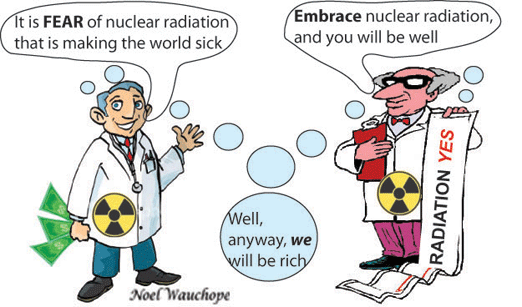 Christina Macpherson, 26 july 13 The spin about ‘Australia’s Nuclear Future” has been buzzing around the media for a while now. The latest headlines – “Embrace nuclear power” “Nuclear power would save $150 billion” spread the spin from the pro nuclear lobby – worthy gentlemen of middle age or beyond, mainly from backgrounds of nuclear physics and engineering. They produce the usual stuff about solving climate change, radiation from Fukushima not a worry, how cheap nuclear power is, and the Australian public coming to like nuclear.
But the key to where Australia’s nuclear lobby is at, is to see what long time nuke spruiker Michael Angwin has to say in today’s Sydney Morning Herald.
Michael Angwin knows what the real situation is, and what the Australian nuclear lobby’s campaign must be. It has to educate, or as Angwin tactfully put it “to advocate”.
Here’s some of Angwin’s spiel:
“People are very susceptible to having their fears stoked by the clever PR people from anti-nuclear NGOs who know how much impact a mushroom-cloud superimposed on the image of a small boy will have.
Nuclear experts know radiation risks associated with nuclear power are very small; but that is little comfort for the targets of NGO spin doctors….
nuclear advocates [must] engage with Australians directly – both broadly and locally – and systematically.
Nuclear advocacy in Australia has mainly been carried out by knowledgeable and informed individuals, science-based organisations and, to some extent, the uranium industry. It has been opportunistic and enthusiastic. If nuclear advocates wish to build on that base, a more strategic and organised approach will be necessary. It still needs to be discovered”
One might ponder why Michael Angwin expects us to believe him, and not those anti nuclear people, seeing that he has an obvious career and financial motive as head of the Australian Uranium Association, and they clearly don’t.
Anyway, from recent articles n by nuclear enthusiasts,it is pretty clear that they see – not cost, not regulation, not renewables competition – but public opinion as the big stumbling block to nuclear power.
Get ready for a renewed media onslaught – as those few news journailists who have not yet been sacked are force fed tripe from the nuclear and uranium industries.
International trend away from nuclear – UK energy analyst
Should Australia consider a nuclear future? ABC Rural, By Babs McHugh, 26 July 13 “…….Antony Froggat has been assessing at the world wide nuclear scene for over 20 years. The London energy analyst co-authors the annual Global Nuclear Status Report. He says that, in the wake of the Fukushima reactor meltdown in Japan two years ago, the use of nuclear has dropped from 17 per cent of world energy production to 10 per 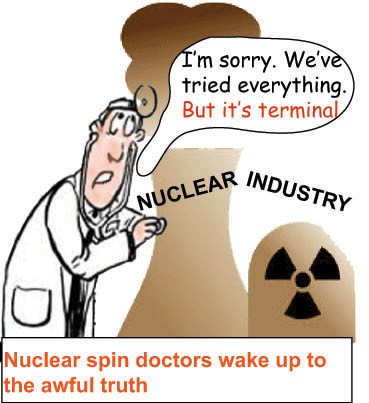 cent.
cent.
“If Australia were to move towards nuclear, it would be going against the international trend, which is that nuclear energy production is declining. “Only one country, the UAE, has started a new nuclear program within the last couple of decades.”
However, there are about 60 reactors being built around the world, with China, India and Korea forging ahead with construction. Mr Froggat says that’s not the complete story.
“China is the largest builder of nuclear power plants, it has 26 under construction. “But it is also the world’s largest builder of solar, the world’s largest builder of wind, the world’s largest builder of coal.
“It has a huge thirst for electricity. But in both India and China, more power is delivered by solar and wind than by nuclear.”The same is true in Germany and Japan, where renewables make a larger contribution than nuclear.”
And although Australia may look to nuclear for further reduction of CO2 emissions in possibly 20 to 30 years, Mr Froggart says the economics don’t stack up. “What we’re seeing is renewables becoming cheaper and cheaper and nuclear becoming more and more expensive.” http://www.abc.net.au/news/2013-07-25/australia-nuclear-future/4843498
Fukushima’s steaming reactor problem continues
[Steaming reactor3] Thermography shows the steaming area is over 15℃ hotter than atmosphere http://fukushima-diary.com/2013/07/steaming-reactor3-thermography-shows-the-steaming-area-is-over-15%E2%84%83-hotter-than-atmosphere/
 by Mochizuki on July 25th, 2013 Following up this article..Reactor3 steaming again / Over 1 Sv/h at 6 of 25 locations on the operation floor [URL]
On 7/24/2013, Tepco conducted the second thermography survey of the operation floor of reactor3, where the steam was observed.
The surveying time was 4:40 ~ 6:04 AM. They conducted the first thermography survey on 7/20/2013 but because the surveying time was from 12:39 to 14:40, sunshine distracted the details. (cf, Thermography shows 50℃ on operation floor of “steaming” reactor3 [URL 2])
This second thermography survey showed the steaming area is about 34.3℃, where the atmospheric temperature was 18.6℃.
It was surveyed at 5m above the floor.
Around where they detected over 1Sv/h, the temperature was 24.7℃, which was also higher than back ground. However, it was surveyed at 40m above the floor. Details are not clear. (cf, Reactor3 steaming again / Over 1 Sv/h at 6 of 25 locations on the operation floor [URL 3])
Official cover-up of Iraq’s birth defects linked to depleted uranium
 The withholding of the WHO report suggests extreme pressure on the World Health Organization by nations which have something terrible to hide. It would be difficult for the report to sidestep epidemic rates of cancer in Iraq regions where depleted uranium was used. Chowdhury’s article, “WHO’s Iraq Birth Defect Study Omits Causation,” indicates the WHO report purposefully avoids considering the causes of the overwhelming birth defects, disease, and death rates.

 Syria, Iraq and Depleted Uranium http://www.globalresearch.ca/syria-iraq-and-depleted-uranium/5343806 By John Bart Gerald
Global Research, July 25, 2013 As the U.S.considers expanding its war on Syria to overt military aggression, Iraq provides some warning of the human cost of accepting the policies of madmen. In Iraq military action starting with “Desert Storm” in 1991, caused the near total destruction of Iraq’s society, culture, environment and eventual losses of millions of innocent people. Health and mortality information risks heavy suppression and manipulation since it provides evidence concerning a crime. In Spain, theBrussells Tribunal‘s cogent case attempting to prosecute George Bush, Tony Blair and others for genocide inIraq was rejected by the court. Lack of legal recourse for the people of Iraq before a non-partisan international court marks the International Criminal Court’s failure to bend the major powers from illegal wars of aggression.
Primary alleged crimes of the U.S. and NATO coalition’s war on Iraq remain unaddressed:
1. aggression and the betrayal of Iraq’s sovereignty.
2. massive military bombardment of civilian areas.
3. intentional destruction of the civilian infrastructure and water supply.
4. use of depleted uranium weaponry to cause the slow death of civilian populations and render portions of the land unable to sustain health and life in the future.
While these points are neglected by the media, current information concerning use of depleted uranium is so notably missing there may be an attempt to remove the issue from the public’s awareness (1 and 2). While depleted uranium is a lethal radiological weapon, relevant public information is suppressed, excised, falsely countered and ignored. Continue reading
Dangerous nuclear nationalism and false claims of scientific-technological “achievement”.
 The dangers of nuclear hubris, Praful Bidwai Thursday, Jul 25, 2013, Agency: DNA Nuclear weapons and aggression always go together. So do nuclear weapons, hubris and machismo. Aggressiveness — and readiness to wreak mass destruction or inflict great cruelties upon an adversary’s civilians — lies at the heart of the nuclear weapons rationale, the acceptance and normalisation of their mind-numbing violence, and the development and deployment of such armaments, whether they are used or not.
Nuclear deterrence seeks security through terror, by threatening the enemy with “unacceptable” damage. As the Dr Strangelove film shows, nuclear scientists and experts quintessentially, yet naturally, imbibe deeply cynical, male-supremacist and pathologically aggression-prone attitudes. Many of them personally, literally, exude violence.
India: nuclear project cancelled due to public opposition to nuclear power
 US company nukes Rs 2724 cr nuclear parts project at Vizag Manish & Swati Rathor, TNN | Jul 26, 2013, “….. US player Brighton Energy Corporation Ltd’s Rs 2724 crore megaproject to make forged steel components for use in nuclear power plants was to come up inVisakhapatnam district. According to officials of the Andhra Pradesh Industrial Infrastructure Corporation (APIIC), the project planned by US player in Nakkapalli mandal of the district has been shelved. ….
Arctic permafrost thawing, with drastic climate results
 Release of methane gas from Arctic permafrost could devastate global economy: study http://www.abc.net.au/news/2013-07-25/arctic-methane-could-devastate-economy3a-study/4842994 By David Mack and Stuart Gray
European scientists say the release of large amounts of methane gas from thawing Arctic permafrost could devastate the global economy.
Permafrost, or soil below the freezing point, has been thawing under rising global temperatures for many years.
The thawing is releasing the powerful greenhouse gas methane, which is concentrated in the Arctic tundra and is also found as semi-solid gas hydrates in the sea. A study in the science journal Nature says the release of 50-gigatonnes of methane over a decade will result in flooding, sea-level rise, agriculture damage and health impacts amounting to $60 trillion – which was roughly the size of the entire global economy last year.
The researchers say the impacts will be particularly devastating in developing countries..
Separate research also shows permafrost melting at alarming rates in the Antarctic.
Plutonium blown up at Maralinga, in secret “Vixen B” tests
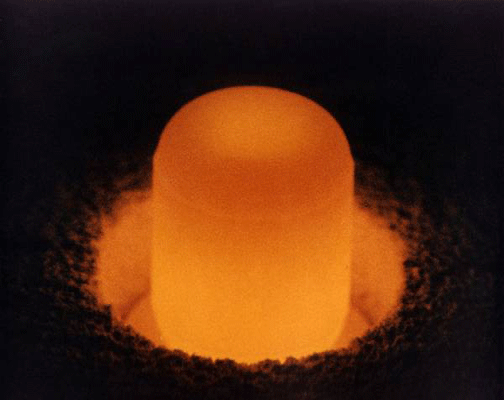 Dig for secrets: the lesson of Maralinga’s Vixen B The Conversation, Liz Tynan, 26 July 13 “……….The tests of far greater consequence were the 12 Vixen B tests, only held at Maralinga These experiments used TNT to blow up simulated nuclear warheads containing a long-lasting form of plutonium.
Vixen B scattered 22.2kg of plutonium-239 around the Maralinga test site known as Taranaki. This form of plutonium has a half-life of over 24,000 years. The extreme persistence of radiation and the threat of cancer posed by inhaling small particles in dust at the site make it especially dangerous.
The Vixen B tests took place amid total secrecy in 1960, 1961 and 1963. Maralinga’s toxic legacy can be summed up in one word: plutonium. When the Maralinga Rehabilitation Technical Advisory Committee (MARTAC) reported in 2002 on efforts to remove contamination from the area it said “Plutonium … was almost entirely the contaminant that determined the scope of the [Maralinga rehabilitation] program.”
The British carried out some clean-up operations after Vixen B and provided a report (by British physicist Noah Pearce) in 1968 that made claims about the level of plutonium contamination at the site. The Pearce report provided the technical basis for the Australian Government to release the UK from any further liability for the Maralinga site.
The technical advisory committee later confirmed that the plutonium contamination at Taranaki was wrong by a factor of 10: “A comparison between the levels reported by the UK at the time (Pearce 1968) and the field results reported by the Australian Radiation Laboratory…(Lokan 1985) demonstrates an underestimate of the plutonium contamination by about an order of magnitude.”……..” http://theconversation.com/dig-for-secrets-the-lesson-of-maralingas-vixen-b-15456
Independent Aboriginal Government created – the Republic of Murrawarri
Aboriginals Create the World’s Newest Government First Peoples Worldwide, 26 July 13 The world is welcoming its newest government – the Republic of Murrawarri, a nearly 82,000 square kilometer territory stretching across northern New South Wales and Queensland in Australia, has declared its independence as a sovereign nation.
Murrawarri’s independence comes after a long diplomatic process. The republic, which has around 4,000 residents, officially declared their continuing independence and statehood on April 3, 2013. The declaration was sent to the Queen of England, who is the constitutional monarch for Australia, along with a request for documents that would prove the Crown’s official rights to governance of Murrawarri. Continue reading
1 This month
7 April – WEBINAR – Australia and the Doomsday Clock – Preventing nuclear war through NoFirstUse and other policies
Online | Tuesday April 7, 4:00-5:30pm, Australian Eastern Time / 8:00-9:30am Central Europe Time
– Access the registration link
15 April – Zoom –Nuclear Power is Not the Solution
Apr 15, 2026 01:00 AM in Canberra, Melbourne, Sydney

Join the International Physicians for the Prevention of Nuclear War (IPPNW) on Tuesday, April 14th for a timely webinar exploring the risks associated with nuclear power and challenging the myth that it offers a simple, safe, carbon-free solution to the climate crisis

21 April Webinar: No Nuclear Weapons in Australia
Start: 2026-04-21 18:00:00 UTC Canberra, Melbourne, Sydney (GMT+10:00)
End: 2026-04-21 19:30:00 UTC Canberra, Melbourne, Sydney (GMT+10:00)
Event Type: Virtual
A virtual link will be communicated before the event.
Host Contact Info: australia@icanw.org

of the week – Australians for War Powers Reform (AWPR)
To see nuclear-related stories in greater depth and intensity
 Antinuclear