Australian media in its own little bubble of nuclear/uranium enthusiasm
 Oblivious of the USA nuclear industry crisis, oblivious of the uranium glut, the good old Australian media cheerleads on.
If you tap “nuclear” into Google News search – you will find page after page telling you how in Australia, nuclear power is becoming more and more popular, scientists love it, it will save Australia $billions.
If you tap “uranium” into Google News search – there will be even more pages, all even more enthusiastic about how you’d better invest in uranium NOW – because clearly, it has such a great future!
 That is the Australian news media bubble.
Where does this media enthusiasm come from? Well – for nuclear, it’s the usual suspects, South Australia’s stooges for the nuclear industry, and a couple of well-paid imported nuclear engineers. Why now – it’s a sign of desperation.
If the nuclear lobbyists are getting desperate, – that’s nothing to the poor old uranium industry. The spot price for uranium has collapsed to half what Toro Energy would need it to be, to make their Western Australian Wiluna  Project halfway viable. Now the term, or contract price for uranium is plunging too.
There’s a touching religiosity about Australia’s uranium lobby – they see this collapse as some kind of proof that Australia’s uranium industry will rocket up.
That’s OK for the Australian uranium and nuclear lobbies. But does the Australia media have to be so blindly subservient to those lobbies? Why doesn’t the Australian media notice what is happening overseas? Especially in the USA – original home and enthusiast for the nuclear industry?
See the articles below page, on what’s really happening to these industries. And -please do find the time to hear the splendid David Freeman (former head of the Tennessee Valley Authority) – in the Youtube presentation at right of this page
AUDIO: Marshall Islands call on Australia for Climate Change support
 rising sea levels will create a humanitarian crisis in the region, with many people eventually seeking asylum in Australia.
“If you look further down the line there are two million people – potential refugees – from the Pacific should climate change continue the way it is now

The Marshallese Government has called on Australia to support its new global climate change initiative.
The Marshall Islands is hosting this year’s meeting of the 16-nation Pacific Islands Forum in September.
It wants leaders to agree to approve the Majuro Declaration for Climate Leadership, an initiative for urgent action on climate change.
Tony de Brum, the Minister in Assistance to the Marshall Islands President, is in Canberra to highlight the unprecedented droughts and floods that have hit his country and to seek support from the Australian Government ahead of the Pacific summit. Continue reading
Australians way ahead of politicians in attitudes to climate change
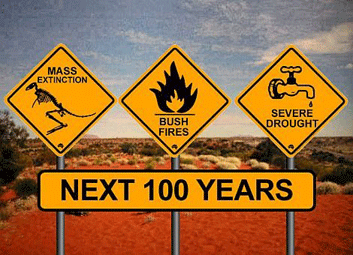 Climate of the nation 2013: Australian attitudes on climate change http://apo.org.au/research/climate-nation-2013-australian-attitudes-climate-change
Kristina Stefanova | The Climate Institute
The 2012 research was conducted in the heat of the toxic and speculative debate leading up to the introduction of the carbon laws.
A year later we find that two-thirds of Australians think that climate change is occurring and almost all of them believe that it is impacting Australia now. People are genuinely worried about the cost impacts of extreme weather and climate change on everyday concerns such as crop production and food supply, insurance premiums, water shortages and climate refugees.
Climate change is not perceived as a major issue in this election, but it is also clear that there is no basis from which to call the election a “referendum on the carbon tax”.
Only around a third of Australians think that the carbon laws should be repealed and more oppose a double dissolution to get rid of them than support one. The “carbon tax” itself is not a major reason for supporting a Coalition vote. “Economic mismanagement”, “lies and incompetence” and the “carbon tax lie” are cited as far stronger reasons.
Opposition to carbon pricing is dropping. While support remains soft, it strengthens significantly when the policy is explained. This matches the findings of other recent polls. Continue reading
Uranium industry in disastrous market situation
 Uranium Nearing Terminal Velocity 9 News Finance By Andrew Nelson, 30 July 13 The steady and significant retreat of the uranium price over the month of July gathered even more pace last week. Volumes were steady, with six transactions involving around 700,000 pounds of uranium being reported, but the spot uranium price still fell 5% over the five days.
THe “disorderly” exit of the uranium market

13/07/29
Over the past few years, the uranium spot price found support whenever it fell to US$40 a pound. But not this time.
Uranium has plunged 14% over the last two months, and now sits at US$34.50 a pound after dropping another US$1.50 last week. It’s the lowest level since 2006.
“It appears that by the end of last week, a disorderly exit from the spot market was underway,” TD Securities analyst Greg Barnes said in a note…..
The USA’s nuclear power dream -now a zombie nightmare?
As Forbes put it in 1985, “The failure of the U.S. nuclear power program ranks as the largest managerial disaster in business history, a disaster on a monumental scale. …
The banner across the front of the Nuclear Energy Institute’s website shows a family running, Sound Of Music-style, across a green meadow beneath a blue sky and the words “NUCLEAR Clean Air Energy.”

Still, all that waste has to go somewhere……nuke plant operators appear to be permanently stuck with “temporary” storage of their waste at their plants.
So is nuclear power back? As of 2013, only four new reactors have broken any sort of ground. But never count out nukes. In most endeavors, there’s a three-strikes-and-you’re-out ethic. Nukes, by contrast, are still batting on strike 17. It’s a testament to how exempt nuclear power appears to be from ordinary market rules. So is nuclear power born, dying, or zombie? Hard to say. But whatever the answer is, it’s probably scary.
 Nuclear Infant Zombies? City Watch by Peter Dykstra 30 Jul 2013 Perhaps the oddest thing about nuclear power’s journey through American history is that we can’t seem to decide whether nukes are dying, being reborn, or walking around as zombies.
On the one hand, nuclear plants have had a bad-news few years. In June, Southern California Edison announced that it would permanently shut its trouble-plagued reactors at San Onofre, which powered 1.4 million homes in the region. By September, the plant will have laid off nearly two-thirds of its 1,500 workers. (The plant was already doomed by a legacy of breakdowns and failed fixes when the Fukushima disaster in Japan persuaded many Californians it posed a threat to the 8.5 million people who live within 50 miles of it.)
This spring, Dominion Resources closed its Kewaunee nuclear plant south of Green Bay, Wisconsin. The plant was in good working order, but falling energy prices made Kewaunee not worth the trouble. (Ironically, Dominion had just received a hard-fought renewal of its operating license for the plant.) …….
The industry’s origins date to the 1950s, when “too-cheap-to-meter” nuclear energy was touted as a sidekick to the H-bomb and a mascot for the Cold War. ….. Wall Street also noticed that nuclear plants were not the financial performers they were cracked up to be. Continue reading
The global abandonment of nuclear power

Very good photos and graphs Despite the Government’s Best Efforts to Prop Up and Bail Out the Nuclear Industry … It’s Failing
As we noted in May, the American “Nuclear Renaissance” is over, “the change in nuclear’s fortunes is staggering”, and a horrible “cauldron of events” has [brought] the nuclear push to a standstill”.
Even though the American government has done everything possible to encourage nuclear power – bywholly subsidizing nuclear power, reducing safety standards after Fukushima, forcing Japan to re-start its nuclear program, covering up the severity of the Fukushima accident, raising acceptable radiation limits and agreeing to buy radioactive Japanese seafood – the number of nuclear plants worldwide and percentage of electricity provided by nuclear is declining.
The Economist reports:
The [nuclear] industry’s role in electricity production is continuing to decline, according to this year’s World Nuclear Industry Status Report, a compendium of analysis and data by the activist and expert Mycle Schneider. The number of reactors peaked in 2002 at 444, compared with 427 today. The share of electricity they produce is down 12% from its 2006 peak, largely because of post-Fukushima shutdowns in Japan. As a proportion of all electricity generated, nuclear peaked in 1993 at 17% and has now fallen to 10%. The average age of operating plants is increasing, with the number over 40 years old (currently 31 plants) set to grow quite rapidly.
This is no loss. Nuclear power is expensive and bad for the environment. And – no matter what you may have heard – it does not help reduce carbon dioxide.
But the answer is not fossil fuels, either … it is decentralization
How Aboriginal culture used science
 Experience the Science of Aboriginal CultureTuesday, 30 July 2013, 2:45 pm Press Release: City of Sydney
A free Family Science Fun Day at Redfern Community Centre on 11 August will reveal how science has been used by the world’s oldest living culture. Visitors will see how Aboriginal practices are helping regenerate the land and improving wildlife habitats in northern NSW, while children can create slime, make a stone axe and enjoy loads of other hands-on activities. Lord Mayor Clover Moore said the free community day was being held as part of Macquarie University’s four-day Indigenous Science Experience. “This is a rare chance to learn from Aboriginal elders and scientists from as far away as Arnhem Land,” the Lord Mayor said. “It’s also a chance to promote their contribution to scientific research, land management and science education.” Fun activities include basket weaving, insect and microbeast handling, microscopes and chemistry, as well as mini water courses controlled by pumps and pulleys. Macquarie University Research Officer, Dave Harrington, from the National Indigenous Science Education Program, said Aboriginal and Torres Strait Islander practices contributed to a better understanding of science. “Science often gets dressed up as a something that is purely intellectual, but it’s actually really hands-on,” Mr Harrington said. “By looking at how Aboriginal peoples use navigation, fire and earth as tools, we gain a better appreciation of how important science is to our day-to-day lives.” Contributing to the displays and activities will be Birds Australia with their popular ‘eagle cam’, Firesticks, National Parks and Wildlife, Yugul Mangi rangers from southeast Arnhem Land, the Australian Tropical Herbarium from Cairns, students from the Silkwood Independent School on the Gold Coast, and Sydney Olympic Park. Oliver Costello is a Bundjalung man and the coordinator of Firesticks, a partnered project that works with Aboriginal landowners in northern NSW to improve landscapes using cultural practices and knowledge. “Traditionally, Aboriginal people relied on fire for many reasons, including maintaining resources and creating pathways, so it plays a very important role in our culture,” Mr Costello said. “All plants and animals have some kind of relationship with fire – they either like it or they don’t. For example, fire will often kill rainforest areas, but some bushland, such as coastal heath, need fire to regenerate, because as some plant species age, they die-off and other species come in and take over. “Appropriate fire regimes protect ecosystems, so a part of our project is acknowledging and re-establishing culturally appropriate regimes. Unfortunately, in many areas those practices have declined or ceased because of land use change, access to land and displacement. “We want to reinvigorate Indigenous cultural practices and knowledge so that Aboriginal landowners are acknowledged and supported to manage their country with their own cultural values and practices.”
Fukushima’s environment – malformed larvae of beetles

When the larvae got out of the soil recently, they were terribly malformed and died soon. The larvae of another child were also malformed and died soon. Probably there are more unreported.
AUDIO: Australia’s climate action has reduced greenhouse gas emissions
 AUDIO http://www.abc.net.au/am/content/2013/s3812350.htm Climate initiatives working despite carbon controversy
Deborah Cornwall reported this story on Saturday, July 27, 2013 ELIZABETH JACKSON: Despite political uncertainty, the latest research indicates that Australia has managed to reduce greenhouse emissions levels to zero growth over the past decade.
The report – released today by independent research body, ClimateWorks Australia, says the findings demonstrate that Australia’s climate change initiatives are working, but they still need to be significantly ramped up to reach the five per cent reduction target by 2020.
Abbott’s gung-ho plans for Northern Australia might meet Aboriginal resistance
 Developing Australia’s ‘frontier’ may be political pipedream
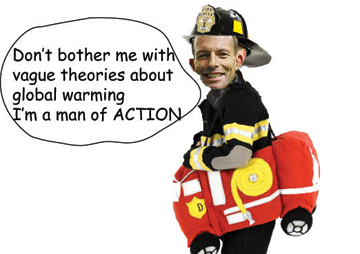
Stuff NZ, JAMES REGAN 29/07/2013″………ABORIGINES CONTROL THE NORTH Australia’s miners and Aborigines are uncomfortable bedfellows. The minerals beneath aboriginal land in the north can benefit the nation’s most disadvantaged people, but often mineral wealth clashes with their ancient beliefs.
In 1991 Australia’s then prime minister stopped then BHP’s planned Coronation Hill gold mine because of local Aborigines believed a giant serpent lived beneath the hill. A fifth of the Northern Territory is now owned or controlled by aboriginal groups and Abbott will need to convince them of the benefits of mining if he is to see a new resources boom.
Many Aborigines have joined environmentalist to discourage mining. Electronic sensors have even been installed in some places to warn if mining companies trespass.
The Gundjeihmi Aboriginal Corp is campaigning for the massive Jabiluka uranium deposit, 300kms (185 miles) south of Darwin, to be included in the nearby Kakadu National Park to stop further development. Resources multinational Rio Tinto’s Energy Resources of Australia Ltd subsidiary is permitted to mine uranium around the site until 2021 but only as long as it adheres to restrictions imposed by indigenous land owners.
Green politicians, likely to be key swing votes in the upper house Senate after the election, oppose Abbott’s plan.
 Reply Reply |
Forward |
 |
Click here to Reply or Forward
|
1 This month

of the week – Australians for War Powers Reform (AWPR)
To see nuclear-related stories in greater depth and intensity
 Antinuclear