Muckaty nuclear waste dump on Aboriginal land – a misguided plan
 Plan to use Aboriginal land as a nuclear waste dump is flawed and misguided
Radioactive waste management is difficult, but secretive deals made without Aboriginal Traditional Owners’ full consent are even more worrying. A transparent debate is needed. Dave Sweeney theguardian.com, 31 July 2013 This week, federal resource minister Gary Gray is talking radioactive waste with Aboriginal people in remote central Australia. Six years ago an Aboriginal clan group, the Northern Land Council (NLC) and the then Howard government signed a secret deal to develop Australia’s first purpose-built national radioactive waste dump at Muckaty, north of Tennant Creek in the Northern Territory.
The commercial-in-confidence plan saw the clan group “volunteer” an area of the shared Muckaty Land Trust for the burial and above ground storage of radioactive waste in return for federal payments, promises and a “package of benefits” worth around $12m.
The deal was not known about or supported by the rest of the Muckaty Traditional Owners and remains the source of bitter contest, deep opposition and a Federal Court challenge. Now Gray is back to talk with the NLC about a second site nomination on Muckaty. Unfortunately the new plan appears to follow the old pattern of secrecy, exclusion and contest. Continue reading
Large scale solar power project for Western New South Wales
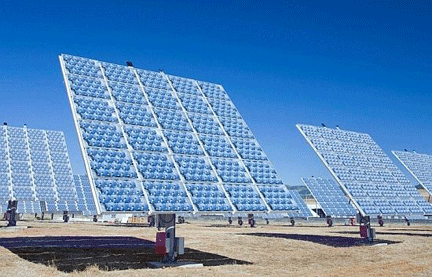 Largest solar power station in the southern hemisphere News International, 31 July 2013 11:16 Gary Gray Canberra , Federal Minister for Climate Change, Mark Butler today announced construction will start in January on the largest solar power station in the southern hemisphere after the Australian Renewable Energy Agency (ARENA) reached financial close with AGL Energy Limited (AGL).
Mr Butler said the project will be built across two sites in Western NSW and will cover a combined area four times the size of the Sydney CBD.
“Australia has the highest average solar radiation per square metre of any continent in the world and we should take advantage of that natural asset,” Mr Butler said.
“This project is 15 times larger than any other solar power station in Australia and represents a big step forward towards making solar a bigger part of Australia’s energy mix.
“The Rudd Government is committed to transitioning Australia to a clean energy future and this combined 155 megawatt solar project helps make renewable energy cost competitive for more Australians.”
Minister for Resources and Energy Gary Gray said this was a major milestone for AGL and the Government and would help boost investor confidence in large utility-scale solar.
“Reaching financial close and progressing to construction is a major achievement paving the way for future investment and meaning that, in a short time, an additional 50,000 homes across New South Wales will be powered by clean energy each year,” Mr Gray said. Continue reading
Bradley Manning verdict a chilling warning to whistleblowers
 the verdict is a chilling warning to whistleblowers
“It seems clear that the government was seeking to intimidate anyone who might consider revealing valuable information in the future,”
WikiLeaks’ Julian Assange says Bradley Manning’s spy convictions are ‘national security extremism’ news.com.au 31 July 13 …..From the courtroom to world capitals, people absorbed the meaning of a verdict that cleared the soldier of a charge of aiding the enemy, which would have carried a potential life sentence, but convicted him on other counts that, together, could also mean a life behind bars.
“It is a dangerous precedent and an example of national security extremism,” he told reporters at the Ecuadorean Embassy in London, which is sheltering him. “This has never been a fair trial.”
Glenn Greenwald, the journalist, commentator and former civil rights lawyer who first reported Edward Snowden’s leaks of National Security Agency surveillance programs, said Manning’s acquittal on the charge of aiding the enemy represented a “tiny sliver of justice.”
And Christian Stroebele, a German lawmaker for the opposition Green Party, tweeted: “Manning has won respect by uncovering the U.S.’s murderous warfare in Iraq.” Continue reading
Nuclear company pulls out of USA nuclear power, switches to renewable energy sources
 EDF to exit US nuclear power over impact of shale gas
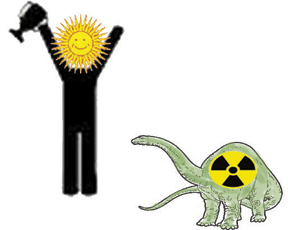
FT, By Hugh Carnegy in Paris , 30 July 13 EDF, the world’s biggest producer of nuclear-powered electricity, is to pull out of nuclear production in the US, citing the “revolution” in US energy markets caused by the advent of shale gas…… High quality global journalism requires investment. Please share this article with others using the link below, do not cut & paste the article. See our Ts&Cs and Copyright Policy for more detail. Email ftsales.support@ft.com to buy additional rights. http://www.ft.com/intl/cms/s/0/d4ee1214-f8e8-11e2-a6ef-00144feabdc0.html#ixzz2abaLez6n
EDF, majority owned by the French state, announced that it was pulling out of CENG, its joint venture in the US with Exelon which operates five nuclear plants. Exelon will take over operation of the CENG plants while EDF will exercise a put option to sell its 49.9 per cent stake in the venture between 2016 and 2022. EDF will also receive an immediate special dividend of $400m…….
Mr Proglio said the prospects for nuclear power in the US had been hit by “a true revolution” caused by the exploitation of shale deposits, which had “completely reshaped the landscape of electric power generation in favour of gas”.
Mr Proglio said EDF would switch its focus in the US to renewable energy sources….
Japanese public nervous, in the dark, as TEPCO struggles to manage Fukushima’s crippled nuclear reactors
 Japanese utility, and the public, in dark about crippled nuclear plant Tokyo Times, Jul 30, 2013 * Tokyo Electric Power confronts many unknowns at crippled plant
* Japanese public also in the dark over clean-up, say critics
* Utility says radiation makes it hard to reach all parts of facility
* Says trying to explain clean-up problems to the public
* Chair of third party panel blames incompetence, not deliberate policy
By Antoni Slodkowski and Mari Saito
– Two and a half years after the worst nuclear disaster since Chernobyl, the operator of Japan’s wrecked Fukushima plant faces a daunting array of unknowns.
What is clear, say critics, is that Tokyo Electric Power Co is keeping a nervous Japanese public in the dark about what it does know.
The inability of the utility, known as Tepco, to get to grips with the situation raises questions over whether it can successfully decommission the Fukushima Daiichi plant, say industry experts and analysts.
“They let people know about the good things and hide the bad things. This culture of cover up hasn’t changed since the disaster,” said Atsushi Kasai, a former researcher at the Japan Atomic Energy Research Institute.
Tepco’s handling of the clean-up has complicated Japan’s efforts to restart its 50 nuclear power plants, almost all of which have been idled since the disaster over local community concerns about safety……
Tepco’s improvised efforts to stop radioactive water leaking into the sea include sinking an 800-meter-long steel barrier along the coastline, injecting the ground with solidifying chemicals and possibly even freezing the ground with technology used in subway-tunnel construction.
Industry experts are not impressed.
“You can’t do temporary fixes in nuclear power,” said Goto. “They say everything’s fine until bad data comes out.”
|
|
REFILE-Japanese utility, and the public, in dark about crippled … |
 |
|
|
Raioactive water must be drained from underground tunnels – Tepco ordered
Go to this site for this story TEPCO ordered to drain radioactive water from underground tunnels
Australia needs a public and independent national commission on nuclear waste management
-
 Plan to use Aboriginal land as a nuclear waste dump is flawed and misguided Dave Sweeney theguardian.com, Wednesday 31 July 2013

“……..Radioactive waste management is difficult. Only time can take the heat out of the waste – but transparent and robust processes and policy development can take the heat out of the waste debate.
Australia has never had an independent assessment of what is the best (or least worst) way to manage our radioactive waste. Decades ago unelected bureaucrats decided a centralised remote dump was the best model and ever since a chain reaction of politicians have tried – and failed – to find a compliant postcode.
Australia is better placed than some countries to do things differently – and better. We have much less radioactive waste than nations with domestic nuclear power and ours is mostly stored at two secure federal sites – the Woomera prohibited area in South Australia and the Australian Nuclear Science and Technology Organisation’s Lucas Heights nuclear facility in southern Sydney.
ANSTO, which produces and houses most of Australia’s radioactive waste, is upgrading its storage facilities. It and the federal nuclear regulator agree ANSTO has the ability and capacity to securely manage all radioactive waste on site, including material due for return from overseas.
This reality provides Australia with some much needed breathing space. For more than two decades, politicians have talked big and listened little – and they have spectacularly failed come up with an agreed, credible and mature approach to radioactive waste management.
It is time to move away from the obsession with finding a place to dump and instead build a space to discuss. We need to get the policy architecture right so future generations of Australians will not have a radioactive legacy that is badly wrong.
A public and independent national commission would advance the discourse on what constitutes responsible radioactive waste management and to move all stakeholders out of the trenches and to the table.
In a long overdue and most welcome change of style, if not yet of substance, the latest federal minister with responsibility for this issue has acknowledged that there are deep Aboriginal and wider concerns over the Muckaty plan.
A minister named Gray should be well-placed to show leadership on an issue of inter-generational national importance that is not – and should never be – just black and white.
|
Reply |
Forward |
1 This month

of the week – Australians for War Powers Reform (AWPR)
To see nuclear-related stories in greater depth and intensity
 Antinuclear