Australian uranium delivered to Russia
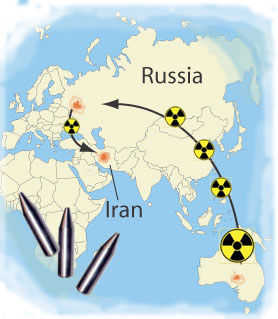 Siberia gets its first shipment of Australian uranium under a 2007 agreement http://siberiantimes.com/business/casestudy/news/siberia-gets-its-first-shipment-of-australian-uranium-under-a-2007-agreement/ By The Siberian Times reporter 12 December 2012
Tomsk region’s Siberian Chemical Combine received the uranium on December 3, but the official confirmation came one week later.
The development is seen as paving the way for Tenex to import uranium mined in Australia for enrichment in Russia.
The plant is one of Russia’s four uranium enrichment sites. ‘After it is processed, Tekhsnabexport (Tenex) will deliver the low-enriched
uranium to an operating nuclear power plant abroad’, a spokesperson told RIA Novosti.
The delivery from Energy Resources of Australia Ltd was made under an agreement on nuclear cooperation for peaceful purposes signed by
Vladimir Putin and then Australian Prime Minister John Howard in Sydney in 2007.
‘Many utilities outside Russia have long-term agreements based on the supply of uranium from Australia, but they haven’t thought about the
possibility of enriching the uranium in Russia’, said a Tenex spokeswoman.
‘Execution of this relatively small, but very important contract gives the green light to Australian natural uranium to be used as feed material for … contracts between Western utilities and Tenex’, said Tenex acting director general Lyudmila Zalimskaya in an earlier statement.
Nuclear Test Ban Treaty – the motive was to stop radiation’s harmful effects
The Legacy of the Nuclear Test Ban Treaty, counterpunch by JOSEPH J. MANGANO and JANETTE D. SHERMAN, MD, 5 Aug 13, “…….The treaty is often referred to as a peace treaty, a step against nuclear war. While it was a goodwill gesture between hostile nations, it did nothing to prevent a war, since both sides continued to furiously test weapons underground and add to its already-large stockpiles. Only in the 1970s did non-proliferation treaties begin the process of cutting nuclear arsenals.
 The 1963 test ban treaty was actually an environmental and public health action to reduce threats of deadly radiation, especially to the more susceptible infants and children. In a speech urging passage of the treaty, Kennedy – whose prematurely born son died that summer after living only 39 hours – made the case to prevent suffering among the youngest members of society:
“The number of children and grandchildren with cancer in their bones, with leukemia in their blood, or with poison in their lungs might seem statistically small to some, in comparison with natural health hazards. But this is not a natural health hazard, and it is not a statistical issue. The loss of even one human life, or the malformation of even one baby, who may be born long after we are gone, should be of concern to us all. Our children and grandchildren are not merely statistics toward which we can be indifferent.” Officials who had downplayed the idea that fallout was causing cancer and other diseases now told the truth. In October 1964, at a campaign stop in New Mexico, President Lyndon B. Johnson triumphantly told a cheering crowd:
“We cannot and will not abandon the test ban treaty to which I just referred, which is the world’s insurance policy against polluting the air we breathe and the milk we give our children.
Already that policy has paid off more than you will ever know, and since this agreement was signed and the tests stopped, the dread strontium-89 and iodine-131 have disappeared from the environment. The amount of strontium-90 and cesium-137 has already been, in a year, cut in half. This is technical language, but what it means is that we can breathe safely again.”
Johnson was correct. U.S. infant mortality had only dropped 13% in the 14-year period from 1951 to 1965, during bomb testing (the fallout peak was 1964). The next 14 years showed a decline of about 50% – the same 50% drop during the prior 14 year period. The years 1951-1965 had the poorest improvement in infant mortality during the 20th century. Cancer cases in children under age five in Connecticut, the only state with a cancer registry, plunged from 58 to 30 from 1963 to 1968. Years later, a 1999 report by the National Academy of Sciences estimated that up to 212,000 Americans developed thyroid cancer from radioactive iodine in bomb fallout. ….. http://www.counterpunch.org/2013/08/05/the-legacy-of-the-comprehensive-test-ban-treaty/

Tony Abbott aims to shut down clean energy initiatives
 Renewables fear the worst as Tony Abbott targets clean energy REneweconomy, By Giles Parkinson on 6 August
  2013 Australia’s clean energy industry leaders have been invited to a special meeting next week to discuss the future of renewable energy policy in the country and to contemplate the unpalatable, as Coalition leader Tony Abbott began his campaign with an early lead and a call to the Clean Energy Finance Corporation to cease its operations immediately.
A meeting of the CEOs of Australia’s largest companies involved in the renewable energy industry is believed to have been called by AGL Energy managing director Michael Fraser, who doubles as chair of the Clean Energy Council, to discuss strategies to protect the renewable energy target (RET). Or indeed to assess whether they have the political capital or influence to maintain the target as is under a Coalition government.
The crisis meeting comes as the Coalition takes an early lead in the first days of the election campaign, and with increasing uncertainty about the likely make-up of the Senate. The renewables industry fears that with a Coalition win, the lobbying from incumbent utilities and generators, including the Business Council of Australia, to have the RET diluted or removed will intensify, and there may be little political protection for the current target.
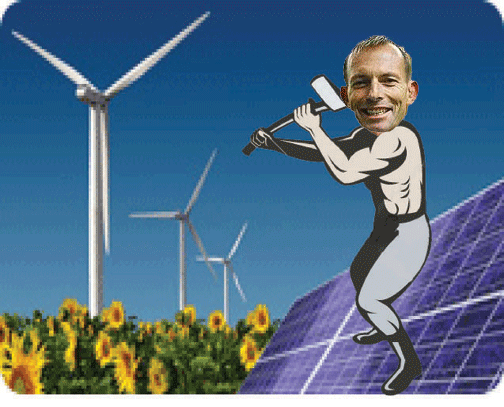
The renewable energy industry is probably the industry sector most directly affected by the outcome of this election. While Labor has vowed to push the next RET review out to 2016, the Coalition wants to have yet another review of the RET in 2014, and has expressed sympathy with pleas to dilute the fixed 41,000GWh target because of falling demand.
The uncertainty that this has created has already brought most large-scale developments to a halt. Continue reading
Australia’s solar energy revolution in outer suburbs
Solar revolution led by outer suburbs, SBS World News, 5 AUG 2013, Households across the country are putting solar panels on their roofs at a rate that has exceeded all expectations, By Tim Flannery
 Households across the country are putting solar panels on their roofs at a rate that has exceeded all expectations. This year we hit 1 million rooftops with photovoltaic (PV) solar panels, up from just 8,000 in 2007. This means that a staggering 2.6 million Australians, 11% of the population, are now using the sun to power their homes.
The solar energy revolution is being led in suburbs and towns like Dubbo and Campbelltown in NSW, Bundaberg in Queensland, Hoppers Crossing in Melbourne, and Mandurah in Western Australia. This increase is being driven by ordinary Australians. It is the modest outer metropolitan suburbs across the country, with high concentrations of mortgages, which show the greatest uptake.
The cost of installing a PV panel today is less than a quarter of what it was in 2002. The decision to install solar panels is no longer just about global responsibility – it makes financial sense. As global momentum for solar continues to grow, the technology is advancing and manufacturing is being up-scaled in countries like China. Together these factors are rapidly driving down costs, making solar increasingly competitive even without subsidies. Businesses are watching the drop in technology costs keenly as payback periods become increasingly cost competitive.
Smart investors are realising that this trend is here to stay and that the future of energy is renewable. …. http://www.sbs.com.au/news/article/1796353/Comment-Solar-revolution-led-by-outer-suburbs
Global warming is stopping the functioning of nuclear reactors
 Nuclear Reactors Can’t Handle Global Warming , Progressive, By Harvey Wasserman, August 5, 2013 An overheated world now threatens the ability of nuclear reactors to operate at all.
Just as the sales pitch that atomic energy could help with global warming gets its biggest hype, the reactors themselves go very wrong.
And as a “renaissance” turns into a rout, a “new generation” of reactors fades ever-deeper into the realm of expensive fantasy.
The bad news on nuclear power and global warming comes most recently from Cape Cod Bay. All commercial reactors spew huge quantities of waste heat into the rivers, lakes and oceans they use for coolant.
The worst instance (so far) is Fukushima, where hot radioactive effluent still pours into the Pacific Ocean after three explosions the industry claimed could never happen.
Reactors in Alabama, France, Germany, and elsewhere have already been forced to shut because of excess heat.
At Entergy’s Pilgrim, in Plymouth, Massachusetts, a global-warmed summer has heated Cape Cod’s waters beyond the legal limit for cooling a “normal” reactor. So in mid-July Entergy was forced to take Pilgrim down to 85 percent power. Entergy may ask regulators to let it operate at full power with overheated water anyway. Such requests–still under official consideration–have been made repeatedly at Connecticut’s Millstone 2, where the Long Island Sound has soared over 75 degrees.
Meanwhile, Nebraska’s Cooper and Ft. Calhoun reactors were shut in 2011 by massive global-warmed flooding. As many as three dozen U.S. reactors are at risk from dam breaks and the flooding unleashed by climate chaos. Ft. Calhoun may never reopen.
The irony of reactors closed by the global warming they’re supposed to cure seems lost on their pushers….. http://www.progressive.org/nuclear-reactors-global-warming
Queen Elizabeth has lucrative investments in depleted uranium weapons
UK Queen in depleted uranium trade? British anti-war campaign group the Stop the War Coalition has in a video claimed that Britain’s Queen Elizabeth is one of the richest women on earth and much of her profits are from arms trade including the notorious depleted uranium trade. http://www.presstv.ir/detail/2013/08/05/317277/uk-queen-in-depleted-uranium-trade/
The video apparently created by anti-monarchy activists and published on YouTube says the British monarch has managed to increase her wealth from £300 million early in her 60-year reign to £17 billion at present thanks to investments in arms firms that produce uranium used in depleted uranium (DU) shells, including Rio Tinto Zinc
DU shells are notorious for their ability to pierce armor and kill targets due to their deadly radioactive features.
The video cites the American nuclear radiation expert Jay M. Gould as saying in his 1996 book titled “The Enemy Within: the High Cost of Living Near Nuclear Reactors” that the British royal family, especially the Queen herself, privately own investments in uranium holding worth some £4 billion through Rio Tinto Zinc. Continue reading
The Nuclear Guardianship Ethic – a bill of rights for future generations

The Nuclear Guardianship Ethic is proposed as an evolving expression of values to guide decision-making on the management of radioactive materials.
On floating lanterns – and nuclear bombs National Catholic Reporter, Thomas C. Fox | Aug. 5, 2013 Kansas city, Mo. “………..And lastly, I would like to tell you about a woman named Joanna Macy and something she’s developed, called a “Nuclear Guardianship Ethic”. It is basically a bill of nuclear human rights for future generations. I went to a workshop she gave a couple years ago. She talked about plutonium as “poison fire” and said it endangers the future because radioactive materials will be deadly for thousands of generations and millions of years. Future generations have a right to live healthy lives and to have a world left to them in a livable condition.
So I invite you to ponder ideas in the Nuclear Guardianship Ethic and make them your own. Joanna says everyone on earth must become nuclear guardians.
1. Each generation shall endeavor to preserve the foundations of life and well being for those who come after. To produce and abandon substances that damage following generations is morally unacceptable.
2. Given the extreme toxicity and longevity of radioactive materials, their production must cease. The development of safe, renewable energy sources and non-violent means of conflict resolution is essential to the health and survival of life on Earth. Radioactive materials are not to be regarded as an economic or military resource.
3. We accept responsibility for the radioactive materials mined and produced for our alleged benefit.
4. Future generations have the right to know about their nuclear legacy and the dangers it brings. Continue reading
Outrage – the favoured tactic of the anti wind energy crowd

In concert with pseudoscientific assertions, outrage and emotion seem to be integral in driving the skewed perception that wind farms are a risk to health.
A focus on rousing anger has been at the heart of the anti-wind movement for some time. New York anti-wind activist Calvin Luther Martin wrote in 2009 that wind farm opponents should “screw concerned and start getting angry and defiant.”
The same philosophy has been deployed by the anonymously run blog ‘Stop These Things’. Replete with direct vilification of individuals in the wind industry (including myself), death threats, threats of violence and comparisons to genocidal regimes, the anonymous author/s attempt to inspire anger and aggression.
Facts out, wind outrage in Climate Spectator Ketan Joshi 6 Aug 13, Recently, I relayed the tale of a man angrily questioning the health effects of wind farms, and proceeding to smoke a cigarette: two risks that he seemed to react to with odd disparity. In that piece, I explored some of the reasons why it can be quite natural for us to adopt pseudoscience, when it’s predicated on fear and uncertainty.
But that’s only part of the chain of events that has led to ‘Wind Turbine Syndrome’ consuming much of the oxygen of public discourse around wind energy. Community, control and risk perception also play a big role in the genesis of authentic health fears, based on fabricated science.
Technologies designed to meet our ravenous demand for electricity have historically spurred an undercurrent of nervousness in those that live near them………….
In late May, ABC’s ‘Background Briefing’ ran a story on the purported health impacts of wind energy, and a 200-turbine development proposed for the small community of King Island, off the coast of Tasmania. Simon Chapman, Professor in Public Health at Sydney University, states during the story that 17 evidence reviews (recently updated to 19) all reach a similar conclusion: the likelihood that wind farms have direct health impacts on human physiology, through inaudible low-frequency noise emissions, is close to nil.
Despite a conspicuous lack of supporting scientific evidence, opposition to wind farms is regularly predicated on the belief that the health risks are high. Anecdotal reports of health impacts are collated and dispersed by anti-wind groups such as the Waubra Foundation. When the CEO of the Waubra Foundation, Sarah Laurie, visited the King Island community, she informed residents that “Yes, wind turbines do cause adverse health effects” and linked wind energy to autistic behaviour.
Labelling an illusory causal link as established medical truth is not the only technique utilised by anti-wind groups to inspire opposition to wind farms. Continue reading
Australian solar households generate over $2 million in electricity, daily
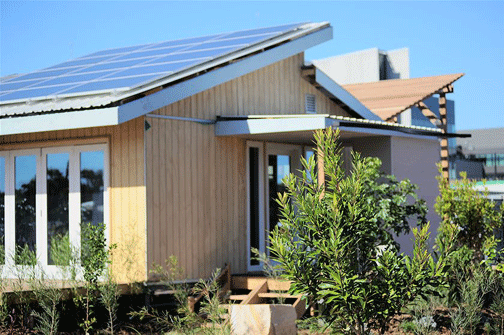 Climate Commission Lauds Solar Power http://www.energymatters.com.au/index.php?main_page=news_article&article_id=3874 6 Aug 13, Solar power in Australia is a ‘revolution that nobody saw coming’ says the Climate Commission in its latest report, The Critical Decade – Australia’s Future: Solar Energy.
‘Nobody’ is probably over-generalising. There are many Australians who understood its potential; however, ‘nobody’ could probably be more accurately applied to Big Energy and the fossil fuel industry. It’s certainly taken those sectors by surprise; having morphed from a mildly amusing novelty to an irritation, to a serious disruption to the energy status quo.
The Climate Commission report states it was only 4 years ago the Australian Bureau of Agricultural and Resource Economics estimated it would take at least a decade for Australia’s solar capacity to reach a stage where it would be able generate 3,500,000 megawatt hours annually. We reached that point this year; thanks to the early adopters who kicked off the revolution, government support and a massive reduction in the price of solar equipment.
With over 1 million solar panel systems installed; around 11% of our population now live in a solar household. In April this year, we estimated Australian solar households to be generating $2 million plus in electricity daily. The Climate Commission report states around a third of all solar PV systems in Australia were installed in 2012 and during last year, approximately 3.4 million tonnes of emissions were avoided. 70% of all new electricity generation capacity installed in Australia in 2012 was solar PV.
Rather than revealing anything new, the Climate Commission’s report gives an overall summary of where we’ve been, where we are and where we might head as a solar nation; providing an overview of the technology and issues, plus a range of interesting statistics gathered from various sources.
For example, while our 2012 figures are stunning and despite having vastly superior solar resources, Australia installed less than a third of the solar capacity that Germany did last year. On sunny days, solar PV now accounts for up to 35% of electricity consumed in Germany.
For new arrivals to the solar party or others wanting a handy guide to refer to for fairly current facts and figures, The Critical Decade – Australia’s Future: Solar Energy (PDF) is recommended reading.
Small Modular Nuclear Reactors (SMRs) – staggeringly costly gimmicks
 Nuclear Reactors Can’t Handle Global Warming, Progressive, By Harvey Wasserman, August 5, 2013
“…….many are pushing an entirely new radioactive gizmo–a “Small Modular Reactor”–with no working prototypes. True to form, the budget and timetable stretch deep into the unknown.
Lead SMR manufacturer Babcock & Wilcox brought us both Three Mile Island and Ohio’s Davis-Besse, whose pressure head was infamously eaten through to the brink by boric acid. The core SMR technology has already been distinguished by a long line of generic failures.
The Tennessee Valley Authority has just postponed the target date to apply for the first SMR construction license until at least 2015. Ultimate development costs are a giant question mark. The huge Savannah River facility meant to convert weapons-grade materials into nuclear fuel for such projects is on the brink of cancellation, with untold billions already down the tubes.
So as its backers claim an unproven ability to help solve an ultra-urgent climate crisis, there won’t be an SMR prototype deployed for an unknowable number of years, at what is certain to be a staggering cost.
With taxpayer money pouring in, even industry supporters already warn of an “atomic Solyndra.”…..
SMR backers still chant the original “too cheap to meter” mantra, claiming a miraculous but unproven ability to somehow burn up old warheads and avoid small annoyances like TMI, Chernobyl, and Fukushima.
But the SMR is already on that familiar atomic go-round of production delays, cost overruns, immediate obsolescence and serious dangers its makers won’t disclose.
Despite a concerted attack from the corporate media, today’s world gets far more usable energy from renewables than SMRs can produce now (none) or for many years to come.
Our sustainable future depends on proven green power, not a supremely expensive failed atomic experiment and its pie-in-the-sky reruns. http://www.progressive.org/nuclear-reactors-global-warming
1 This month

of the week – Australians for War Powers Reform (AWPR)
To see nuclear-related stories in greater depth and intensity
 Antinuclear