Deluded optimism in uranium industry, with price in free fall
Since the Fukushima disaster — a continuing nuclear crisis fuelled by Australian uranium — the price has been in free fall.
Industry advocates remain adamant or delusional that there will be a commodity price recovery but, looking at the sector’s vital signs, we find a weak pulse….. people outside of the uranium industry do not share the optimism about a uranium price recovery.
For new comers like WA uranium hopeful Toro Energy this does not bode well.
When a small inexperienced company like Toro are competing with existing operating mines for scant finance and market access, the $260 million needed to start the proposed Wiluna mine and the further $150-$260 million in upfront bonds looks more and more like “the dream that failed” a term coined by The Economist.
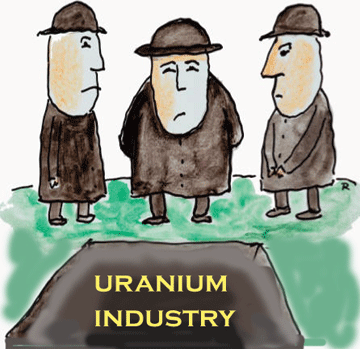 Uranium industry in crisis of confidence http://www.greenleft.org.au/node/54727#sthash.TOxcBrLT.dpuf August 11, 2013 By Mia Pepper, Perth While Australia’s mining sector shows signs of resilience, there is one mineral whose outlook may be terminal.
There are five significant events that have occurred recently that send a clear message about the future of the uranium sector and the wider nuclear industry.
The uranium price dropped to US$34.50 a pound Energy Resources of Australia, the operator of the Ranger uranium mine in Kakadu, announced a $54 million loss.
Perth-based uranium miner Paladin Energy failed to sell a stake in its Langer Heinrich mine in Namibia. French nuclear giant EDF announced its exit from nuclear power in the US and Duke Energy cancelled two proposed reactors in Florida.
These incidents are neither isolated nor unrelated — they are significant indicators about the health of nuclear industry. The uranium price was around US$20 through much of the 1980s and 1990s. It increased dramatically around 2005 with the promise of a “nuclear renaissance” but began a steady drop in 2007 through to the end of 2010.
Since the Fukushima disaster — a continuing nuclear crisis fuelled by Australian uranium — the price has been in free fall. Continue reading
Liberal, Labor, and Warren Mundine in lockstep on Aboriginal issues
 I don’t understand why SBS World News would think that indigenous land rights are an “election issue”. Seeing that Australians face two major parties that are in lockstep about Aboriginal matters.
Both Liberal and Labor are keen to keep the Northern Territory Intervention going. Both are all out to promote the 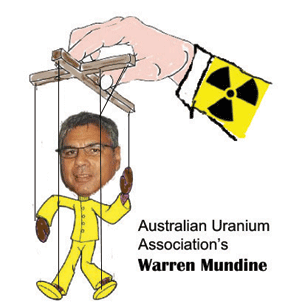 uranium industry, on Aboriginal land. Both are keen to establish a nuclear waste dump on Aboriginal land.
So – no doubt, both major parties are happy to have Aboriginal puppet Warren Mundine close to the helm of whoever wins. As for Mundine – well – he has shown how expert he is, at being “on the side of the winner”. Which definitely does not mean on the side of the Aboriginal people. – C.M
 Indigenous land rights emerging as key election issue, SBS World News 12 Aug 13 “………….. the Coalition’s unveiling of its Aboriginal and Torres Strait Islander Affairs Policy, centred on a new Indigenous advisory council headed by the former President of the Labor Party Warren Mundine……. The advisory council will inform the Prime Minister on policy development and implementation, and it will start with a major review of Indigenous spending and service delivery — most notably land rights reform…….

Solar Citizens bring about Government U-turn in Western Australia – national repercussions?
 Barnett Backs Down From Solar Backflip http://www.energymatters.com.au/index.php?main_page=news_article&article_id=3885 13 Aug 13, Solar supporters rejoiced after the Western Australian State Government yesterday reversed its decision to slash the feed in tariff rate for tens of thousands of solar households.
“Quite simply, we got this decision wrong and we have to fix it,” Premier Colin Barnett said in a short statement.
“We understand that this measure would have had an unfair impact on one section of the community and it has to be reversed.”
Within hours of the original decision to slash the incentive, solar households and supporters mobilized. Mainstream and social media was buzzing with condemnation. A Solar Citizens petition was launched that very quickly attracted over 9,000 signatures protesting the reduction.
Even within the State Government’s ranks, there was dissent. Overall, the backlash was such that it had the potential to impact results in the Federal Election. Continue reading
China, Korea, Taiwan, New Zealand worried about latest Fukushima emergency
TV: China, Korea, Taiwan, New Zealand, and others are going to want to know just how out of control this newly revealed radiation emergency is at Fukushima (VIDEO) http://enenews.com/tv-china-korea-taiwan-new-zealand-others-going-control-new-radiation-emergency-fukushima-video
Title: Fukushima nuclear waste still leaking into Pacific
Source: RT
Date: Aug 9, 2013
Paul Gunter director of the reactor oversight project at Beyond Nuclear: We’re in a very grave situation right now as the Japanese government has declared this is a new radiation emergency coming out of a worsening situation at Fukushima Daiichi […]
The meetings that are going on right now between industry and government are behind closed doors. The Japanese people are asking for more transparency to get a better understanding of just how out of control this whole situation is.
And that’s going to be true for New Zealand, for Taiwan, for Korea, for China, for all the immediate Pacific nations.
But ultimately it raises concerns for radioactive contamination in the ocean currents in the Pacific.
See also: Korea Times: Quarter-billion liters of Fukushima contaminated water flowed into Pacific — Japan cover-up could violate international law — Hid global issue of environmental concern?
Japan’s corrupt nuclear system. Prime Minister Abe in the “Nuclear Village”
My own worry is that the web of scientists, bureaucrats, corporate media. universities, local and central governments in japan – Japan’s “Nuclear Village” will quietly spread around the world. Like the financial crisis – with banks “too big to fail” – so the tangled web of so much money involved could bring about a global Nuclear Village. – C.M
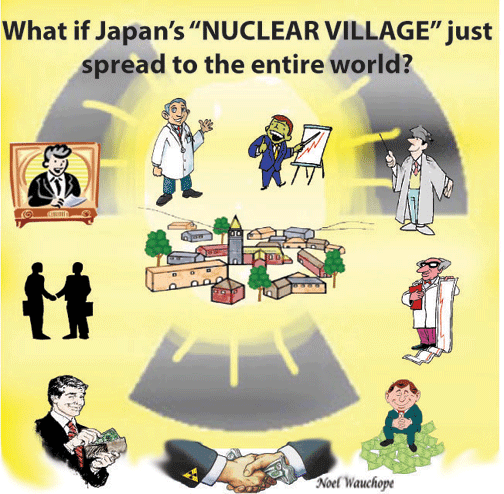
But it takes a village to breed such a corrupt and dangerous system. Tepco got away with its negligence for years because of the cozy ties between power companies and the regulators, bureaucrats and researchers that champion the industry — the “nuclear village.” Backed by its connections, money and control of the media, Tepco has brazenly continued to cook its radiation data for the last two and a half years. It matters little that the government is finally commandeering Tepco’s cleanup: The government is Tepco.
Dollar Signs Abe’s Liberal Democratic Party is blinded by dollar signs. In May, Abe visited Turkey to help close a $22 billion deal for Japan to build nuclear power plants in that seismically active nation. That kind of cash makes power companies virtually untouchable.
Abe’s Japan Is Blind to Scary Nuclear Reality http://www.bloomberg.com/news/2013-08-12/abe-s-japan-is-blind-to-scary-nuclear-reality.html By William Pesek Aug 12, 2013
Forget Abenomics. Ignore Shinzo Abe’s efforts to rejuvenate Japan’s diplomatic and military clout. Look past the quest to rewrite the constitution. History will judge this prime minister by one thing alone: what he did, or didn’t do, to end the worst nuclear crisis since Chernobyl.
It’s mind-boggling how disengaged Japan’s leaders have been since their “BP moment” — the March 2011 near-meltdown at the Fukushima Dai-Ichi nuclear plant. Abe’s predecessorsNaoto Kan and Yoshihiko Noda virtually ignored the radiation leaks and spent fuel rods sitting 135 miles (217 kilometers) from Tokyo. In December, Abe became the third prime minister to pretend all was well at Fukushima after a devastating earthquake and tsunami that flooded the plant.
The official line on Fukushima is depressingly familiar: The folks at Greenpeace International are trouble makers bent on scaring Japanese; the alarmists at theWorld Health Organization should mind their own business; the international news media needs to discover decaffeinated coffee. Nuclear power is clean, safe and — most important, now that a weakened yen has driven up energy bills — cheap.
Reality made an inconvenient reappearance last week. Mounting evidence that radioactive groundwater is gushing into the Pacific Ocean forced Abe to admit that plant owner Tokyo Electric Power Co. Inc. isn’t up to the task of containing the disaster. Under international pressure, he pledged the government would “make sure there is a swift and multifaceted approach in place” to stop the leak.
 Abe’s Seriousness
Pardon me for doubting Abe’s seriousness. It’s not just the sketchiness of the suggested remedy: freezing the ground around Fukushima, a tactic scientists fear will prove inadequate. It’s not the fact that nuclear regulators remain more focused on restarting reactors than on neutralizing the one that’s polluting North Asia. Continue reading
Hear Kellie Tranter – a formidable election candidate for Wikileaks

 AUDIO: Wikileaks seeking accountability in the Senate http://blogs.abc.net.au/nsw/2013/08/wikileaks-seeking-accountability-in-the-senate.html You may have watched or heard the leader’s debate last night that covered the subjects of boats, the economy, tax and the NBN. But did you hear much about monitoring government practice, governmental and public service transparency, internet freedom or your right to protest?
The fact that you didn’t is a major failure by the system and the media who monitors it, according to the new political party; Wikileaks.You may in fact know Wikileaks as a new media organisation-come-whistlebowing operation. But it now wants to take the principles that have made it a household name and form the platform of a senate run.
As far as we know, Julian Assange is under protection in Ecuador, but will still head the Victorian senate ticket.
So what does all this mean for the Hunter? Maitland human rights lawyer Kellie Tranter will head the NSW Senate ticket, and she joined Aaron Kearney to discuss what a vote for Wikileaks actually means in the upcoming election.
Tranter believes the genesis of the Wikileaks party has come from public concern and public groundswell against government secrecy, and that if the public wants to hold the government accountable for its actions, they should cast a vote her way. When questioned about the role of Wikileaks in the senate, Tranter said the Wikileaks party and the Wikileaks organisation are separate entities and that the Wikileaks party is needed to ensure the government is held accountable for its actions.
“We are absolutely fed up with a country being dragged to the far right and we’re looking to pull that back to the middle ground,” Tranter said.
Wikileaks Party strong advocates for Aboriginal rights
 Mr Assange said that the WikiLeaks Party stands alongside all Aboriginal and Torres Strait Islander peoples in their struggle and right to self-determination. The party has an eleven member National Council, with one of its national councillors Gamilaroy man Luke Pearson. Mr Pearson, a teacher and the creator of the highly respected social media project @IndigenousX, is unfolding, alongside others, policy positions and calls for justice for Aboriginal peoples. Mr Pearson is well known for his passion for Aboriginal education as part of a true Australian society and the common good.
“[The Northern Territory Intervention] one of the saddest, if not the saddest episodes of Australian history of the past ten years. A comic-book abuse of the role of the Australian military. A terrible violation of the right of Aboriginal Australia to determine its own destiny.”
Mr Assange said that the Intervention was “…aided and abetted by the credulous mainstream media’s demonization of Aboriginals as sexual deviants.”
Julian Assange on what the WikiLeaks Party will mean to Aboriginal peoples, Wikileaks Party August 10, 2013 by Gerry Georgatos, lead WikiLeaks Party Senate candidate for Western Australia First published in The Stringer, August 10 2013
There is a new political party on the horizon – the WikiLeaks Party. Founded by Julian Assange the fledgling party is bidding for Canberra through the Senate. They have seven Senate candidates including Julian Assange.
Mr Assange was interviewed this week by The Stringer, while holed up in London’s Ecuadorean Embassy in his seeking of Asylum to protect him from the fate that Private Bradley Manning faces in the United States.
The WikiLeaks Party is polling strongly and if the polls were to reflect accurately on election day, September 7, the party would find it has three and maybe four Australian Senators. Continue reading
Scientists and journalists responsible for truth, in the face of corporate globalization
 “Nuclear Guinea Pigs”: Deadly Experiments and Contaminated Reality By Greg Guma Global Research, August 11, 2013 “………Scientists and journalists like to believe that they are neutral witnesses who don’t affect the objects of their observation. But this is at best convenient self-deception, and at worst a callous lie……
Finally, there is the largest experiment of the moment, known as corporate globalization. Described by many experts as an indisputable fact of post-modern life, it is actually another deadly project, a sequel to the industrial revolution. And we know how well that one has gone for the planet. But like the victims in Nevada, the South Pacific, and the Amazon, we haven’t been told about the real costs or objectives. The truth, after all, might lead to resistance and accountability.
As many scientists now acknowledge, conceiving any experiment is the experience of an observer who is also a participant. Building on the theory of relativity, quantum physics has demonstrated that every measurement requires an act of intervention. As quantum physicist John Wheeler explained, “Participator is the incontrovertible new concept given by quantum mechanics. It strikes down the term ‘observer’ of classical theory, the man who stands safely behind the thick glass wall, and watches what goes on without taking part. It can’t be done, quantum mechanics says.”
And so, if there is really no way to observe any event or phenomenon without somehow affecting what happens, what are journalists or scientists to do? Well, at least act responsibly. This means acknowledging bias, intervening with compassion, and providing enough information to let the public make its own, fully informed choices. http://www.globalresearch.ca/nuclear-guinea-pigs-deadly-experiments-and-contaminated-reality/5345606
Australian Aborigines welcome refugees – and shame our politicians!
In an open letter to Rudd released on August 5, Aboriginal activist and president of the Indigenous Social Justice Association Ray Jackson said: “Both Nauru and Papua New Guinea are countries very susceptible to the rattling of the bags of silver proffered by Australian governments to allow us to dump what we see as ‘undesirables’ or ‘queue jumpers’ or ‘illegals’.
“They, of course, are none of these. Under the UN Declaration on Refugees they have every International Human Right to seek comfort and refuge here in Australia.
“You parliamentarians do not speak in my name.”
Aboriginal groups welcome refugees http://www.greenleft.org.au/node/54726#sthash.fMUMhBTG.dpuf August 11, 2013 By Kerry Smith Asylum seekers are welcome on Aboriginal lands in Australia despite the inhumane approach of both major political parties, the Aboriginal Provisional Government said on July 29.
Secretary Michael Mansell said: “As people who know what it’s like to be invaded by boat people we are in a better position to judge how the current boat people should be treated. Where the original boat people who took over our country were armed to the teeth and bent on conquest, asylum seekers in 2013 are unarmed and seeking sanctuary.
“The ancestors of Kevin Rudd and Tony Abbott most likely came by boat. It is certain they never sought Aboriginal permission to enter our shores. It is hypocritical of both Rudd and Abbott, who gained all the benefits of migration to rise to the positions they hold, to deny other migrants the same opportunity. The only difference is that Aborigines are giving permission, not being ignored.
“Some may believe it strange that a people dispossessed and dominated by migrants over two centuries would welcome more. Asylum seekers are not trying to take over anything. They are hoping they will be treated as fellow humans escaping persecution and despair, willing to risk death on the high seas to gain access to a life Rudd and Abbott would deny them.” Continue reading
International win for University of Wollongong’s fibro solar energy cottage
University of Wollongong’s fibro cottage wins international renewable energy competition http://www.abc.net.au/news/2013-08-12/fibro-cottage-wins-international-eco-prize/4880032 By Nick McLaren A team from the University of Wollongong has won a worldwide competition to design a zero-emissions solar house by refitting a humble Australian fibro cottage.
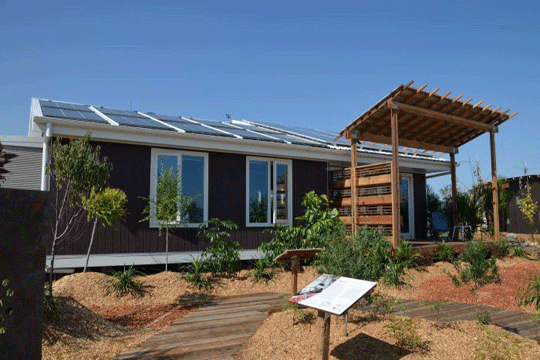
It is the first time an Australian team has entered the Solar Decathlon, which has been held in Datong, China since 2002.
The 51-strong team built the Flame House – a retrofitted fibro cottage designed to appeal to older clients nearing retirement.
The Australians beat 20 other finalists to place first in the engineering, solar and architecture categories, with a team from China second and Sweden third.
Project Manager Lloyd Niccol says the competition is about producing a home that is comfortable and generates more energy than it consumes. “We’re trying to find some way to make an immediately and positive impact on our environment,” he said.”There are eight million homes existing in Australia, and quite a few hundred thousand fibro homes.
“Only 2 per cent of those are replaced every year, so if we do want to make a real impact…we thought the best way to do that is to retrofit our homes. “So it’s showing how you can bring the typical home built in the 1950s into the current modern age so its comfortable, its got all the amenities you require, and it produces more energy than it consumes.”
Mr Niccol says the team used a range of technologies to modernise the cottage………… “In terms of the rest of the world…there are a lot of Chinese people that have actually asked whether we can just build them in Australia, so rather than actually retrofitting, just building the timber frame from scratch, essentially, and building this home.
“So there’s a market and a desire out there.” Mr Niccol says the competition home would cost approximately $300,000 to build in Australia.The prize-winning pad is set to be pulled apart before being shipped back to the University of Wollongong to be used for education and research.
Atomic Bombs Were Dropped On High-Density Civilian Populations In Japan To Make A Political Statement
.it wasn’t necessary to use the bomb against the cities of Japan in order to win the war but our possession and demonstration of the bomb would make the Russians more manageable in Europe.
The real purpose in incinerating two high-density civilian population centers, says Stimson, was “to persuade Russia to play ball.”
that’s the very definition of terrorism: using violence or the threat of violence as the means to achieve political ends. It’s terrorism with a vengeance. Americans just don’t do that kind of thing. Americans would never behave in such a horribly depraved and cruel manner. But, in fact, we did. And, as Part II of this article will make devastatingly clear, we still do. And it won’t stop until America awakens to the truth about itself, and, openly acknowledging that truth with a show of genuine heartfelt remorse, proceeds to make amends where amends are due.
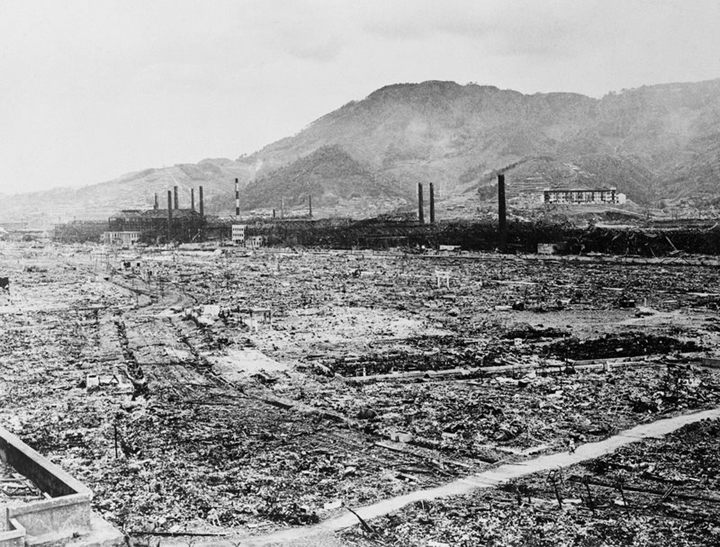
 America’s Nuclear Madness: Terrorism With A Vengeance (Part I) By Robert Quinn” OpEdNews 8/11/2013 “………… The inhumanity of it all couldn’t be more telling. The dropping of the second bomb on Nagasaki was especially brutal and cruel. Knowing of the horrendous horrors that had already been unleashed in Hiroshima, three days later the U.S. did the same thing to the civilian population of Nagasaki. Why? Japan’s surrender was already assured without the bombs. Surely surrender would soon be following on the heels of Hiroshima’s decimation. So, again, why the second bomb?
The answer is as simple as it is grotesque. The second bomb was dropped on Nagasaki because Japan’s surrender was never the issue. Getting Japan to surrender was the pretext. The bombs were dropped to make a point. There were political reasons for nuking those two high-density civilian populations, and the United States was not going to let Japan interfere with its political agenda by way of an untimely surrender. The dropping of the second bomb on Nagasaki was part of a political maneuver that had already been decided upon — a one-two punch stratagem designed to strike fear into post-war Russia (our ally in the war against Germany) and convince them to accept their subordinate position on the postwar world stage. Continue reading
Desperate and failing nuclear industry now bleating about Nuclear Fusion
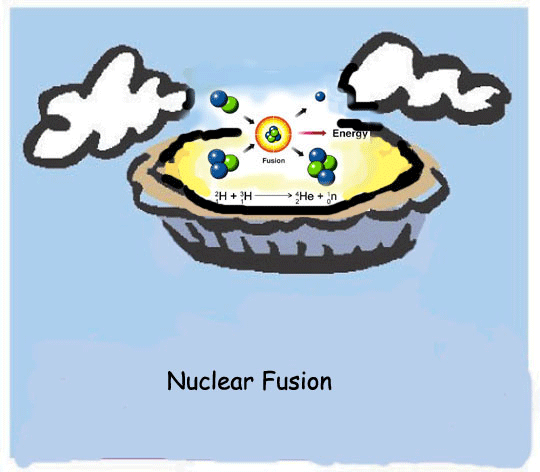 Britain’s leading nuclear scientist has said research into nuclear fusion is something all nations of the world should be putting money into…… Critics say it is another example of how fusion is always only “20 years away” and that in reality it will never be realised. RTE News World, 12 August 13
 Electricity prices will rise if carbon tax is scrapped
 http://www.abc.net.au/radionational/programs/breakfast/axing-carbon-price-will-hit-power-prices/4882394 AUDIO: Scrapping the carbon tax will lead to electricity price rises: report 13 August 2013 A new report out today says that the Coalition’s promise to ending carbon pricing in Australia would lead to higher wholesale energy prices. The report’s author told RN Breakfast that the policy would be a blow to renewable energy and household power bills, asJames Bourne reports.
An independent report released today has found that ditching the carbon price in Australia will hit investment in the renewable energy sector—and almost certainly lead to an increase in electricity prices.
Bret Harper, the Director of Research at advisory firm RepuTex which was commissioned by the World Wildlife Fund to write the report, says that without proper investment in renewable energy—made possible by a carbon price—wholesale electricity prices could rise by between five to ten percent by 2020.
And while the findings of today’s Renewable Energy and the Carbon Price report appear to be counter intuitive, Mr Harper says the potential price hikes are already common knowledge among government and business.
‘Renewable energy, when it’s put onto the system, tends to cut household electricity bills, not push them up,’ he told RN Breakfast.
‘It represents a very low-cost form of energy that displaces other fossil fuel generators which have very high fuel costs.’………..
Renewable energy revolution having an impact on energy prices
EnergyAustralia hurt by falling prices August 12, 2013 – SMH, Brian Robins EnergyAustralia, one of the country’s largest energy groups, has fallen into the red, hit by the downturn in wholesale electricity prices with little prospect of a quick revival in its fortunes……
The Australia energy market is facing unprecedented structural changes,” the Hong Kong-based parent said.
“The past two years have seen a pronounced decline in residential electricity demand in response to rising prices, and the deployment of rooftop solar photovoltaic systems and energy efficiency savings have more than offset any increase in demand from population growth……. Commercial and industrial demand has also been impacted … by a difficult manufacturing environment, in part due to rising energy costs, a highly valued Australian dollar and a slowing global economy.”
Wholesale electricity prices are also being pressured by a high level of output from renewable energy sources, it said, which is “likely to continue”. http://www.smh.com.au/business/earnings-season/energyaustralia-hurt-by-falling-prices-20130812-2rry3.html#ixzz2bt6ZK8vH
1 This month

of the week – Australians for War Powers Reform (AWPR)
To see nuclear-related stories in greater depth and intensity
 Antinuclear