Minister Gary Gray is disingenuous about radioactive wastes
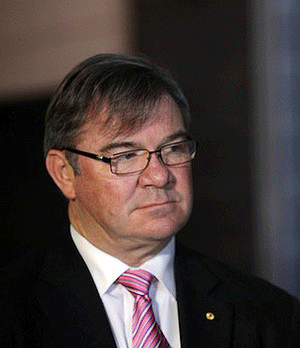 Christina Macpherson, 15 Aug 13, Australia’s new Energy Minister Gary Gray appears to be an improvement on the previous Minister, in that Gray at least met with some Traditional owners of land in Northern Territory – designated for a nuclear waste dump.

Australian govt’s nuclear waste plan contravenes UN Declaration
Northern Territory nuclear waste dump ‘contravenes UN declaration’ http://www.theguardian.com/environment/2013/aug/14/test-nuclear-waste-nova-peris Oliver Milman theguardian.com, Wednesday 14 August 2013
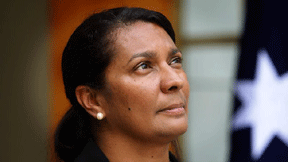 Conservationists say plan falls foul of agreement on Indigenous people’s rights, with senator-in-waiting Nova Peris also opposed Nova Peris is strongly opposed to the proposed plan for a nuclear waste dump.
The government risks breaching an international agreement if it goes ahead with a controversial nuclear waste dump in a remote part of the Northern Territory, conservationists say, with Labor Senate candidate Nova Peris calling for the plan to be dropped.
Conservationists claim that the Muckaty dump, near Tennant Creek, would be in contravention of the UN declaration on the rights of indigenous peoples, which states that nations must “ensure that no storage or disposal of hazardous materials shall take place in the lands or territories of indigenous peoples without their free, prior and informed consent”.
The basis of this consent is currently being challenged in the federal court, with a directions hearing set to take place in Melbourne on 26 August. Continue reading
Petition to World Health Organisation on Iraq birth defects study
-
-
 Petitioning Dr Margaret Chan , Director General of World Health Organisation, by Samira Alaani Fallujah, Iraq
-
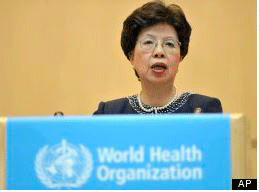
“………….The research is now complete and we were promised that it would be published at the beginning of 2013, yet six months later the WHO has announced more delays. We worry that this 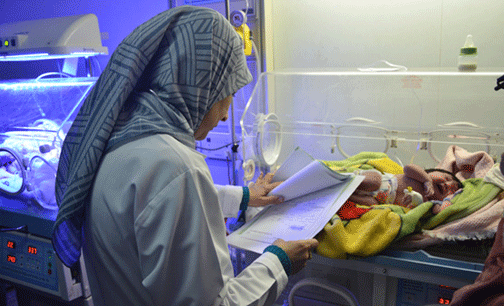 is now politics, not science. We have already waited years for the truth and my patients cannot wait any longer. The WHO has another option. The data should be published in an open access journal for independent peer review. The process would be fast, rigorous and transparent.
My patients need to know the truth, they need to know why they miscarried, they need to know why their babies are so ill but, most importantly, they need to know that something is being done about it. The Iraqi Ministry of Health and the World Health Organisation need to release this data and give us answers.
Please sign this petition and show that the rest of the world has not forgotten about the people of Iraq……..
http://www.change.org/en-GB/petitions/world-health-organisation-and-iraqi-ministry-of-health-act4iraq-and-release-birth-defect-data
World Health Organisation delays publishing studies on birth deformities in Iraq
In March 2013, BBC World broadcast a documentary on the story. As with other media reports, Born Under A Bad Sign visited the hospitals and spoke with parents and doctors – all of whom were convinced that the health problems they were witnessing were linked to the war.
Broadcast of the BBC report in March was followed by updates to the WHO’s FAQ. Gone was the petulant ‘No, absolutely not’ from the line on depleted uranium and the first of a series of procedural delays was announced as committees were formed and new analyses proposed. For campaigners seeking disclosure of the data as a first step towards focused research and humanitarian assistance in Iraq, the delays were worrying.
So how can civil society and individuals influence an organisation as monolithic and apparently compromised as the WHO? On the 31st July, Dr Al’aani launched an online petition through Change.org (with the associated twitter hashtag of #Act4Iraq) calling for the WHO to immediately publish the collected data for independent peer review, so that scientific conclusions can be drawn and the affected parents can finally understand what has happened to their children
Birth Defects: Did The Occupation of Iraq Leave a Toxic Legacy? http://www.newleftproject.org/index.php/site/article_comments/birth_defects_did_the_occupation_of_iraq_leave_a_toxic_legacy 6 Aug 13, During the occupation of Iraq, the city of Fallujah bore witness to some of the most intense US combat operations since Vietnam, with 2004’s OperationPhantom Fury widely condemned for its ferocity and disregard for international law.
Paediatrician Dr Samira Al’aani has worked in the city since 1997. In 2006 she began to notice an increase in the number of babies being born with congenital birth defects (CBD). Concerned, she began to log the cases that she saw. Through careful record keeping she has determined that at Fallujah General Hospital, 144 babies are now born with a deformity for every 1000 live births. This is nearly six times higher than the average rate in the UK between 2006 and 2010, and one strong suspicion is that contamination from the toxic constituents of munitions used by occupying forces could be the cause. (photo of Dr A;’aani by Donna Mulhearn)
Now a new nationwide study by the Iraqi Ministry of Health, in collaboration with the World Health Organisation, has the potential to catalyse efforts to understand and confront the issue, but only if science can be allowed to rise above politics. Continue reading
Danger in removing radioactive rods from Fukushima reactor’s raised pool
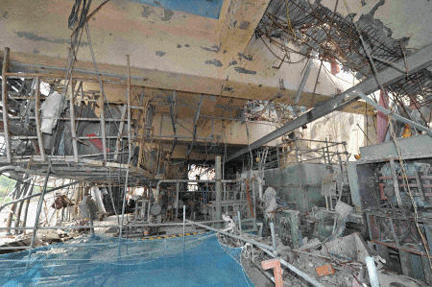 The deadliest part of Japan’s nuclear clean-up Stuff.co.NZ AARON SHELDRICK AND ANTONI SLODKOWSKI 14 Aug 13, The operator of Japan’s crippled Fukushima nuclear plant is preparing to remove 400 tonnes of highly irradiated spent fuel from a damaged reactor building, a dangerous operation that has never been attempted before on this scale.
INADVERTENT CRITICALITY “There is a risk of an inadvertent criticality if the bundles are distorted and get too close to each other,” Gundersen said. He was referring to an atomic chain reaction that left unchecked could result in a large release of radiation and heat that the fuel pool cooling system isn’t designed to absorb.
“The problem with a fuel pool criticality is that you can’t stop it. There are no control rods to control it,” Gundersen said. “The spent fuel pool cooling system is designed only to remove decay heat, not heat from an ongoing nuclear reaction.”
The rods are also vulnerable to fire should they be exposed to air, Gundersen said.
The fuel assemblies are situated in a 10 metre by 12 metre concrete pool, the base of which is 18 metres above ground level. The fuel rods are covered by 7 metres of water, Nagai said. Continue reading
Public comment called for about Mulga Rocks uranium project, Western Australia
 Mia Pepper, 15 Aug 13, Mulga Rocks uranium deposit held by Energy and Minerals Australia has been referred to the WA EPA for assessment. Mulga Rocks is adjacent to the Queen Victoria Springs A class reserve – 250km North East of Kalgoorlie – just next door to Tropicana Gold mine. There are priority flora and endangered fauna in the area.
There is an option for public comment on this referral – about the Level of Assessment the project will get. As a nuclear action it must be assessed under the EPBC Act and the Bilateral agreement with WA – but we have been calling for uranium projects in WA to be assessed by Public Inquiry under section 40(2)(c) of the EP Act 1986 through the The Royal Commissions Act 1968. Given the high level of public interest and uniques risks to the environment posed by uranium.
More details on the proposal and public comment can be made to the WA EPA here: https://consultation.epa.wa.gov.au/seven-day-comment-on-referrals/mulga-rock-uranium-project/consult_view
It would be great for everyone to submit a submission on the Mulga Rocks referral. There is now an easy online form to fill out on the WA EPA website so please take the time to fill it in:https://consultation.epa.wa.gov.au/seven-day-comment-on-referrals/mulga-rock-uranium-project/consult_view
Ice wall around Fukushima’s leaking reactors – it might work
At Fukushima, those problems will be even more extreme, but the cost of doing nothing is even higher
 How to Build an Ice Wall Around a Leaking Nuclear Reactor Yahoo News, Alexis C. Madrigal, The Atlantic 14 Aug 13 Building cryogenic barriers sounds like the specialty of an obscure supervillain, but it’s a well-established technique in civil engineering, used regularly for tunnel boring and mining. Ground freezing was even tested as a way of containing radioactive waste in the 1990s at Oak Ridge National Laboratory and performed admirably.
at left, workers near Fukushima radioactive water storage tanks
Joe Sopko, the civil engineering firm Moretrench’s director of ground freezing, has spoken with several consultants about the details of the project, and he’s convinced it’s certainly possible. “This is not a complicated freeze job. It really isn’t,” he told me. “However, the installation, because of the radiation, is.”…….
Here’s how it works. Freeze pipes, made from normal steel, are sunk into the ground at regular intervals. The spacing is normally about one meter. Then, some type of coolant is fed into the pipes. Sopko uses a brine — salty liquid which can be cooled far below the freezing point of fresh water without turning into a solid. On the surface, a big refrigerator chills the liquid, which is pumped into the pipes. The liquid extracts heat from the ground, and returns to the chiller, where it is recooled and sent back down. It’s not a fast process and can take many months. (Sometimes, for speed’s sake an expendable refrigerant like liquid nitrogen is used, but it requires trucking in tanks full of the stuff.) Continue reading
Australia not getting new coal power investment any time soon
New Coal Power Investment To Be Deferred – AEMO by Energy Matters, 15 Aug 13 Thanks in part to Australia’s home solar power revolution, the prospects for new fossil fuel based power generation investment look rather bleak over the next decade in much of the nation.
The recently published Electricity Statement of Opportunities (ESOO) from the Australian Energy Market Operator AEMO says the rise of residential rooftop solar, increasing energy efficiency in response to electricity price hikes and more large scale renewable energy development “is expected to defer new thermal electricity generation investment.”…….
Rooftop solar panels are treated as a demand offset for supply–demand balance, and are not included in the 522.7MW figure. However, in 2012-13, the AEMO estimates 774 MW of rooftop PV generation capacity was installed in the NEM. ….. Of the 1,000 MW in new large scale generation committed since last year’s ESOO; 95% consists of wind generation and 5% solar generation…… http://www.energymatters.com.au/index.php?main_page=news_article&article_id=3889
1 This month
7 April – WEBINAR – Australia and the Doomsday Clock – Preventing nuclear war through NoFirstUse and other policies
Online | Tuesday April 7, 4:00-5:30pm, Australian Eastern Time / 8:00-9:30am Central Europe Time
– Access the registration link
15 April – Zoom –Nuclear Power is Not the Solution
Apr 15, 2026 01:00 AM in Canberra, Melbourne, Sydney

Join the International Physicians for the Prevention of Nuclear War (IPPNW) on Tuesday, April 14th for a timely webinar exploring the risks associated with nuclear power and challenging the myth that it offers a simple, safe, carbon-free solution to the climate crisis

21 April Webinar: No Nuclear Weapons in Australia
Start: 2026-04-21 18:00:00 UTC Canberra, Melbourne, Sydney (GMT+10:00)
End: 2026-04-21 19:30:00 UTC Canberra, Melbourne, Sydney (GMT+10:00)
Event Type: Virtual
A virtual link will be communicated before the event.
Host Contact Info: australia@icanw.org

of the week – Australians for War Powers Reform (AWPR)
To see nuclear-related stories in greater depth and intensity
 Antinuclear