A bold, but feasible, plan for Australia as renewable energy exporter
The economic equation is moving in the right direction as the price of renewables drops sharply, and as the world starts to put a price on the negative externalities of fossil fuels, including carbon emissions. Yes it is technically formidable, and assembling the necessary geopolitical and financial architecture to make it happen won’t be trivial.
But the drivers are compelling.
This project would secure sustainable energy and low carbon futures for the fastest growing region on Earth,
This project would catapult us to the forefront of the technology savvy and rapidly growing green energy sector, generating many thousands of high-tech jobs in Australia and beyond.
North Australia’s electrifying future: powering Asia with renewables REneweconomy, By Andrew Blakers on 21 August 2013
By Andrew Campbell, Andrew Blakers and Stuart Blanch
It may just be election season, but big dreams for the development of northern Australia are back in fashion. So here’s our piece of “next-frontier”, big-picture 21st-century thinking. It may even have room for a dam or two.
A Snowy scheme for the 21st century
Imagine a project that could help Indonesia achieve energy security, dramatically cut energy poverty for hundreds of millions, catalyse renewable energy production in Assocation of South East Asian Nations (ASEAN) countries, cut regional carbon pollution, and transition Australia’s energy exports from risky fuels to renewable energy.
Sounds far-fetched? In fact, such a proposal has already been published in the international peer-reviewed literature. It takes several existing technologies already in widespread deployment, and joins them together in a new configuration on an unprecedented scale, in a region with enormous natural competitive advantage — north-western Australia.
Here’s the plan.
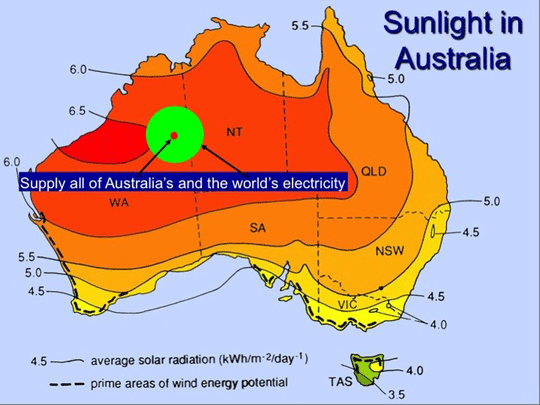
Take part (say 2,500 km2) of an existing cattle station somewhere near Lake Argyle and cover one third of it with solar panels on tracking arrays. Build a large reservoir upslope at least 300 metres above Lake Argyle, holding at least 1,000 gigalitres of water.
Build a 100 gigawatt power station that uses solar energy to pump water from the lake up to the upper reservoir. The water flows back down the hill through turbines at night, generating power to the grid 24 hours a day, 365 days a year. Hundreds of “pumped hydro” schemes of this nature are already working well around the world, albeit not on this scale.
The “grid” in this case, would be an integrated south-east Asian supergrid, the spine of which would be a High Voltage Direct Current (HVDC) cable running from northern Australia along the Indonesian archipelago and up into the Philippines, Malaysia and Indochina, and then eventually into China.
The capital cost of building such a power station, storage and HVDC link and extending it as far as Jakarta is estimated at around US$500 billion. This compares with Indonesia’s current projections that it needs to invest US$1,000 billion in conventional (coal and nuclear) power stations to meet its energy needs over the next 40 years.
The electricity price in Jakarta from this scheme would be around 8 cents per kilowatt-hour, compared with the current 6 cents price (externalities excluded) from coal-fired power in Indonesia.
Much cleaner energy, forever, at a comparable price. What’s not to like?
If this sounds unlikely, or too grand by half, let’s back up and look at the individual elements in turn.
Looking back, and looking forward………
The economic equation is moving in the right direction as the price of renewables drops sharply, and as the world starts to put a price on the negative externalities of fossil fuels, including carbon emissions.
Yes it is technically formidable, and assembling the necessary geopolitical and financial architecture to make it happen won’t be trivial.
But the drivers are compelling.
This project would secure sustainable energy and low carbon futures for the fastest growing region on Earth, reducing energy conflicts and energy poverty, tackling climate change and saving rainforests, and exploiting the region’s natural advantage in renewable resources.
This project would catapult us to the forefront of the technology savvy and rapidly growing green energy sector, generating many thousands of high-tech jobs in Australia and beyond.
Such a project would integrate northern Australia into south-east Asia as never before. Indeed it would be transformative for this region, giving real ambition to the idea of “the next frontier”.
Andrew Campbell is dDirector, Research Institute for Environment and Livelihoods at Charles Darwin University. Andrew Blakers is directors of the Centre for Sustainable Energy Systems (CSES) at ANU. Stuart Blanch is adjunct research fellow at Charles Darwin University.
This article was co-authored by Rob Law, Policy Officer at Environment Centre NT. eneweconomy.com.au/2013/north-australias-electrifying-future-powering-asia-with-renewables-80382
No comments yet.
1 This month

of the week – Australians for War Powers Reform (AWPR)
To see nuclear-related stories in greater depth and intensity
 Antinuclear
Leave a comment