Crowd building against radioactive waste dump

 Capacity crowd attends ‘Save the Great Lakes from Nuclear Waste’ town hall meeting Macomb Daily By GINA JOSEPH
Gina.joseph@macombdaily.com; @ginaljoseph, 08/20/13 The tide opposing a proposed Canadian underground nuclear waste repository on the shore of Lake Huron appears to be rising.
“I was very happy with the turnout but given the magnitude of the potential risk I wish hundreds more would have been here,” said State Rep. Sarah Roberts (D-St. Clair Shores) referring to the crowd attending last night’s ‘Save the Great Lakes from Nuclear Waste’ public forum at Wayne State University in Detroit. “Tonight demonstrated to me that there are many concerned citizens who care about our Great Lakes, our public health, our drinking water and the potential danger of the proposed underground repository.”
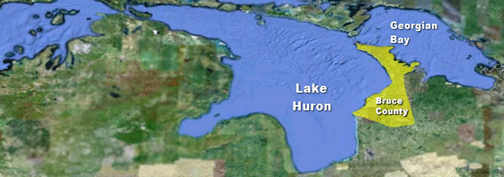
Ontario Power Generation wants the Canadian federal government to approve its plan to bury low and intermediate level radioactive nuclear waste under the Bruce Nuclear Power Plant, located on the shore of Lake Huron in the municipality of Kincardine.
Kincardine is less than three hours from the Blue Water Bridge in Port Huron and north of Grand Bend, Ont. Roberts, who introduced a resolution urging Congress to oppose the underground nuclear waste dump, co-hosted the public forum on the proposed nuclear waste dump along with State. Sen. Hoon-Yung Hopgood (D-Taylor), who introduced a similar resolution that was unanimously passed by the Michigan Senate.
If the license is approved by the federal government, Ontario Power Generation will construct a deep geologic repository (DGR), consisting of burial caverns carved out of limestone and shale rock formations, less than a mile inland from the shore of Lake Huron and about 440 yards below the Great Lakes basin…… http://www.macombdaily.com/article/20130820/NEWS03/130829994/capacity-crowd-attends-save-the-great-lakes-from-nuclear-waste-town-hall-meeting
Economic facts remain bad for the uranium industry
 Uranium sags once more 9 news Finance. 20 Aug 13 “…..Once again the floor was pulled out from under the spot market, and prices have responded accordingly. Some 800,000lbs of U3O8 equivalent did change hands in several transactions over the course of last week, but prices trended lower with each trade now that the sellers are on the hop once more. TradeTech’s weekly spot price indicator has fallen US75c to US$35.00/lb.
These fluctuations in the spot price are having their effect on the term market. A number of utilities are looking to enter the term market for supply contracts, TradeTech reports, but none appears in a great hurry while price movements are unclear. No term transactions were reported last week….http://finance.ninemsn.com.au/newscolumnists/greg/8709269/uranium-sags-once-more
Fact checking the clams about “wind turbine syndrome”
 DO WIND TURBINES CAUSE HEALTH PROBLEMS? > CHECK THE FACTS HTTP://WWW.FACTSFIGHTBACK.ORG.AU/DO-WIND-TURBINES-CAUSE-HEALTH-PROBLEMS-CHECK-THE-FACTS/ Facts Fight Back, August 20, 2013 ·
Who: “[Health concerns are] justified on the scientific evidence. We know from evidence from field studies… that low frequency noise actually causes health problems, physiological damage to people.” Senator Nick Xenophon
The claim: There is scientific evidence that wind turbines cause health problems.
The facts: In July 2010, the National Health and Medical Research Council reviewed the literature and found that there is currently no published scientific evidence to positively link wind turbines with adverse health effects.
In January 2012, an Independent Expert Panel in the US released a Wind Turbine Health Impact Study Report for the Massachusetts Department of Environmental Protection and the Department of Public Health. The reportfound that literature on human response to wind turbines related to self-reporting of “annoyance”.
The finding: Negative health outcomes appear to be caused by people being stressed by incorrect information about wind turbines not from the actual wind turbines. There is no evidence to show that wind turbines cause health problems.
Discussion of evidence: Reviews of the scientific literature have found that wind turbines cause no ill health effects. Health effects that are reported are consistent with stress and further studies have shown that there is a correlation between these adverse impacts and exposure to negative health information about wind turbines. Senator Xenophon is incorrect to say there is scientific evidence that point to wind turbines causing adverse health effects in humans.
It turns out that renewable energy is no more costly than fossil fuels
So it seems that Canberra bureaucrats, if not the politicians, are conceding that there is little difference in costs between the relatively modest climate and clean energy goals proposed by the current government, and the more ambitious targets proposed by The Greens, and environmental groups.
 Renewables future no more costly than fossil fuels REneweconomy, By Giles Parkinson on 21 August 2013 The Australian government appears to have made a remarkable concession following the release of the 100% renewables report by the country’s energy market operator – a renewables future will be no more costly than the largely fossil fuel alternative.
As we reported earlier this month, after the release of the Australian Energy Market Operator’s 100% renewables scenario, the estimated wholesale cost of electricity from a system based largely around wind, solar, geothermal and biomass would cost around $110/MWh and $130/MWh between 2030 and 2050 – depending on the speed of that transition.
A “community summary” posted on the Department of Climate Change website, highlights the fact that the various scenarios painted by Treasury, the CSIRO, the UNSW, and now the AEMO modeling suggests that wholesale prices – whatever the scenario – will fall in a generally narrow range of around $100/MWh to $130/MWh in 2030, and $110/MWh to $150/MWh in 2050.
Here is the relevant piece from the document: Continue reading
Quieter and cleaner wind turbines
 Quieter Wind Turbines = More Power http://www.energymatters.com.au/index.php?main_page=news_article&article_id=3898 20 Aug 13 GE has been conducting research into new low-noise wind turbine blade design. It’s not about addressing infrasound – which has already been shown not to be an issue in areas surrounding wind farms – it’s all about producing more power.
“There’s no question, aerodynamic noise is a key constraint in wind turbine blade design today”, says Mark Jonkhof, Wind Technology Platform Leader at GE Global Research.
“By using high-performance computing (HPC) to advance current engineering models that are used to predict blade noise, we can build quieter rotors with greater blade tip velocity that produce more power. This not only means lower energy costs for consumers, but also a significant reduction in greenhouse gas emissions.” Continue reading
Shabby history of destruction of Aboriginal culture and land ownership
Rudd and Abbott charge the north Eureka Street Dean Ashenden | 19 August 2013 “……..Credit for getting this history under way goes to the pastoral grandees of the colony of South Australia. In the 1860s they funded an obsessive-compulsive alcoholic Scotsman to find out what lay between their northern border and the far coast, and how it could be got. John McDouall Stuart’s six expeditions found little to encourage them, but lust trumped reason, and South Australia set itself to be the first colony in history to found a colony. The two would fuse, in time, to become the Great Central State.
Dreams of imperial glory and speculative fortunes turned almost immediately into a long-running mixture of farce and nightmare. Eventually South Australia got lucky. In 1911 it managed to palm off its colony onto the newly-constituted Commonwealth of Australia. Astonishingly, the Commonwealth even agreed to pay serious money for it, nearly four million pounds, plus another 2.2 million for a railway line that had not even reached South Australia’s northern border, let alone made any money.
Believing, as had the South Australians before them, that there must be a way to turn space into land, the Commonwealth did what South Australia had done, with the same result. An official inquiry report in 1937 was scathing. It found that in the 25 years since the takeover the federal government had spent more than 15 million pounds and was heading further into the red. The previous year’s production had brought in 100 000 pounds less than the Government’s outlay for the year of 600,000 pounds.
But the inquirers nonetheless found that it can be done, if it’s done right. It prescribed the familiar medicine: ports, roads, bridges, railways, ports, industry development boards, the lot.
Much of what the inquiry wanted soon came to pass, but not in result of its proposals. In 1939, war saw tens of thousands of troops stream north to build roads, airfields, a port and other infrastructure. For the first time the white population exceeded the black.
Soon motor vehicles, aircraft, air conditioning and buckets of public money transformed the look and feel of the Territory, but ‘development’ remained elusive. In the Territory, and more particularly in neighbouring tropical Queensland and Western Australia, mining was the only big earner, not necessarily to the advantage of government revenues.
The kind of on-the-ground industries apparently envisaged by Rudd and Abbott — horticulture and agriculture particularly — were confined to coastal enclaves or to the margins of viability. Much of the north proved too hot, too wet, too dry, too far from markets, too barren or too pestilential, with the happy consequence that the frontier failed to do its grim work.
Instead of a near-obliteration of Aboriginal populations of the kind seen on the eastern and southern seaboards, northern Australia witnessed a slow-motion saga of sporadic violence and accommodation, of advance and retreat. Neither side ever looked liked winning, and neither ever looked like giving up.
In the aftermath of the Coniston massacres of 1928 both sides abandoned violence for other means, and since then both have used the law, politics, money and public opinion in hundreds of struggles over land and ‘culture’, some famous or notorious, most not, one side straining to gain ground, the other to resist and to recover.
That 160-year struggle now seems to be reaching a new stage. We like to think that the devastation of one population and culture by another is all in the past, but the apparent failure of Rudd and Abbott to notice that northern Australia is shared country suggests that there might be more to come.http://www.eurekastreet.com.au/article.aspx?aeid=37087#.UhP0g9Jwo6I
Boring, boring: uranium price further down
 Uranium spot price falters after rumored deal falls through: sources Washington (Platts)–20Aug 2013 An early-August rally in the uranium spot price ended after the market learned that a potential deal with an investment fund for up to 1 million pounds of U308 will not close anytime soon, if at all, price publishers and market sources said. Since the, the price has steadily weakened.
Price publishers TradeTech and Ux Consulting both lowered their weekly uranium spot price by 75 cents/lb to $35/lb, Friday and Monday, respectively.
“While it was never guaranteed that the buyer would purchase, the possibility that up to 1 million pounds of supply could be removed from the near-term market had served to create some upward price pressure,” TradeTech said in its weekly report Friday. “Now that it is clear the purchase will not go forward, at least for the time being, seller optimism has waned.”…….
1 This month

6 March -Online – Reversing nuclearization:
From nuclear weapons in Belarus and NATO host countries to a European-Nuclear-Weapon Free Zone
Mar 6, 2026 03:00 AM in Canberra, Melbourne, Sydney

of the week – Australians for War Powers Reform (AWPR)
To see nuclear-related stories in greater depth and intensity
 Antinuclear