Nuclear power and the Australian Economy – theme for September 2013
In Australia, discussion of the economics of nuclear power is strangely quarantined from the global discussion. Under the influence and ignorance of politicians, corporate bosses, and the Murdoch media, economic information about nuclear power is marvellously skewed away from the truth.
We just don’t get to hear about the collapsing nuclear industry in America, the agonies over nuclear costs in the UK, the movement away from nuclear in Europe, and doubts over nuclear economics, in Asia. The renewed emergency at Fukushima now adds to the dimming prospects for the nuclear industry
The “spot” price for uranium plunges ever downward. The “term” or contract price now tends downward, too. Australian uranium mining companies are hanging on like grim death, waiting for the fabled “nuclear renaissance” that never comes. They are bolstered by a subservient media, that seems to swallow the line that – uranium prices are so near the bottom – it is proof that that they must come up. Must they, really?
Nuclear power for Australia is a crackpot idea. You get people like Martin Nicholson advocating it as an economically viable industry. He spews out impressive figures. But he doesn’t mention what climate change is likely to do to nuclear reactors (they have to be near water). Doesn’t mention costs of waste disposal, costs of endless security. And of course – the big one – that renewable energy is fuelled for free, can co-exist with farming, can be erected quickly in small scale methods, and relatively quickly in large scale, – and does not degrade the soil underneath.
The Australian nuclear lobby might seem impressive. But – it is made up of separate wrangling interests, competing with each other.
Japan’s grave warning on latest Fukushima radiation crisis
 Japan to issue gravest Fukushima nuclear warning in two years Toronto Sun, KENTARO HAMADA AND JAMES TOPHAM, REUTERS, AUGUST 21, 2013 03 TOKYO – Japan will dramatically raise its warning about the severity of a toxic water leak at the Fukushima nuclear plant, its nuclear watchdog said on Wednesday, its most serious action since the plant was destroyed by an earthquake and tsunami in 2011.
The deepening crisis at the Fukushima plant will be upgraded from a level 1 “anomaly” to a level three “serious incident” on an international scale for radiological releases, a spokesman for Japan’s Nuclear Regulation Authority (NRA) said.
That will mark the first time Japan has issued a warning on the International Nuclear Event Scale (INES) since three reactor meltdowns after the massive quake in March 2011.
Water still leaking from the plant is so contaminated that a person standing close to it for an hour would receive five times the annual recommended limit for nuclear workers in a year…… The leak, which has not been plugged, is so contaminated that a person standing 50 cm (1.6 feet) away would, within an hour, receive a radiation dose five times the average annual global limit for nuclear workers.
After 10 hours, a worker in that proximity to the leak would develop radiation sickness with symptoms including nausea and a drop in white blood cells.
Each one-step INES increase represents a tenfold increase in severity, according to a factsheet on the website of the International Atomic Energy Agency. http://www.torontosun.com/2013/08/21/japan-to-issue-gravest-fukushima-nuclear-warning-in-two-years
Christine Milne announcs Greens policy to promote community renewable energy.
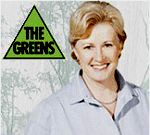 Greens to give power to people : http://www.smh.com.au/federal-politics/federal-election-2013/greens-to-give-power-to-people-20130820-2s9dk.html#ixzz2cjGRYj August 21, 2013 Heath Aston
Political report Local communities could own and produce their own renewable power under a $100 million election plan to be announced by Greens leader Christine Milne on Wednesday.
The Greens would provide the money as seed funding to enable communities to invest in green energy to reduce or end their reliance on the fossil fuel-powered electricity grid. Similar schemes in Germany have involved small cities establishing hydro power schemes using the run of rivers.
In the US, communities have banded together to invest in solar.
Investment in wind power and other renewables has been hit by Labor’s promise to rush to an emissions trading scheme.
Bradley Manning revealed truth about Afghanistan war atrocities
Bradley Manning’s Heartbreaking Apology
18 Fukushima children have thyroid cancer, (normally very rare in children)
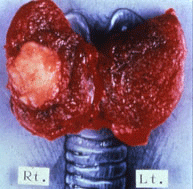 Thyroid cancer found in 18 Fukushima children http://www3.nhk.or.jp/nhkworld/english/news/20130821_06.html 20 Aug 13, Medical examinations in Fukushima Prefecture following the nuclear crisis of 2011 have detected 18 children with thyroid cancer.
The finding was reported on Tuesday by a prefectural panel examining the impact of radiation on the health of local residents.
The prefecture is giving medical checkups to all 360,000 children aged 18 or younger at the time of the accident at the Fukushima Daiichi plant in March 2011.
That’s because radioactive substances released in the accident can accumulate in children’s thyroid glands, possibly increasing their risk of developing cancer. Some 210,000 children had been tested by the end of July.
Besides the 18 minors diagnosed with cancer, 25 others are suspected to have the illness.
The incidence rate of thyroid cancer in children is said to be one in hundreds of thousands. In Japan, 46 people under 20 were diagnosed with thyroid cancer in 2006.The panel says it cannot determine if the accident has affected the incidence of cancer among children in Fukushima. But it has decided to set up an expert team to look into the situation.
Panel chief Hokuto Hoshi says they will carefully examine the accumulated data and individual cases so they can give explanations to residents in a responsible manner.
1 This month

of the week – Australians for War Powers Reform (AWPR)
To see nuclear-related stories in greater depth and intensity
 Antinuclear