Dr David Palmer explores the reasons for pro nuclear South Australia
Listen to this terrific radio broadcast. You will get an insight into why a few go getting business people in South Australia are willing to put the dangerous nuclear fuel cycle in to South Australia.
TRANSCRIPT is now available at https://antinuclear.net/2013/08/29/radio-adelaide-the-hub-of-military-industrial-intelligence-nuclear-complex/ – we need to know what the Australian nuclear lobby is up to! – CM

 AUDIO: https://radio.adelaide.edu.au/nuclear-power-in-south-australia-a-golden-age/ Nuclear Power in South Australia – a golden age? Radio Adelaide 23 Aug 13
Would you support increased uranium mining, enrichment and the generation of nuclear power if it reduces carbon emissions and enriches South Australia?
Sounds like a golden future, but is it? Chris Komorek spoke with Dr David Palmer from Flinders University to explore the changing landscape.
Produced by Ian Newton (Below – a group of pro nuclear South Australians)

Australia’s low return high-risk uranium industry a part of global nuclear weaponry

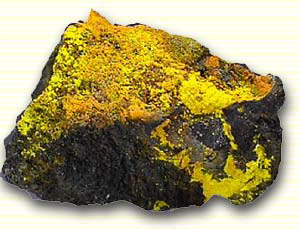 Time to stop the (uranium) boats, SMH, Dave Sweeney, 28 Aug 13, “…….. Time after time the uranium industry promises big but delivers little. It contributes less than 0.3 per cent of export revenue and account for 0.015 per cent of Australian jobs.
The most recent independent assessment Australia’s uranium industry – a 2003 Senate inquiry – found the sector characterised by underperformance and non-compliance and urged changes to protect the environment and its inhabitants from “serious or irreversible damage”.
Sadly, in the decade since then little has changed, even though the need to manage radioactive materials over extremely long periods with specific security and proliferation issues make uranium mining fundamentally different from other types of mining.
Uranium mining remains a contested and contaminating industrial activity that poses serious and continuing problems – now and long into the future – and continues to lack community consent and a social licence.
But Australia can – and must – do better than this.
We are a rich nation blessed with a skilled workforce and abundant renewable energy resources. Instead of literally fuelling disaster we should be leading the world in clear and sustainable energy technology and generation.
Two decades ago nuclear power provided around 17 per cent of the world’s electricity, today it is close to 10 per cent. In China, Germany and Japan – three of the world’s four largest economies – renewable energy sources generate more power than nuclear reactors.
In France, a favourite of the atomic lobby, the share value of state utility EDF, the world’s largest nuclear operator, has fallen 85 per cent over the past five years.
Talk of domestic nuclear power is fanciful but Australia is a major global nuclear player by virtue of the uranium we sell to other countries and we now need a genuine debate about our role in fuelling this trade.
As home to around 35 per cent of the world’s uranium, the decisions we make here count and – like the waste – they count for a very long time. That is why Hawke’s call for Australia to become the world’s nuclear waste dump is way off the mark. http://www.smh.com.au/comment/time-to-stop-the-uranium-boats-20130827-2snau.html#ixzz2dIOX2ZZw
Australia’s hypocrisy on the South Pacific Nuclear Free Zone Treaty
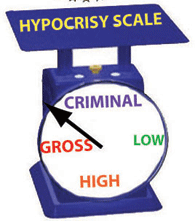 Declassified documents from the National Archives of Australia, including the 1985 Cabinet minute about the SPNFZ Treaty, show clearly that Australia designed the treaty to protect US interests in the Pacific, including the deployment of nuclear-armed warships and the testing of nuclear missiles.
Hayden’s cabinet submission includes details of Australian negotiating positions in the final months before the treaty was signed:
(iii) Australia oppose the inclusion in the draft SPNFZ Treaty of a ban on missile tests.
(iv) Australia oppose the inclusion in the draft SPNFZ Treaty of a ban on the facilitation of the stationing of nuclear weapons,
Delaying the nuclear-free zone in the Pacific, Inside story, 27 Aug 13 As Pacific leaders gather this week in the Marshall Islands, the United States continues to delay ratification of the South Pacific Nuclear Free Zone Treaty. Using previously classified documents Nic Maclellan recounts a history of opposition to a nuclear free Pacific, and a reminder that Australia could be breaching the treaty
AT THE height of the nuclear arms race between the United States and Soviet Union, a treaty to create a South Pacific Nuclear Free Zone, or SPNFZ, was opened for signature on Hiroshima Day, 6 August 1985, at the Pacific Islands Forum meeting in Rarotonga. Twenty-eight years after it was signed on that day by Australia, New Zealand and island nations, the United States still hasn’t ratified its protocols, Continue reading
ICAN calls on universities, Future Fund, to stop investing in nuclear weapons,

A lot of Australians would be shocked to learn that the Future Fund has more than A$130 million invested in companies that manufacture nuclear arms.
“It’s easy to imagine that Australia is not involved in the global nuclear weapons trade, but with the Future Fund’s investments in nuclear weapons companies and the Federal Governments intentions to export uranium to India and other nuclear weapons states, it most certainly is,” ICAN Australia’s Outreach Coordinator, Gem Romuld, told IDN.
ICAN AUSTRALIA SHOWS THE WAY TO ABOLISH NUKES BY NEENA BHANDARI | IDN-INDEPTH NEWSANALYSIS, 28 AUG 13, SYDNEY (IDN)
“………..The Future Fund ICAN is calling on universities to develop ethical investment policies that exclude nuclear weapons companies both from their direct investments and their investments through fund managers. An Australian Government investment fund, The Future Fund, currently invests A$227 million in nuclear weapons companies.
A petition with 14,000 signatures was delivered in August 2013 to the Fund’s board members and ICAN members visited the Fund’s head office in Melbourne on Hiroshima Day (August 6) and Nagasaki Day (August 9), demanding that it divests from nuclear weapons companies.
Wright said, “The Fund has divested from companies involved in the production of other inhumane weapons such as cluster munitions and landmines. They recently excluded tobacco companies from their investments in response to public pressure, so we are optimistic that we can also convince them to exclude nuclear weapons companies.” Continue reading
An Abbott government’s climate policy not likely to pass in the Senate
Frontier Economics has proposed an intensity-based emissions trading scheme imposed initially only on electricity generators – but Tony Abbott has ruled out any form of carbon price or “tax”
 Opposition to Abbott’s key policies raises possibility of double dissolution Lenore Taylor, political editor theguardian.com, Tuesday 27 August 2013
Climate plan and paid parental leave scheme may be blocked in Senate if Coalition wins election Tony Abbott’s central policies, including the “direct action” climate plan and his paid parental leave scheme, are likely to face major problems in the upper house whichever way the unpredictable Senate ballot falls on 7 September, leaving open the possibility of a double dissolution election.
If the Coalition wins government, as all major polls are predicting, it is unlikely to win control of the Senate in its own right. Continue reading
Liberal Coalition talking about funding Victorian solar project
 Coalition open to supporting north-west Victorian solar projects 27 Aug 2013, The Federal Coalition has indicated it would support solar projects in north-west Victoria if elected. http://www.abc.net.au/news/2013-08-27/coalition-open-to-supporting-north-west-victorian/4914666
The Commonwealth’s Australian Renewable Energy Agency (ARENA) says it is interested in funding future solar projects in Mildura. However, the agency decided last year not to fund Energy Australia’s Mallee Solar Park Project.
The Coalition’s climate action spokesman Greg Hunt could not make any firm election commitments for solar but says he would keep ARENA running. “We have the potential through both ARENA and the renewable energy target for solar farms and the third element which gives us opportunities through the solar towns program,” he said.
“We’re keeping … ARENA … and ARENA is the body which is looking at specific support for developmental projects in the solar space, so ARENA becomes the way forward but in particular, we also have the solar towns and solar schools projects.”
Meanwhile, Energy Minister Gary Gray says Labor is supporting future solar projects in Mildura through the agency. Although in a statement, he defended its decision last year not to fund Energy Australia’s Mallee Solar Park Project.
Space radiation worse for female astronauts- (? discrimination)
 Female Astronauts Face Discrimination from Space Radiation Concerns, Astronauts Say, Space.com

Both male and female astronauts are not allowed to accumulate a radiation dose that would increase their lifetime risk of developing fatal cancer by more than 3 percent. A six-month mission on the International Space Station exposes astronauts to about 40 times the average yearly dose of background radiation that a person would receive living on Earth, NASA spokesman William Jeffs said in an email .
.
While the level of risk allowed for both men and women in space is the same, women have a lower threshold for space radiation exposure than men, according to physiological models used by NASA. “Depending on when you fly a space mission, a female will fly only 45 to 50 percent of the missions that a male can fly,” Peggy Whitson, the former chief of NASA’s Astronaut Corps, said. “That’s a pretty confining limit in terms of opportunity. I know that they are scaling the risk to be the same, but the opportunities end up causing gender discrimination based on just the total number of options available for females to fly. [That’s] my perspective.” [Radiation Threat for Mars-Bound Astronauts (Video)]
NASA follows radiation exposure recommendations established by the National Council of Radiation Protection and Measurements. The exposure limits for women are about 20 percent lower compared to men “largely due to additional cancer risk for woman from breast, ovarian, and uterine cancers,” Jeffs told SPACE.com……..
“Depending on when you fly a space mission, a female will fly only 45 to 50 percent of the missions that a male can fly,” Peggy Whitson, the former chief of NASA’s Astronaut Corps, said. “That’s a pretty confining limit in terms of opportunity. I know that they are scaling the risk to be the same, but the opportunities end up causing gender discrimination based on just the total number of options available for females to fly. [That’s] my perspective.” [Radiation Threat for Mars-Bound Astronauts (Video)] …… http://www.space.com/22252-women-astronauts-radiation-risk.html
International Campaign to Abolish Nuclear Weapons (ICAN) gathers strength, especially among the young
Students across the world are participating in the campaign. Earlier this year, students from Gisborne Secondary College in Victoria (Australia) made 1000 paper cranes and delivered them to the parliamentary secretary to Australian prime minister, calling for ban on nuclear weapons.
The school’s Japanese language teacher, Noriko Ikaga, has been taking Years 10 and 11 students to Japan every alternate year. “It has become a tradition to make 1000 paper cranes when we visit the Hiroshima Peace Memorial Museum. This year, the students also folded another 6000 paper cranes for the kids affected by the Fukushima nuclear disaster,” Ikaga told IDN.
With Australia going to polls on September 7, these students are hoping that future leaders will take Australia’s nuclear obligations seriously.
ICAN AUSTRALIA SHOWS THE WAY TO ABOLISH NUKES BY NEENA BHANDARI | IDN-INDEPTH NEWSANALYSIS, 28 AUG 13, SYDNEY (IDN) – Even as the nuclear-armed countries continue to amass new warheads and build and modernise ballistic missiles, bombers and submarines to launch them, the campaign for nuclear abolition is growing from strength to strength.
International Campaign to Abolish Nuclear Weapons’ (ICAN) Paper Cranes Project – symbolizing support for nuclear disarmament – is urging governments to begin negotiations on a global treaty banning nuclear weapons this year. More than 190,000 paper cranes have already been delivered to world leaders, and messages of support have been received from the Secretary-General of the United Nations and amongst others national leaders of Australia, Afghanistan, Greece, Kazakhstan, the Marshall Islands, Mozambique, Slovenia and Switzerland. Continue reading
By 2030, wind and solar power to outpace China’s coal energy
China has already demonstrated what’s in store by reducing the cost of solar PV modules so much that they are now commonplace on roofs across the mortgage belt suburbs of Australia. Between one-in-10 and even as much as one-in-three households now have solar PV systems installed in the outer metropolitan suburbs of Sydney, Brisbane, Perth, Adelaide and Melbourne as well as several regional cities. Such an outcome wasn’t even dreamt about by the most wildly optimistic greenie just four years ago.
What Japan did for home entertainment equipment, China will do for clean energy
 Wind & solar outpace coal in China by 2030 – Bloomberg Tristan Edis 28 Aug 13, Bloomberg New Energy Finance (BNEF) has released analysis which finds renewables will make up more than half of new power capacity growth in China to 2030, across a variety of plausible scenarios. By 2030 total installed capacity of renewable energy power plants will equal that of coal.
This study sought to examine how technological and economic changes might realistically alter the make-up and growth of China’s power sector. They found that coal’s dominance will be challenged by:
– faster technological improvement and cost reductions achieved by renewable energy technologies;
– increased social concern and, consequently, government regulation over environmental pollution;
– the prospects of shale gas, and;
– a potential price on carbon emissions. Continue reading
Mainstream media ignores the most dangerous aspect of the Fukushima radioactive clean-up
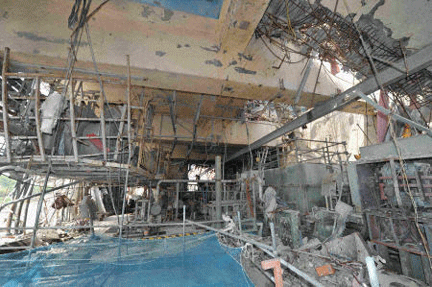 Glowing Green with Outrage By Adam Smith OpEdNews Op Eds 8/27/2013 “………Unfortunately the reality has been that the media have simply not been doing their job. The Tokyo Electric Power Company (Tepco) has been allowed to dictate the narrative of what is occurring with basically no oversight. It turns out that the site was never actually contained and radioactive water has been leaking with “no accurate figures for radiation levels.” You may say that since this issue is being reported by all major news organizations now, the media is doing their job albeit in a very tardy fashion.
However, that would be missing the reality that this leaking radiation water is the least of our worries vis-a-vis the plant. Much less reported by the media is what will be required by the clean-up crew to end this whole saga. Reliable old Reuters often provides the on-the-ground breaking scoops that our local media then report to us. Despite their well-deserved reputation, it seems that most media organizations have chosen to ignore their recent scoop about the dangers involved in the clean-up process.
Essentially, Tepco needs to remove 1300 spent fuel rods, containing 14,000 times the amount of radiation dropped onto Japan in WWII, from a dilapidated, flooding, and collapsing power plant that still sits in an earthquake-prone location. The whole process will take about 40 years and cost about eleven billion dollars. Each rod weighs 660 pounds, is 15 feet long, and cannot get too close to each other or will trigger a chain-reaction. If exposed to air, they may also trigger a chain-reaction. Usually, when these rods are moved as part of normal operations, a sophisticated robot is used to guide the work and ensure accuracy down to millimeters. Due to the damage caused by the earthquake/tsunami, this is not possible and the cranes will be operated in a poisonously radioactive area by scared human hands with all of their limitations. These rods will be removed individually, one at a time, and a mistake on any of them could trigger an unstoppable chain-reaction…….. http://www.opednews.com/articles/Glowing-Green-with-Outrage-by-Adam-Smith-Cancer_Energy_Energy_Energy-130827-96.html
Time for Australia to manage its own radioactive wastes, not import others’
In October 2011 the Department of Foreign Affairs and Trade confirmed that not only was Australian uranium sold to the inept electric utility TEPCO, but it was Australian yellowcake that was inside the reactor complex when it failed.
The two major parties have ignored repeated calls – including from the UN Secretary General – for a post-Fukushima review of Australia’s high-risk, low-return uranium industry.
Time to stop the (uranium) boats, SMH, Dave Sweeney, 28 Aug 13, SMH, August 27, 2013 Former Prime Minister Bob Hawke gained some airtime in the crowded pre-election public arena with his well-worn call for Australia to host the world’s radioactive waste. In the shadow of Fukushima it would be appropriate for the mantra of “stop the boats” to apply to those departing Darwin and Adelaide carrying uranium oxide, risk and radiation.
At the very least we need all our politicians to commit to a comprehensive and public review of the costs and consequences of Australia’s controversial uranium trade.
While it’s unlikely that many politicians will be enthused by the idea ahead of an election, it is timely to raise serious questions about the issue of radioactive waste in Australia. Not to open the door to more from overseas but rather to talk about how we might responsibly manage our own. Continue reading
Film “Pandora’s Promise” an elaborate hoax to promote Small Modular Nuclear Reactors
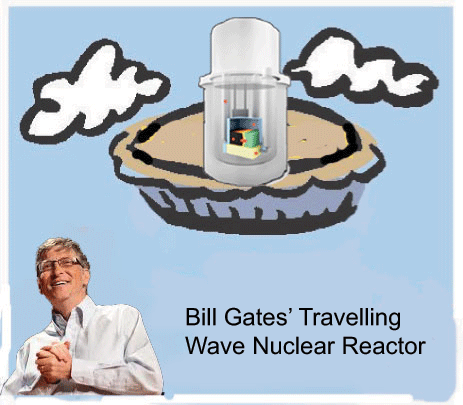 the most obvious deal killer is economic. Even by current calculations, any new reactor design would have difficulty competing with renewable energy sources, especially solar panels that can be installed on rooftops, thus avoiding transmission costs.
 The SMR’s primary customer, the Tennessee Valley Authority, has now pushed back to 2015 the target date for submitting its construction permit application. Even if wildly successful, the SMR could not meaningfully affect climate change for another 20 years—this in the midst of a crisis Hansen and so many others see as critical and immediate.
The SMR blueprint hinges on technologies that have already failed. Continue reading
Australia very much involved in nuclear deterrence, and nuclear weapons worldwide
 ICAN AUSTRALIA SHOWS THE WAY TO ABOLISH NUKES BY NEENA BHANDARI | IDN-INDEPTH NEWSANALYSIS, 28 AUG 13, SYDNEY (IDN)
“……..Doctrine of extended nuclear deterrence While Australia doesn’t have any nuclear weapons, it subscribes to the doctrine of extended nuclear deterrence under the United States alliance. The supposed protection afforded by the US nuclear weapons is seen as key to Australia’s national security. It also has almost 40 per cent of the world’s known uranium reserves and supplies 19 per cent of the world market.
All of Australia’s uranium is exported, including to countries who continue to produce nuclear weapons. TheAustralian Conservation Fund has consistently opposed uranium mining and worked to highlight the threats it poses to the environment, sensitive ecosystems, Indigenous cultures and local communities.
In May this year, ICAN Australia launched a booklet entitled Disarmament Double-Speak assessing Australia’s record on nuclear weapons, its continuing support for the United States extended nuclear deterrence, its resistance to a global ban on nuclear weapons, the inadequacy of safeguards on uranium exports and investments in nuclear arms companies.
Today, there are at least 20,000 nuclear weapons worldwide, around 3,000 of them on launch-ready alert. The potential power of these would roughly equate to 150,000 Hiroshima bombs. Sixty- eight years on since the atomic bombs were dropped on Hiroshima and Nagasaki, the need to develop a legally binding tool to prohibit and ultimately eliminate nuclear weapons is more than ever before. [IDN-InDepthNews – August 27, 2013] The writer’s previous articles on IDN: http://www.indepthnews.info/index.php/search?searchword=Neena%20Bhandari&ordering=newest&searchphrase=all
2013 IDN-InDepthNews | Analysis That Matters http://www.indepthnews.info/index.php/global-issues/1742-ican-australia-shows-the-way-to-abolish-nukes
1 This month

of the week – Australians for War Powers Reform (AWPR)
To see nuclear-related stories in greater depth and intensity
 Antinuclear