The secret economics of nuclear power for Australia – theme for September 2013
We need to separate the (uneconomic) role of uranium in the (uneconomic) nuclear power industry, from the (thriving) role of uranium in the nuclear weapons industry.
Puzzled as to why Australia’s uranium lobby remains so optimistic, in the face of the crumbling nuclear “renaissance”? Well, there mightn’t be much money in nuclear energy any more, but there sure is money in nuclear fuels for weapons. As an important strategic military location for USA, and a blindly loyal ally of USA, South Australia is well positioned to be the supplier of uranium enriching for USA. Also handy as a dump for nuclear wastes.
So all that’s needed is the full nuclear fuel cycle in South Australia. That’ll make, well, a few selected individuals, very rich.

Australian nuclear news this week
 Well, in the election fever, I thought that there was no nuclear news. However, I’ve learned that there has been a series of radio broadcasts – Radio Adelaide – covering the push for the full nuclear cycle in South Australia. And it’s worse than I had thought. I have listened to only the latest of these broadcasts, but it really did wake me up as to what is being proposes for South Australia.
I had thought that it was motivated by money – the idea of somehow making money out of nuclear power. Well, of course, it IS money. But the big connection is really uranium enrichment plans for the nuclear weapons industry, and USA’s nuclear war strategy. South Australia’s already got Beverley and Heathgate uranium mines, owned by nuclear weapons giant General Atomics. No surprise that some want to further entrench Adelaide’s military-industrial -intelligence complex in the nuclear war machine. Envouragment is provided by professor Stefan Simons, of UCL Adelaide, funded by BHP. Anyway, I have transcribed this broadcast .
Election. I am so fed up with all the rubbish. That includes the Liberal Coalition saying on Tuesday that they would use Australian Renewable Energy Agency (ARENA) to fund a solar power station in Victoria. and on Thursday that they would cut the funding of ARENA. But I did like Guy Rundle’s respectful and insightful story about Greens leader, Christine Milne.
Liberal Coalition flounders, – its Renewable Energy Policy based on bad advice
 the Coalition – and in particular its energy spokesman, Ian Macfarlane – needs little encouragement to argue against wind and solar. But such decisions should not be based on false premises.
The dangerous thinking behind Coalition renewable energy policy (excellent charts and graphs) REneweconomy By Giles Parkinson on 29 August 2013 The Coalition’s admission this week that it had thrown the Australian Renewable Energy Agency into the basket of climate change and green energy programs  to be cut if elected should not have taken people by surprise, because they have been hinting at it for a few months.
But it does raise questions about where the Coalition is heading with its energy policies, and why there appears to be such deliberate moves to wind back support mechanisms for wind energy and solar, and other emerging renewable technologies.
Part of the problem may be in the quality of the advice it is receiving. Many in the Coalition defer to the Institute of Public Affairs when asked about climate change and renewables policies. The IPA, of course, is a right-wing think tank  that doesn’t accept the science of climate change, and argues against climate and clean energy policies.
More recently, Greg Hunt has been using the work of Bjorn Lomborg to justify Direct Action. Lomborg, as we discussed in last month’s piece, is known for downplaying the dangers of climate change, for arguing that renewable energy should not be deployed until costs are reduced in research labs, and for suggesting that wacky “geo-engineering” schemes such as cloud whitening should be priorities.
That may explain why the Coalition is now targeting ARENA, whose job it is to help take technologies out of the lab and actually deploy them. The Coalition also intends to shut down the Clean Energy Finance Corp, which plays a similar role, as well as the Climate Change Authority, which conducted last year’s review of the Renewable Energy Target. The Coalition wants the RET to be reviewed yet again, but not by the CCA. The uncertainty is already causing Australia to fall down the ranks of investment attractiveness.
Another document that may be influential in Coalition thinking was circulated in recent months by one of its so-called “star” candidates, Angus Taylor, the anti-wind campaigner who is seeking election in the seat of Hume in NSW. Continue reading
Fukushima nuclear reactors now on soggy, mushy land, as groundwater rises
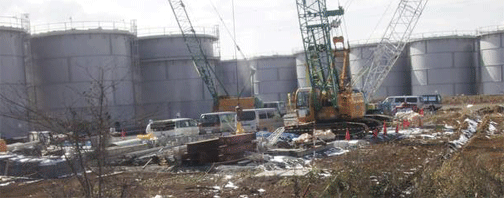 “Big Problem”: Cracked floors in Fukushima reactors leaking into groundwater that’s rising and rising and rising due to Tepco wall — “Can no longer be stopped from getting in ocean” — “Worse than that… buildings now on mushy land” (AUDIO)
Title: Breaking News: Entergy pulling the plug on Vermont Yankee
Source: Fairewinds Energy Education
Host: Nathaniel White-Joyal
Date: Aug 27, 2013
Arnie Gundersen, Fairewinds chief engineer:: The big problem is the nuclear reactors themselves have cracked floors. The buildings in those reactor buildings have cracked floors. And groundwater is getting into those buildings, and becoming contaminated, and then leaking out. So, in addition to what’s in those tanks, the physical plant itself is contaminating the groundwater as well.
So what Tepco tried to do is to build a wall along the water. They injected basically a concrete type of a compound and made the ground less porous. That’s not a good idea — it’s a poor idea — because what happened is the mountain that’s behind Fukushima continues to pour the water into the ground. Now it’s got no place to go. So now the groundwater’s rising and rising and rising and likely over-topping this wall, certainly going around it on the sides. So we’ve got radioactive water that can no longer be stopped from getting in the ocean.
It’s worse than that though. The radioactive water has made the site seismic response different. The buildings that were on dry land are now on mushy land. So that if there were to be another earthquake, the seismic response of these buildings — which was already marginal — is further compromised because the ground that they are now on is wet soggy soil, when before it had been firm.
Follow ENENews on Twitter for latest updates
Japanese government’s problem: to win over fishermen, about releasing Fukushima water to ocean

Fishing culture has deep historical roots in Japan. The country imports more seafood than any other
“If you run roughshod over the fishermen” it will backfire when Abe asks the public for support of his economic agenda and nuclear restarts,”
Fukushima Fishermen Ruined by Tepco Now Key in Radiation Fight, Bloomberg, By Yuriy Humber, Chisaki Watanabe & Masumi Suga – Aug 29, 2013 “………Tokyo Electric Power Co. (9501) ruined the livelihoods of the commercial fishermen that trawled the seas off Fukushima prefecture when its leaking reactors poisoned the fishing grounds. The utility now needs their help……
Japan’s government promised “to take drastic measures to the maximum extent possible” to contain the radiated water leaks. That has so far amounted to Prime Minister Shinzo Abe and the ruling Liberal Democrats instructing Tepco to win over the fishermen before proceeding.
Tepco, Optics
“Despite its support for nuclear power, the Cabinet and LDP politicians know that the public dislikes atomic power and holds Tepco in contempt,” Robert Dujarric, director of the Institute of Contemporary Asian Studies at Temple University, said by e-mail. “They realise that the ‘optics’ of going over the objections of the fishermen would be very bad.” Continue reading
Uranium Enrichment Creates Massive Amounts Of Depleted Uranium (DU)


Tasmania’s Labor and Liberal vote down Greens’ plan for moratorium on fracking
 Greens lose vote to introduce a moratorium on fracking MATT SMITH MERCURY AUGUST 29, 2013THE Tasmanian Greens’ push for a moratorium on the mining practice of fracking has been voted down by Labor and the Liberals. Greens MP Tim Morris said his party would continue to work with concerned landowners, businesses and communities to protect the best interests of Tasmania’s environmental and economic future…… HTTP://WWW.THEMERCURY.COM.AU/NEWS/TASMANIA/GREENS-LOSE-VOTE-TO-INTRODUCE-A-MORATORIUM-ON-FRACKING/STORY-FNJ4F7K1-1226706169520
August 29 was United Nations International Day against Nuclear Tests

 United Nations marks International Day against Nuclear Tests http://www.un.org/apps/news/story.asp?NewsID=45726&Cr=nuclear&Cr1=#.UiD4iNJwonE 29 August 2013 – As the United marked the International Day against Nuclear Tests,Secretary-General Ban Ki-moon called on all States that have not yet signed and ratified the Comprehensive Nuclear-Test-Ban Treaty (CTBT) to do so in order to achieve the goal of a safer and more secure world.
In his message on the occasion of the International Day against Nuclear Tests, commemorated each year on 29 August, Mr. Ban noted that “although twenty years have passed since the Conference on Disarmament began negotiations on the Comprehensive Nuclear-Test-Ban Treaty (CTBT), this treaty has still not entered into force.”
Mr. Ban said that there are “no justifiable grounds for further delay in” preventing the CTBT’s entry into force. He added that “it is time to avert any more of the horrific human and environmental effects caused by nuclear tests through a global ban, the most reliable means possible to meet this challenge.”
The International Day highlights the efforts of the UN and a growing community of advocates, including Member States, non-governmental organizations, academia, and media, in raising awareness of the importance of the nuclear test ban.
The General Assembly chose 29 August as the annual commemoration date since it marks the day in 1991 when Semipalatinsk, one of the largest test sites in the world and located in north-eastern Kazakhstan, was closed permanently.
With the aim of establishing a verifiable, permanent global ban on all types of nuclear explosive tests, the CTBT enjoys near-universal support but has yet to enter into force. The Secretary-General is the depositary of the treaty, which, as of today, has been signed by 183 States and ratified by 159.
“The eight remaining States whose ratifications are necessary for the Treaty to enter into force have a special responsibility; none should wait for others to act first. In the meantime, all States should maintain or implement moratoria on nuclear explosions,” Mr. Ban stressed in the message.
The International Day against Nuclear Tests is being marked around the world with events to call attention to the dangers of nuclear test explosions, the threats posed to humans and the environment, and the need to ultimately eliminate all nuclear weapons and their testing.
Check out world’s largest solar thermal energy plant – California
Take A Tour Of This Insane Solar Thermal Energy Plant (Excellent photos) GIZMODO ALISSA WALKER 30 AUG 13 Sometime in the next few months, the Ivanpah Solar Electric Generating System will flip the switch on the largest solar plant of its kind in the world: a 377-megawatt, 3500-acre solar thermal energy system. It’s located in California’s Mojave Desert, near the Nevada border, and it’s ridiculously big. ‘

‘I would suggest going to check it out in person during your next Vegas binge weekend, but from the 15 freeway it’s little more than a silvery blur — a rippling, mirage-like, silvery blur that feels like it might sear your retinas if you look at it too long. So it’s a good thing they’ve just posted this incredible virtual tour……. HTTP://WWW.GIZMODO.COM.AU/2013/08/TAKE-A-TOUR-OF-THIS-INSANE-SOLAR-THERMAL-ENERGY-PLANT-IN-THE-CALIFORNIA-DESERT/
New meter to monitor risk of cancer-causing UV radiation
UV meter warns of sunburn risk http://au.news.yahoo.com/thewest/a/-/breaking/18714833/uv-meter-warns-of-sunburn-risk/ Phoebe Wearne, The West Australian August 30, 2013, The Cancer Council WA wants public UV index meters installed in school playgrounds and at popular beaches, parks and sporting grounds to warn of sunburn and skin cancer risks.
Australia’s first public UV index meter, which measures solar radiation intensity every minute, was switched on at Deep Water Point in Mt Pleasant this week. The solar-powered meter is on a 4m nautical-themed sculpture by renowned Perth artist Tony Jones, whose best known works are the sculptures Eliza in Crawley and that of CY O’Connor near Fremantle.
Cancer Council WA SunSmart manager Mark Strickland said the real-time UV index meter, which only recently became possible with new technology, would show when the UV level was above three – the level when people are advised to protect themselves from the sun.

Mr Strickland said it was important people were aware of the UV level because it was not linked to the sun’s heat and people could not see or feel UV radiation. “We hope people will find it a useful reminder to know when they really should be protecting themselves from UV and are at risk of sunburn and skin cancer,” he said.
“People tend to make the false correlation that they need to protect themselves from the sun when it’s hot, but it doesn’t work that way.”
The Deep Water Point sculpture was funded with $20,000 from the City of Melville.
Mr Strickland hoped other councils, schools and businesses with outdoor staff would express an interest in installing the UV meters in public open spaces, playgrounds and workplaces. He wants people to plan their day around the highest risk from UV radiation once they have the information to do so. “We hope people who are in the area will see the signs over a period of time and realise UV is not always correlated with heat,” Mr Strickland said.
“If people know the UV is really going to be cranking in the middle of the day we hope they might move their outdoor activities to earlier or later in the day when the UV level will be lower.”Melville deputy mayor Duncan Macphail said public health and safety was a priority for the city and it supported Cancer Council efforts to educate people.
Australian government urged to act on energy efficiency – Australian Council of Social Service
 Australian social service council urges government action on energy efficiency http://www.renewableenergymagazine.com/article/australian-social-service-council-urges-government-action-20130829 Renewable Energy Magazine 30 Aug 13 The Australian Council of Social Service is calling for urgent government action on affordable energy for low income households according to a new report.
The report, entitled Energy Efficiency and People on Low Incomes, identifies measures to empower households to become active participants in controlling their energy use as well as becoming more involved in the energy market and reducing energy costs.
“Energy efficiency should be a key policy response to address the impacts of rising energy prices, yet we’ve heard little mention of it in the current political debates about cost of living pressures and energy affordability” said Andrea Pape, ACOSS Senior Policy Officer. “ACOSS advocates an energy efficiency policy agenda which includes direct investment in building and fixture upgrades as well as incentives to stimulate private landlord investment in energy efficiency measures.”
Ms Pape added that the policy proposals are designed to improve energy efficiency in low income households including both private rental and social housing. Investment will improve affordability, climate resilience and health outcomes for current and future occupants.
People on low incomes in Australia, as in many other countries around the world, are especially prone to the burden of energy price rises but they lack the capital investment required to upgrade the energy efficiency of their homes and are also more likely to own inefficient appliances. This has resulted in a lower incidence of measures such as insulation in low income housing and tenanted properties. While government programmes have been beneficial, they also need to be complemented by measures that deliver energy efficiency over the long term, particularly with regard to building and fixture upgrades.
“Targeted retrofits of the worst performing social housing where health, climate and hardship risks are greatest should be a high priority” continued Ms Pape. “We know that those most at risk from heatwaves are low income people, the elderly and people living with disabilities or health issues. We need to build the safety and resilience of our housing stock, and we need to start with the most vulnerable households first. This is a sensible approach in the current fiscal environment and we urge all sides of politics to commit to action on this important front.”
ACOSS proposals include the introduction of landlord tax incentives for energy efficiency measures in rental properties, the introduction of energy efficiency standards for rental properties along with mandatory disclosure of energy and water efficiency of all properties at point of sale, additional funding for targeted retrofits for the worst performing and highest risk social housing stock and financial support to help low income households afford the up-front costs of energy efficiency upgrades.
Further information: Australian Council of Social Service (ACOSS)
Asserting Australia’s First Nations Sovereignty into Governance
“The argument is twofold.
• Firstly, the question of jurisdiction and the right of the Shire tocharge rates from Euahlayi living within their own territory, as the
Euahlayi Peoples’ are now asserting their pre-existing and continuing statehood under our Law and custom.
• The second point of contention is that the Brewarrina Shire Council, like all other shire councils in Australia, have and are being paid by the
Commonwealth government of Australia, allegedly ‘illegally’, for their Aboriginal population, under a 1975 funding agreement between the
Commonwealth government and the Local Government Association of Australia.
This makes every Aboriginal man, woman and child legal tender and a commodity for shire councils throughout Australia, with no accountability.
Rates Case back on track Sovereign Union of First Nations and Peoples in Australia www.sovereignunion.mobi 30 August 2013
Contact Michael Anderson 0427 292 492
Convenor of the Euahlayi Nation and the Sovereign Union of Aboriginal
Nations and Peoples
ghillar29@gmail.com
www.sovereignunion.mobi
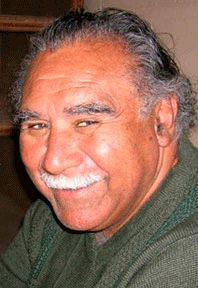 Michael Anderson said from Sydney today: “The Rates Case in the NSW Magistrates Court in Sydney is a contest on the question of sovereignty and what law now applies to the land.”
Anderson pointed out to the court that, in respect the Euahlayi Nation, there is now an active legal dispute on the question of jurisdiction.
When appearing before the Chief Magistrate in the Downing Centre, Anderson pointed out that correspondence has now been entered into between the Queen and the Euahlayi government.
“In 2010 the Euahlayi requested that Queen Elizabeth II investigate whether British or Australian records have deeds of cession by the Peoples
of the Euahlayi, or any formal British Admiralty declarations of war against the Peoples of the Euahlayi. Queen Elizabeth referred our request
to her Australian representative, Governor-General, Mrs Quentin Bryce, who responded on 12 October 2010, under the signature of Mark Fraser OAM, Deputy Official Secretary to the Governor-General. He confirmed that no such documents exist. Mark Fraser wrote on 12 October 2010: Continue reading
1 This month

of the week – Australians for War Powers Reform (AWPR)
To see nuclear-related stories in greater depth and intensity
 Antinuclear