Asserting Australia’s First Nations Sovereignty into Governance
“The argument is twofold.
• Firstly, the question of jurisdiction and the right of the Shire tocharge rates from Euahlayi living within their own territory, as the
Euahlayi Peoples’ are now asserting their pre-existing and continuing statehood under our Law and custom.
• The second point of contention is that the Brewarrina Shire Council, like all other shire councils in Australia, have and are being paid by the
Commonwealth government of Australia, allegedly ‘illegally’, for their Aboriginal population, under a 1975 funding agreement between the
Commonwealth government and the Local Government Association of Australia.
This makes every Aboriginal man, woman and child legal tender and a commodity for shire councils throughout Australia, with no accountability.
Rates Case back on track Sovereign Union of First Nations and Peoples in Australia www.sovereignunion.mobi 30 August 2013
Contact Michael Anderson 0427 292 492
Convenor of the Euahlayi Nation and the Sovereign Union of Aboriginal
Nations and Peoples
ghillar29@gmail.com
www.sovereignunion.mobi
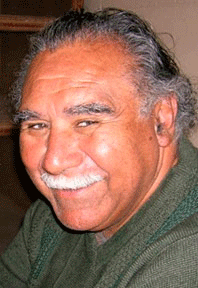 Michael Anderson said from Sydney today: “The Rates Case in the NSW Magistrates Court in Sydney is a contest on the question of sovereignty and what law now applies to the land.”
Anderson pointed out to the court that, in respect the Euahlayi Nation, there is now an active legal dispute on the question of jurisdiction.
When appearing before the Chief Magistrate in the Downing Centre, Anderson pointed out that correspondence has now been entered into between the Queen and the Euahlayi government.
“In 2010 the Euahlayi requested that Queen Elizabeth II investigate whether British or Australian records have deeds of cession by the Peoples
of the Euahlayi, or any formal British Admiralty declarations of war against the Peoples of the Euahlayi. Queen Elizabeth referred our request
to her Australian representative, Governor-General, Mrs Quentin Bryce, who responded on 12 October 2010, under the signature of Mark Fraser OAM, Deputy Official Secretary to the Governor-General. He confirmed that no such documents exist. Mark Fraser wrote on 12 October 2010:
“ … I am unable to supply any of the documents that you seek.”
“Whilst the original case Brewarrina Shire Council – v – Ngurampaa Ltd is
a dispute over the payment of rates, the matter is far more substantial.
Before the question of rates payable can be dealt with, the substantive
legal argument is clearly a question of jurisdiction.
“The argument is twofold.
• Firstly, the question of jurisdiction and the right of the Shire tocharge rates from Euahlayi living within their own territory, as the
Euahlayi Peoples’ are now asserting their pre-existing and continuing statehood under our Law and custom.
• The second point of contention is that the Brewarrina Shire Council, like all other shire councils in Australia, have and are being paid by the
Commonwealth government of Australia, allegedly ‘illegally’, for their Aboriginal population, under a 1975 funding agreement between the
Commonwealth government and the Local Government Association of Australia.
This makes every Aboriginal man, woman and child legal tender and a commodity for shire councils throughout Australia, with no accountability.
For a shire council to charge an Aboriginal corporation, eg. Ngurampaa
Ltd, and Euahlayi individuals for services that have already been paid for
by taxpayers’ money from the Commonwealth is double dipping, bordering on
fraud.
“This raises the question of the complicity, in particular the complicity of the State police, who constantly monitor and record the movement and whereabouts of Aboriginal people as they travel from one shire to another.
But to prove a complicit act on the part of the State police would require
a judicial enquiry into surveillance records kept by the State police and
their related availability to local shires. These records would greatly
assist shires and local governments to determine the location and numbers
of Aboriginal people at the time local governments submit their Aboriginal
population details to the Commonwealth.
“We must remember that funding from the Commonwealth for the provision of
services to Aboriginal Peoples in the respective shires is done annually.
Therefore it would of interest to all of us as to know how the Shires
maintain and keep their records of Aboriginal people living in their
shires on an annual basis, or do they merely take an average based on the
Bureau of Census and Statistics data?
“If police surveillance records are shared with shires and local
governments, this raises the question of gross violations of human rights,
freedoms and liberties, as these practices are often used by police states
against persecuted Peoples.
“There is another question of complicity and that is the role of FHCSIA,
the Department of Families, Housing, Community Services and Indigenous
Affairs. The question now, however, is: Does FHCSIA, through their
Centrelink offices, provide detailed information to shires and local
governments on the number of Aboriginal people receiving welfare
assistance within any given Shire on an annual basis? If this is the case,
then I’m sure that there is a legal case to be answered by the minister
responsible. On the other hand, if this is not the case then surely the
shire councils would be missing out on a lot of money, if they did not
have up to date data on their Aboriginal population at any given time.”
When the 1975 Commonwealth/Shires arrangement was first being discussed,
the Chief Magistrate responded from the bench that he was but a child in
school, to which the Brewarrina lawyer, Mr Merewether, agreed he too was a
child at this time. Anderson’s response was “Maybe you should have
listened to your Elders!”
Anderson’s submission to the Magistrate’s Court in the Rates Case, Brewarrina Shire Council – v – Ngurampaa Ltd, points out that the
executive government of Australia does not have the constitutional powers to enter into any agreements for direct funding to local governments and Shires anywhere in the Commonwealth of Australia.
In relation to this Rates Case, the Australian Local Government
Association has energised the campaign for a referendum on Local Councils
. Their information sheet “thefactssayyes.com.au” states:
When our Constitution was written more than 112 years ago there was no
mention of Federal Government funding for Local Councils or community
projects.
This means there is now an unforeseen loophole in the way community
projects re currently funded. It means important funds for community
projects are open to challenge because Federal funding is not referred to
in the Constitution. …
In March 2013, during the initial hearing of the Rates Case, Anderson
submitted to the Chief Registrar of the Downing Centre Civil and Small
Claims Court that his defence is one of a constitutional question to which
the Registrar agreed. The Registrar erred, however, when he failed to
correctly understand Section 78B of the Commonwealth Judiciary Act 1903,
where the Attorneys-General within Australia, that is Federal, State and
Territory Attorneys-General, have to be notified when a question of
constitutionality.
Anderson continues: “Now, five months later, the Chief Magistrate of NSW
agrees that this matter has to be forwarded to all the Attorneys-General
as the previous correspondence only went to the NSW Attorney-General. I
reminded the court that a major error had been made. The matter has now
been stood over until November 2013 to await the Commonwealth
Attorney-General’s response on this constitutional matter.”
Contact Michael Anderson 0427 292 492
Convenor of the Euahlayi Nation and the Sovereign Union of Aboriginal
Nations and Peoples
ghillar29@gmail.com
www.sovereignunion.mobi
No comments yet.
1 This month

of the week – Australians for War Powers Reform (AWPR)
To see nuclear-related stories in greater depth and intensity
 Antinuclear
Leave a comment