When Tony Abbott says “mandate” he means “open season” on progressive policies
 Coalition’s election victory doesn’t mean a mandate to do anything it pleases PAUL SYVRET THE COURIER-MAIL SEPTEMBER 10, 2013 JUST what exactly is this thing we call a “mandate” beyond being arguably one of the most abused words in the political lexicon? Is mandate something to do with marriage equality or the electoral equivalent of a mankini (bright Speedo red, of course) except with a man and a … Actually, let’s not go there.
I ask this because to listen to some members of the incoming government, the word seems interchangeable with terms like carte blanche, or perhaps even “open season”. Certainly Australia’s Climate Change Minister-in-waiting Greg Hunt seems convinced that an election win equals a “mandate” and constitutes, ipso facto, a requirement that all in the Parliament bend over and offer blind obeisance to the new world order.
Bollocks. Polling consistently showed carbon pricing way down the list of voter concerns, making the election no more a referendum on carbon that it was on Bronwyn Bishop’s hair lacquer.
Secondly, the election result gives the new Government a mandate to introduce its policies and prosecute an argument for their passage through Parliament, nothing more. This may come as a shock to some conservative voters, but millions of Australians viewed the prospect of an Abbott government with a mixture of embarrassment and despair and voted for the other mob. In the process we non-Abbott voters gave the party of our choice a mandate to push their policy platforms on our behalf, not to sell us out.
Personally speaking, as someone who supports carbon pricing for both economic and environmental reasons, I would view a decision by Labor to acquiesce to the Coalition’s Wreck-It Ralph approach as an act of gross betrayal. I – and the aforesaid millions of others – cast my vote for a party that believes in tackling climate change via a market-based solution,……. HTTP://WWW.COURIERMAIL.COM.AU/NEWS/QUEENSLAND/OPINION-COALITION8217S-ELECTION-VICTORY-DOESN8217T-MEAN-A-MANDATE-TO-DO-ANYTHING-IT-PLEASES/STORY-FNIHSRF2-1226715384036
Repealing Australia’s carbon tax will be a difficult task, with an uneconomic result
 With the carbon price, the 20 per cent Renewable Energy Target and the Clean Energy Finance Corporation, Australia has the main tools required to stay competitive in the 21st century,
Abolishing the carbon price and moving to a Direct Action grant scheme will change this. Not only will we lose the momentum of a functioning market, but we will move to a scheme most economists agree won’t work
Repealing the carbon tax is not easy, ABC, CLAIRE MARIESABC Environment9 SEP 2013 ‘Axing the tax’ will not be an easy ride for new PM Tony Abbott. While the Coalition has pledged to repeal the carbon tax, none of the steps required to do so are straight-forward. THIS WEEK TONY ABBOTT WILL be sworn in as Australia’s new Prime Minister. He has vowed to do away with Australia’s main tool for tackling climate change: the price on pollution.
Since Australia’s carbon price came into effect 14 months ago, emissions from electricity have fallen by about seven per cent, coal use for electricity is down by about 17 per cent and renewable energy generation is up by 25 per cent. We’re not going it alone on pricing carbon. More than 30 other countries have carbon pricing schemes (this figure does not include state schemes like those in California and some Chinese provinces) and 74 countries have some policy measure designed to limit greenhouse pollution. Continue reading
Abbott begins his destructive action against climate change action
 Abbott government begins process to repeal carbon tax; says pressure on Labor to honour mandate ABC News, By chief political correspondent Emma Griffiths 9 Sep 2013, The Coalition is already piling pressure on the Labor Party to “honour” the new government’s mandate to repeal the carbon tax.
Prime Minister-elect Tony Abbott yesterday instructed his department to begin drawing up the legislation to dump the carbon pricing scheme, and says Federal Parliament will resume in late October or early November to deal with it……. Mr Abbott’s spokesman – and likely minister – for the environment, Greg Hunt, says scrapping the carbon tax will be new government’s “first order of business”……..However, both Labor and the Greens have indicated they will not support moves to dump the carbon pricing scheme, nor will they support the Coalition’s direct action scheme to address climate change.
Senior Labor frontbencher Chris Bowen says his party’s stance is clear. “The Labor Party believes that climate change is real,” he said.”The Labor Party believes that we need to do something about it. The Labor Party believes that a market mechanism is the best way to do that, and we won’t be walking away from those beliefs.”
Labor’s opposition to the moves, would leave the bills deadlocked in the Senate and could trigger a double dissolution election – an option Mr Abbott has said is on the table. The alternative would be to wait until the newly elected senators take their seats next July, though that would mean negotiating with a disparate group including South Australian senator Nick Xenophon and, potentially, two senators from the Palmer United Party and one from the Australian Motoring Enthusiast Party…….http://www.abc.net.au/news/2013-09-09/abbott-carbon-tax/4945330
Low probability, high consequence risks make nuclear power unaffordable
Nuclear Energy Survives Only on the Basis of Faulty Risk Assessment HUFFINGTON POST, 9 Sept 13 Jeff Schweitzer Scientist and former White House Senior Policy Analyst; Ph.D. in marine biology/neurophysiology Nuclear power survives on empty promises and false hopes fed by our inability to effectively evaluate risk. We are lulled by long periods of stability and safe operation, and then seem shocked in the face of catastrophe that could have and should have been anticipated. If the costs of just one major disaster were embedded in the price of electricity, the industry would not be even close to economically viable; only massive taxpayer subsidies keep nuclear power alive.
The costs of sustaining nuclear power are too great for society to bear; so why is it still with us? Beyond the obvious, such as effective lobbying, nuclear plants are still online today because society is extraordinarily weak in its ability to assess and manage risks that have a low probability of happening (or that may occur in the distant future), but have catastrophic impact when they do………
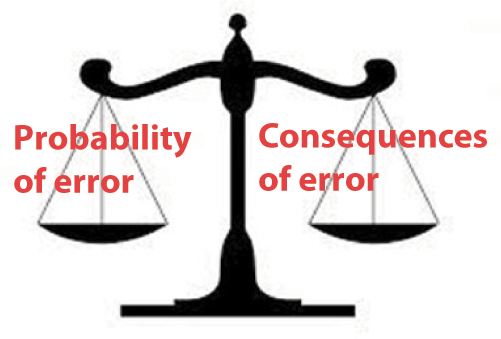
Nowhere is our poor ability to address low-probability-high-impact events more evident than in society’s approach to nuclear power. Continue reading
Corrupt dealings in choice of Tokyo for 2020 Olympic Games
 Boycott The Radioactive 2020 Olympics . http://www.rense.com/general96/boycott.html rense.com By Yoichi Shimatsu 9-8-13 It does not take 20/20 vision to realize that the corrupt Japanese government has bribed the International Olympic Committee to make the suicidal decision to send young athletes into the radioactive fallout
  from Fukushima. The decision in Buenos Aires to award Tokyo as host city of the 2020 Games did not arise from a lack of choices between Istanbul and Madrid, but was a knowing decision that is incomprehensible except for the factor of bribery. To risk the lives of young people and their supporters is more than an ethical lapse, it is a crime of manslaughter to the cruelest degree.
The bidding for the Games were rigged from the start by a quintet of disreputable character and dubious association, including former capital governor Shintaro Ishihara, Prime Minister Shinzo Abe, Education Minister Hakubun Shimomura and Japan Olympic Chairman Tsunekazu Takeda, scion and successor to a heinous war criminal. Their industrial partner, is Fujio Cho, honorary chairman of Toyota Motor Company and chief of the Japan Sports Association
During their promotion campaign for the Games of Death, these five Japanese officials spun outright lies claiming that there are zero leaks of radioactive water from the Fukushima nuclear plant. Continue reading
Community owned solar farms work well for investors
 Minnesota’s First Community Owned Solar Farm http://www.energymatters.com.au/index.php?main_page=news_article&article_id=3934 10 Sept 13 The WH Solar Community, the first community owned solar project in Minnesota, has been officially opened.
While not a huge solar farm (just 171 panels), the facility is also the first of its kind to incorporate battery storage.
Each member purchased one or more solar panels and will receive a kilowatt-hour credit on their power bill each month. The credit is based on the number of panels purchased, as well as the amount of the energy produced by the solar array each month.
“The WH Solar Community is a great way for members to own local generation and participate in the excitement of solar in bite size pieces,” said Wright-Hennepin Cooperative Electric Association (WH) president and CEO Mark Vogt when the project was originally announced.
“Our solar community model makes it easy for members to own solar without installing equipment on their property or worrying about maintaining their system.”
This project quickly sold out and WH says it is now taking reservations for panels in a second solar community, which will likely be built this year.
WH is a member-owned non-profit electric utility servicing Wright County and the western part of Hennepin County. The utility currently services 46,000 accounts.
The concept of community-owned solar has been popular in Australia; but of the dozens of communities wanting to develop wind and solar farms; few have received funding to assist in the early stages.
In the lead-up to the Federal Election, the Australian Greens unveiled details of its Australian Community Renewable Energy Plan; a fully costed $100 million initiative over 5 years to provide funding for feasibility grants, project management and specialist expertise for community owned renewable energy projects. Community solar farms are particularly attractive to investors who for whatever reason are not able to install solar panels on their own premises, but wish to play a role in Australia’s clean energy future.
Caution to avoid panic hoaxes about ionising radiation
 I was very grateful to “Hoax-Slayer” for this article. I had studied the photo of these ‘fatally radioactive’ whales, and pondered at the group of people so close to them , and none wearing protective clothing. And I puzzled as to how these whales got so close to highly radioactive matter at the Fukushima Daiichi nuclear power plants?
It is important for us, who oppose nuclear [power, and warn about ionising radiation, to scrutinuse extreme stories like this. We don’t need fantasies for evidence. The true facts are bad enough. And – the nuclear lobby will use stories such as this one, against us!
No, Radiation from Fukushima has NOT Killed Hundreds of Whales Outline, Hoax Slayer 10 Sept 13 Circulating message couched as a news report claims that hundreds of whales have been killed by radiation from the stricken Fukushima nuclear plant in Japan. The report features a photograph showing dead whales on a beach.
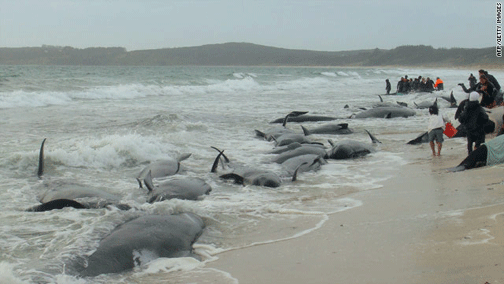
Brief Analysis The claims in the story are outright lies. There are no credible reports of large numbers of whales dying from Fukushima radiation. The image used in the articles shows pilot whales stranded on a New Zealand beach in 2010 and has no connection whatsoever with the 2011 Fukushima meltdown. While the potential effects of the Fukushima disaster are of significant concern, spreading lies and misinformation about the issue is counterproductive and irresponsible…….
In fact, the image shows pilot whales stranded on a beach in New Zealand. And the event occurred in August 2010, months before the March 2011 Fukushima meltdown. ….. The Fukushima disaster and the possible long-term effects on the environment are certainly of concern, not only to Japan, but to the world as a whole. And that is why it is vital that discussions of the issue use verified facts rather than lies, hearsay and misinformation. http://www.hoax-slayer.com/fukushima-dead-whales-hoax.shtml
Difficult paths for Tony Abbott in trying to repeal Australia’s carbon pricing
Repealing the carbon tax is not easy, ABC, CLAIRE MARIESABC Environment 9 SEP 2013“………can Mr Abbott repeal the carbon price? Even though the Coalition lists ‘axing the tax’ as their first order of business, it may be harder than thought.
To repeal the current laws and enact Direct Action the new government may go down a couple of different avenues – but they both have potential roadblocks.
One, Mr Abbott can try to convince the ALP or Greens to back his repeal bill in the senate. The Greens hold the balance of power until the new Senate is sworn in on 1 July 2014 – and both the Greens and the ALP have stated they will vigorously defend the carbon price – so this avenue would not appear to be easy street.
Two, Mr Abbott can wait until after 1 July 2014 and negotiate with the eclectic new senate, the make-up of which is looking decidedly unpredictable. But, importantly, the government is required by law to make a series of climate change decisions before 1 July 2014.
Chief among these is choosing the number between 5 and 25 per cent that will become Australia’s legally binding cap on carbon pollution for 2020.
The Clean Energy Act enacted by the previous government has set in train a process whereby the Climate Change Authority is undertaking a review to recommend a 2020 target for Australia, taking into account what is required to keep global warming below two degrees and Australia’s fair share of the international effort. The Authority must present these to the relevant Minister by 28 February 2014 and the Minister must then set the 2020 cap by 30 May 2014. If the Minister attempts to delay the decision, a default cap is built into the legislation that will result in a target of approximately 10 per cent by 2020.
The government cannot simply abolish the Climate Change Authority, preventing it from delivering recommendations – it is established by an Act of Parliament that would be subject to similar repeal conditions as the carbon price.
Then there are international obligations. The Coalition is committed to ratifying the next phase of the Kyoto Protocol, which includes our international commitment to limit warming to two degrees and cut pollution by 5 to 25 per cent by 2020.
Mr Abbott or his representatives would have to attend the international climate negotiations and tell other world leaders Australia will be the first country to expect others to take stronger action in our national interest, while we do less. Much less.
Meanwhile climate change marches on. During the election campaign the Bureau of Meteorology confirmed that the last 12-month period was Australia’s warmest on record.
1 This month

of the week – Australians for War Powers Reform (AWPR)
To see nuclear-related stories in greater depth and intensity
 Antinuclear