Low probability, high consequence risks make nuclear power unaffordable
Nuclear Energy Survives Only on the Basis of Faulty Risk Assessment HUFFINGTON POST, 9 Sept 13 Jeff Schweitzer Scientist and former White House Senior Policy Analyst; Ph.D. in marine biology/neurophysiology Nuclear power survives on empty promises and false hopes fed by our inability to effectively evaluate risk. We are lulled by long periods of stability and safe operation, and then seem shocked in the face of catastrophe that could have and should have been anticipated. If the costs of just one major disaster were embedded in the price of electricity, the industry would not be even close to economically viable; only massive taxpayer subsidies keep nuclear power alive.
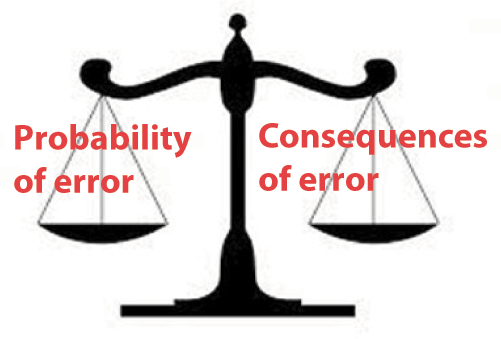
The costs of sustaining nuclear power are too great for society to bear; so why is it still with us? Beyond the obvious, such as effective lobbying, nuclear plants are still online today because society is extraordinarily weak in its ability to assess and manage risks that have a low probability of happening (or that may occur in the distant future), but have catastrophic impact when they do………
Nowhere is our poor ability to address low-probability-high-impact events more evident than in society’s approach to nuclear power. Operators of the Fukushima Daiichi nuclear power plant, which was severely damaged the 2011 earthquake and tsunami, initially received a $12.8 billion bailout from the government to help contain the disaster. Japan announced this week an additional $500 million to further stabilize the continuing contamination. We are witnessing acts of desperation: building a “frozen wall” underground to prevent a flood of groundwater from contacting the contaminated buildings. This has never been tried on such a vast scale or for the decades needed here, and the scheme requires electricity to work; a problem given the number of blackouts suffered by the power plant. We just learned that 300 tons of water contaminated with radioactive strontium drained into the sea from a faulty tank. There are now 430,000 tons of contaminated water being held at the site, increasing at rate of 400 tons per day.
None of these infrastructure problems cover the tremendous human and economic costs of forced evacuations of more than 160,000 people; the equivalent of a small city evacuated, never to be occupied again, with land permanently lost to high levels of radiation. Imagine abandoning forever Madison, WI, or Akron, OH, because of radiation contamination. Then too are the exorbitant costs of remediation where that is even possible, and long-term health costs of radioactive releases to the air. Experts estimate that the total cost of the accident will be nearly $300 billion.
Just one such event calls into question the economic viability of the nuclear industry.. Here we see a deep irony. Those who wholeheartedly support nuclear energy are often the same folks who want a small government to get out of the way of business, allowing the magic of the market to work its glory. And yet the moment we have a Chernobyl or Fukushima, these very people expect the government, and taxpayers, to bail out the industry. And this is why nuclear energy is not viable and never will be; low probability high consequence risk. While bad events are rare, when they happen, the political, economic and human costs are much too high for society to absorb, even amortized over long periods of stability. And this does not include the problem of disposing of nuclear waste or the life cycle costs of decommissioning a spent plant. Nuclear energy sounds good, but only if most of the true costs are externalized. Trapping the true cost of nuclear energy in the price of electricity would render the industry useless……..
The allure of nuclear power is strong, but based on false premise. Insurmountable technical and economic problems ensure the industry will never be viable, even beyond the already sufficiently catastrophic issue of core melt or another Fukushima disaster. We currently have no good way to treat and dispose of highly toxic and dangerous nuclear waste. Other problems beyond those already cited include the high cost of plant construction (independent of regulatory demands), the potential of creating raw materials from which nuclear bombs could be made, risks of transporting nuclear waste from power plants to storage facilities, and the low but not zero probability of radioactive releases and contamination (not caused by meltdown)……. . Nuclear power is with us only because we have inherent flaws in our ability to evaluate risk. That inherent imperfection is blinding us to the simple reality that nuclear power is dead; we just don’t see it yet. http://www.huffingtonpost.com/jeff-schweitzer/nuclear-energy-survives-o_b_3882434.html
No comments yet.
1 This month
7 April – WEBINAR – Australia and the Doomsday Clock – Preventing nuclear war through NoFirstUse and other policies
Online | Tuesday April 7, 4:00-5:30pm, Australian Eastern Time / 8:00-9:30am Central Europe Time
– Access the registration link
15 April – Zoom –Nuclear Power is Not the Solution
Apr 15, 2026 01:00 AM in Canberra, Melbourne, Sydney

Join the International Physicians for the Prevention of Nuclear War (IPPNW) on Tuesday, April 14th for a timely webinar exploring the risks associated with nuclear power and challenging the myth that it offers a simple, safe, carbon-free solution to the climate crisis

21 April Webinar: No Nuclear Weapons in Australia
Start: 2026-04-21 18:00:00 UTC Canberra, Melbourne, Sydney (GMT+10:00)
End: 2026-04-21 19:30:00 UTC Canberra, Melbourne, Sydney (GMT+10:00)
Event Type: Virtual
A virtual link will be communicated before the event.
Host Contact Info: australia@icanw.org

of the week – Australians for War Powers Reform (AWPR)
To see nuclear-related stories in greater depth and intensity
 Antinuclear
Leave a comment