Abbott government proceeding to slash renewable energy and climate programs
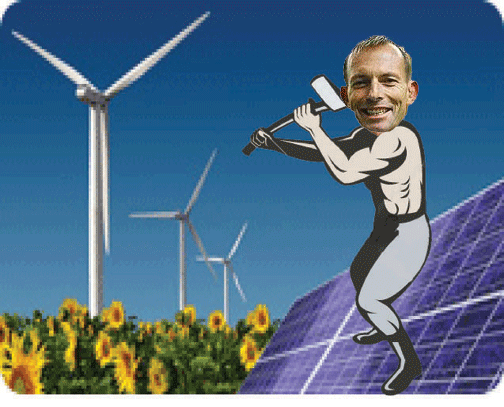 Coalition takes axe to climate programs BY:SID MAHER AND LAUREN WILSON The Australian September 11, 2013 PUBLIC servants are drawing up plans to collapse 33 climate change schemes run by seven departments and eight agencies into just three bodies run by two departments under a substantial rewrite of the administration of carbon abatement schemes under the Coalition.
Coalition climate action spokesman Greg Hunt briefed public servants on the dramatic restructure of the federal climate change bureaucracy before the election was called and yesterday confirmed the Coalition was committed to proceeding with the plan.
Under the simplification, the Department of the Environment and the Department of Resources and Energy will run all of the climate change programs under the Coalition’s direct-action program…….
The changes will see all carbon abatement schemes run by three bodies: the Australian Renewable Energy Agency, which will be overseen by the Department of Resources and Energy; and the Clean Energy Regulator and Low Carbon Australia, which will be run by the Department of the Environment……
The Climate Change Authority, which sets emissions caps, the Climate Commission, which has conducted research into climate change, and the Clean Energy Finance Corporation, which funds renewable technologies, are all slated to be abolished under the plans…… The Coalition will need to legislate to abolish the CEFC, which has amassed a $560m investment portfolio and leveraged $1.6bn in private sector investment. But the bank is understood to be lobbying a Coalition government to utilise its staff and assets as part of its Direct Action scheme, and change its investment mandate so it could work within the framework of the Coalition’s policy.
An Abbott government will need to legislate if it seeks to abolish the Climate Change Authority, which is proceeding with work on a draft report about emissions reductions targets that is due to be completed next month. In the wake of Labor and Greens declarations that they would oppose the abolition of carbon pricing, Mr Abbott said he expected the parliament to “respect the mandate that the new government has”….. http://www.theaustralian.com.au/national-affairs/election-2013/coalition-takes-axe-to-climate-programs/story-fn9qr68y-1226716471498
Australia’s new Prime Minister to carry out climate denialist agenda
 Australia rips up climate-change policies New Scientist, 11:57 10 September 2013 by Michael Slezak Australia’s landslide election result seems to be bad news for the climate. Following the election of a new government, Australia is to abolish its emissions trading scheme, disband a climate advisory body and institute a carbon reduction policy that experts say will fail to meet its meagre target. …
The carbon price – widely called a “carbon tax” – was set to increase gradually until 2015 when carbon credits would be opened for trading, allowing the market to set the price.
Abbott’s coalition also signalled that it would disband Australia’s Climate Commission – an independent scientific body that provides reliable information on climate change to the public. In response to a report the commission released, warning that extreme weather was made more likely by climate change, Abbott said: “When the carbon tax goes, all of those bureaucracies will go and I suspect we might find that the particular position you refer to goes with them.”
Contentious views
In 2009, Abbott said, when talking about climate change, that the “science is highly contentious, to say the least” and “the climate change argument is absolute crap”,…..
It is a “great leap backwards”, says Ian Lowe from Griffith University in Queensland, Australia. He says that no experts think the targets will be met and that the stance is ideological, because senior members of the government don’t think climate change is man-made He worries that the outgoing government will also see the election result as a reason to abandon serious effort on climate policy.
Despite one analysis suggesting that the direct action plan’s funding of A$3.2 billion represents less than half of what is needed to meet the 5 per cent target, Abbott indicated the government will not up this figure…….. http://www.newscientist.com/article/dn24173-australia-rips-up-climatechange-policies.html#.UjFX8NJwonE
Fukushima’s protective ice wall will have to last for 300 years!
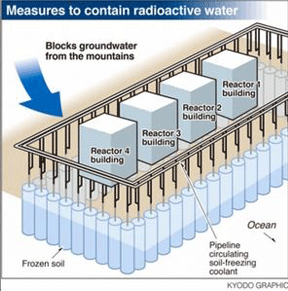 Japan to spend £300 million on Fukushima ‘ice wall’ containment The Japanese government says it will invest over £300 million to try and stop radioactive water leaking from the damaged Fukushima nuclear plant. Plans include an ‘ice wall’ of frozen earth. Experts say that radiation will enter the human food chain by contaminating water, crops and fish. VoR’s Daniel Cinna reports.
The 27-metre deep ice wall is intended to prevent contaminated water seeping into the surrounding earth.
However, nuclear expert John Large is sceptical: “The problem with ice walls is that you can crack and fissure the clay, which provides migration routes for the water and the radioactivity through the ice wall, so it’s not at all certain.”
He also points to the fact that the ice wall presents a technical challenge for future generations as it will have to be maintained at minus 40 degrees for 200-300 years. Large says releasing of contaminated water into the sea will create new uptake routes into the human food chain and the environment.
Conditions are so disastrous now partly because the government pumped water in to cool the reactors that went into meltdown after the 2011 earthquake and tsunami – that contaminated water is now leaking out.
Some calculations put the exposure at five times that of the 1986 Chernobyl nuclear accident.
http://ruvr.co.uk/2013_09_03/Japan-300-million-Fukushima-clean-up/
Uranium industry’s hopes for a recovery are unfounded
 uranium’s losses have been sharper than many other raw materials, as the fuel also faces antinuclear politics, which are expected to hurt demand even if economic activity picks up.
“This is not only an extremely volatile commodity, but a volatile business. It only takes one headline, somewhere in the world, and 15 years of work is gone down the drain.”
, political opposition and cheap prices for alternative fuels, like natural gas and coal, make a recovery unlikely
Prices Pull Plug on Uranium’s Power Play, WSJ, 10 Sept 13, Fuel Trades at Multiyear Lows as Nuclear Energy Languishes By RHIANNON HOYLE Uranium prices are at their lowest level in nearly eight years, as investors and utilities give up on a quick revival for nuclear power.
The market for the radioactive fuel hasn’t recovered from the 2011 earthquake and tsunami that devastated Japan’s Fukushima Daiichi power plant. Due to safety concerns following the disaster, only two of Japan’s 50 reactors are running today, while Germany and France are reducing their reliance on nuclear power. In the U.S., some utilities have abandoned plans for new nuclear plants. Continue reading
1 This month
7 April – WEBINAR – Australia and the Doomsday Clock – Preventing nuclear war through NoFirstUse and other policies
Online | Tuesday April 7, 4:00-5:30pm, Australian Eastern Time / 8:00-9:30am Central Europe Time
– Access the registration link
15 April – Zoom –Nuclear Power is Not the Solution
Apr 15, 2026 01:00 AM in Canberra, Melbourne, Sydney

Join the International Physicians for the Prevention of Nuclear War (IPPNW) on Tuesday, April 14th for a timely webinar exploring the risks associated with nuclear power and challenging the myth that it offers a simple, safe, carbon-free solution to the climate crisis

21 April Webinar: No Nuclear Weapons in Australia
Start: 2026-04-21 18:00:00 UTC Canberra, Melbourne, Sydney (GMT+10:00)
End: 2026-04-21 19:30:00 UTC Canberra, Melbourne, Sydney (GMT+10:00)
Event Type: Virtual
A virtual link will be communicated before the event.
Host Contact Info: australia@icanw.org

of the week – Australians for War Powers Reform (AWPR)
To see nuclear-related stories in greater depth and intensity
 Antinuclear