New equipment: old problems – ERA’s Kakadu uranium plans in focus
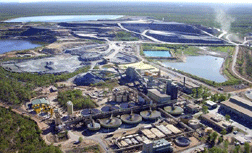 Environment Centre NT, 17 Sept 13, Uranium miner Energy Resources of Australia will unveil its new brine concentrator – a long overdue piece of infrastructure that seeks to address both chronic water management problems and contaminated process water – at its aging Ranger uranium mine in Kakadu on Thursday.
The Ranger mine has been plagued with water and waste management problems that have caused extended shutdowns and deep concerns about impact on the World Heritage Kakadu National Park. “The new infrastructure is a long overdue and welcome initiative,” said Lauren Mellor, Nuclear Free NT Campaigner with the Environment Centre NT.
“The delay in commissioning this key piece of equipment is a poor reflection on ERA’s commitment to rehabilitation, given the company’s long history of water mismanagement. That ERA has been allowed to continue mining and expanding its waste water inventory, now estimated at eleven gigalitres, without having an effective waste water management plan or the ability to treat process water shows a disturbing lack of regulatory rigour.”
National and NT environment groups have been encouraged by early trials of the brine concentrator that indicate it will start to reduce the waste water inventory, but say there is a long way to go before water management is responsibly addressed at Ranger. ERA still has no plans to stop an estimated 100,000 litres of contaminated liquid leaking daily from below the tailings dam – a major operational risk that could lead to uncontrolled groundwater contamination.
“Because of ERA’s slow response Ranger barely has adequate waste water storage capacity ahead of the coming wet season,” Ms Mellor said.
ERA continues to advance a contested plan for a new underground mining operation (Ranger 3 Deeps) at the troubled site. This plan is the subject of a federal assessment process. After three years of significant losses ERA hopes Ranger 3 Deeps will be the start of a new chapter for the mine. However, with Ranger’s operational period due to end in 2021 ERA has, if approved and at best, only five years to mine – at a time when the global uranium market remains deeply depressed.
“Any expansion of underground operations at Ranger would inevitably add cost, time and complexity to the already daunting rehabilitation task facing ERA and Rio Tinto,” said Australian Conservation Foundation campaigner Dave Sweeney.
“Given the high risks of the planned underground operation and the low return, with a constrained commodity price, ERA would do well to cut its losses.
“The company should halt the R3D project – as it did with its earlier flawed acid heap leaching proposal – and concentrate its brine and its brain on the challenges raised in responsibly ending operations, rehabilitating Ranger and assisting the transition to a post-mining future for this World Heritage listed region.”
Contact:
Lauren Mellor, Environment Centre NT, 0413 534 125
Dave Sweeney, Australian Conservation Foundation, 0408 317 812
No comments yet.
1 This month
6 March -Online – Reversing nuclearization:
From nuclear weapons in Belarus and NATO host countries to a European-Nuclear-Weapon Free Zone
Mar 6, 2026 03:00 AM in Canberra, Melbourne, Sydney

of the week – Australians for War Powers Reform (AWPR)
To see nuclear-related stories in greater depth and intensity
 Antinuclear
Leave a comment